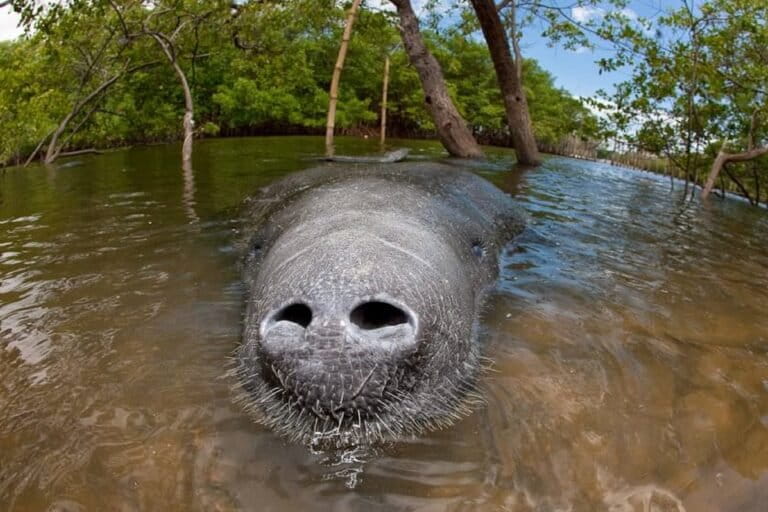
In October 2025, Brazilian state oil company Petrobras began drilling in the seabed where the Amazon River empties into the Atlantic Ocean, following a long, controversial environmental licensing process. At the center of the debate were concerns about the unique wildlife living here, on the shores of the states of Amapá and Pará, and about the company’s capacity to rescue these animals in the event of an oil spill. The potential victims range from marine birds and turtles to the recently discovered Amazon reef system. One endangered marine mammal, however, has prompted particular concern because of the extra challenges to rescuing it in the event of a disaster: the West Indian manatee (Trichechus manatus), a species that grows to a length of around 3.5 meters (11.5 feet) and weighs an average of 700 kilograms (more than 1,500 pounds); some individuals reach up to 1,600 kg (more than 3,500 lbs). “Handling and transporting animals of this size requires complex logistics and large-scale equipment,” said marine biologist Fábia de Oliveira Luna, coordinator at the National Center for Research and Conservation of Aquatic Mammals (CMA), which is part of Brazil’s environmental ministry. With a population estimated at only 1,047 individuals in Brazil and a reproduction rate of one calf every four years, “every individual removed undermines the survival of the population,” Luna told Mongabay. According to scientists, the oil project also jeopardizes a unique genetic code shared only by animals from this region, a result of the interbreeding between the marine manatee and…This article was originally published on Mongabay
Smuggled in cars, aboard airplanes, or on sailboats crossing the Atlantic Ocean, tiny golden-furred monkeys are being wrenched from their Brazilian forest homes and trafficked overseas by sophisticated criminal networks. These golden lion tamarins (Leontopithecus rosalia) are moved through Latin America and Africa, with strong indications that they are bound for the Asian black market. Collectors are willing to pay as much as $100,000 for this friendly animal, which is one of Brazil’s conservation symbols. Some of the tamarins die before reaching their destination. Those that survive may end their journey emaciated, sick and sometimes, mutilated. “It is frightening in the sense that [tamarin trafficking] is a threat we believed was relatively under control,” said Luis Paulo Ferraz, executive secretary of the Golden Lion Tamarin Association (AMLD), which has led an international effort to preserve the species since the 1990s. In recent years, his team has increasingly encountered people venturing deep into the forests of Rio de Janeiro state to capture these animals. “Our field team started coming face to face with these guys, to the point that I became deeply concerned about having my staff working in areas where criminals were operating.” The golden lion tamarin, featured on Brazil’s 20-real banknote, drew the attention of the Brazilian Federal Police in 2023 after seven of these monkeys and 29 Lear’s macaws (Anodorhynchus leari), another species native to Brazil, were seized at a captive facility in neighboring Suriname. In February 2024, authorities in Togo were startled to find the same two…This article was originally published on Mongabay

 Login
Login