Reading view

Urban bowerbirds prefer human-made items over natural materials for courtship
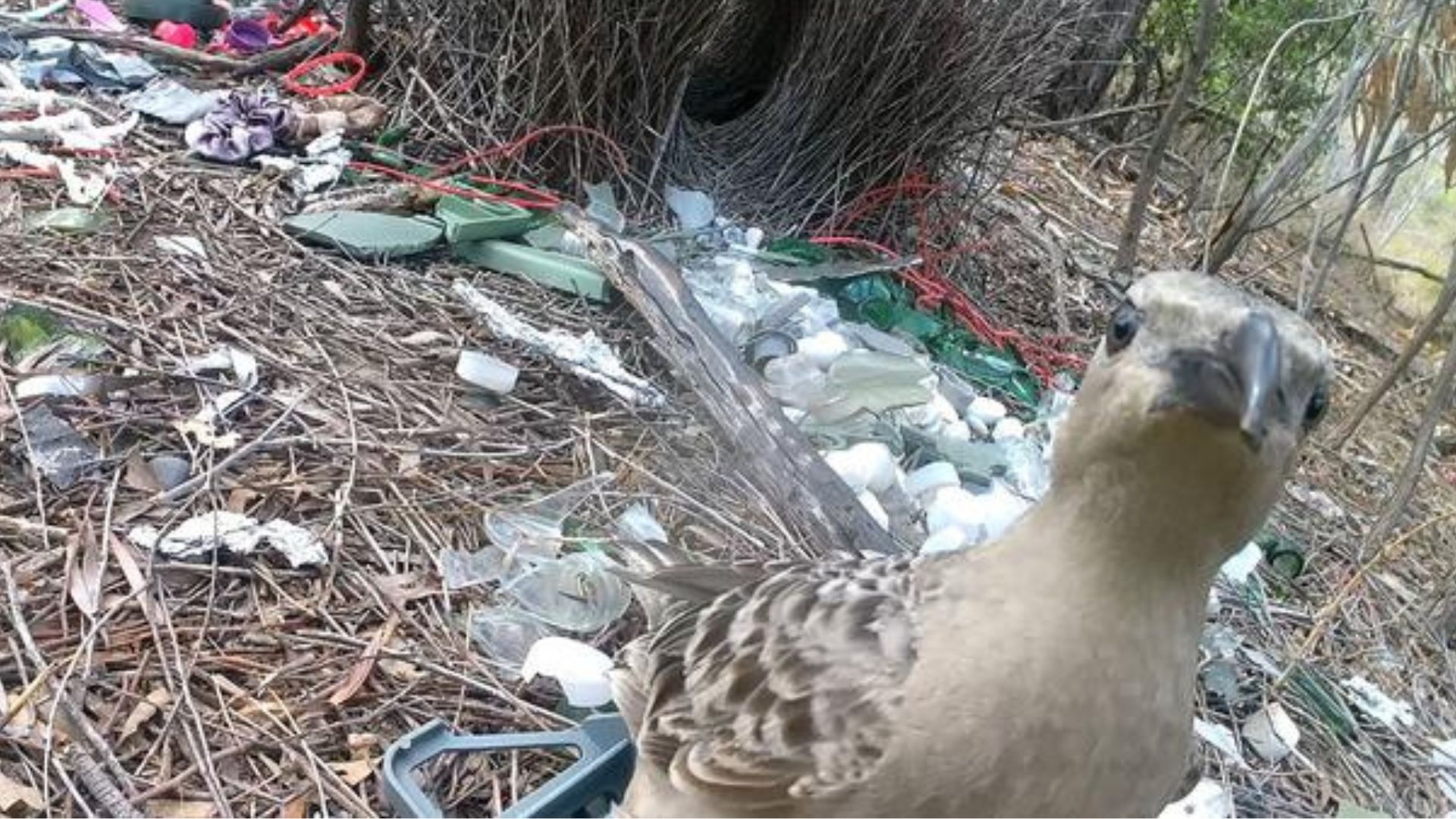
Unsual mating rituals are emerging in modern times. In a bizarre wild twist, a female great bowerbird can be won over by a pair of handcuffs, discarded medicine jars, or a neon football mouthguard.

A new study shows that urban male bowerbirds are ditching otherwise natural decorations and turning to a wild assortment of human trash to woo mates.

Researchers from the University of Exeter compared birds in Townsville City to their rural counterparts in Queensland, Australia.

It was discovered that urban displays featured much more vivid reds and duller greens than their rural counterparts

“Our study demonstrates that availability of human items – often glass and plastic – is affecting the behavior of bowerbirds,” said Dr Laura Kelley from the University of Exeter. 

“We don’t yet know whether this has any negative or positive impact on them, but it’s a reminder of how human activity is changing the natural world in unanticipated ways,” Kelley said.   

City birds ditch nature

Male bowerbirds do not help raise young. Their only goal is to attract a mate. To do this, these avians build a special tunnel of twigs called a bower and surround it with a courtyard of colorful objects. When a female visits, the male throws objects into her line of sight while flaunting his colorful plumage.

In the wild, this means typically collecting berries, seeds, leaves, and other such natural items. In the city? It means raiding the local stadium.

“Bowers are built exclusively to attract a mate, and males choose decorations that contrast against their own plumage and the bower itself,” said Caitlin Evans from the Center for Ecology and Conservation at Exeter’s Penryn Campus in Cornwall.

“Our findings show that bowerbirds in a city use a wide range of items scavenged from humans. Glass, plastic, and wire were common choices, but we also found items including a pair of handcuffs, medicine jars at bowers near a hospital, and fluorescent mouth guards from a site near an Australian Rules football ground,” Evans added

Overachiever bird

Urban bowerbirds are prolific collectors, hoarding an average of 90 items per bower — with one overachiever amassing more than 300. In comparison, the average was a modest 20 items for rural males. 

The researchers also evaluated the bowers through the eyes of the female birds. Bowerbirds have incredible vision, and their eyes are much more sensitive to color than human eyes.

Interestingly, the birds’ choice of décor also reflects their surroundings. While rural birds rely on green leaves, seeds, and occasional green glass, city birds heavily favor synthetic, high-contrast materials, making green glass and red wire their top two decorations.

To test how deep this preference runs, the team set up a swap experiment. They offered both city and country birds a mix of natural and human-made items. The choice was unanimous.

Both groups overwhelmingly chose the human-made plastic and glass. Even the rural birds were willing to raid farm garages and trash bins to upgrade their collections.

However, the study did not directly measure female preference. The intense enthusiasm city males for hoarding these human objects likley suggests that the females find them attractive.

Whether this helps the birds win more dates or accidentally introduces environmental risks is a question scientists are still trying to solve

The study was published in the journal Royal Society Open Science on June 2.
💾

A new study shows that urban male bowerbirds are ditching otherwise natural decorations and turning to human trash to woo mates.
  •  

Scientists map complex maritime winds to maximize fuel savings from ship sails

Global shipping is facing a huge fuel crisis. Massive cargo ships, bulk carriers, and tankers generate roughly 90 percent of the maritime sector’s carbon emissions. True zero-emission alternatives like hydrogen, ammonia, or pure electrification are still years away from scaling.

Faced with tightening climate regulations, shipowners are turning to the world’s oldest propulsion method: the wind.

Today’s commercial fleets are deploying towering, high-tech aerodynamic structures known as Wind-Assisted Propulsion Systems (WAPS). These include spinning rotor sails that harness the Magnus effect, vertical wing sails, and advanced suction sails that use internal fans to pull air across their surfaces.

The adoption curve is steep. In 2020, only nine major ships utilized these modern sails. Today, that number has jumped to 64, with dozens more currently being retrofitted.

However, a major problem has emerged. In theory, these sails should slash fuel bills. In practice, the real-world results are maddeningly inconsistent, with fuel savings fluctuating wildly between 2 percent and 25 percent.

To uncover the reason, researchers at the European research institute SINTEF launched the reSail project. Their findings suggest the shipping industry relies on oversimplified wind models that fail to capture real-world ocean conditions.

“We’ ve looked more realistically at the wind conditions, and they deviate significantly from wind theory,” said Yannick Jooss, a SINTEF researcher. 

“If you just use the standard wind profile as is often done today, your measurements will be inaccurate. Simplified assumptions and simulations are not good enough, because they do not take into account the complexity and variation in the wind,” noted Jooss.

Optimizing modern ship sails

According to project lead Jooss, relying on these oversimplified simulations leads to inaccurate data. Rather, maximizing emission reductions requires precise, real-world knowledge of wind behavior and sail placement, along with automated adjustments to optimize overall ship operations.

The primary complication is structural. When a 22-meter-tall rigid sail is bolted onto a massive metal hull, the ship itself alters the environment. The vessel bends, blocks, and whips the wind into complex micro-currents before the air ever hits the sails.

To map this invisible chaos, the reSail team outfitted the Bow Olympus — a chemical tanker operated by Odfjell — with high-frequency LiDAR (Light Detection and Ranging) systems. With this technique, the team successfully tracked highly accurate wind speeds and angles relative to a moving ship.

To do this, researchers fired laser beams into the atmosphere and used the Doppler effect to track the light as it bounced off airborne dust particles.

Fuel savings on large ships

The data gathered from the Bow Olympus is shifting the research into a lab-optimization phase focused on three key areas. 

The team aims to optimize ship operations holistically by using wind tunnels at NTNU to identify the aerodynamic sweet spot for sail placement, developing predictive systems to automatically adjust sails before wind gusts hit, and integrating real-time wind forecasting into navigation computers. 

“Our goal is to make it more attractive to use modern sails on ships, and thus contribute to the necessary emissions reduction from the maritime sector,” added Jooss.

Regulations such as FuelEU Maritime require an 80% reduction in shipping emissions by 2050. If the reSail project succeeds in closing the gap between theory and reality, it could push fuel savings securely past the 25 percent mark.

💾

Researchers at the European institute SINTEF launched the reSail project to advance a wind-based propulsion system for ships.
  •  
❌