Reading view

Watch: Vietnam’s first humanoid robot Dyno targets security and household roles
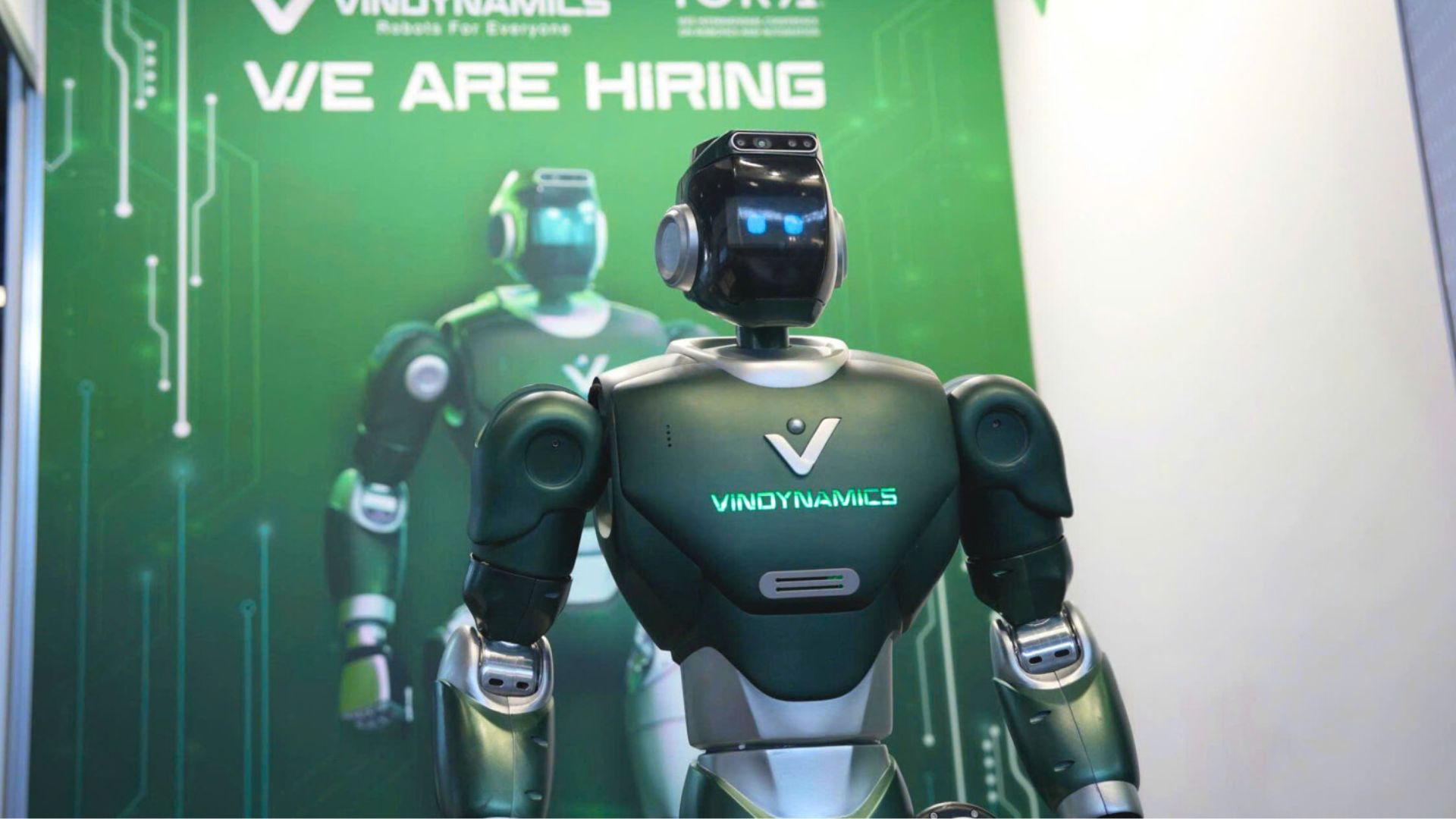
Vietnamese technology company VinDynamics has unveiled its first humanoid robot, Dyno, marking the country’s entry into the global humanoid robotics arena.

The intelligent robot made its international debut at the ongoing ICRA 2026 in Vienna and Computex Taipei 2026.

Designed as a versatile assistant for modern environments, Dyno combines advanced AI with a sophisticated sensing system to operate in dynamic settings.

According to the firm, the humanoid is intended for security and surveillance tasks in urban and commercial spaces while also being developed as a household assistant.

Vietnam’s humanoid leap

Dyno is an intelligent humanoid robot built to combine advanced artificial intelligence, environmental perception, and dexterous manipulation in a single platform.

Designed for operation in complex real-world environments, Dyno integrates a sophisticated AI system with a highly responsive sensor suite that enables autonomous navigation, situational awareness, and human-robot interaction.

Though detailed specifications are not out, the humanoid is being developed for applications ranging from security and surveillance in urban spaces, campuses, and service complexes to domestic assistance tasks requiring precise object handling. Its flexible arm architecture and advanced manipulation system allow it to perform a variety of interactions in dynamic environments, according to a statement by the firm.

A major demonstration at the ongoing ICRA 2026 and Computex 2026 highlights Dyno’s capabilities as an autonomous robotic guide. During pilot deployments at Vinpearl Safari Phu Quoc, the robot operated in challenging outdoor conditions, utilizing multilingual speech capabilities, natural language interaction, and real-time environmental awareness to engage with visitors and respond to questions.

According to VinDynamics, the deployment demonstrated the platform’s ability to function reliably in unpredictable service environments while maintaining continuous interaction with people.

Building better humanoids

Alongside Dyno, VinDynamics is showcasing a range of technologies that form the building blocks of its humanoid robotics platform. These include a high-performance actuator joint, a human-like robotic hand, and a dedicated AI training dataset designed to help robots learn and perform more effectively in real-world environments.

One of the key components is the VDM 80 actuator joint, a compact but powerful motor that acts as the robot’s muscles. Weighing less than one kilogram, it delivers high torque and precise movement while operating on a standard 48V power supply. The actuator supports industrial communication standards such as CAN FD, RS485, and EtherCAT, making it easy to integrate into robotic and automation systems. It can reach speeds of up to 235 rpm and is designed for long-term reliability, with an expected operational life of more than 10,000 hours.

VinDynamics is also presenting a robotic hand built to closely replicate the movement of a human hand. Featuring 11 moving joints and six actively controlled degrees of freedom, the hand can perform smooth and precise motions while handling a variety of objects. Integrated force sensors help improve grip control and accuracy, allowing the hand to carry out delicate tasks with consistent performance.

According to VinDynamics, when combined with the company’s AI training platform, these technologies provide the foundation for future humanoid robots capable of operating safely and efficiently in real-world settings.
💾

Vietnam's Dyno humanoid debuts globally, combining AI and sensing technology for security and household assistance.
  •  

China: Pudu unveils semi-humanoid learning robot built to transform factory automation

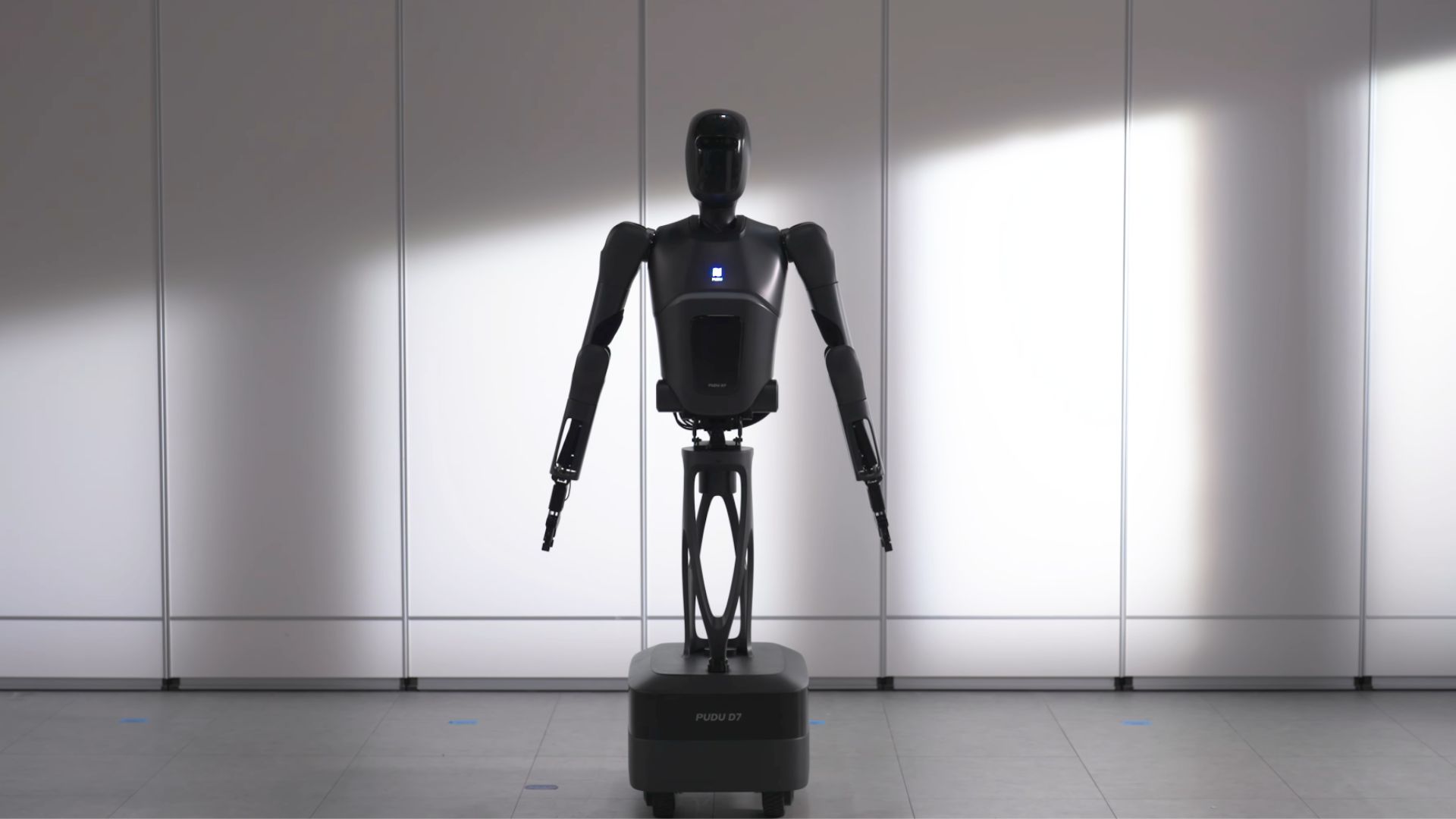
Chinese robotics firm Pudu has unveiled a next-generation industrial semi-humanoid robot designed for manufacturing and factory environments.

The D7 robot combines industrial-grade hardware with embodied AI, powered by the company’s PuduFM 1.0 foundation model.

Unlike conventional industrial robots that follow fixed programs and predefined workflows, the PUDU D7 can understand tasks, learn from experience, and adapt its actions in real-world settings.

The Shenzhen-based company says the platform is designed to improve factory automation by enabling intelligent decision-making, continuous learning, and greater operational flexibility across a wide range of industrial applications.

In 2024, Pudu unveiled Pudu D7, its first semi-humanoid robot, combining an omnidirectional chassis, robotic arms, and a human-like upper body.

Adaptive warehouse worker

D7 is a semi-humanoid robot designed to evolve through real-world experience rather than relying solely on pre-programmed capabilities.

At the core of the system is an end-to-end data collection architecture that captures and processes operational data across a wide range of industrial workflows. Through low-latency transmission and synchronized data processing, the platform creates a continuous feedback loop that supports ongoing model training and performance optimization.

Powered by the PuduFM 1.0 AI foundation model, the robot learns from real-world operations, gradually improving its understanding of industrial procedures, spatial relationships, and manufacturing processes. Unlike traditional robots whose capabilities remain fixed after deployment, D7 continuously enhances its performance through every task it performs.

According to a statement by the firm, D7 is designed to improve efficiency in warehouses, factories, and logistics environments. Equipped with dual robotic arms, the robot can autonomously perform tasks such as material handling, shelf picking, inventory replenishment, and internal transportation. It supports payloads of up to 30 pounds (14 kilograms) and can operate at heights of up to 6.5 feet (2 meters), allowing it to interact effectively with high-rack storage systems.

Its force-control technology enables careful handling of both heavy and delicate items, reducing the risk of damage during transport. The robot can also push carts and move materials across facilities. By integrating navigation, approach planning, grasping, and manipulation into a unified action framework, PUDU D7 eliminates the traditional separation between movement and operation, enabling more efficient execution of complex, multi-step tasks.

Smarter industrial intelligence

For applications requiring fine control, such as assembly, dispensing, and precision handling, D7 incorporates advanced tactile sensors that provide real-time force and pressure feedback. The system delivers millimeter-level force-control accuracy, automatically adjusting applied force according to task requirements and material characteristics. This enables stable, consistent operation while minimizing the risk of component damage.

To operate safely in dynamic industrial settings, the robot is equipped with dual front-and-rear LiDAR systems and a comprehensive perception suite. These technologies allow it to continuously monitor its surroundings, detect obstacles, adapt to route changes, and navigate safely through busy factory environments with minimal infrastructure modifications.

PUDU D7 supports fully autonomous battery swapping, allowing it to independently replace and recharge batteries without human intervention. This capability minimizes downtime and enables continuous 24/7 operation, improving equipment utilization and productivity.

According to the firm, looking ahead, PuduAgent, its embodied AI agent platform, extends this vision by enabling robots to interpret user goals, break down complex workflows, coordinate navigation and manipulation tasks, and collaborate with multiple robots across different locations. Together, these technologies represent a shift from task-based automation toward autonomous systems capable of decision-making, long-term planning, and intelligent collaboration in industrial environments

💾

Chinese frim Pudu unveils the D7, an AI-powered semi-humanoid robot that learns, adapts, and boosts industrial automation.
  •  
❌