Reading view

Scientists shrink lab-grade ultrafast laser on a single chip for making atomic clocks

Researchers at EPFL – Swiss Federal Technology Institute of Lausanne have integrated an ultrafast femtosecond laser onto a photonic chip. 

In a major milestone, the tiny laser went toe-to-toe with tabletop models, packing 1.05 nanojoules of energy into fleeting 147-femtosecond bursts.

“For more than twenty years, a high-pulse-energy femtosecond laser on chip was widely regarded as a holy grail of integrated photonics,” said Professor Tobias J. Kippenberg at EPFL. 

“Our result shows that it is not only possible, but that it can be achieved with a surprisingly elegant architecture that the integrated-photonics community had overlooked,” added Kippenberg. 
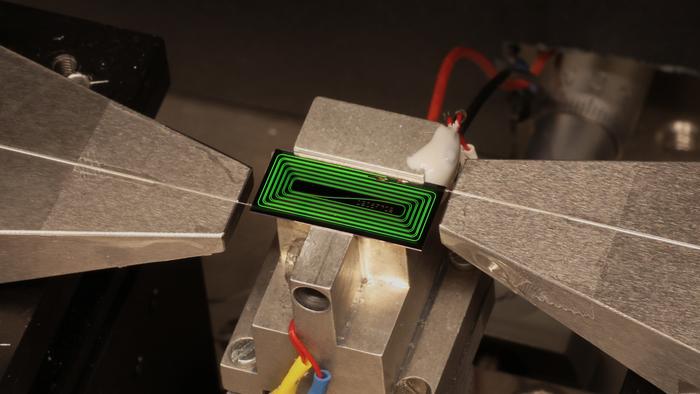
EPFL’s chip-based ultrafast laser operating in the laboratory test setup. Credit: Zheru Qiu/EPFL

Photonic chip milestone

In this work, an ultrafast laser was miniaturized using photonic chips to route light through microscopic waveguides rather than bulky laboratory equipment. These emit incredibly precise light pulses lasting only a few hundred femtoseconds or quadrillionths of a second.

The high-speed lasers are vital for advanced applications like eye surgery, micromachining, and atomic clocks.

The EPFL team has achieved what many in the field considered impossible. They have built the first integrated chip-scale ultrafast laser that matches the raw performance of its giant, tabletop ancestors.

To pull this off, the EPFL team had to rethink how lasers handle light.

Instead of routing electricity through copper wires, photonic chips guide light through microscopic channels called waveguides etched into a wafer. But when you squeeze immense laser power into channels thousands of times thinner than a human hair, the light violently interacts with itself.

In standard laser designs, this structural stress causes the hyper-fast pulses to destabilize and rip themselves apart.

The solution lay in a forgotten, decades-old fiber-laser concept: the Mamyshev oscillator.

Use in GPS and medicine

Operating like a highly selective photon security checkpoint, this design traps light inside a laser cavity between two optical filters tuned to entirely different color spectra. 

While weak, chaotic light fails the test and dies out because it cannot pass through both barriers, high-powered pulses behave differently. Inside the tiny channel, intense pulses naturally spread out into a wide range of colors. This allows the light to clear both filters, loop back, and gain power.

“This design is especially attractive because it does not require any component that is difficult to make on this erbium-doped silicon nitride chip,” explained Zheru Qiu, a co-leading author of the paper.

Better yet, the Mamyshev architecture actually thrives on the intense light-to-light interactions that destroy other chip designs.

The implications of folding a 42-centimeter-long laser path into a microscopic spiral are immense.

Interestingly, these photonic chips can be mass-produced on silicon wafers just like computer processors. A single production run can simultaneously yield more than 1,000 completely independent ultrafast lasers.

Manufacturing at this scale will plummet production costs. Kilowatt-level peak powers, once costing tens of thousands of dollars and occupying half a room, could soon be deployed on affordable, handheld devices.

The technology could be used in various fields. In the near future, environmental teams could use pocket-sized sensors to detect microscopic pollutants in real time. Doctors could perform advanced medical diagnostics in remote villages using handheld tools. 

Eventually, these tiny lasers will power compact, highly portable atomic clocks—paving the way for next-generation navigation systems that function flawlessly even when completely cut off from satellite GPS.

The study was published in the journal Nature on June 3. 

💾

Researchers at EPFL - Swiss Federal Technology Institute of Lausanne have integrated an ultrafast femtosecond laser onto a photonic chip. 
  •  

MIT uses sacrificial bonds to toughen plastics for impact-resistant electronics, tires

Drop the phone on the pavement, and you brace for the sickening sound of cracking plastic. Skidding on a highway can shred your car’s tires, sending microscopic bits of toxic rubber into the air.

Material scientists have long tried to prevent these everyday disasters by making plastics harder, stiffer, and tougher. 

But a team of MIT chemists has figured out how to make plastics vastly stronger by engineering them to break.

Researchers revealed that adding weakened chemical bonds to common polymers could make them more resistant to high-speed impacts. 

Interestingly, these sacrificial bonds selectively break at the site of impact when struck by a high-speed object. It creates pathways that absorb and dissipate the destructive energy while keeping the surrounding structure stable. 

“These cross-linkers can substantially increase the amount of energy that the material absorbs under ballistic impact. You can imagine many applications of that, especially if this could be generalized to other polymers,” said Jeremiah Johnson, the A. Thomas Geurtin Professor of Chemistry at MIT and a member of the Koch Institute for Integrative Cancer Research.

Tougher polystyrene. Credit: MIT

Testing the technology

The new development builds on a 2023 study that used weak chemical bonds called mechanophores to prevent polymers from slowly tearing. Researchers have now adapted this strategy to resist rapid, sudden impacts. 

In distributing these weak linkages throughout a material like polystyrene, the mechanophores split in two as a crack begins to propagate, successfully redirecting the crack and dissipating the destructive energy.

This sacrificial mechanism forces an impact to expend far more energy to penetrate the material, thereby protecting the stronger, load-bearing polymer bonds from failing during rapid deformation.

Using a specialized system called Laser-Induced Microprojectile Impact Testing (LIPIT), the researchers launched tiny silica beads at thin films of the modified plastic. 

This technique fires microscopic silica beads at the polymer film at supersonic speeds of 750 meters per second (over 1,600 mph). 

Standard polystyrene shattered or punctured easily under the stress. But the plastic laced with the new weak molecules absorbed the heavy impact with ease.

“We first developed this method to study microparticle impact and penetration into bulk polymer samples, where we would monitor particle propagation through about 100 microns of material and analyze after impact how polymer morphology had changed,” said Keith Nelson, the senior author. 

“Our new measurements show how much additional information can be extracted from particle velocities before and after penetration through a thin layer. They also show deeply informative deformation patterns both during particle impact and afterward,” Nelson added. 

Make tougher tires

This high-speed testing allowed for mimicking real-world forces, such as dropping a phone or a plastic object being struck.

The experiments successfully demonstrated that the mechanophore-cross-linked polystyrene absorbed more impact energy than standard unmodified polystyrene.

It was discovered that high-speed impacts heat the material locally to create a “mobile zone. ” In this, the mechanophore bonds selectively break under force, absorbing energy while keeping the surrounding area stable. 

The team successfully replicated this impact-resistant effect in styrene-butadiene-styrene (SBS) rubber, which is commonly used in shoe soles, asphalt, and roofing. And is now exploring its application to styrene-butadiene rubber for vehicle tires.

If successful, this technology could produce longer-lasting, blowout-resistant tires and more protective electronics cases. Furthermore, it could reduce environmental waste by curbing tire wear, which currently accounts for at least 10 percent of all global microplastics.

The findings were published in the journal Nature on June 3.

  •  

New 100kW superconducting motor paves way for future electric propulsion aircraft

Researchers at the University of Strathclyde in Glasgow have developed and demonstrated a 100kW fully superconducting aviation motor. 

This prototype could make lightweight, high-power electric propulsion a reality for future commercial aircraft.

The motor achieves a power density that conventional electric motors simply cannot match, thanks to specialized materials that exhibit zero electrical resistance when frozen.

When cooled to an ultracold 20 Kelvin (K) (-253°C or -423F), the motor’s specialized materials lose virtually all electrical resistance. This means that a small engine can handle immense power loads without generating wasteful heat.

Temperature challenge

Commercial flight faces a strict weight trap that standard electric motors cannot escape. 

Standard jet engines deliver far more power for their weight than conventional electric motors can manage, largely because standard copper wiring becomes prohibitively heavy and dangerously overheats when pushed to its limits. 

Superconducting motors overcome this technological barrier, standing as the only known innovation capable of delivering the immense power-to-weight ratio required to lift a commercial passenger plane off the ground.

“Superconducting technology offers a route to much lighter and more efficient propulsion systems, but it also brings major engineering challenges in cryogenic cooling, protection and system integration,” said Professor Min Zhang, who leads the ASL at Strathclyde. 

A superconducting axial-flux aviation motor is an electric motor that uses cryogenically cooled materials to eliminate electrical resistance. 

Though labeled “high temperature,” the motor’s superconducting tape still requires cryogenic cooling to between 20K and 77K. 

However, this is a massive engineering victory, as it operates at significantly higher temperatures than conventional superconductors, which require extreme liquid helium cooling at 4K. 

Prototype requirement

To turn this physics quirk into a working prototype, the Strathclyde team had to solve the gap between fundamental superconductor research, cryogenic engineering, and mechanical system integration.

The multidisciplinary team successfully condensed complex physics into a single working machine. 

The prototype was integrated with low-loss superconducting windings, a novel brushless starting mechanism, and internal cryogenic cooling that functions while spinning. This combined technology proved that a fully superconducting motor architecture can operate as a unified, real-world platform.

This temperature shift changes everything for aerospace giant Airbus, which backed the project under its ZEST1 (Zero Emissions for Sustainable Transport) program.

The zero-emission race

Airbus is betting on liquid hydrogen to fuel its future zero-emission fleet. Liquid hydrogen must be stored on board at extremely low temperatures, allowing it to serve a dual purpose. It acts as the fuel for the plane while simultaneously serving as the coolant for the superconducting motor.

“This demonstrator shows that fully superconducting aviation motors are no longer just a theoretical concept,” said Professor Zhang.

Apart from Airbus, several other companies like Hinetics, the U.K.’s HyFlux, and giants like Toshiba and Raytheon are racing to build ultra-efficient, high-power-density motors using high-temperature superconductors

The aviation industry accounts for roughly 2.5 percent of global CO2 emissions. While a 100kW motor is far too small to lift a commercial airliner, the Strathclyde team views this success as the definitive proof of concept. The underlying physics works.

This leap in power density is exactly what future hydrogen-electric and fully electric aircraft need to finally get off the ground. The next step is scaling this architecture up to megawatt-class superconducting systems for larger commercial aircraft.

  •  

Urban bowerbirds prefer human-made items over natural materials for courtship

Unsual mating rituals are emerging in modern times. In a bizarre wild twist, a female great bowerbird can be won over by a pair of handcuffs, discarded medicine jars, or a neon football mouthguard.

A new study shows that urban male bowerbirds are ditching otherwise natural decorations and turning to a wild assortment of human trash to woo mates.

Researchers from the University of Exeter compared birds in Townsville City to their rural counterparts in Queensland, Australia.

It was discovered that urban displays featured much more vivid reds and duller greens than their rural counterparts

“Our study demonstrates that availability of human items – often glass and plastic – is affecting the behavior of bowerbirds,” said Dr Laura Kelley from the University of Exeter. 

“We don’t yet know whether this has any negative or positive impact on them, but it’s a reminder of how human activity is changing the natural world in unanticipated ways,” Kelley said.   

City birds ditch nature

Male bowerbirds do not help raise young. Their only goal is to attract a mate. To do this, these avians build a special tunnel of twigs called a bower and surround it with a courtyard of colorful objects. When a female visits, the male throws objects into her line of sight while flaunting his colorful plumage.

In the wild, this means typically collecting berries, seeds, leaves, and other such natural items. In the city? It means raiding the local stadium.

“Bowers are built exclusively to attract a mate, and males choose decorations that contrast against their own plumage and the bower itself,” said Caitlin Evans from the Center for Ecology and Conservation at Exeter’s Penryn Campus in Cornwall.

“Our findings show that bowerbirds in a city use a wide range of items scavenged from humans. Glass, plastic, and wire were common choices, but we also found items including a pair of handcuffs, medicine jars at bowers near a hospital, and fluorescent mouth guards from a site near an Australian Rules football ground,” Evans added

Overachiever bird

Urban bowerbirds are prolific collectors, hoarding an average of 90 items per bower — with one overachiever amassing more than 300. In comparison, the average was a modest 20 items for rural males. 

The researchers also evaluated the bowers through the eyes of the female birds. Bowerbirds have incredible vision, and their eyes are much more sensitive to color than human eyes.

Interestingly, the birds’ choice of décor also reflects their surroundings. While rural birds rely on green leaves, seeds, and occasional green glass, city birds heavily favor synthetic, high-contrast materials, making green glass and red wire their top two decorations.

To test how deep this preference runs, the team set up a swap experiment. They offered both city and country birds a mix of natural and human-made items. The choice was unanimous.

Both groups overwhelmingly chose the human-made plastic and glass. Even the rural birds were willing to raid farm garages and trash bins to upgrade their collections.

However, the study did not directly measure female preference. The intense enthusiasm city males for hoarding these human objects likley suggests that the females find them attractive.

Whether this helps the birds win more dates or accidentally introduces environmental risks is a question scientists are still trying to solve

The study was published in the journal Royal Society Open Science on June 2.

💾

A new study shows that urban male bowerbirds are ditching otherwise natural decorations and turning to human trash to woo mates.
  •  

Scientists map complex maritime winds to maximize fuel savings from ship sails

Global shipping is facing a huge fuel crisis. Massive cargo ships, bulk carriers, and tankers generate roughly 90 percent of the maritime sector’s carbon emissions. True zero-emission alternatives like hydrogen, ammonia, or pure electrification are still years away from scaling.

Faced with tightening climate regulations, shipowners are turning to the world’s oldest propulsion method: the wind.

Today’s commercial fleets are deploying towering, high-tech aerodynamic structures known as Wind-Assisted Propulsion Systems (WAPS). These include spinning rotor sails that harness the Magnus effect, vertical wing sails, and advanced suction sails that use internal fans to pull air across their surfaces.

The adoption curve is steep. In 2020, only nine major ships utilized these modern sails. Today, that number has jumped to 64, with dozens more currently being retrofitted.

However, a major problem has emerged. In theory, these sails should slash fuel bills. In practice, the real-world results are maddeningly inconsistent, with fuel savings fluctuating wildly between 2 percent and 25 percent.

To uncover the reason, researchers at the European research institute SINTEF launched the reSail project. Their findings suggest the shipping industry relies on oversimplified wind models that fail to capture real-world ocean conditions.

“We’ ve looked more realistically at the wind conditions, and they deviate significantly from wind theory,” said Yannick Jooss, a SINTEF researcher. 

“If you just use the standard wind profile as is often done today, your measurements will be inaccurate. Simplified assumptions and simulations are not good enough, because they do not take into account the complexity and variation in the wind,” noted Jooss.

Optimizing modern ship sails

According to project lead Jooss, relying on these oversimplified simulations leads to inaccurate data. Rather, maximizing emission reductions requires precise, real-world knowledge of wind behavior and sail placement, along with automated adjustments to optimize overall ship operations.

The primary complication is structural. When a 22-meter-tall rigid sail is bolted onto a massive metal hull, the ship itself alters the environment. The vessel bends, blocks, and whips the wind into complex micro-currents before the air ever hits the sails.

To map this invisible chaos, the reSail team outfitted the Bow Olympus — a chemical tanker operated by Odfjell — with high-frequency LiDAR (Light Detection and Ranging) systems. With this technique, the team successfully tracked highly accurate wind speeds and angles relative to a moving ship.

To do this, researchers fired laser beams into the atmosphere and used the Doppler effect to track the light as it bounced off airborne dust particles.

Fuel savings on large ships

The data gathered from the Bow Olympus is shifting the research into a lab-optimization phase focused on three key areas. 

The team aims to optimize ship operations holistically by using wind tunnels at NTNU to identify the aerodynamic sweet spot for sail placement, developing predictive systems to automatically adjust sails before wind gusts hit, and integrating real-time wind forecasting into navigation computers. 

“Our goal is to make it more attractive to use modern sails on ships, and thus contribute to the necessary emissions reduction from the maritime sector,” added Jooss.

Regulations such as FuelEU Maritime require an 80% reduction in shipping emissions by 2050. If the reSail project succeeds in closing the gap between theory and reality, it could push fuel savings securely past the 25 percent mark.

💾

Researchers at the European institute SINTEF launched the reSail project to advance a wind-based propulsion system for ships.
  •  
❌