Reading view

A Painful Side Effect of Statins Explained After Decades of Mystery

For millions of people, statins are a daily shield against heart disease.

But around 10 percent of those who take statins to lower cholesterol experience a mysterious, painful side effect that causes many to discontinue these potentially life-saving medicines.

Scientists have recently found one possible reason why.

Research from Columbia University and the University of Rochester in the US revealed a potential culprit: a tiny calcium gate inside muscle cells that statins may force open.

The resulting calcium leak can damage muscle tissue, offering a new explanation for at least some cases of statin-associated muscle symptoms (SAMS).

"I've had patients who've been prescribed statins, and they refused to take them because of the side effects," said lead author Andrew Marks, a cardiologist at the Columbia University Vagelos College of Physicians and Surgeons.

YouTube Thumbnail

Statins work by blocking an enzyme that's required for the biosynthesis of cholesterol in the liver.

As a result, levels of 'bad' LDL cholesterol are reduced in the blood, helping to prevent one of America's top killers: cardiovascular diseases like atherosclerosis, the buildup of fatty deposits in blood vessels.

But statins also affect "off-target" molecules, including a protein called ryanodine receptor 1 (RyR1). RyR1 is a mushroom-shaped channel, or gate, located on the sarcoplasmic reticulum, a web-like structure that surrounds muscle fibers.

RyR1 acts like a bouncer at a club, opening or closing the door to let calcium ions flow into the muscles. This calcium flow is an essential process that mediates muscle contractions.
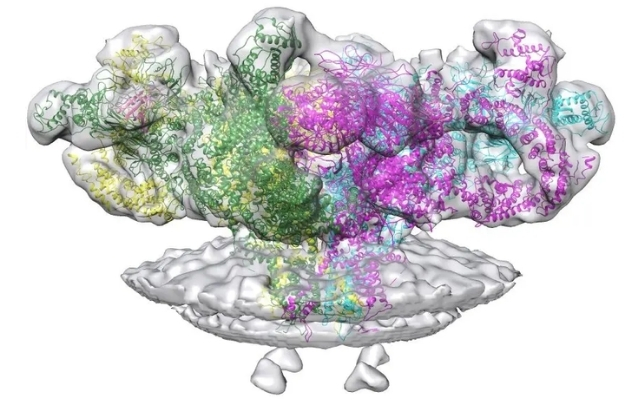
protein structure
Structure of RyR1, a protein channel that allows calcium to leak into muscles. (Wenbo Chen/Chen & Kudryashev, EMBO Rep., 2020)

Using mice as models, the researchers observed the precise way statins bind to RyR1, using an imaging technique called cryo-electron microscopy (cryo-EM).

Cryo-EM involves flash-freezing biological samples and then blasting them with electron beams. The deflection pattern of the electrons reveals tiny structures, allowing scientists to create highly detailed 3D images of things like proteins and view their constituent molecules.

Yet cholesterol-lowering drugs like simvastatin may keep these gates open, allowing calcium ions to leak into muscle cells, which can either directly damage muscles or trigger enzymes that degrade them.

As a result, statin users may experience persistent pain, weakness, tenderness, and cramps.

Subscribe to ScienceAlert's free fact-checked newsletter

The issue is exacerbated in individuals with RyR1 mutations, who may also experience episodes of malignant hyperthermia (a severe overheating triggered by medication) or weakness in the diaphragm that leads to reduced lung function and respiratory disorders.

In rare but potentially life-threatening cases, the side effects of statins can induce rhabdomyolysis, a serious syndrome in which muscle tissues rupture and leak into the bloodstream, culminating in kidney failure.

The equally gruesome autoimmune-mediated necrotizing myositis may also rarely occur, a condition in which the immune system turns against its own tissues and kills muscle tissue.

The leaky calcium gate explanation may not apply to all cases of SAMS, but now that we understand this mechanism, it could help identify people at risk of statin intolerance.
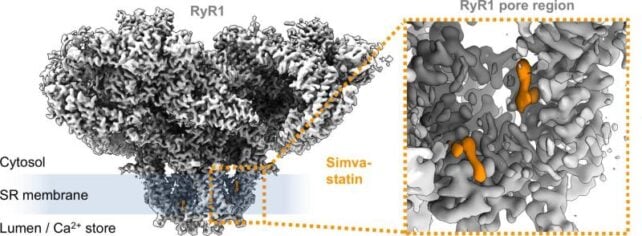
Cryo-EM model of the RyR1 calcium channel, with simvastatin binding sites highlighted in orange and a magnified view of the pore region.
Simvastatin molecules bind to ryanodine receptors on a muscle protein. The flow of calcium through the opened channels in the receptors could explain the muscular side effects of statins. (Columbia University)

Around 40 million adults take statins in the US alone, and approximately 10 percent of treated individuals experience SAMS.

"It's the most common reason patients quit statins, and it's a very real problem that needs a solution," said Marks.

Related: US Cardiologists Have Published New Guidelines For Managing Cholesterol

The researchers highlight two promising options. The first is to redesign statins so they don't bind to RyR1 but still inhibit cholesterol production in the liver.

Alternatively, when the researchers treated statin-intolerant mice with Rycal, an experimental class of drug used to treat patients with rare muscle diseases, they were able to close the leaky RyR1 calcium gates and prevent simvastatin-induced muscle weakness.

"It is unlikely that this explanation applies to everyone who experiences muscular side effects with statins," Marks explained.

"But even if it explains a small subset, that's a lot of people we could help if we can resolve the issue."

This research was published in the Journal of Clinical Investigation.

An earlier version of this article was published in February 2026.
ScienceAlert stories are written, fact-checked, and edited by humans, never generated by AI. Don't miss a story, subscribe here.

  •  

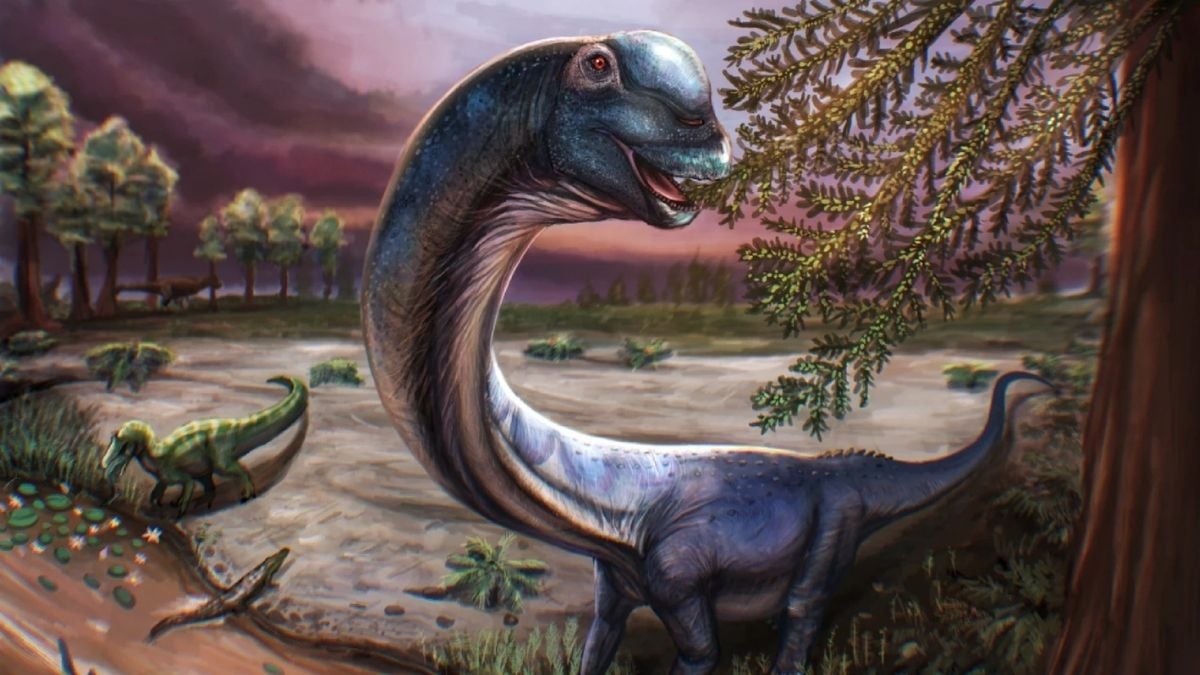
Largest Ever Dinosaur Discovered in Southeast Asia Was a Real Doozy

An ancient giant – as massive as nine elephants – has emerged from Thailand.

The dinosaur, named Nagatitan chaiyaphumensis, lived more than 100 million years ago during the Early Cretaceous.

It was a sauropod, sporting a lengthy tail, a long neck, and a prodigious appetite for plants, à la the on-again off-again Brontosaurus.

It likely weighed up to 28 tons and stretched some 27 meters (89 feet) long.

That's truly immense – more than 10 tons more massive than the hugely famous (and famously huge) Dippy the Diplodocus.

And it makes Nagatitan the largest dinosaur ever discovered in Southeast Asia.

Researchers Reveal a Doozy of a Dinosaur, The Size of Nearly 10 Elephants
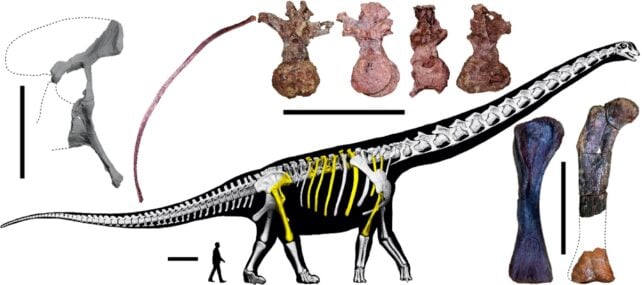
An illustration showing the skeleton of N. chaiyaphumensis, with the preserved bones highlighted in yellow. (Sethapanichsakul et al., Sci. Rep., 2026)

Yet Nagatitan would have been only modestly mammoth compared with Patagotitan, a sauropod thought to have weighed approximately 70 tons and which may have been the largest land animal to ever walk the Earth.

Nagatitan has also been bestowed with an interesting etymology.

"Naga" refers to mythological water serpents frequently featured in Asian and Buddhist mythos. "Titan" derives from the Titans, or elder deities of Greek myths.

"Chaiyaphumensis" comes from the Chaiyaphum province of Thailand, where the bones were found.

As described in a recent paper published by a collaboration of researchers from Thailand and University College London (UCL), the remains of Nagatitan were discovered in 2016 on the edge of a dried pond in northeastern Thailand.

To tease out fine details and safely study bones across institutions, the researchers used a surface-scanning technique to create three-dimensional models.

"The material was studied both in Thailand and at UCL – 3D scanning and printing has meant that we can study the specimen and collect data without having to travel," says Paul Upchurch, paleobiologist at UCL and one of the study's co-authors.

Researchers Reveal a Doozy of a Dinosaur, The Size of Nearly 10 Elephants
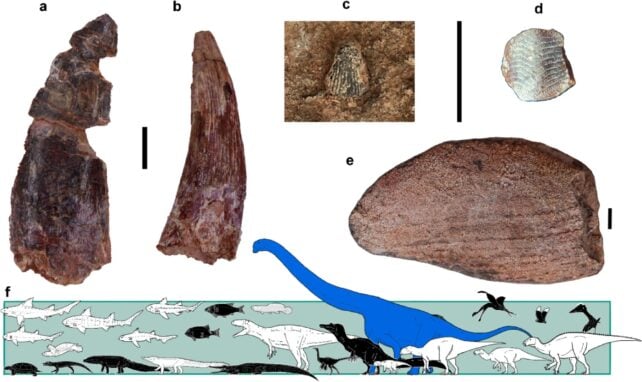
Figures a-e show other, non-sauropod remains found in the same area. Figure f depicts the known faunal assemblage from the Khok Kruat Formation, with N. chaiyaphumensis in blue and tentative taxa in black. (Sethapanichsakul et al., Sci. Rep., 2026)

In relation to other dinosaur fossils, it presented a fairly comprehensive collection of bones that exhibited a few morphological differences from those of other known sauropods.

The fossil find included eight vertebrae, five ribs, parts of the pelvis, a humerus, and a femur, along with some indeterminate fragments.

The dinosaur appears to be somewhat of an endling. The researchers have dubbed it "the last titan" because it was found in the Khok Kruat Formation, the youngest dinosaur-fossil-bearing stratigraphic region in Thailand.

The Khok Kruat Formation preserves a diverse array of fossils, including sharks, turtles, pterosaurs, ancestral crocodiles, and fearsome, predatory theropods, including an 8-meter-long shark-toothed predator.

Subscribe to ScienceAlert's free fact-checked newsletter

In the Early Cretaceous, this area may have hosted shrublands and savannas, cut through by a meandering river system. As flying reptiles swiftly swooped up fish from the currents, Nagatitan could have dipped its long neck to gulp vast mouthfuls of water.

A product of their environment, as creatures usually are, sauropods seemed to have adjusted well to rising temperatures, despite their size. Perhaps they evolved their large surface area to dissipate heat.

The landscape then shifted dramatically, ending the dinosaurs' reign in Southeast Asia.

Related: Giant Dinosaurs Were Riddled With a Devastating Disease, Fossils Show

"Younger rocks laid down towards the end of the time of the dinosaurs are unlikely to contain dinosaur remains because the region by then had become a shallow sea," explains Thitiwoot Sethapanichsakul, a paleontologist at UCL, and first author of the study.

"So this may be the last or most recent large sauropod we will find in Southeast Asia."

Nagatitan isn't just an important 'last' – it's an exciting first for its discoverers, too.

"I've always been a dinosaur kid," says Sethapanichsakul.

"This study doesn't just establish a new species but also fulfils a childhood promise of naming a dinosaur."

This research was published in Scientific Reports.

ScienceAlert stories are written, fact-checked, and edited by humans, never generated by AI. Don't miss a story, subscribe here.

  •  
❌