❌

Reading view

Novel particle beam could challenge Einstein’s Theory of Gravity

Researchers at ETH Zurich and the Paul Scherrer Institute in Villigen, Switzerland, have produced a high-intensity beam of muonium atoms in a cold state, an experimental advance that could enable a direct test of whether gravity acts differently on second-generation matter. The peer-reviewed study in Nature Physics describes a new method for generating muonium in superfluid helium. The resulting atoms travel at similar speeds and almost parallel to one another, properties required for a future interferometer that would measure the tiny influence of gravity on muonium.

The study did not conduct that gravitational measurement or find evidence that gravity departs from its expected behavior for ordinary matter; it instead developed the beam source needed for the proposed test. The experiment is designed to examine the universality of free fall and the equivalence of gravitational and inertial mass, a cornerstone of Albert Einstein’s theory of gravitation. In ordinary matter, bodies fall at the same rate at a given point within a gravitational field, while the equivalence principle links gravitational mass with inertial mass.

According to the research team, this principle has so far been demonstrated only with ordinary matter or first-generation antimatter. Muonium is a neutral atom formed from a positively charged antimuon and a negatively charged electron, making it a second-generation probe. A gravity experiment with this exotic atom would test whether the equivalence continues to hold for particles outside the first generation.

Muonium has two characteristics that make it useful for this test: it is neutral, and it belongs to a heavier and less familiar generation of particles. A neutral object allows gravitational behavior to be studied without the weak gravitational signal being masked by stray electromagnetic fields, which can dominate the behavior of charged particles. At the same time, muonium is exceptionally difficult to produce and control.

Its constituent muon decays after only about 2.2 microseconds. Earlier sources generated muonium atoms that flew off in many directions at different speeds and were therefore unsuitable for the precision required in a gravity experiment. The researchers addressed this problem by creating a cold, intense and well-directed beam.

The antimuons were directed into a thin layer of superfluid helium that had been cooled close to absolute zero, at minus 273 degrees Celsius. Superfluid helium is a quantum fluid in which individual helium atoms lose their identity and in which impurities are not tolerated. Lead author Jesse Zhang said the researchers used the superfluid as an “atomic cannon,” exploiting the conversion of chemical potential into kinetic energy to propel the newly formed muonium atoms out of the liquid.

When an antimuon encounters a free electron in the superfluid helium, it forms a neutral muonium atom with positive chemical potential. The atom is forced out of the liquid, and as it reaches the surface, that chemical potential is converted into kinetic energy. The resulting boost sends the muonium vertically out of the helium.

Importantly, the atoms must move through the quantum liquid at a suitable speed without collisions, because excessive scattering would prevent them from reaching the surface within their very short lifetime. The high-intensity antimuon beam from PSI allows many muonium atoms to be generated for the planned experiments. Anna Soter, a professor of physics at ETH Zurich and member of the research team, said the cold state is what makes the proposed gravity experiment possible.

In this context, “cold” does not mean that the atoms are motionless; it means that they propagate at similar speeds and nearly parallel to one another. This improved control over direction and velocity is important because the planned instrument will use the wave properties of the atoms to create an interference pattern. A very small shift in that pattern caused by Earth’s gravitational pull would provide a measure of gravity’s effect on muonium.

The study establishes the upstream beam capability rather than reporting the result of that comparison. The next stage of the program is the development of a muonium interferometer. According to the researchers, they hoped to test the method for the first time with the atomic beam in the year of the announcement and, if that worked as expected, to carry out the actual gravity experiment two or three years later.

Those are planned milestones rather than completed measurements. If the interference pattern of muonium shifts differently from the pattern expected for ordinary matter, Soter said the result would be surprising and could, among other theoretical possibilities, point toward the existence of a fifth force. No fifth force has been proven, and the present work provides no evidence for one.

The team’s primary aim is to measure whether the equivalence between gravitational and inertial mass applies to a second-generation particle. Physics recognizes four fundamental interactions: gravity, electromagnetism, the strong interaction and the weak interaction. A fifth force has been proposed repeatedly, but it has never been established.

Soter emphasized that the researchers are open-minded about what the measurement may show while keeping the immediate objective focused on the first such test. The new beam is therefore an enabling experimental result, not a demonstration that Einstein’s theory has been challenged or overturned. Beyond the planned gravity measurement, the high-intensity muonium beam is expected to enable more precise laser-spectroscopy experiments.

These could allow muonium to be measured more accurately than in previous work and provide information about the muon’s mass and fundamental physical constants, which are stated goals of the research group. The same experimental source can thus serve two purposes: supplying a cold, directed beam for a gravitational comparison and providing a larger, better-controlled population of muonium for detailed spectroscopic study. The reported advance addresses a major technical obstacle while leaving the central scientific question unresolved.

A successful gravitational test will still require an interferometer capable of resolving a minuscule shift in an interference pattern while dealing with muonium’s short lifetime, beam quality and other sources of uncertainty. The study’s demonstrated result is the generation of a high-intensity, superthermal muonium beam in superfluid helium, with atoms emerging in the cold state needed for future work. Whether muonium falls exactly as expected for ordinary matter remains to be measured.

The beam nevertheless supplies the experimental foundation for testing gravitational universality in a second-generation particle, a comparison that had not previously been carried out with muonium.

Subject of Research: A cold muonium beam developed for future tests of gravitational universality and laser spectroscopy

Article Title: Novel particle beam could challenge Einstein’s Theory of Gravity

Article References: Novel particle beam could challenge Einstein’s Theory of Gravity. Original publication (Bibliographic details unavailable.)

Image Credits: AI Generated

DOI: Not provided

Keywords: muonium, muon beam, gravity, gravitational universality, equivalence principle, interferometry, superfluid helium, laser spectroscopy, ETH Zurich, Paul Scherrer Institute, Novel, particle
  •  

MacVoices #26283: Live! – ‘Pro and Tell,’ Duo Delays, Apple at $5 Trillion, and Affinity for iPad

Apple’s upcoming “Pro and Tell” event sparks speculation about new MacBook Pro models, while iPhone Duo preorders raise questions about shipping delays and retail availability. The panel discusses Apple’s $5 trillion valuation, why HomeView won’t launch in the European Union, and the anticipated arrival of Affinity Studio on iPad, including how it could transform creative workflows and provide yet another powerful alternative to Adobe Creative Cloud. 

💾

  •  

MLS Cup Playoffs schedule on Apple TV: wild cards November 18, final December 18

The Audi 2026 MLS Cup Playoffs begin on November 18 with the wild card matches, and every postseason game streams on Apple TV, Major League Soccer said in its schedule announcement. Apple TV subscribers get the playoffs as part of their subscription, which Apple listed at $12.99 per month in February, and 2026 MLS Cup […]

The post MLS Cup Playoffs schedule on Apple TV: wild cards November 18, final December 18 appeared first on The Mac Observer.

  •  

Early iPhone Duo Reviews Highlight Display Strengths and Everyday Trade-Offs

Early iPhone Duo reviews are examining how Apple’s first foldable handles everyday tasks ahead of its October 23 launch. Reviewers describe an appealing inner display alongside adjustments involving one-handed use, authentication, and app layouts, providing a practical picture of where the design works well and where it asks users to adapt.

Evaluations published October 21 offer a more substantial picture than brief demonstrations, ahead of initial retail availability on OctobeIn a September 19 hands-on, Android Central’s Harish Jonnalagadda also highlighted the inner display’s coating. Those earlier impressions provide context for the October reviews, but came from a shorter session rather than extended everyday use.r 23. The emerging story combines an appealing inner display with practical questions about handling, applications, and the compromises involved in carrying one device that serves two roles.

The Matte Display Changes the Experience

The inner screen’s finish is becoming one of the most consistent points of interest. Apple’s official announcement describes a nano-textured polymer cover intended to reduce glare and minimize the visibility of the fold.

In his PetaPixel review, Jaron Schneider praises the reduction in reflections and says fingerprints are much less noticeable during normal use. He also acknowledges that people who dislike matte displays may not appreciate this one.

In a September 19 hands-on, Android Central’s Harish Jonnalagadda also highlighted the inner display’s coating. Those earlier impressions provide context for the October reviews, but came from a shorter session rather than extended everyday use.

That gives the comparison with existing foldables a more useful starting point than screen size alone. A larger panel matters less if reflections repeatedly interfere with what someone wants to see. Equally, a finish that one reader finds comfortable may disappoint someone who prefers the appearance of glossy glass.

The relevant difference is therefore partly experiential. Shoppers should examine text, photographs, and dark scenes under several lighting conditions rather than judging the screen from a promotional image.

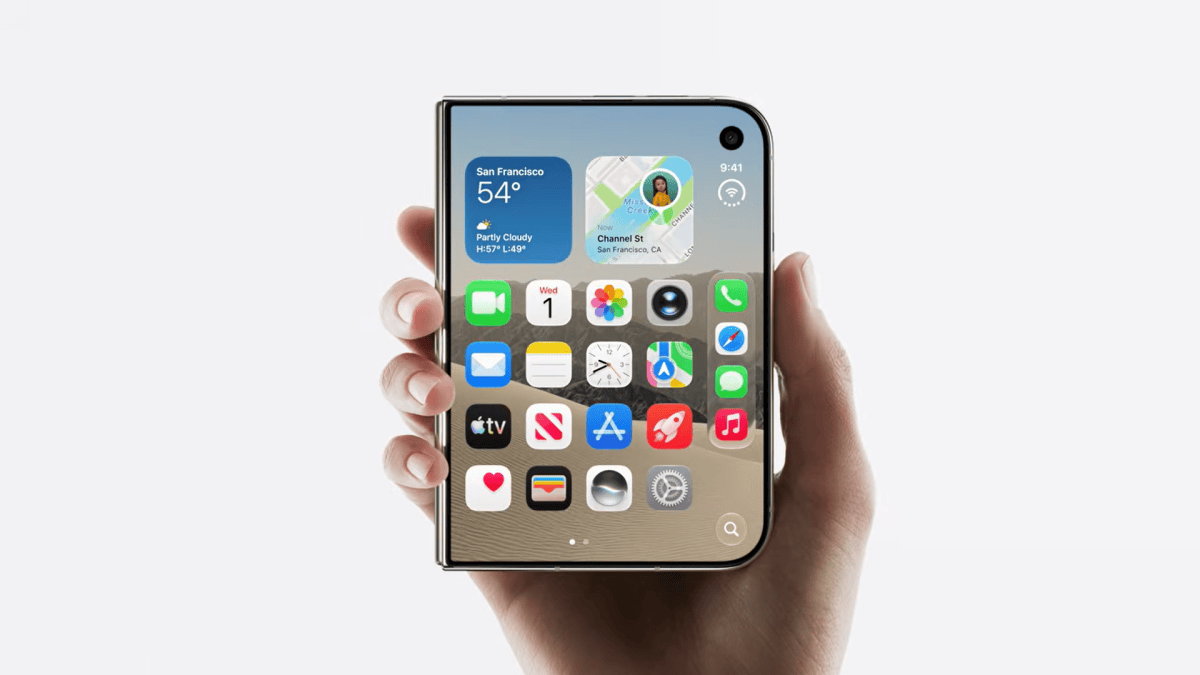
Two foldable smartphones—the iPhone Duo in sleek silver and the A20 Pro in striking dark blue—are displayed side by side, each partially open, showcasing vivid mountain and desert landscapes on their vibrant iOS 27 screens.
Image Credit: Apple Inc.

A Folding Phone Still Has to Work Closed

Schneider’s assessment also exposes a practical tension: he finds the hardware exceptionally well made, yet describes difficulty with one-handed typing and adjusting his grip for Touch ID. His experience favors using both hands.

Those observations should remain attributed to the reviewer. Hand size, preferred grip, and familiarity can produce different reactions to the same device.

Nevertheless, they identify something worth testing before choosing a foldable. The closed phone will still handle quick messages, authentication, and tasks performed while standing or moving. Those interactions deserve as much attention as the impressive moment when the inner screen opens.

A useful demonstration would involve composing a message, reaching frequently used controls, unlocking the device, and then opening it to continue working. Comfort across that sequence reveals more than holding an unfolded phone briefly for a photograph.

Software Makes the Comparison More Complicated

Mark Spoonauer’s October 21 Tom’s Guide review praises the ease of using two applications together, but finds that applications without appropriate optimization can look poor. He also reports that rotating into portrait interrupts the side-by-side layout, which returns when the phone rotates back.

In that specific comparison, he notes that Samsung’s Galaxy Z Fold 8 keeps two narrow app windows visible in portrait.

This illustrates why “supports multitasking” is only the beginning of a useful comparison. What happens when the phone rotates, when someone switches tasks, or when an application encounters an unfamiliar shape can determine whether the extra space feels productive.

The Duo’s Split View limitations become more relevant when they interrupt a task already underway. The review describes a change in layout rather than the loss of the app pair, which returns when the device rotates back to landscape.

Buyers should check the applications they rely on most. A polished demonstration using selected software cannot establish that every banking app, editing tool, or work service will make equally effective use of the display.

Battery Testing Adds a Measured Reference Point

Tom’s Guide recorded 13 hours and 20 minutes in its web-browsing battery test, using the larger display, a 5G connection, and brightness set to 150 nits. The publication says it adapted the test to fill the Duo’s screen and ran it alongside the Galaxy Z Fold 8 and iPhone 18 Pro Max.

In that simultaneous comparison, the Galaxy Z Fold 8 lasted 10 hours and 6 minutes, while the iPhone 18 Pro Max reached 17 hours and 31 minutes. The Samsung phone had previously recorded 12 hours and 19 minutes, illustrating why results from different runs need context rather than being treated as fixed rankings.

The result provides a useful reference, rather than a promise about every owner’s day. It also demonstrates why a single competitive headline can oversimplify testing: the method, screen used, and comparison conditions belong alongside the number.

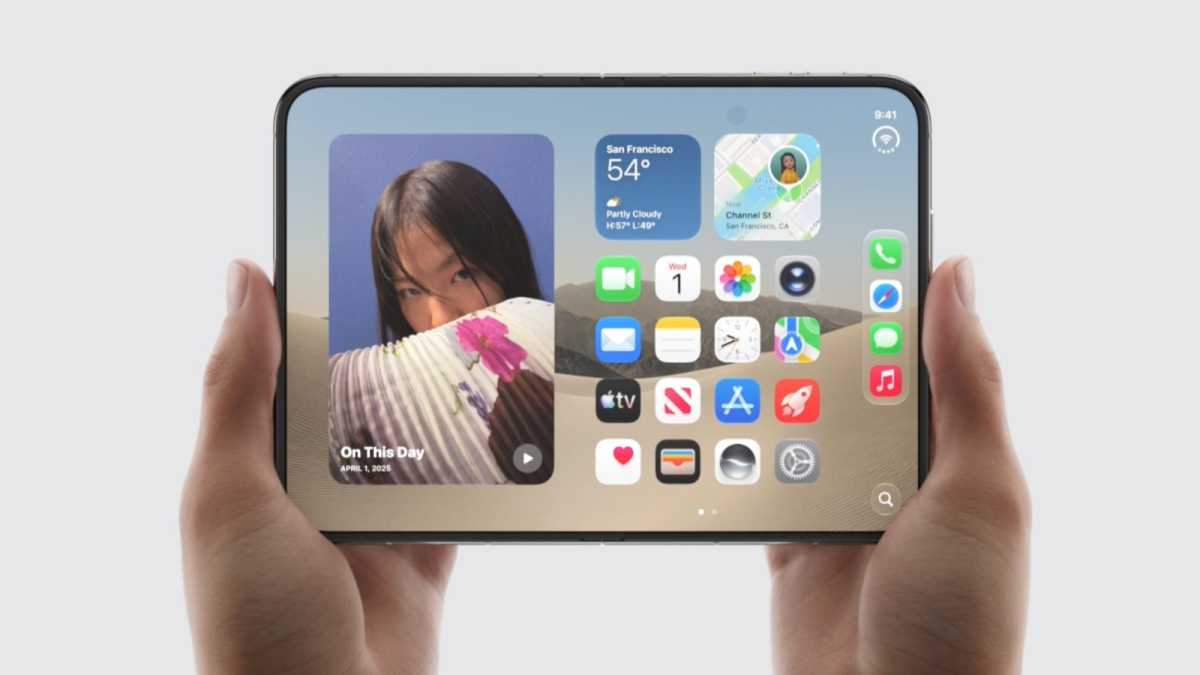
iPhone Duo reviews - A foldable iPhone Duo displaying a dashboard of widgets on the left screen and a messaging app thread on the right screen.
Image Credit: Apple Inc.

The Strongest Differences Are Practical

These accounts suggest that the Duo’s identity depends on how its screen finish, physical format, and software work together. They also reveal disagreement about whether those benefits outweigh the adjustments. Praise for construction does not automatically resolve concerns about grip or application behavior.

For prospective buyers, the useful question is which compromises fit their routine. Reading comfort, dependable access to work applications, and easy one-handed interactions may carry different weight for different people. The first reviews now provide concrete experiences to investigate, while long-term display and hinge durability still require longer observation.

The post Early iPhone Duo Reviews Highlight Display Strengths and Everyday Trade-Offs appeared first on AppleMagazine.

  •  

The new human-crafted Apple Music brand matters in an AI world

Apple just revealed a new brand identity for Apple Music, with the expected turn to Liquid Glass. I’m not much of a fan of their new design language in general; this is where I admit that I’m still running MacOS Sequoia and have grumpy things to say about rounded corner radii and text legibility.

It’s just a trend, it will pass, and at some point I’ll probably cave and upgrade when it starts actually affecting my ability to get work done, or more importantly get security updates. Once I adjust, I’ll stop noticing it, and life will go on.

As such, I wouldn’t normally find an obvious rebrand like this notable, much less feel like I had much to say about it. But then I happened to catch Apple’s behind-the-scenes video in my YouTube recommendations, and I realized I did have thoughts.

Read full article

Comments

© Apple

  •  

How to watch the US Grand Prix on Apple TV: race starts 4pm ET on October 25

The 2026 United States Grand Prix at the Circuit of The Americas in Austin streams exclusively on Apple TV in the US, with the race starting at 4pm ET (1pm PT) on October 25. Apple holds the US rights to every F1 session this season, including all practice, qualifying, Sprint sessions and Grands Prix, under […]

The post How to watch the US Grand Prix on Apple TV: race starts 4pm ET on October 25 appeared first on The Mac Observer.

  •  

OpenAI's latest AI models are coming to Google Cloud and Antigravity

Google would certainly prefer that everyone used its Gemini models with Google Cloud services, but soon, you'll have more options. OpenAI and Google have come to an arrangement that will see the former's frontier models arrive in Google Cloud services. Perhaps more importantly, GPT models will soon appear in Antigravity, Google's agent-powered coding tool.

For enterprise customers and AI enthusiasts, OpenAI's latest model will appear in Google's "Model Garden" in the coming weeks, adding to its 200-plus options. The garden already offers access to Google's Gemini models, as well as an assortment of open models like Mistral, Llama, and Gemma. Anthropic's Claude AI has also been available for some time. Google says it's now the only large cloud provider offering access to all three leading closed LLMs.

While OpenAI notes that Microsoft continues to be its primary cloud partner, the full suite of current GPT 6 and 6.1 models—Astra, Sol, and Luna—will launch on Google Cloud. Astra will naturally cost the most to run, but Google's system supports dynamically moving workloads between LLMs based on performance, latency, and efficiency.

Read full article

Comments

© Ryan Whitwam

  •  

iOS 27 call recording is still unavailable in the EU, Russia and Turkey

Apple’s iPhone User Guide for iOS 27 explains how to record a phone call when you are talking to one other person, with the recording saved to the Notes app. Apple also lists where call recording is not available: Azerbaijan, Bahrain, Egypt, the European Union, Iran, Iraq, Jordan, Kuwait, Morocco, Nigeria, Oman, Pakistan, Qatar, Russia, […]

The post iOS 27 call recording is still unavailable in the EU, Russia and Turkey appeared first on The Mac Observer.

  •  

Microsoft deixa projeto de datacenter com Nscale no Reino Unido. Planos para Sines estão em risco?

A Microsoft saiu de um acordo com a Nscale para um projeto de datacenter de IA no Reino Unido devido a constrangimentos no acesso à rede elétrica. Apesar da decisão no projeto britânico, os planos para Portugal mantêm-se, avança uma fonte familiarizada com o processo ao TEK Notícias.

The post Microsoft deixa projeto de datacenter com Nscale no Reino Unido. Planos para Sines estão em risco? appeared first on Tek Notícias.

  •  

iPhone Duo review roundup: A little weird, a lot of fun, and a breath of fresh air

Macworld

The first wave of iPhone Duo reviews has landed, and the overall response is very positive. Reviewers have uncovered numerous issues with Apple’s first-ever foldable, but have proved surprisingly forgiving. Let’s get into the details.

Late to the party

Apple, not for the first time, is arriving late to the party. “The iPhone Duo arrives seven years after Samsung’s first Galaxy Fold,” pointed out Wired. But this is classic Apple strategy, and there are good reasons why the company bided its time. “In Apple tradition,” the site continued, “its first entry into an existing category feels fully mature; the Duo has significantly less jank than the first few generations of its Android counterparts.”

“The iPhone Duo took its time getting here,” CNET agreed, “but it’s made quite an entrance.”

And Gizmodo was impressed by Apple’s ability to play catch-up. “I think we can all agree that the iPhone Duo has already achieved what competing foldables have not been able to in seven years: generate considerable buzz for foldable phones,” the site argues.

Design: Something new

Considering it’s Apple’s first foldable, the Duo appears to offer a more polished design than one might expect. “Apple’s first foldable phone doesn’t look or feel like a first attempt,” wrote Tom’s Guide, “because of the sheer attention to detail. The way the friction hinge holds nearly any angle. The seamless switching between the cover and main display with the same aspect ratio. And the nano-texture coating, which minimizes glare and the dreaded crease.”

PC Mag was impressed, too. “Apple knows hardware, designing high-end devices that look good, feel great to use, and work seamlessly,” the site observed. “And that’s largely true with the Duo… The matte white rear panel of my review unit looks and feels fantastic. I also like how Apple polishes its logo into the glass, making it reflective in contrast to the smooth matte finish surrounding it… The hinge feels utterly fantastic.”

“Despite its added thickness and weight, I’ve found the iPhone Duo surprisingly comfortable to carry in my pockets,” reported 9to5Mac. “Its shorter, wider footprint makes a bigger difference than I expected… it’s hard to overstate just how impressive the whole thing feels in practice.”

Gizmodo did raise one concern. “I was a little irked that the iPhone Duo caused my front pants pocket to sag. I’ve been so spoiled by the iPhone Air’s lightness that the only solution was to wear a belt again to cinch my pants tighter around my waist.” The site conceded, however, that the Duo “is a beautifully engineered device.”

iPhone Duo held in a right hand

Apple

How easy is it to use?

The problem with new things is that they are unfamiliar. Some reviewers were concerned that buyers would find the Duo difficult to use, particularly at first.

“I’ve been using iPhones since June 2007,” wrote PC Mag, ominously. “I know how to use an iPhone. And since Face ID arrived on the iPhone X back in 2017, I’ve gotten into a good rhythm for swiftly unlocking the phone. You can toss all that muscle memory out the window.”

Gizmodo agreed. “I’ve gotten so used to using Face ID since the iPhone X that going back to Touch ID required a little muscle memory retraining,” the site complained.

The Verge argued that it is “wild to have iPhone apps with controls in all kinds of different places; reaching for the back button in Apple’s Mail app and realizing it’s moved from the top left to the right is kind of disorienting. A lot of using the Duo is just figuring out how to use an iPhone again, which hasn’t happened in a long time.”

But not everyone found the user experience a trial. CNET reported that switching from the iPhone 18 Pro Max to the iPhone Duo “has been seamless, and not only because of the synchronization baked into Apple’s operating system. I haven’t experienced any hiccups while using iOS 27 on both Duo screens. Instead, the implementation feels intentional.”

Screen quality and the crease question

The great challenge when creating a foldable is to avoid the appearance of a crease in the screen. Reviewers felt that Apple did a good job in this department.

“The infamous crease—where the phone folds—is hardly visible thanks to Apple’s display stack and clever use of a matte-finish nanotexture screen,” Wired reported.

PC Mag was a little more conservative in its praise. “Apple has done well at minimizing the crease’s appearance,” the site noted, “but it’s still there. You can see it when the display is off, and you can feel it if you run your finger across the screen.”

In other respects the screens on the Duo were positively received. CNET said the 5.4-inch cover screen “doesn’t feel cramped. I can comfortably do just about anything I would on a bar-style phone, just on a smaller scale. The keyboard is roomy, taking up around half the cover screen, so typing feels seamless and easy. I haven’t grappled with any more typos than usual.” And The Verge was similarly complimentary about the 7.6-inch inner display. “Apple’s very proud of this inner matte display, and for good reason,” the site said. “It looks and feels incredibly solid, a big step up from foldables with glossy, seemingly soft screens with glaringly obvious creases.”

Apple iPhone Duo

??????????

Apple

How well do third-party apps work?

Apple’s own apps have naturally been tweaked and redesigned to work perfectly on the Duo’s unfamiliar screen arrangement, but the big question is how much effort and skill will third-party developers be prepared to put into optimizing their apps? The answer is: it depends.

“I was intrigued to try third-party apps optimized for the iPhone Duo,” wrote Tom’s Guide, “and there are plenty of standouts so far. [But] non-optimized apps can range from looking a bit off to horrible. Keeping in mind that many top apps will be updated by the Duo’s release date, I noticed that certain apps had huge black bars on the left and right side of the display, like Disney Plus and The Weather Channel. Unoptimized games look pretty terrible, too, filling up only three quarters of the screen. I just hope developers update their wares. Quickly. And I expect they will out of fear of sheer embarrassment.”

Wired was also struck by the disparity between optimized and non-optimized apps, but was more sanguine about the prospects of developers falling into line. “Several apps I’ve tried to open on the sprawling 7.6-inch screen look awful,” the site wrote. “Thick, black bars on the sides, with a phone-sized app in the middle of this tablet-like display. But you likely won’t encounter this problem once the Duo is in your hands… Developers need to target the iOS 27.1 software development kit for full Duo compatibility. That will take some time. But it is a little maddening that some app developers, who for years have never seemed to care about optimizing their app for Android folding phones, are so quick to embrace Apple’s fold.”

Performance: Fast, but occasionally hot

The Duo is a powerful phone with excellent specs, but for the very best performance you may wish to look elsewhere.

“Despite sharing the same processor, memory, and storage options, the Duo’s speeds and performance don’t quite reach the same heights as the [iPhone] Pro models, but it outmatches the [Samsung Galaxy] Z Fold 8,” reported PC Mag. In real life, however, such distinctions are unlikely to make much difference. “In terms of using the phone naturally over the course of a week,” the site added, “I experienced no problems or hiccups. The Duo smoothly transitions from the front screen to the inner screen, apps open swiftly, and multitasking isn’t a challenge at all.”

CNET wrote that Geekbench 7 CPU benchmark tests “place the iPhone Duo well above the Galaxy Z Fold 8, Z Fold 8 Ultra and Pixel 11 Pro Fold. In a graphics test using 3DMark’s Wild Life Extreme, the iPhone Duo again exceeded the performance of the Z Fold 8 and Fold 8 Ultra, and far outpaced the Pixel 11 Pro Fold.”

Impressive. But there are slight concerns about overheating. “For most things it’s plenty fast,” wrote The Verge. “But the reality is that it’s also a thin phone driving two big displays, and it definitely gets warm, and sometimes hot.”

iPhone Duo facetime

Apple

Cameras: Not pro, but plenty good

As was the case with the iPhone Air last year, the Duo packs slightly less impressive cameras than one might expect given the price. But this may or may not be a problem, depending on your photographic needs.

“I was nervous about whether the iPhone Duo’s cameras would pull their weight,” admitted CNET. “Thankfully, I’ve been pleasantly surprised… The photos I’ve taken in a variety of conditions have turned out sharp and vibrant–though you won’t find more advanced, pro-oriented formats like ProRAW capture and ProRes video.”

PC Mag was also happy with the device’s performance in photo tests. “The Duo takes superb photos in most scenes,” the site wrote. “Outdoor daytime shots look fantastic, with accurate color, sharp focus, and plenty of contrast.”

But Tom’s Guide felt it is “a big deal that the iPhone Duo doesn’t have a telephoto lens. You get just a 48MP main and 48MP Ultrawide, which take great shots. But if you’re zooming in, you’re going to miss the level of detail a dedicated optical can provide.” And The Verge complained that the Duo “relies on heavier sharpening to make up for its weaker [camera] hardware, so fine details look a little crunchier than they do on the 18 Pro. The Duo retains a bit less color detail in low light too, though Night Mode kind of evens out the playing field between them.”

Battery life: Mixed messages

Some sites were happy with the Duo’s battery performance, while others were frustrated.

On the positive side, CNET reported that “even with my excessively high screen time over the past few days, the battery has consistently held up well. One day, I started with a full battery at 8:15 a.m., and after a full day of scrolling through social media, working in Google Docs, sending emails, texting, taking pictures, watching YouTube videos, and placing a couple of phone calls and a video call, I ended the day with 29% at 11 p.m.”

And PC Mag wrote: “I ran our usual battery test overnight and came away impressed. I streamed a YouTube video via Wi-Fi on the inner display with the screen’s brightness set all the way up. It ran for 18 hours and 15 minutes. It bested the Motorola Razr Fold (18 hours), Galaxy Z Fold 8 (16 hours, 30 minutes), Z Fold 8 Ultra (16 hours, 29 minutes), and the Pixel 11 Pro Fold (14 hours, 21 minutes).”

But The Verge was less happy. “The Duo,” it wrote, “doesn’t seem ready to last a full day of heavy use.”

Price: High but justified

Perhaps the most surprising aspect of the early reviews was how comfortable the reviewers were with the iPhone Duo’s price tag.

“The iPhone Duo costs $1,999 for 256GB, rising to $3,199 for 2TB of storage,” noted CNET. “While that starting point is high, it’s in line with most foldable phones.” It added that these prices “sure didn’t stop [the Duo] from selling out almost instantly when preorders opened.”

“Do I think the iPhone Duo is worth two grand?” asked Tom’s Guide. “Yes, as it’s only $100 more than the Galaxy Z Fold 8. And you get a more durable design, faster performance, longer battery life, and smarter software.”

“[On price,] the Duo is surprisingly on par with its competitors (though still expensive),” concluded Wired.

Verdict: Flawed but fun

The iPhone Duo clearly isn’t perfect. But reviewers enjoyed themselves and had plenty of qualified praise for the device.

“It is expensive, it’s full of compromises, and it can be incredibly frustrating to use,” said The Verge. “But all of the risk and weirdness of the Duo is also fun, in the way the best early adopter devices are fun. It’s incomplete as a product, but complete enough as an idea that you can see where things are going.”

“Aside from some minor shortcomings, Apple appears to have stuck the landing with its long-awaited foldable,” said CNET. “Foldable phones offer a breath of fresh air in a stagnant industry, and the iPhone Duo is no exception.” The site did stress, however, that the Duo is not for everyone.

PC Mag was very complimentary in its summing up. “The iPhone Duo overcomes Apple’s late start by delivering the best hardware, performance, and battery life of any foldable phone on the market,” the site enthused. Tom’s Guide described the Duo as “the best designed foldable yet with the most polished, intuitive and fun software experience.” Gizmodo added that “phone hardware and software are genuinely exciting again, which is something to celebrate.”

We’ll end with a note of caution from Wired. “This is often the case with first-generation products,” the site wrote, “but it may be prudent to wait for the Duo 2.”

  •  

Imperfect Women season 2 sends Kerry Washington’s Eleanor to Martha’s Vineyard

Apple TV is bringing back its thriller “Imperfect Women” for a second season built around Kerry Washington’s character, Eleanor, and set on Martha’s Vineyard. Apple announced the renewal on October 5, 2026, and said the new season will be based on an original idea rather than the source novel. Apple has not given a premiere […]

The post Imperfect Women season 2 sends Kerry Washington’s Eleanor to Martha’s Vineyard appeared first on The Mac Observer.

  •  

Google Chrome Deploys Stronger Defenses Against Online Scams

Google is stepping up its fight against deceptive websites with a fresh batch of security tools. As bad actors constantly change their tactics to trick users, the popular web browser is bringing in new layers of defense to its Enhanced Protection mode. These updates aim to catch more threats in real time, from sneaky fake […]

The post Google Chrome Deploys Stronger Defenses Against Online Scams appeared first on The Mac Observer.

  •  
❌