
❌

Reading view

The coastwide Atlantic sturgeon abundance index has risen steadily since 2013, while the Hudson’s own Atlantic juvenile index has declined in recent years.
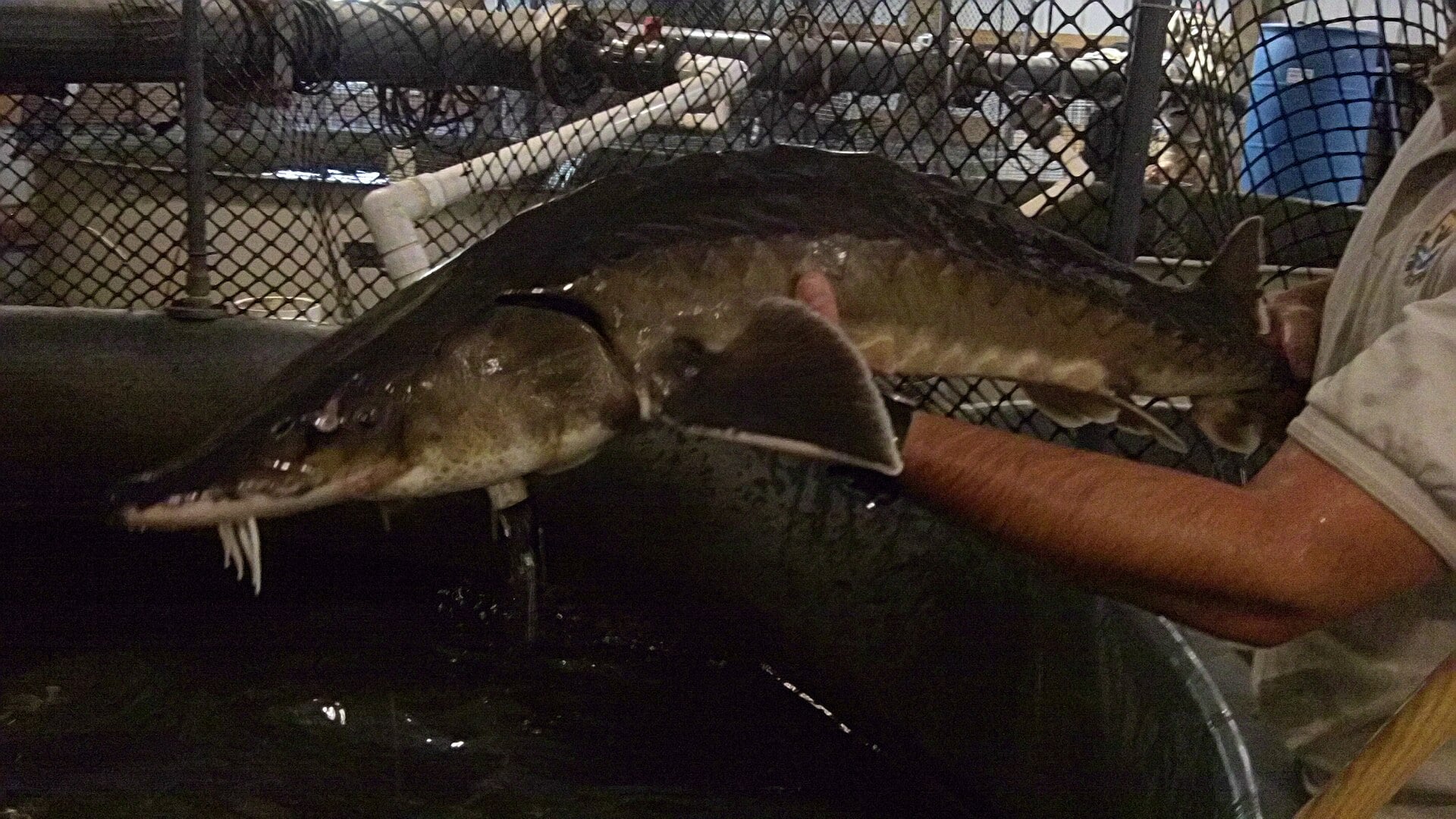
A hand holds a large Atlantic sturgeon above a hatchery tank

A coastwide index of Atlantic sturgeon abundance has been rising steadily since 2013, the Atlantic States Marine Fisheries Commission found in its 2024 stock assessment update, published in August 2024.

The update extends the commission’s 2017 benchmark assessment with data from 2016 to 2022. It combines nine fishery-independent surveys into a single index of relative abundance, which the commission describes as variable from 1990 to 2022.

The composite index had a 100 per cent probability of being above its 1998 value, the year a coastwide moratorium on Atlantic sturgeon fishing took effect, and showed a statistically significant positive trend over the time series. The probability that total mortality exceeded the assessment’s threshold was less than 2 per cent.

Several states had closed their Atlantic sturgeon fisheries in the mid to late 1990s. New York imposed its own statewide moratorium in 1997.

The increase appears as a steady upward trend in the composite index. Most of the nine individual surveys showed either no trend or an increase. The commission still rates Atlantic sturgeon as depleted relative to historic levels, both coastwide and in every regional population it assessed.

That term covers more than the directed fishing that ended in 1998. The commission said the term acknowledges bycatch mortality, ship strikes and reductions in productivity from habitat loss. Bycatch in other fisheries, for which data begin in the 2000s, has generally been decreasing in recent years, the update said, except for estimates from gill nets in the federal observer programme.

Results for individual populations were more mixed. The New York Bight and Carolina indices had average probabilities of 59 per cent and 77 per cent of sitting above their reference year values. The other three populations came in below 50 per cent, with the Chesapeake Bay lowest at 27 per cent. The Gulf of Maine had a 56 per cent probability that total mortality exceeded the threshold.

The Hudson River, part of the New York Bight population, is presumed to be one of the two healthiest Atlantic sturgeon populations in the United States, alongside the Altamaha, according to the New York State Department of Environmental Conservation’s species status assessment for its 2025 State Wildlife Action Plan.

The same document reports that the department has monitored juvenile Atlantic sturgeon in the Hudson since 2004 and built a relative abundance index from fish aged about one to six years. The trends in that survey were initially positive but have declined in recent years, the assessment says.

A New York juvenile survey covering 2004 to 2022 is one of the nine indices in the commission’s coastwide composite. Genetic work on more than 500 juvenile and subadult sturgeon caught at Haverstraw Bay between 2017 and 2022 assigned the majority to the Hudson River population. The commission said this indicates the long-term survey data collected at Haverstraw Bay primarily reflects demographic trends in the Hudson River population.

Earlier estimates cited by the department put the Hudson’s spawning population at about 870 adults a year, against 343 for the Altamaha. A study published in 2020 and cited in the commission’s update used side-scan sonar and acoustic telemetry to estimate the Hudson’s 2014 spawning run at 466 fish, with a 95 per cent confidence interval of 310 to 745.

The commission said that once reported spawning intervals are taken into account, the 2014 estimate appears similar to the earlier total adult population estimate.

Atlantic sturgeon were listed under the Endangered Species Act in February 2012. The New York Bight, Chesapeake Bay, Carolina and South Atlantic populations are designated endangered. The Gulf of Maine population is designated threatened. The species was reported present in 32 US rivers, with spawning in at least 14 of them, according to figures from 1998 cited in the New York assessment.

The Hudson’s Atlantic sturgeon are distinct from the river’s shortnose sturgeon, a separate species. On 27 June 2025 the department announced a study, coauthored by the US Geological Survey, that estimated the Hudson’s shortnose population at nearly 70,000, a figure that does not describe Atlantic sturgeon numbers.

The coastwide moratorium is meant to stay in force until each spawning stock has at least 20 protected year classes, a point the New York assessment says could take 40 years.

Sources:

The post The coastwide Atlantic sturgeon abundance index has risen steadily since 2013, while the Hudson’s own Atlantic juvenile index has declined in recent years. appeared first on Space Daily.
  •  

A buried crater under the town of Ames, Oklahoma, that produces oil and gas was dated to the wrong era by about 100 million years, and its new age of about 370 million years puts it close to a mass extinction that wiped out much of the sea’s life

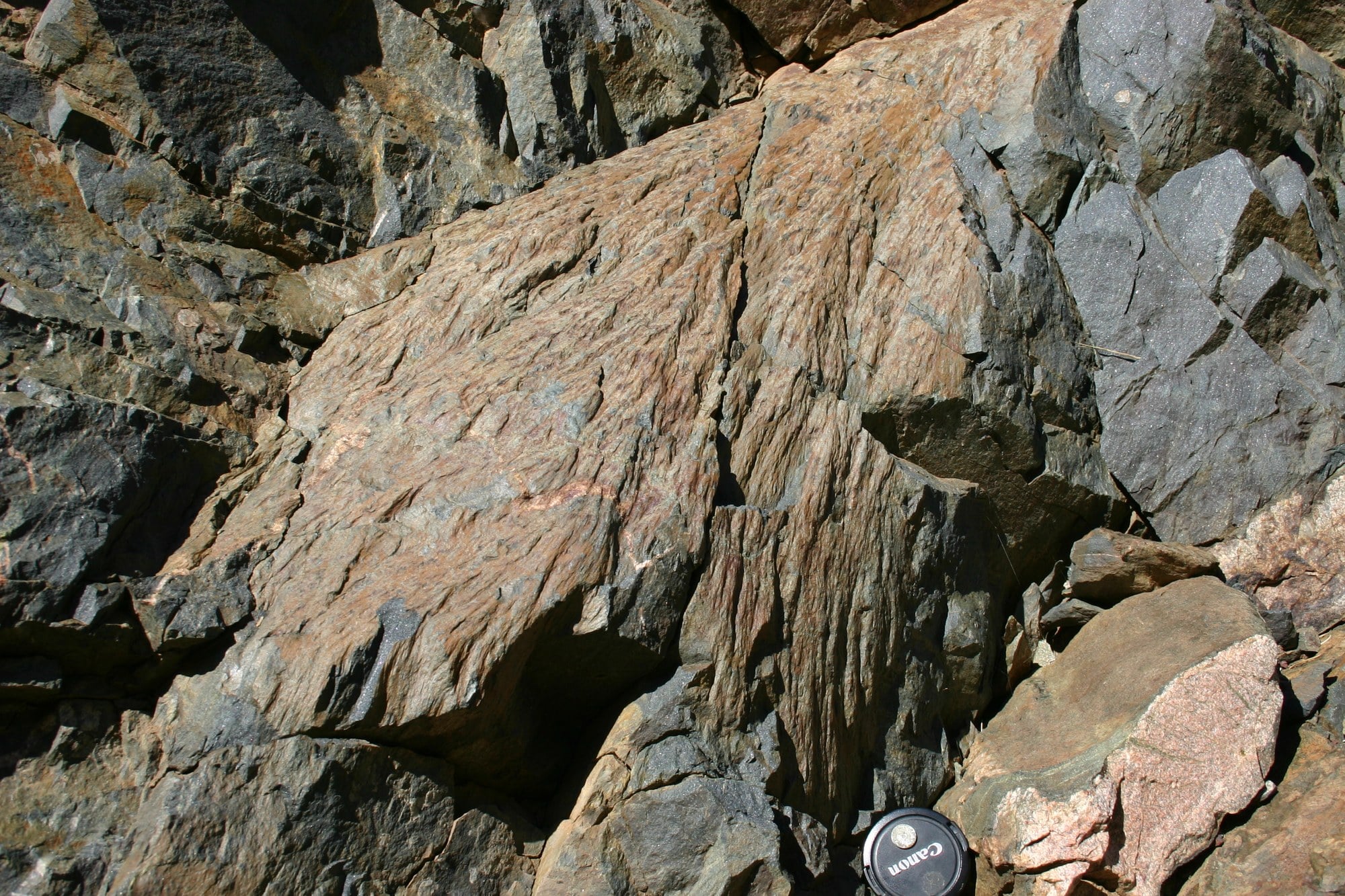
Rock face with ridged, cone-shaped shatter cone fractures in the Santa Fe impact structure, New Mexico

Austin, Texas: A meteorite impact buried under the town of Ames, Oklahoma, struck about 370 million years ago, nearly 100 million years later than previously believed, University of Texas at Austin researchers have found.

The study, published in July 2026 in Meteoritics & Planetary Science as an open access paper, dated zircon crystals from granite struck by the impact. Zircon is a mineral that forms small crystals and is used in uranium-lead dating.

The earlier age of 467 million years placed the impact in the Ordovician period. It was grouped with a series of North American impacts centred around 467.5 million years ago, called the Ordovician Meteor Event, according to a University of Texas press release.

The new date puts Ames in the Late Devonian, close to the Frasnian-Famennian mass extinction about 372 million years ago. The release says that event led to the extinction of a huge percentage of marine life on Earth.

Whether the impact and the extinction are connected remains an open question.

“Our results establish a new hypothesis that the Ames impact is linked to the Late Devonian mass extinction, but they do not demonstrate the causal relationship,” Elizabeth Catlos, lead author and associate professor in the Department of Earth and Planetary Sciences at UT’s Jackson School of Geosciences, said in an email.

“Establishing this connection requires additional evidence, such as finding impact-related material in Late Devonian sedimentary rocks, identifying other impact structures of this age and understanding their environmental consequences,” she said.

Catlos said she had “a high degree of confidence in the age”. It came from two independent radiometric dating approaches, laser ablation and ion-beam methods, applied to zircon grains taken directly from the impacted granite, she said.

For an impact structure, the strongest age constraint comes from dating minerals in the impacted material directly and showing that they record the impact, she said. That is what the team did.

“No matter what technique we used, it was coming back to this younger signal,” Catlos said in the university’s press release. The release says the result means Ames could not have been part of the Ordovician Meteor Event.

Doubts over the fossil date

The old date was biochronological, meaning it came from fossils. Researchers had found teeth of conodonts, eel-like creatures that lived during the Ordovician, in rock from the site. The teeth were probably already millions of years old when the asteroid struck and got jumbled in the impact, Catlos said in the release.

Catlos said in an email that she does not question the identification of the Ordovician conodonts. “The issue is whether they remain in their original stratigraphic position and can therefore reliably date the impact itself,” she said.

The conodont evidence came from a conference abstract and a PhD dissertation, Catlos said. Those sources did not go through the same formal peer review as a journal paper, but they gave the historical basis for assigning an Ordovician age to the structure.

To show the zircons recorded the impact, the team worked with NASA to image the crystals using cathodoluminescence and electron backscatter diffraction, two imaging methods. A zircon hit by an impact recrystallises in a specific way that these methods reveal, the release says.

Danny Stockli, dean of the Jackson School and a co-author, said in the release that uranium-lead dating of zircon is the most accurate way to tell when such events occurred. Microstructures in zircon can also record the shock pressures of impacts, he said.

He said he would like to see the same done for more impact sites across the continent to build a more accurate timeline of these events.

Catlos said in the release that a more accurate timeline for mass extinctions and other big moments in Earth’s history is needed to understand how the planet works. The question is whether such extinctions were driven by an extraterrestrial force or an interior one such as a series of massive volcanic eruptions, she said.

In her email, Catlos said the findings allow researchers to investigate a possible connection that had not been considered before.

The work was begun by Andrew Parisi, a Jackson School graduate student who collected the Ames rock core from the Oklahoma Geological Survey, extracted the zircons and helped date them. He graduated in 2018 and has since died, as has co-author Michael Brookfield. Sean Gulick and Mark Cloos of the Jackson School also contributed.

The Ames impact structure is a major oil and gas producer, the release says. The crater is more than eight miles wide and lies about 20 miles southwest of Enid under 9,000 feet of sediment, according to the American Oil & Gas Historical Society.

It went unrecognised until 1991, when Continental Resources found an oilfield there. Many geologists had believed impact craters were unlikely places for petroleum, the society says.

Sources:

The post A buried crater under the town of Ames, Oklahoma, that produces oil and gas was dated to the wrong era by about 100 million years, and its new age of about 370 million years puts it close to a mass extinction that wiped out much of the sea’s life appeared first on Space Daily.

  •  
❌