❌

Reading view

Taction solicita indenização e pagamento de juros em processo contra a Apple

E a novela do processo entre a Taction e a Apple continua: depois de a Maçã tentar anular a condenação de US$5,7 bilhões por violação de patentes, a empresa requerente pede agora uma indenização adicional pelas vendas de iPhones e Apple Watches realizadas desde março de 2026.

Em uma petição protocolada em nome da Taction (e reportada pela Reuters), a empresa argumentou que o valor da decisão contempla apenas as vendas realizadas pela Apple entre 2021 e março de 2026, e pediu um valor adicional pelas vendas posteriores a esse período.

Além disso, os advogados da Taction pediram a concessão de juros anteriores ao julgamento com base na taxa legal prevista na legislação da Califórnia (cerca de 7% ao ano, o que pode somar algumas centenas de milhões de dólares à indenização), pois, de acordo com a Taction, “o valor da indenização determinada pelo júri não é motivo para negar o pagamento de juros”.

Iniciado em 2021, o processo movido pela Taction alegava que a tecnologia Taptic Engine (presente nos iPhones e Apple Watches) infringia as patentes da empresa, e que a Apple se apossou das invenções da empresa sem autorização ou negociação prévia.

Além de solicitar a anulação do veredito do júri, a Apple afirmou que pretende recorrer da decisão.

via 9to5Mac

  •  

For the first time, artificial intelligence is a top 10 fear in the U.S.

It’s official—artificial intelligence is one of the top 10 fears in the United States. Well, it’s technically two of the top 10 fears, according to the 12th annual Chapman University Survey of American Fears.

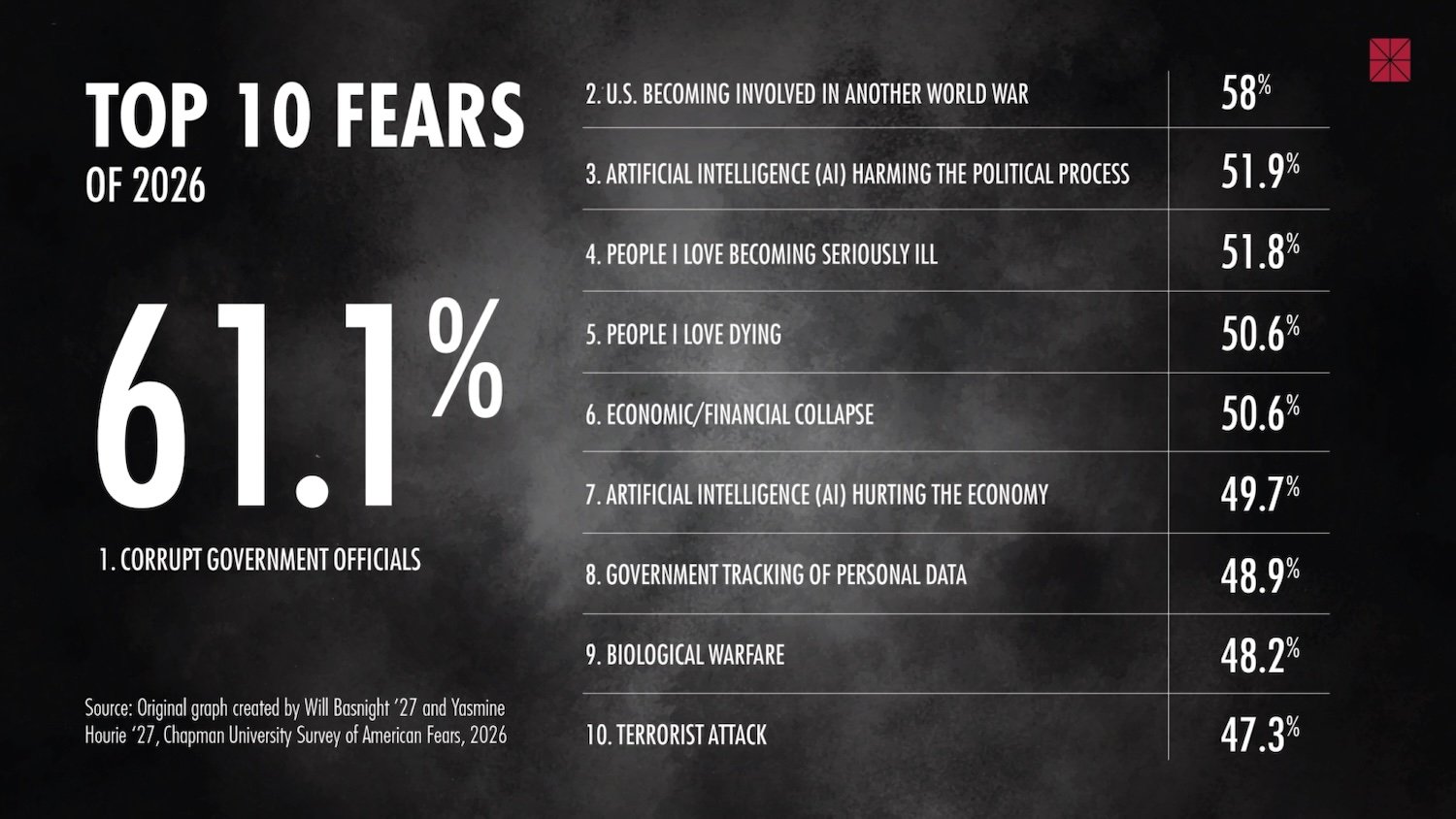
First conducted in 2014, the recurring questionnaire tracks yearly anxiety trends that often range from everyday concerns to existential terrors. This year, 61.1 percent of over 1,200 respondents once again cited “corrupt government officials” as their biggest fear—the same subject was last year’s number one entrant as well as its 11th year on the list. After that, it’s the fear of another world war (51.9 percent). However, “AI harming the political process” wasn’t too far behind for third place at 51.9 percent. The technocentric worry is now essentially tied with the fear of loved ones becoming gravely ill (51.8 percent).

Illustration of 2026 fear survey results listing the top ten answers. Corrupt government officials is first place, followed by the US entering World War III, then AI harming political process
Government corruption is once again at the top of the list. Credit: Chapman University

That said, the survey’s own plus or minus 3.79 percentage point margin of error complicates the results a bit. Taking the margin of error into consideration, it’s a tossup when trying to definitively rank the list’s third through tenth fears. Regardless, about 49.7 percent survey takers are also anxious about AI negatively impacting the economy—a double dose of AI-centric woes for the first time in the survey’s history. It’s also the first year researchers at Chapman University in California included questions about AI, but they made it clear it likely won’t be the last.

“As artificial intelligence becomes more integrated into everyday life, understanding these fears will be increasingly important,” said Chapman University sociologist and survey creator Christopher Bader. “We expect concerns about AI to remain a significant part of the national conversation in the years ahead.”

It’s understandable why AI currently vexes so many people. The blanket term now encompasses everything from photorealistic fake images, to dubious search engine chatbots, to nebulous doomsday warnings. Despite these worries, the AI industry’s biggest threats arguably remain the rampant spread of misinformation, coupled with a lack of meaningful regulations or oversight.

But no matter your top technological fear, survey organizers still believe the annual report highlights a very relatable human emotion.

“What I’m seeing more and more over time is that our fear about our loved ones is going to always be there, no matter what’s going on in the world,” said sociologist Ashley Kranjac, director of Chapman University’s Earl Babbie Research Center.

The post For the first time, artificial intelligence is a top 10 fear in the U.S. appeared first on Popular Science.

  •  

This robot exists solely to bounce ping-pong balls

In a world where tech leaders are racing to build autonomous machines that can do almost anything, one hobbyist is going the complete opposite route: an over-engineered  robot that does exactly one thing and one thing only. 

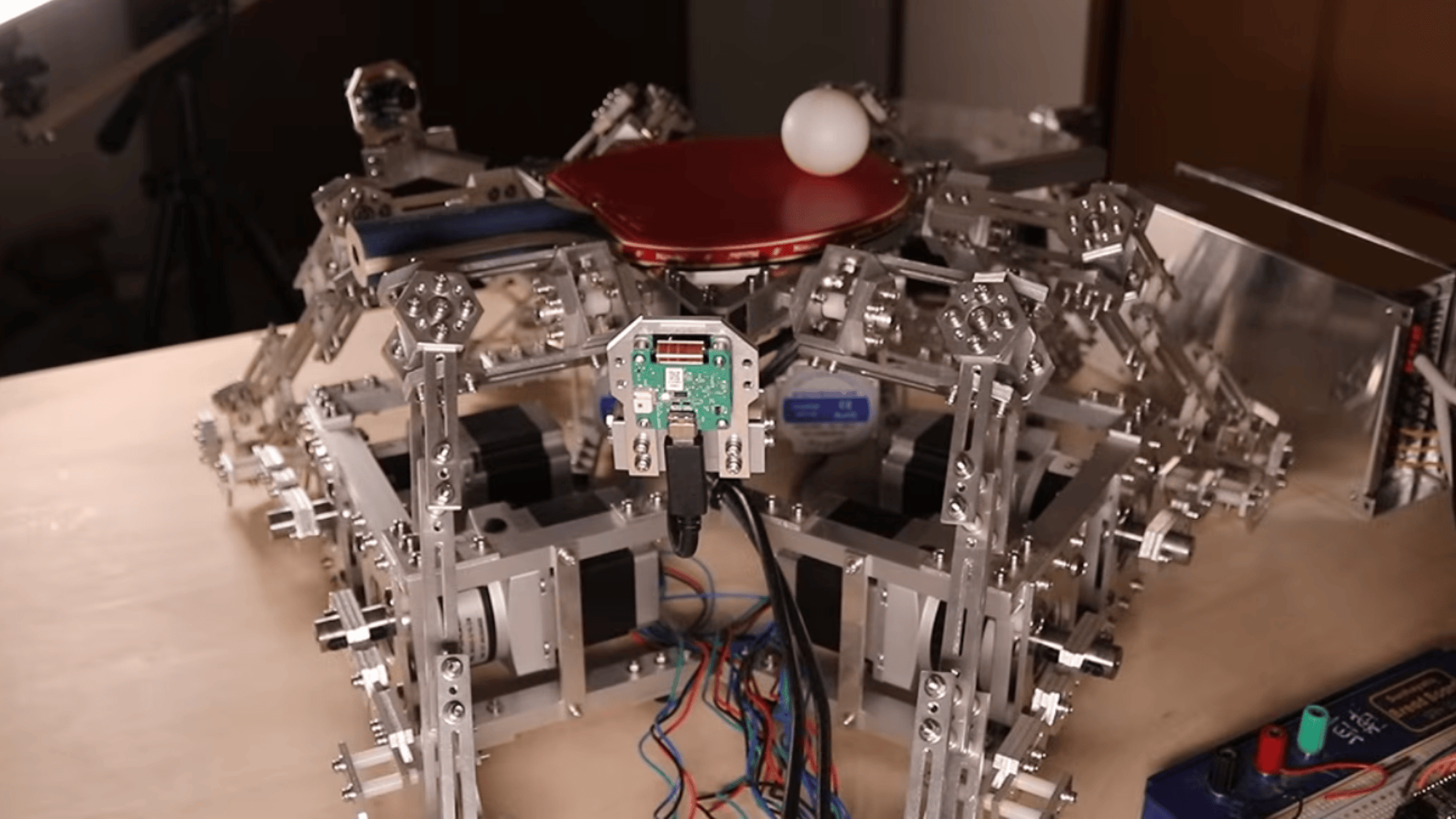
T-Kuhn’s Hexa-Bouncer only bounces a ping-pong ball, but looks like it’s capable of far more. The six-armed, metal machine was first designed  in a simulated environment and then brought to life with a CNC milling machine. Custom-built joints let it rise, fall, and tilt, and even bob up and down while tracing a circle. A pair of cameras, set 120 degrees apart, track the ball’s position and send that data to a computer over USB. The computer then builds a 3D picture of the scene, then calculates when the paddle should strike the ball and at what angle. All of this happens in a fraction of a second.

Hexa-Bouncer keeps balls in the air remarkably well. In a video, Kuhn holds a ping-pong ball above his creation, and the machine moves up and down in sync with his hand. When he drops the ball, the robot immediately reacts, striking it back into the air and keeping it aloft bounce after bounce, all the while making small adjustments. After a few more bounces, the device eases off its swing and the ball starts bouncing lower and lower. It’s unclear exactly how long Hexa-Bouncer can keep the ball in the air, it never misses—at least in the video posted online.. 

Kuhn describes his ball juggler as the latest in a series of, “useless but mildly interesting ball bouncing machines.” Prior to this, he released his Octo-Bouncer, a similar design that keeps a ping-pong ball bouncing in the air using a four-sided flat plate. Some might say all this over-engineered ball bouncing is unnecessary, but Kuhn would disagree. For him, solving the design puzzle is a journey in itself. 

“Building a thing like this is like bashing your way through a jungle,” he said. “It’s an adventure. You’re not completely sure if you can make it through or not, and that’s exactly why you do it.”

The post This robot exists solely to bounce ping-pong balls appeared first on Popular Science.

  •  

New comet accidentally discovered by space telescope

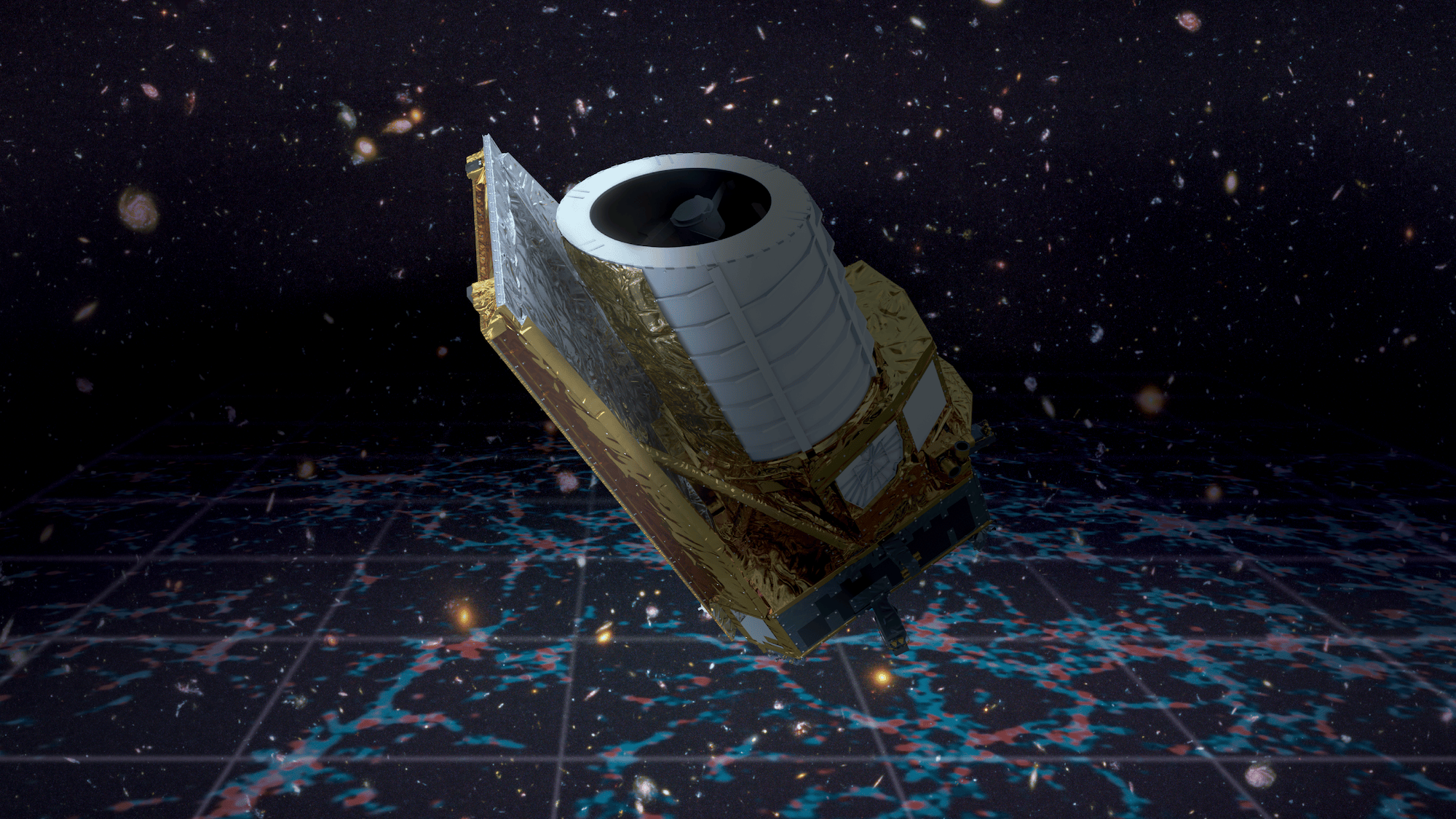
Launched in 2023, the European Space Agency’s (ESA) Euclid space telescope observes some of the most distant regions of the visible universe for signs of dark matter and dark energy. But even while focused on the “big picture,” Euclid’s onboard equipment is surprising astronomers by capturing tiny photobombers like errant comets.

Its recent portraits of one specific dusty space rock are especially impressive, however. Euclid spotted a never-before-seen comet sailing through space more than 807.7 million miles from Earth. The telescope isn’t designed to automatically flag an image interloper. Instead, the bright blemish seen in multiple images was spotted by a moving object detection program designed by Mikko Pöntinen, an astronomer at the University of Helsinki in Finland.

“I was excited to see my software flag a ‘streak’ smeared across several images—the result of a fast-moving object,” said Pöntinen. “Further inspection revealed that it had a fuzzy cloud around it, indicative of an active object like a comet that is shedding dust and gas.”

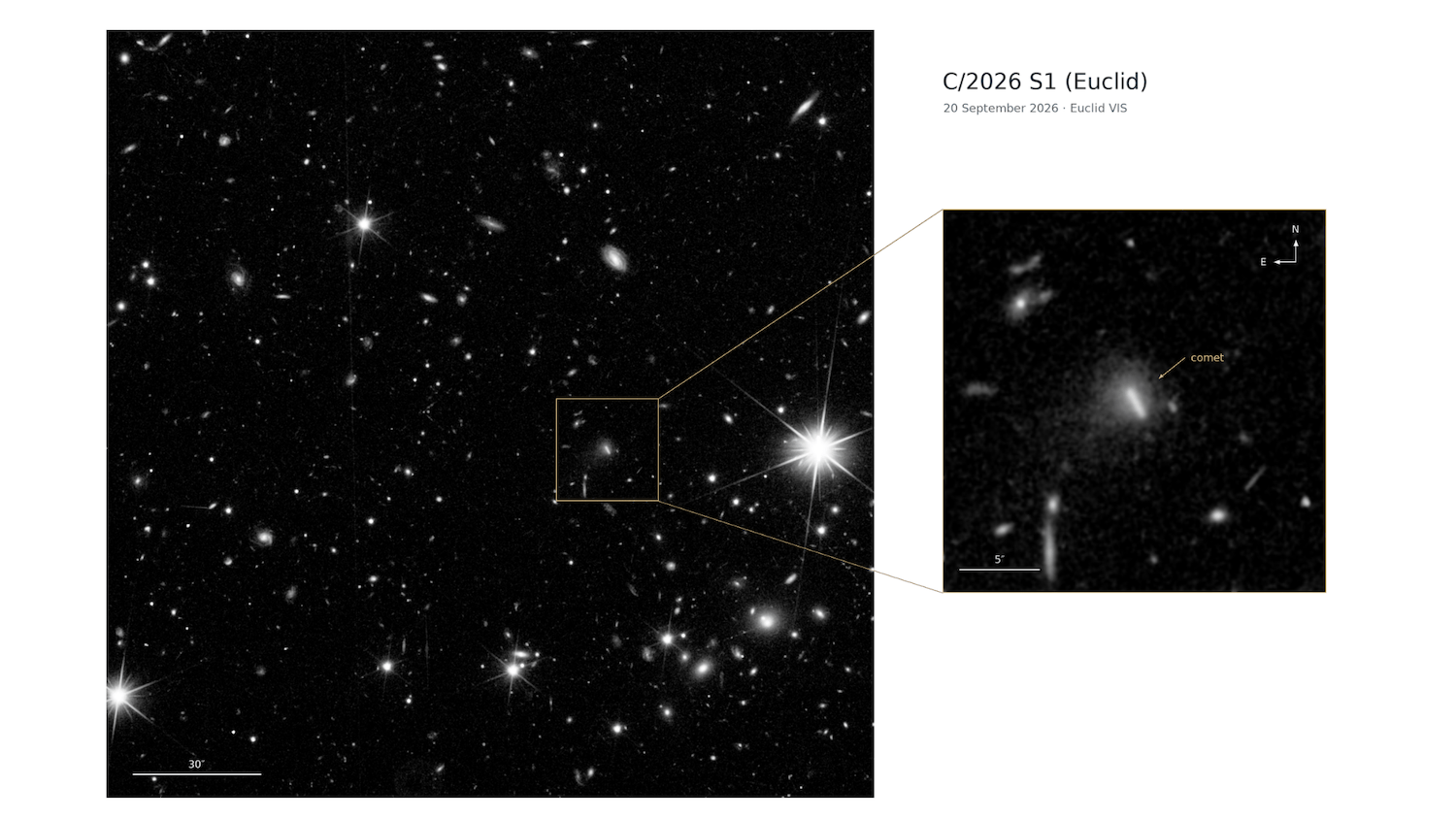
A black-and-white Euclid image shows a sky field filled with bright points and faint fuzzy light sources on a dark background. A boxed region is enlarged in an inset, where comet C/2026 S1 (Euclid) is marked by an arrow. The comet appears as a bright elongated streak surrounded by a diffuse cloud of light. Lines connect the inset to the comet’s location in the wider image.
Comet C/2026 S1 (Euclid) seen in a wide VIS image for context (left), with a zoom in (right). Credit: ESA/Euclid/Euclid Consortium/NASA, M. Pöntinen et al. 2026

Pöntinen quickly relayed his findings to the International Astronomical Union’s Minor Planet Center (MPC), which then passed the news along to researchers around the world. On October 8, the MPC confirmed the newly discovered comet, which is now classified C/2026 S1 (Euclid).

C/2026 S1 was seen from five different fields of view over multiple days in the Euclid Deep Field North region of the telescope’s scans. Astronomers now know the comet’s trajectory isn’t located on the same horizontal plane as the planets. Instead, its path is technically taking it over the solar system along a multi-thousand-year orbit.

Euclid’s discovery is particularly striking because the telescope’s six-year mission is specifically mapped to avoid areas of the sky that are laden with comets and asteroids.

“Very few comets are expected to be discovered by Euclid, so it was a happy coincidence,” added Euclid archive scientist Bruno Altieri.

The post New comet accidentally discovered by space telescope appeared first on Popular Science.

  •  
❌