❌

Reading view

When is solar desalination worth it?

Desalination is used to produce fresh drinking water from seawater, but it also generates a highly concentrated waste stream known as brine. Disposing of this brine is a major challenge and is often achieved through deep-well injection, in which the waste is pumped underground, an approach that can be expensive. Oil and gas production creates similarly saline wastewater, which is often managed in the same way.

In this work, the researchers developed a modelling platform to evaluate different strategies for managing these waste streams and to determine whether it is more cost effective to dispose of brine or to treat it further and recover additional water using solar-powered technologies. They applied the framework to two case studies: the Kay Bailey Hutchison Desalination Plant in Texas, a large inland desalination facility, and produced water from the Permian Basin, one of the most productive oil-producing regions in the United States.

The study compared a range of desalination technologies, including reverse osmosis, which uses membranes to separate water from dissolved salts, and thermal desalination methods that use heat to evaporate and recover water. Solar technologies included photovoltaic panels that generate electricity and solar thermal systems that provide heat. The researchers found that for desalination brine, the most cost-effective solar-powered option was photovoltaic combined with reverse osmosis, while solar-thermal desalination remained relatively expensive because of the cost of solar collectors and heat storage. For highly saline oilfield wastewater, zero-liquid-discharge systems, which recover almost all of the water and leave behind solid salts, could be economically attractive because they reduce or eliminate costly brine disposal.

More broadly, the findings suggest that renewable energy could help make desalination and wastewater treatment more sustainable, particularly in water-stressed regions. By identifying cost-effective ways to increase water recovery and reduce brine disposal, the work could support wider water reuse and potentially enable valuable minerals to be recovered from waste streams rather than discarded.

Do you want to learn more about this topic?

Energy efficiency and renewable energy utilization in desalination systems by Veera Gnaneswar Gude and Vasilis Fthenakis (2020)

The post When is solar desalination worth it? appeared first on Physics World.
  •  

A new route to spin-controlled photonics

When a material does not have inversion symmetry, particles within it will move in different directions when they have different spin states. This is because the asymmetry of the material creates an effective electric field that couples the particles’ spin and momentum. The behaviour is called the Rashba effect, and it allows researchers to manipulate electron spins without requiring a magnetic field.

Surface plasmons are waves of oscillating electrons that travel along a metal surface when it interacts with light. In this work, the researchers investigated surface plasmons to see if they could create something like the Rashba effect but in a completely symmetrical material. To do this, they shone polarized light onto a periodic gold nanostructure (a plasmonic crystal) and measured how the resulting plasmon modes behaved, comparing what happened for left- and right-circularly polarized light.

They observed that differently polarized light caused the plasmon modes to split according to the light’s spin (polarization), mimicking Rashba spin splitting. Instead of being caused by the lack of symmetry in the material, the tightly focused light interacts with the anisotropic gold grating. The gold grating has lines running in one direction, meaning that light polarized along the grating lines behaves differently from light polarized across them. When light is tightly focused, its polarization is no longer identical everywhere, so the light experiences different combinations of birefringence and dichroism depending on its propagation direction. This creates a geometric phase gradient that gives left- and right-circularly polarized light opposite momentum shifts, causing the observed spin splitting. The researchers describe this mechanism as a geometric linear birefringence-linear dichroism effect.

The findings show that Rashba-like spin splitting does not necessarily require structural asymmetry and suggest that researchers may be able to achieve spin-controlled optical behaviour using simpler symmetric metasurfaces rather than increasingly complex asymmetric nanostructures.

Read the full article

Rashba-like spin splitting in inversion symmetric plasmonic metasurface

Sujit Rajak et al 2026 Rep. Prog. Phys. 89 070501

Do you want to learn more about this topic?

Quantum transport in Rashba spin–orbit materials: a review by Dario Bercioux and Procolo Lucignano (2015)

The post A new route to spin-controlled photonics appeared first on Physics World.

  •  

Turning disorder into a resource for wave control

When waves travel through complex environments (such as acoustics), repeated scattering is usually a problem because it scrambles wavefronts and distorts the information they carry. As a result, most approaches seek to suppress or compensate for scattering. In this work, however, the researchers take the opposite approach and show that scattering itself can be harnessed to manipulate waves.

The challenge is to design a disordered medium so that multiple scattering produces a desired outcome. This is difficult because the scattering matrix, which describes how waves are transformed by the medium, depends sensitively on the positions of many individual scatterers. Finding a configuration that performs a target operation can therefore be like searching for a destination in a vast landscape. The researchers used a mathematical tool known as the generalized Wigner-Smith operator, which reveals how small changes in scatterer positions modify the scattering matrix. In effect, it acts as a local map of the design landscape, guiding the system toward target unitary transformations while maintaining near-perfect transmission.

The team demonstrated the concept using an acoustic waveguide containing eighty metallic cylinders. By carefully arranging the scatterers, they controlled how different waveguide modes were converted into one another, enabling operations known as braiding. Similar to weaving strands in a braid, braiding exchanges modes in a prescribed sequence. A particularly striking example is non-Abelian braiding, where changing the order of those exchanges produces different outcomes. Such order-dependent operations are of great interest in topological quantum computing and can also manipulate information encoded in classical waves. The researchers demonstrated this behavior experimentally using a compact multiple-scattering medium only a few wavelengths thick, avoiding the long structures required in previous wave-based braiding schemes.

The significance of the work extends well beyond braiding. The same design principle can realize a broad range of unitary transformations, suggesting that complex media can be programmed to process information carried by waves rather than simply transmit it. Although practical implementations will still face challenges such as loss, bandwidth, and fabrication constraints, the work offers a new way of thinking about disorder. Instead of treating scattering as an obstacle to overcome, researchers may be able to harness it as a resource to build compact, reconfigurable devices for communications, imaging, signal processing, and wave-based computation.

Read the full article

Tailoring reflectionless complex media for non-Abelian braiding of acoustic modes

Hongkuan Zhang and Guancong Ma 2026 Rep. Prog. Phys. 89 088001

Do you want to learn more about this topic?

Non-local and non-Hermitian acoustic metasurfaces by Xu Wang, Ruizhi Dong, Yong Li and Yun Jing (2023)

The post Turning disorder into a resource for wave control appeared first on Physics World.

  •  

Faster fabrication, better performance for PCECs

Protonic ceramic electrochemical cells (PCECs) function as fuel cells, converting hydrogen into electricity, or as electrolysers, where electricity is used to split water into hydrogen and oxygen. This makes them useful in hydrogen energy systems because surplus electricity from integrated energy sources like nuclear, hydropower and geothermal can be converted into hydrogen, stored, and later converted back into electricity. Inside PCECs, two electrodes are separated by a ceramic electrolyte that controls the movement of hydrogen ions, which are protons.

Unfortunately, manufacturing the proton-conducting ceramic electrolyte layer is cumbersome. Long processing times involve multiple steps, including intensive ball-milling and high-temperature sintering, making protonic ceramics expensive to produce. In this work, the researchers investigated how PCECs could be manufactured more affordably, more rapidly and with better performance.

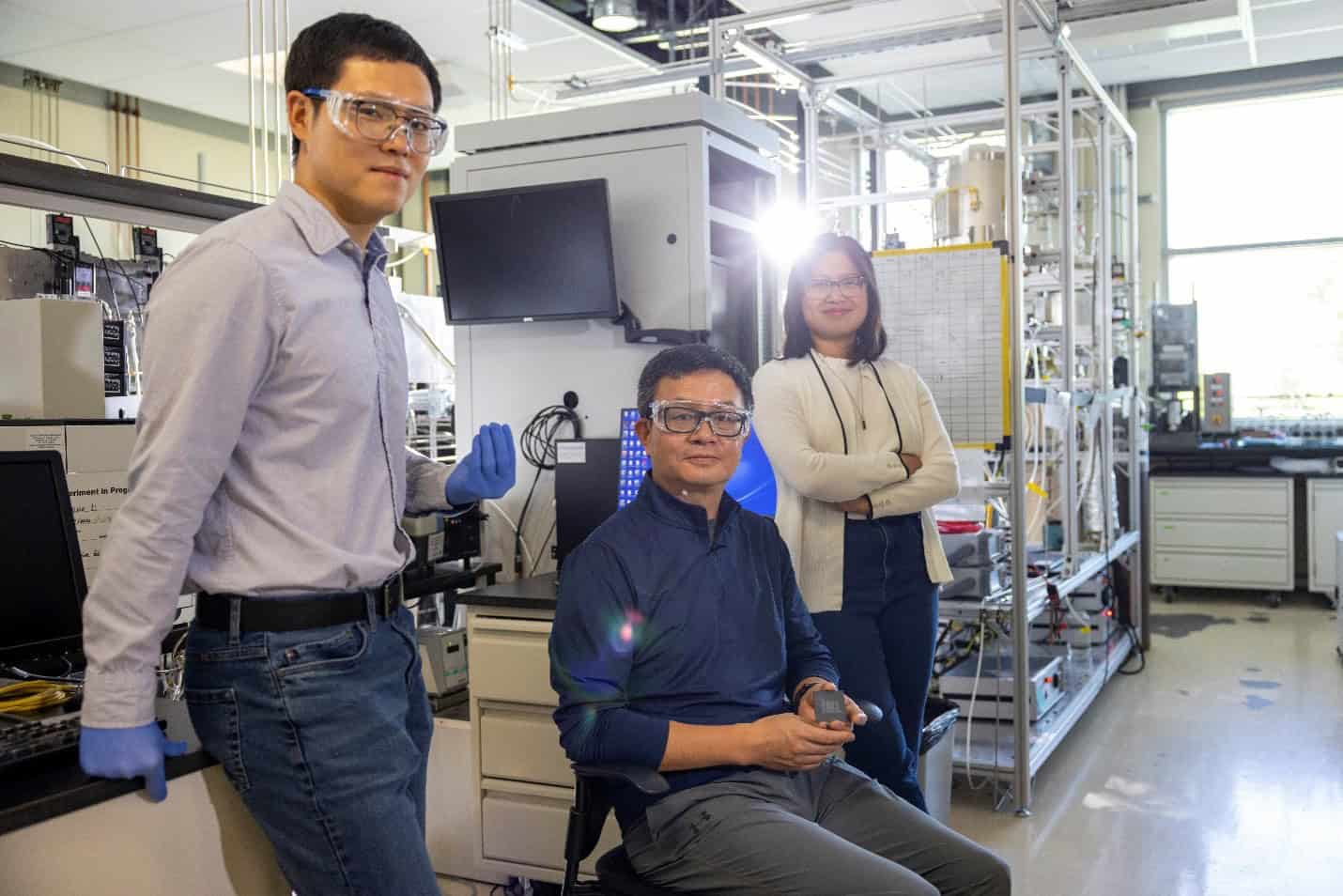
From left to right: Wei Tang, Dong Ding, and Wenjuan Bian, with a 5 cm × 5 cm protonic ceramic electrochemical cell fabricated using the team's new n-SSR method.
From left to right: Wei Tang, Dong Ding, and Wenjuan Bian, with a 5 cm × 5 cm protonic ceramic electrochemical cell fabricated using the team’s new n-SSR method. (Courtesy: Dong Ding/Idaho National Laboratory)

Instead of using larger precursor particles and grinding them for many hours, they started with nano-sized precursor powders. This enabled them to remove the ball-milling step entirely and reduce production time from 85 hours to 33 hours. In addition, it produced a finer electrolyte powder whose smaller particles packed together and sintered more easily, allowing the ceramic to become dense at temperatures around 100 °C lower than those required by the conventional method. The resulting electrolytes had lower electrical resistance, improving cell performance.

Compared with cells made using the conventional synthesis method, the new cells delivered up to 32% higher peak power density in fuel cell mode and 40% higher electrolysis current density at 600 °C, while maintaining stable operation for more than 500 hours. The process also reduced estimated electrolyte-powder fabrication costs by 25-29% and was successfully demonstrated in larger-area cells. This work could help accelerate the deployment of protonic ceramic electrochemical technologies for hydrogen production and energy conversion.

Do you want to learn more about this topic?

Focus on Protonic Ceramics: A Promising Class of Materials for Energy Conversion and Storage – Guest Editors: Sandrine Ricote and Aayan Banerjee

The post Faster fabrication, better performance for PCECs appeared first on Physics World.

  •  

Using quantum entanglement to probe hidden properties of quarks

A quark is a fundamental building block of matter. There are six types known as flavours of quark: up, down, strange, charm, bottom, and top. Quarks combine to form particles known as hadrons. Most ordinary matter is made from up and down quarks, for example, a proton consists of two up quarks and one down quark, while a neutron consists of one up quark and two down quarks. Electrons belong to a different family of particles called leptons and are not made of quarks.

Particle physicists continuously test the Standard Model of particle physics to search for signs of new phenomena. One possibility is that quarks possess anomalous magnetic or electric dipole moments, which would indicate physics beyond the Standard Model. However, quarks are never observed in isolation because they are confined inside particles such as protons and neutrons.

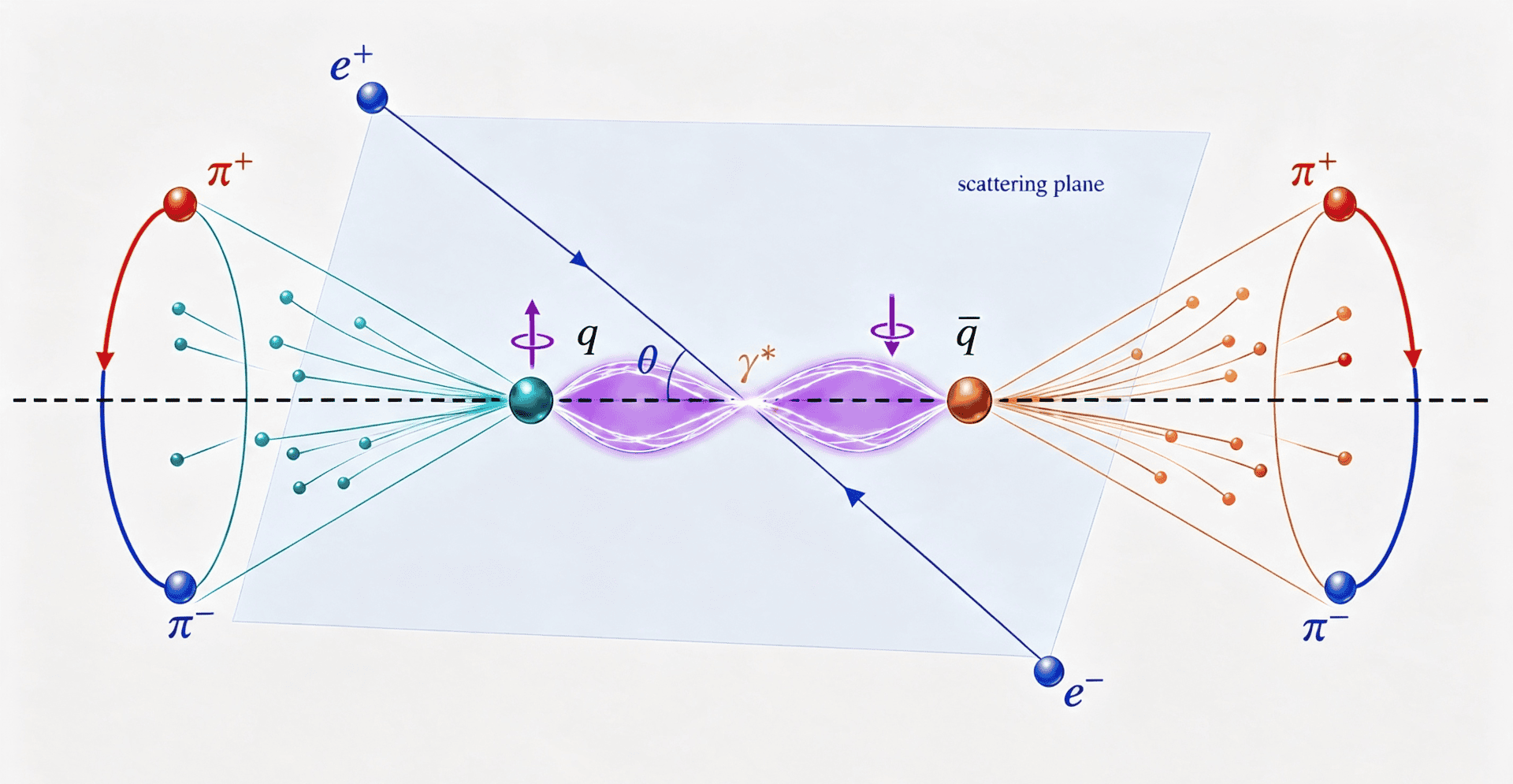
Schematic of the entanglement-based probe for quark electromagnetic dipole interactions
Schematic of the entanglement-based probe for quark electromagnetic dipole interactions. An electron-positron collision produces an entangled quark-antiquark pair. Anomalous magnetic or electric dipole interactions modify the spin correlation of the pair to be opposite orientation, leading to distinct azimuthal angular distributions of the fragmented hadrons. (Courtesy: Xin-Kai Wen/Chinese Academy of Sciences)

In this work, the authors study electron-positron collisions, which can produce quark-antiquark pairs. These quarks subsequently fragment into hadrons. By analysing the directions in which the hadrons emerge, information about the spins of the original quarks can be reconstructed. The authors show that anomalous magnetic or electric dipole interactions would modify the quantum-entangled spin state of the quark-antiquark pair in a characteristic way, producing either a spin-triplet state (for magnetic dipole interactions) or a spin-singlet state (for electric dipole interactions). These changes lead to measurable signatures in the angular distributions of the resulting hadrons. Rather than searching for an excess of events, the method probes changes in the spin-correlation structure of the quark-antiquark system.

The work introduces a new entanglement-based approach for probing the electromagnetic properties of light quarks. By connecting quantum spin correlations in hadron production with possible quark dipole interactions, it provides a complementary method for searching for physics beyond the Standard Model using collider data.

Read the full article

Probing quark electromagnetic properties via entangled quark pairs in fragmentation hadrons at lepton colliders

Qing-Hong Cao et al 2026 Rep. Prog. Phys. 89 080501

Do you want to learn more about this topic?

The sea of quarks and antiquarks in the nucleon by D F Geesaman and P E Reimer (2019)

The post Using quantum entanglement to probe hidden properties of quarks appeared first on Physics World.

  •  

Finding the signatures of chiral spin liquids

In magnets, the magnetic moments of electrons, known as spins, usually align in an ordered pattern. However, in a spin liquid, the spins never settle into a fixed arrangement. Instead, they continue to fluctuate collectively even at very low temperatures. In a chiral spin liquid, these fluctuations have a preferred handedness, similar to the difference between left and right hands or clockwise and anticlockwise rotation.

This research focuses on the pyrochlore lattice, a three-dimensional structure made of interconnected tetrahedra. Because of this geometry, the spins cannot all simultaneously satisfy their preferred interactions, making the system “frustrated”. This frustration can prevent conventional magnetic order and create the conditions needed for spin-liquid behaviour.

The researchers classified all possible chiral spin-liquid states allowed by the symmetries of the pyrochlore lattice. They then built theoretical models and performed simulations to predict how these states would appear in experiments. One unusual feature of spin liquids is that the collective motion of the spins can behave as if it creates emergent gauge fields, which resemble electromagnetic fields. The researchers found that some chiral spin liquids are dominated by these emergent gauge fields, while others are influenced more strongly by the spin-like excitations themselves.

The researchers showed that different chiral spin liquids have distinct signatures, providing a way to distinguish them experimentally. Their results offer a roadmap for identifying and classifying elusive three-dimensional chiral spin liquids in real materials.

Read the full article

Classification and correlation signatures of chiral spin liquids on the pyrochlore lattice

Chunxiao Liu et al 2026 Rep. Prog. Phys. 89 078003

Do you want to learn more about this topic?

Dynamical quantum phase transitions: a review by Markus Heyl (2018)

The post Finding the signatures of chiral spin liquids appeared first on Physics World.

  •  

Exploring efficiency and durability in fuel cell catalysts

An important low-carbon technology is the hydrogen fuel cell, which can be used in vehicles, backup power systems and other applications. Fuel cells convert hydrogen into electricity, producing only water as a by-product. A key process inside the cell is the oxygen reduction reaction, in which oxygen from the air is reduced at the cathode. This reaction is relatively slow and is one of the main factors limiting fuel-cell performance.

To speed up this step, platinum catalysts are used. While highly effective, platinum is expensive and gradually degrades during operation. Much research therefore focuses on reducing the amount of platinum required while improving performance and catalyst lifetime. One approach is to use platinum alloys, where a cheaper metal is mixed with platinum to improve efficiency. However, these alloying metals can gradually leach out, causing the catalyst to lose activity over time.

In this work, the researchers aimed to address the trade off between catalytic activity and long-term durability by investigating two alloy catalysts, platinum-copper (PtCu) and platinum-iron (PtFe). These were attached to a two-dimensional material, similar to graphene, called a MXene, which can improve performance while helping to hold the nanoparticles in place and enhance their stability. PtCu/MXene showed the highest catalytic activity, as copper modifies the platinum surface to improve oxygen reduction and accelerate the reaction. PtFe/MXene was less active but more durable, with strong Fe-O-MXene interactions helping to stabilise the catalyst during long-term operation.

By using in-situ X-ray spectroscopy, the researchers were able to observe the catalysts during operation and identify the structural and electronic changes responsible for their performance. This revealed how alloy composition and catalyst supports influence activity and durability, the study provides a roadmap for developing improved catalysts for future fuel cells.

Do you want to learn more about this topic?

Catalyst designing strategies for electrochemical CO2 reduction: a perspective by Shreya Sarkar and Sebastian C Peter (2022)

The post Exploring efficiency and durability in fuel cell catalysts appeared first on Physics World.

  •  

Graviton modes survive on the lattice

In some materials, when many electrons interact very strongly, they behave collectively like a quantum fluid with unusual properties. One example is a Fractional Quantum Hall state, which occurs in a two-dimensional system under a strong magnetic field. In this state, the electrons form a topologically ordered quantum fluid that supports unusual collective excitations.

A Fractional Chern Insulator aims to recreate the same type of physics without requiring such a strong magnetic field. Instead, the crystal lattice and electronic band structure are engineered to mimic the effects of the magnetic field.

The electron fluid has an internal geometric structure that describes how electrons are correlated with one another. When this internal geometry oscillates collectively, it produces a special excitation known as a graviton mode.

In this work, the authors developed new mathematical tools and performed large-scale computer simulations to search for graviton modes in lattice-based systems. They then smoothly transformed a known Fractional Quantum Hall state into a Fractional Chern Insulator and showed that the graviton mode persists throughout the transition.

Graviton modes were already known to exist in Fractional Quantum Hall systems and have recently been observed experimentally. However, it was unclear whether they could survive in a Fractional Chern Insulator because the crystal lattice breaks some of the symmetries that are thought to protect these excitations.

Min Long from Meng’s research group at the University of Hong Kong and Zeno Bacciconi from Dalmonte’s group at the ICTP, Università di Bologna.
Min Long from Meng’s research group at the University of Hong Kong and Zeno Bacciconi from Dalmonte’s group at the ICTP, Università di Bologna. Picture taken by Cheng Huang during Zeno’s visit in Hong Kong. (Courtesy: Dalmonte/Università di Bologna)

The authors found that graviton modes do survive on the lattice. They showed that the Fractional Chern Insulator graviton is not a completely new excitation, but is continuously connected to the graviton found in Fractional Quantum Hall systems. They also found that the graviton decays much more slowly than many researchers expected, meaning it remains a well-defined excitation. Finally, the work suggests that graviton modes could provide a valuable experimental signature for identifying exotic topological phases such as Fractional Chern Insulators.

“It is remarkable how geometric excitations can govern the behavior of inherently discrete lattices, demonstrating unexpected universal features of topological quantum matter.“ – Zi Yang Meng, The University of Hong Kong, and Marcello Dalmonte, Università di Bologna.

Read the full article

Chiral graviton modes in fermionic fractional Chern insulators

Min Long et al 2026 Rep. Prog. Phys. 89 078001

Do you want to learn more about this topic?

Fractional charge and fractional statistics in the quantum Hall effects by D E Feldman and Bertrand I Halperin (2020)

The post Graviton modes survive on the lattice appeared first on Physics World.

  •  

Most comprehensive study yet of the Higgs boson at CMS

The Higgs boson is associated with the Higgs field, which gives many fundamental particles their mass. Although it was predicted in the 1960s, it was not discovered until 2012. Since then, researchers have been studying whether the Higgs behaves exactly as predicted by the Standard Model of particle physics or whether it shows signs of physics beyond the Standard Model. This involves measuring how often Higgs bosons are produced, how they are produced, what they decay into, and how they interact with other particles.

In this work, the researchers combined measurements from proton-proton collisions recorded between 2016 and 2018 by the CMS experiment. These collisions can produce Higgs bosons, but such events are rare, so a huge dataset was needed. The study used 138 fb-1 of data, representing an enormous sample of proton-proton collisions on which to perform measurements of the Higgs. The researchers examined many Higgs decay channels, including decays into photons, bosons, and leptons. They also searched for invisible Higgs decays, in which the Higgs would produce undetectable particles such as dark matter candidates, and studied rare off-shell Higgs production, where the Higgs is produced as a virtual state with a mass different from its physical mass.

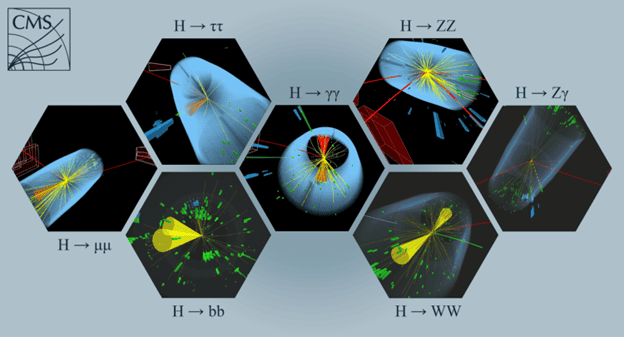
A display of a collision event from each of the Higgs boson decay channels included in this measurement.
A display of a collision event from each of the Higgs boson decay channels included in this measurement. (Courtesy: CMS collaboration)

The researchers found that, with the current experimental precision, the Higgs boson behaves as predicted by the Standard Model. They measured an overall Higgs signal strength of 1.01 ± 0.05, where a value of 1 represents perfect agreement with the Standard Model. The result is therefore fully consistent with theoretical expectations. Many theories that extend the Standard Model predict that undiscovered particles or forces could subtly alter how the Higgs boson is produced or how it decays. Because the CMS measurements agree with Standard Model predictions, there is currently little evidence for such effects, significantly constraining many proposed theories of new physics.

This study provides the most comprehensive test of the Higgs boson to date using data from the CMS experiment. By narrowing the range of possible deviations from the Standard Model, it helps guide future searches for new physics at the Large Hadron Collider and other particle physics experiments.

“It is amazing to see how far we have come in just over a decade since discovery. We are now able to measure the Higgs boson production rate at the LHC with a 5% precision, confirming our theories regarding the origin of mass in the Universe.” –  Dr Jonathon Langford from Imperial College London, a lead analyst for this paper.

Do you want to learn more about this topic?

Prospects for Higgs physics at energies up to 100 TeV by Julien Baglio, Abdelhak Djouadi and Jérémie Quevillon (2016)

The post Most comprehensive study yet of the Higgs boson at CMS appeared first on Physics World.

  •  

Producing hydrogen, electricity and freshwater with one reactor

The majority of hydrogen comes from natural gas, produced in a process called Steam Methane Reforming. Even though this process is relatively cheap, it has the downside of producing significant amounts of the greenhouse gas carbon dioxide. Alternatively, hydrogen can be made by splitting water, a process that requires electricity for electrolysis and therefore another energy source, as well as large supplies of water. There is an ongoing desire for low-carbon electricity, clean hydrogen for industry (e.g. steel manufacturing, fertiliser manufacturing and heavy transport), and greater freshwater supplies, particularly in water-stressed regions.

In this work, the researchers investigate how a small nuclear reactor can be used to produce all three: hydrogen, clean electricity, and freshwater through seawater desalination. A small modular reactor produces 200 MW of thermal power. The heat creates steam that drives turbines and generates electricity. Part of the steam is diverted to a process called High-Temperature Steam Electrolysis, which splits water into hydrogen and oxygen. Because the steam is already hot, less electricity is needed than in conventional electrolysis. After the hydrogen production process, the steam is cooler but still contains useful heat, which is then used in a desalination plant to convert seawater into freshwater.

The integrated system was able to simultaneously produce around 90 MW of electricity, 0.6 kg/s of hydrogen (~52 tonnes/day), and 612 m³/day of freshwater from a single reactor module. By reusing waste heat from hydrogen production to drive desalination, the overall energy utilisation increased from 48% for electricity generation alone to 53% in the full tri-generation system.

The researchers evaluated two operating modes: a self-sufficient option, where desalinated water is used internally for hydrogen production, and a market-led option, where freshwater is sold externally. The market-led scenario achieved lower hydrogen production costs ($2.93-3.19/kg compared with $3.49-3.88/kg for the self-sufficient scenario) due to the additional revenue from water sales.

Overall, the study demonstrates that a small modular nuclear reactor could be used to produce clean electricity, hydrogen, and freshwater, offering an efficient and potentially attractive solution for water scarce regions seeking low carbon energy and industrial hydrogen supplies.

Do you want to learn more about this topic?

Energy storage in long-term system models: a review of considerations, best practices, and research needs by John Bistline et al. (2020)

The post Producing hydrogen, electricity and freshwater with one reactor appeared first on Physics World.

  •  

Voltage switches exciton transport in 2D hybrid material

Information can be transported using electrons, for example in conventional computing, or using light in photonic devices. A third option that researchers are exploring is the use of excitons, which are bound electron-hole pairs created when a material is excited by light. Excitons can be thought of as an intermediate state between light and electrical charge carriers. However, excitons typically recombine quickly and emit light or undergo non-radiative recombination, limiting how far they can travel. One way to extend their lifetime is to separate the electron and hole across two different material layers, creating an interlayer exciton that can transport energy over longer distances.

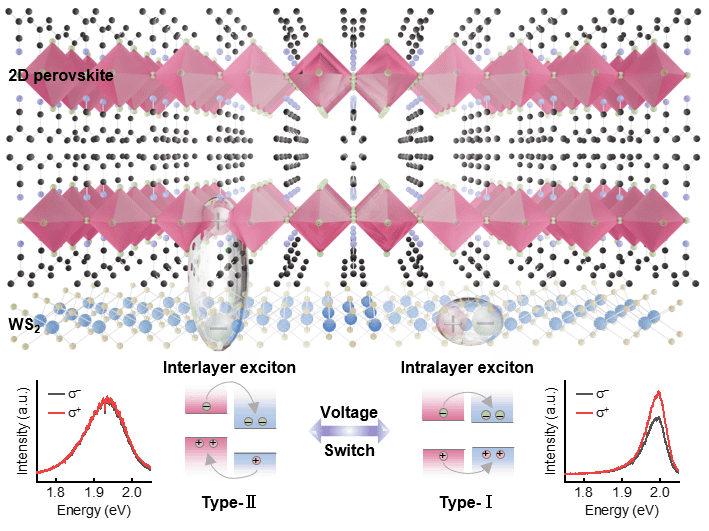
Previous studies have used stacked transition-metal dichalcogenides such as MoSe₂/WSe₂ or WS₂/WSe₂, which require extremely precise rotational alignment between layers to form prominent interlayer exciton emission. In this work, however, the researchers use a hybrid perovskite-WS₂ heterostructure that does not require such careful twist-angle engineering. They demonstrate a device in which an applied voltage switches between two different exciton states—interlayer excitons and intralayer excitons, allowing them to control whether excitons can move through the material or remain localised.

Schematic illustration of the WS2/(iso-BA)2PbI4 heterostructure, showing the electrical switching and polarization dynamics between interlayer excitons and intralayer excitons.
Schematic illustration of the WS2/(iso-BA)2PbI4 heterostructure, showing the electrical switching and polarization dynamics between interlayer excitons and intralayer excitons. Top: Structural illustration of the WS2/(iso-BA)2PbI4 heterostructure and the formation of interlayer excitons and intralayer excitons. Bottom Centre: Energy band diagrams of electrical switch between Type-Ⅱ band alignment and Type-Ⅰ band alignment, and the charge transfer dynamics. Bottom Sides: The Polarization-resolved photoluminescence spectra of the heterostructure at opposite voltages under circularly polarized laser excitation. (Courtesy: Dehui Li/Huazhong University of Science and Technology)

Valley polarisation describes how strongly carriers favour one of two equivalent energy minima, known as valleys. The researchers used voltage to switch the device between low and high valley-polarisation states between these two different exciton states, allowing them to electrically control a form of information carried by excitons. This capability is an important step toward future valleytronic devices, which aim to use valley states for information processing.

More broadly, the research demonstrates a practical way to electrically control both energy transport and information states in a 2D material system, bringing excitonic and valleytronic circuits a step closer to reality.

Read the full article

Switchable band alignment in 2D-perovskite/WS2 heterostructures for tunable exciton transport and valley polarization

Yingying Chen et al 2026 Rep. Prog. Phys. 89 078004

Do you want to learn more about this topic?

Valley manipulation in monolayer transition metal dichalcogenides and their hybrid systems: status and challenges by Siwen Zhao et al. (2021)

The post Voltage switches exciton transport in 2D hybrid material appeared first on Physics World.

  •  
❌