In a lab at the Okinawa Institute of Science and Technology (OIST) in Japan, a slab of diamond smaller than a pencil eraser hangs from a carbon fiber rod about 5 centimeters (2 inches) long. The rod is attached to a graphite plate that floats in mid-air above four magnets. Nobody touches it. When a […]
Physicists have confirmed the two foundational postulates of Richard Feynman’s path-integral approach to quantum mechanics in a real-world experiment for the first time. This comes nearly 80 years after Feynman first published his path-integral formulation, which describes the time evolution of quantum systems.
Fundamental thought experiments, such as Schrödinger’s cat, the Einstein–Podolsky–Rosen paradox and the quantum double-slit experiment have always been important for developing the theories of quantum mechanics. As technology improves, some thought experiments have been realized in the lab, confirming many aspects of quantum theory. However, thought and real experiments thus far have not addressed the fundamental question: how do quantum systems evolve between initial and final states? This question, explains Shi-Liang Zhu of South China Normal University in Guangzhou, lies at the heart of Feynman’s path integral postulates for his famous propagator equation.
The postulates, first proposed in 1948, have never been directly tested – despite their foundational role in modern physics. Indeed, the path-integral formulation has been critical for the development of fields ranging from quantum field theory to cosmology and has provided a unified framework that connects quantum mechanics with classical physics through the principle of least action. The path integral’s predictions also underpin modern quantum science, from condensed matter physics to quantum statistical physics.
As quantum theory was developed, several “pictures” emerged of how a quantum system evolves with time – including the Schrödinger and Heisenberg pictures. The Schrödinger equation, the Heisenberg equation and the Feynman propagator equation are formally equivalent formulations of quantum mechanics, explains Zhu. “However, while the first two are typically treated as fundamental postulates, the Feynman propagator equation is derived from two underlying postulates. This derivational asymmetry makes experimental tests of Feynman’s postulates particularly compelling.”
Not a simple sum
The first postulate is that a quantum particle does not travel along a single trajectory when moving from point A to point B; and instead every probable path contributes to its trajectory. The second postulate is that all possible paths have the same probability (or equal-magnitude amplitudes) and differ only by a path-dependent phase factor. This is very different from simply summing all the probabilities as in classical physics.
At time ti, explains Zhu, a particle is localized at xi with its wave function denoted as ψ(xi, ti). The probability of the particle reaching xf at time tf is therefore determined through all possible paths connecting points A at (xi, ti) and B at (xf,tf). The j-th path contributes a probability amplitude ϕj.
Feynman postulated that the probability P of the particle reaching xf at time tf equals the absolute square of the sum of probability amplitudes ϕj for all paths. As mentioned, all these contribute equally in magnitude, with each contribution’s phase being given by the classical action (in units of the Planck constant, ħ).
“We have now directly measured the probability amplitudes ϕj of more than 1.4 million possible paths taken by single photons in an optical system,” says Zhu. “We did this by dividing the region between the starting point A and the end point B into a grid of points. We connected adjacent points by line segments and then measured the propagator for each segment. In total, there are 175 possible paths.”
The results from this experiment, which is detailed in Science Advances, validate the first postulate with a mean absolute percentage error of 4.45% and a fidelity of 94.9%. They also confirm the second postulate with 94.7% fidelity.
Reconstructing millions of path amplitudes
The paper’s first author Yong-Li Wen notes: “because there were so many possible paths that the photons could take, the primary challenge in our experiments was to achieve sufficient accuracy to reconstruct millions of path amplitudes, since even marginal errors in individual propagator measurements accumulate multiplicatively, destroying phase coherence and rendering the reconstructed path distribution nearly random.
“We overcame this problem through four key technical advancements: amplifying the signals; designing a customized high-precision imaging system; implementing real-time normalization via a reference beam to correct for photon fluctuation errors; and making sure the set-up was mechanically stable on the nanoscale.”
These innovations improved single-photon propagator fidelity from 87.6% to 98.5%, something that allowed the team to resolve the global structure of path amplitudes with unprecedented precision.
The work establishes a powerful experimental framework for investigating path integrals in quantum systems, Zhu tells Physics World. “By confirming that quantum probabilities arise from path interference and that phases are governed by classical action, we provide experimental evidence supporting the view that quantum paths reflect physical reality rather than being mere mathematical artefacts.”
The high-precision propagator methodology could also be used to study quantum-to-classical transitions and decoherence mechanisms, where understanding the role of interfering paths is essential, he adds. And it could be extended to probe fundamental phenomena such, as entangled histories and indefinite causal order across multiple space–time points.
Beyond fundamental physics, the technique may make quantum simulations of complex condensed matter and quantum field theory phenomena, including instantons and magnetic monopoles, easier. “Perhaps most excitingly, by enabling precise propagator measurements in diverse environments, this framework could eventually be extended to interacting systems and curved space–times, allowing for valuable experiments with artificial quantum systems,” says Zhu.
A new quantum test of the weak equivalence principle performed on the China Space Station using cold atom interferometry is the most precise to date, yielding an uncertainty of 2.8 x 10⁻⁸ and a test result of around –2.7 x 10⁻⁷. Meanwhile, a separate team in Israel, Germany and the UK has measured an object’s quantum phase in freefall in the laboratory and confirmed that Einstein’s equivalence principle holds here too.
The weak equivalence principle (WEP), or the “universality of freefall”, is an important pillar of Albert Einstein’s general theory of relativity, in which mass and gravity are intimately linked to the curvature of space–time. The WEP states that, in the absence of other forces, all objects fall with the same acceleration under the influence of gravity regardless of their mass or composition. In other words, gravitational mass (the m in F = GMm/r2, where F is the gravitational attraction between two masses placed a distance r apart and G is the gravitational constant) and inertial mass (the m in F = ma, where a is the acceleration produced by the force F) are the same.
Precisely measuring this principle is crucial since any detected violation could point to new physics. It is also important for continuing to corroborate the theory of general relativity, which may be incomplete because it appears to be fundamentally incompatible with another well-tested theory: quantum mechanics. Today, tests of the WEP using macroscopic bodies have reached extraordinary precision – at the 10−13 level on Earth and 10−15 in space. These latest studies investigate the principle in the quantum realm.
Cold atomic interferometry
Conventional interferometry works by splitting a coherent beam of light and then recombining the different components at a detector. If the two components are in phase when they recombine, the interference is constructive and the two components reinforce each other. However, if the two components are out of phase, they cancel each other out, leading to a characteristic pattern of bright and dark fringes. Atomic interferometry is similar but relies on beams of atoms rather than beams of light.
Cold atom interferometry (CAI), which is atomic interferometry at ultracold temperatures of just above absolute zero, has found applications in inertial sensing and fundamental physics research. It also turns out to be a powerful technique for testing the WEP.
There is a problem with using CAI on Earth, however, because our planet’s gravity limits the interference time of the atom beams to just a few seconds. Experiments in microgravity allow this time to be extended to minutes, but because the resolution of a WEP test scales inversely with the square of the interference time, even longer interference times are needed to achieve the required precision (10−17 or more). This necessitates a permanent microgravity environment, something that is only possible in space.
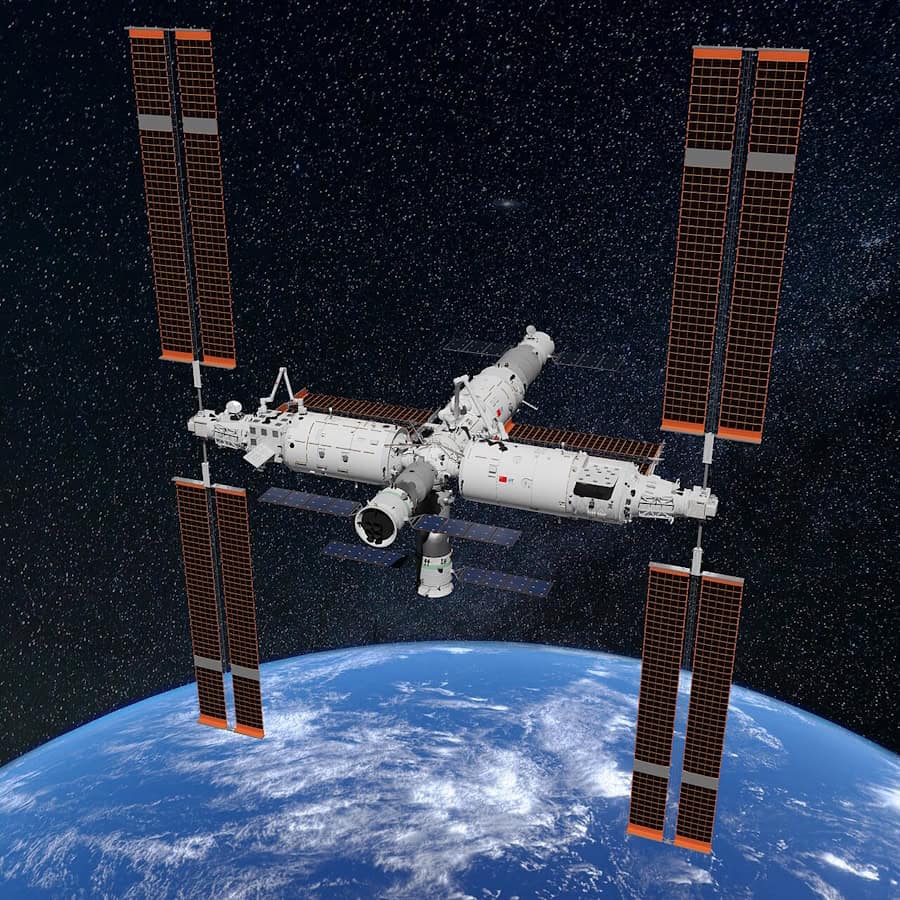
Permanent microgravity environment Rendering of the China Space Station. (Courtesy: CC BY-SA 4.0/Shujianyang)
By exciting and detecting the fluorescence of the isotopes sequentially at slightly different times, the researchers obtained two sets of symmetric interference images, one from the 85Rb atoms and one from the 87Rb atoms. Measuring the differential phase of these images – after suppressing the residual acceleration of the space station and effects from vibrations – allowed them to calculate the difference in the acceleration between the two isotopes in the vertical, freefalling direction.
After running their experiment for 280 days, during which time the researchers acquired more than 9700 pairs of interference fringes, they obtained a test result of around –2.7 x 10⁻⁷, after correcting for errors.
“We believe that our technique will have a significant impact,” says Zhan. “First, it demonstrates that an integrated interferometer meeting the requirements of in-orbit operation is possible, giving the community confidence to continue with even more technically demanding space-based interferometry experiments that aim for ever increasing precision. The technology developed in this project will also itself help advance atom-interferometry-based instruments, such asinertial navigation systems.”
Measuring an object’s quantum phase in freefall
Meanwhile, physicists at the Ben-Gurion University of the Negev, the University of Ulm and the University of Oxford have also used CAI, this time to measure an object’s quantum phase in freefall. They confirm that the effect is the same as predicted by Einstein’s equivalence principle (EP), which states that for an observer in freefall, gravity should locally disappear.
In their work, also detailed in Science Advances, the researchers used a completely novel version of the CAI technique that they call the Quantum Galileo Interferometer (QGI) – in honour of Galileo Galilei’s discoveries regarding the laws of freefall. The experiment, which was carried out at Ben-Gurion University, again makes use of clouds of 87Rb atoms cooled to just above absolute zero.
The researchers began by applying microwave pulses to put the ultracold atoms – which were placed 113 µm below the surface of an atom chip containing current-carrying wires that produce magnetic field gradients – into a quantum superposition. This meant that each atom effectively travels along two different paths at once. One part of the atomic wave responded to the magnetic fields such that an applied upward force exactly counteracted the downward pull of gravity and the wave was held stationary in the apparatus – that is, static relative to Earth. This part of the wave is referred to as the reference atomic wave (or wavepacket). The second part of the wave was sent upwards in a ballistic trajectory.
A magnetic cannon and parachute
Realising this ballistic trajectory, affected only by gravity, required a “magnetic cannon” and a “magnetic parachute”, explains Ron Folman, who is one of the leaders of this study. “After the short-duration magnetic cannon, we switched this part of the wave into a state that is almost unaffected by the magnetic field so that it could fall freely under gravity. And at the end of the fall, we used another precisely controlled magnetic pulse to stop the relative motion between the two waves and reunite the two parts so that they interfered with each other.”
That interference allowed the researchers to measure the tiny difference in quantum phase accumulated while one was falling and the other was held still — two frames that may be referred to as the Einsteinian and the Newtonian frames, respectively. This means that when both parts of the wave have the same velocity, the transformation between the wavefunction in a Newtonian (laboratory) frame of reference and the wavefunction of the same object in an Einsteinian frame that freefalls with the same acceleration, involves a transformation phase known as a gauge phase.
According to their experiments, the gauge phase measured by the researchers is the same as the one predicted when Einstein’s EP is applied to such a quantum wave, so confirming the principle for these quantum objects and at these low masses and energies.
“Some members of our team,” notes Folman, “including Nobel laureate Sir Roger Penrose, expect this co-existence between general relativity and quantum mechanics to break for objects with higher masses. Indeed, the Ben-Gurion University group is now repeating the same experiment with nanodiamond particles to test this hypothesis,” he tells Physics World.
The observation, says study co-leader Vlatko Vedral at Oxford University’s department of physics, constitutes a fundamental test of the interface between quantum theory and gravity. “The connection between these two pillars of modern physics remains one of the most important open questions in physics, and it is thus of paramount importance to understand the phenomenon of freefall and the EP in the quantum domain.”

 Login