❌

Reading view

Nanotyrannus named Jodi needs a new home (if you have $9M)

Almost one year ago, paleontologists finally settled a longstanding debate about Tyrannosaurus rex, arguably Earth’s most famous dinosaur. After reviewing decades of mounting evidence, researchers documented around 150 morphological differences across multiple supposed juvenile T. rex skeletons. Instead of young dinosaurs, these were actually adult examples of an entirely separate species now known as Nanotyrannus lancensis.

While Nanotyrannus was dwarfed by its massive relative, it still reached an impressive 18 feet long and weighed as much as 1,500 pounds. But while it may have lost some of its cultural cache during the rebrand, a well-preserved specimen nicknamed Jodi may still sell for upwards of $9 million at an upcoming auction.

“It completely changes what we understand about the Cretaceous,” Cassandra Hatton, Sotheby’s head of science and natural history, said during a recent interview.

Paleontologists first suspected the existence of a separate species after discovering a uniquely proportioned skull at Montana’s Hell Creek Formation in 1946. Back-and-forth arguments about the dinosaur’s true identity continued for the next 80 years, but the ramifications weren’t simply a matter of semantics. If confirmed, it meant T. rex wasn’t the only tyrannosauroid roaming North America during the late Cretaceous period.

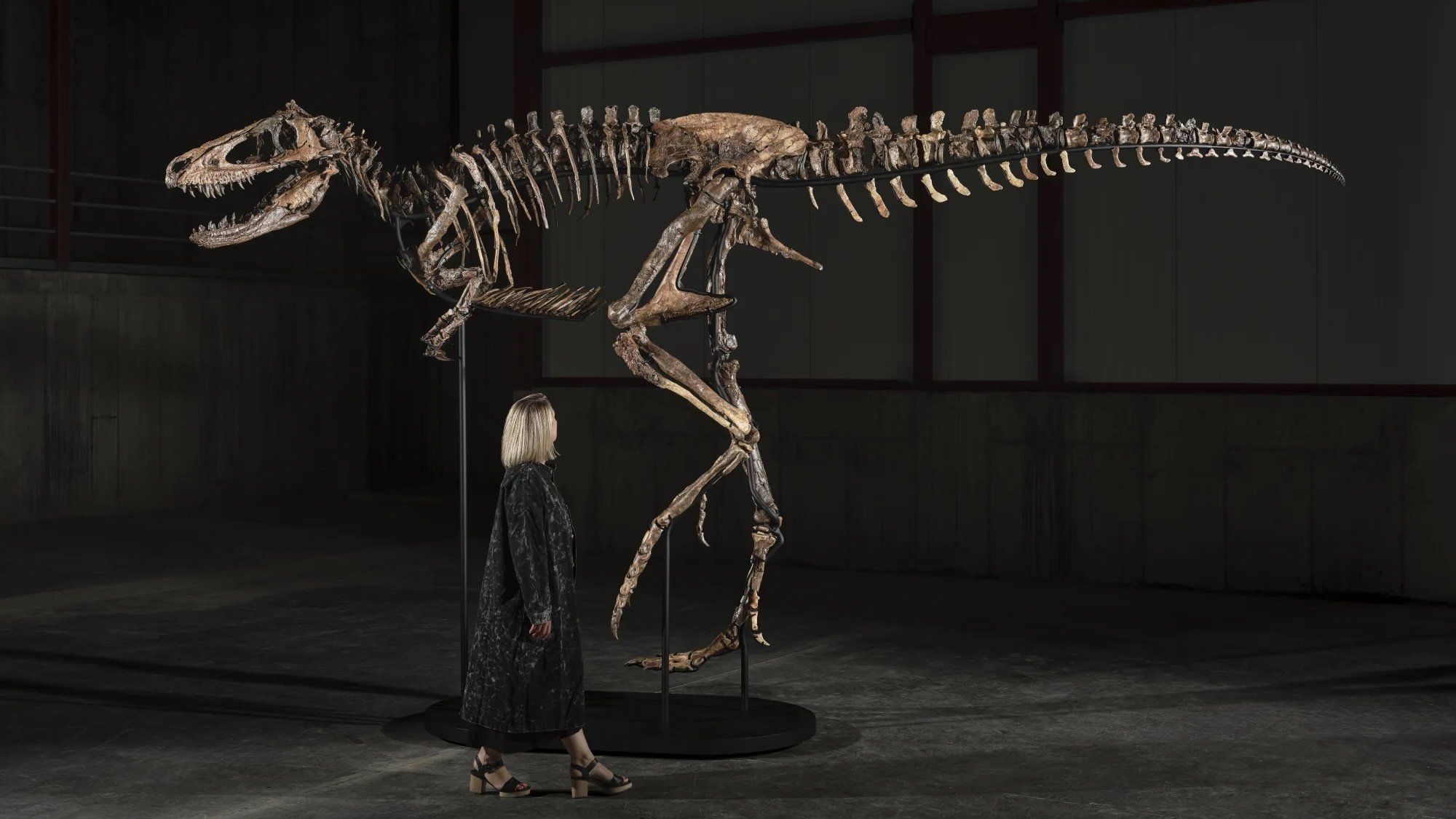
Jodi is a relatively new find. Named after the Montana rancher who found it, Jodi Pierson, the skeleton was excavated at the Hell Creek Formation in 2019, and is estimated to be about 55 percent complete. It features all four of its claws as well as 35 teeth in a nearly complete skull. According to the Sotheby’s auction listing, Jodi stands about 6.5 feet tall and measures 19.6 feet from nose to tail. The mounted dinosaur includes all of its surviving fossilized bones along with 3D-printed and sculpted additions to fill in the paleontological gaps.

Jodi will officially go up for auction on October 27 in New York City, where she is expected to sell for $6–8 million. The final price may still surprise bidders, however. In July, auctioneers estimated that a nearly complete T. rex named Gus would sell for $30 million. Gus blew that out of the water, ultimately fetching over $50 million.

The post Nanotyrannus named Jodi needs a new home (if you have $9M) appeared first on Popular Science.
  •  

When ‘T. rex’ died, a new giant fungus named ‘D-rex’ took over

It’s a fungi-filled world and we are just living in it. There are roughly 150,000 to 157,000 known species of fungi, and now there is a new giant species to add to that tally. 

A team of scientists exploring the forests of Yunnan in southern China discovered the new fungus, which shows just how large these organisms can grow. The new species Dianjunus rex grows vertical fruiting bodies (the top part of the fungi that we usually see as a mushroom) that can grow as high as a foot (50 centimeters) and weigh close to five pounds (2.2 kilograms). 

This new fungus is the largest known species within the phylum Ascomycota, the largest known phylum of fungi with over 64,000 known species. The new fungus is described in a study recently published in the journal Frontiers in Fungal Biology.

“This remarkable species represents a new fungal family, Dianjunaceae, and provides a rare window into the evolution of extreme fungal body forms,” Indunil C. Senanayake, a study co-author and mycologist at the Germplasm Bank of Wild Species of the Kunming Institute of Botany in China, said in a statement. “The discovery illustrates how much fungus biodiversity remains to be discovered in East Asian forests.”

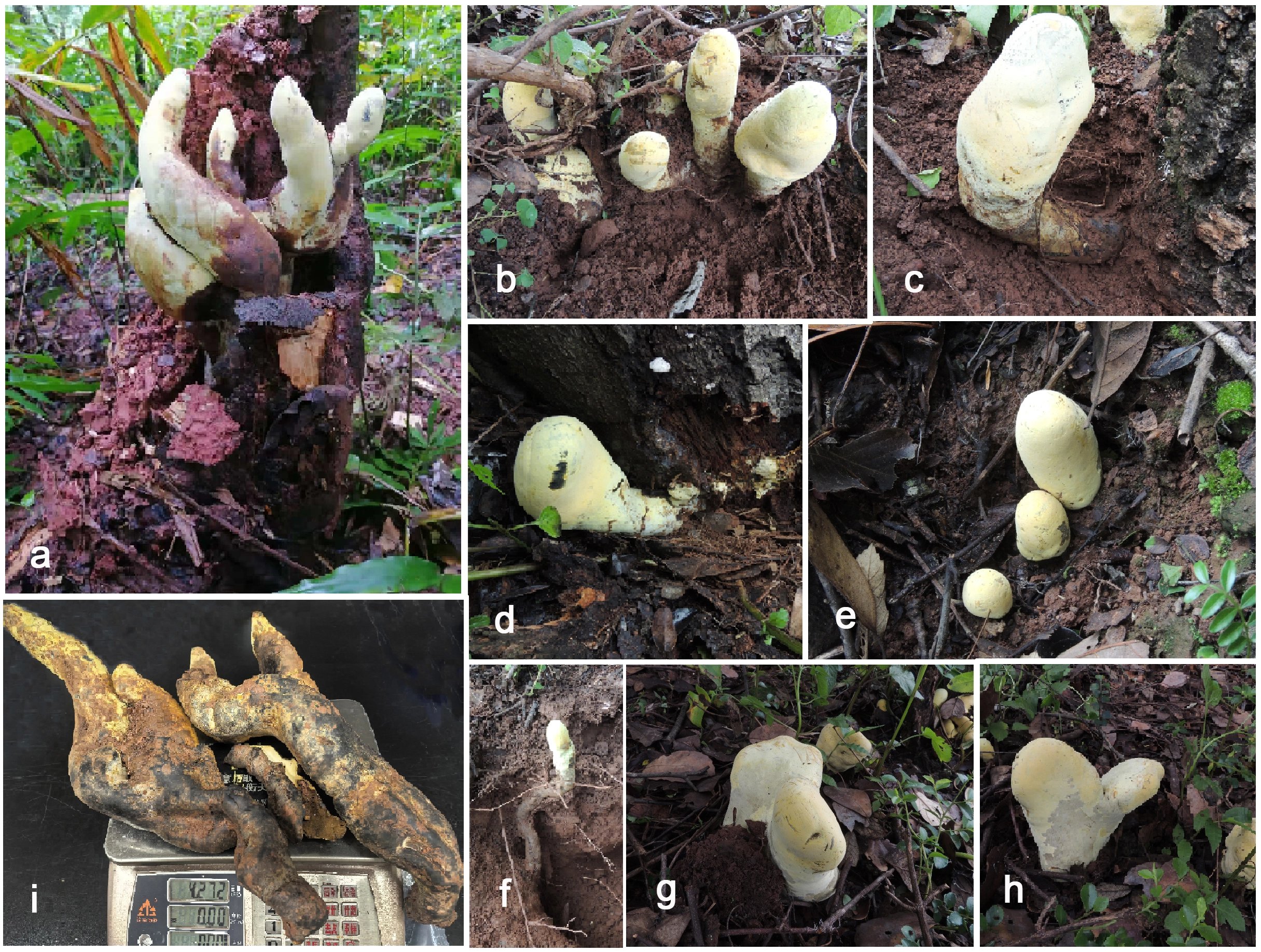
The scientists spotted the fungus during fieldwork in the temperate coniferous forests near Damaidi and Yipinglang and in a tropical rainforest near Nanbang in southern China. They noticed large whitish fruiting bodies (called stromata) coming out of some fallen wood that belonged to an unknown species of Ascomycete fungus. 

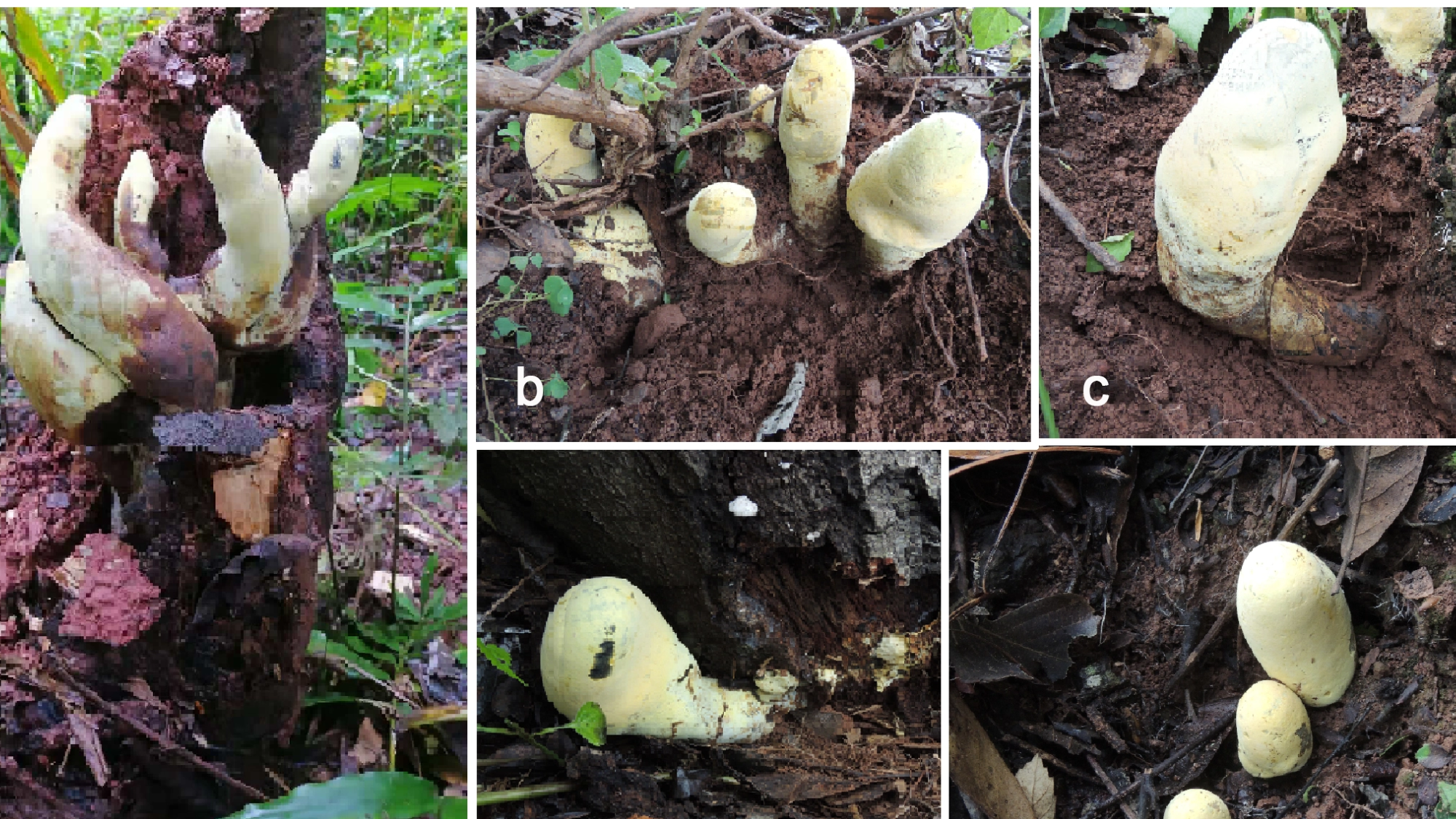
Stromata of Dianjunus rex in the field. (a, c, d, f) Stromata attached to host roots. (b, e, g, h) Stromata around host plant. (a) Collectors. (i) Total weight of largest bilobedstromata. Image: Song, Yan, Pérez-Moreno, Zhang, Yang, Xie, Su, Liu, Wang, Liu, Yang, Yang, Liu, Shi, Wan, Cheewangkoon, Dai, Senanayake and Yu

Ascomycetes don’t always sprout traditional mushrooms, but release their spores from tiny, sac-like structures inside or on the surface of such fruiting bodies instead. They typically grow on woody roots of Chinese cork oak trees.

The team collected the curious fruiting bodies, and grew spores back in the lab to study the fungus’ morphology and its genome. The genetic tests and a detailed study of its morphology revealed that the fungus is a new species, a new genus, and even a new family. 

They named it Dianjunus rex (which the team calls D-rex for short), for its regal size and the ancient Dian kingdom. This ancient civilization in Yunnan reached its height during the second and first centuries BCE.

The team also found a connection to dinosaurs beyond its nickname which sounds like T. rex. It appears that this fungi family arose around 65 million years ago, or only one million years after the Cretaceous-Paleogene mass extinction event. This most famous of Earth’s mass extinctions wiped out the dinosaurs and countless other animals and plants.

“This timing raises an intriguing possibility. After the mass extinction, forests experienced dramatic changes, including the sudden availability of large amounts of dead plant material,” added Senanayake. 

For fungi, this kind of environmental disruption may have created new ecological opportunities for it to fill.

As for its size, D-rex’ fruiting bodies grow about 20 to 30 centimeters taller than other Ascomycetes. The team thinks this size might help the wind disperse their spores better in dense forests. However, a large fruiting body like D-rex requires a lot of energy, so the strategy may have evolved if the ecological benefits outweighed the energy costs.

The team also believes that there are more fungi waiting to be discovered in subtropical China—we just need to keep looking. 

The post When ‘T. rex’ died, a new giant fungus named ‘D-rex’ took over appeared first on Popular Science.
  •  

A baby tyrannosaur possibly cannibalized its dead relative

Bitemarks on the fossilized jaw of a tyrannosaur called Albertosaurus appear to illustrate the first known example of scavenging raptors feasting on a much larger dinosaur The prehistoric snack scene is detailed in a recent study in the Journal of Paleontology. However, researchers, one alternative theory may point to an even darker fate.

A close relative of Tyrannosaurus rex, Albertosaurus roamed its present-day namesake Canadian territory about 73 to 67 million years ago (Late Cretaceous period). It was the region’s undisputed apex predator,and regularly grew upwards of 30 feet long while weighing around 6,000 pounds. But even a fearsome dinosaur like Albertosaurus ultimately succumbed to injury, illness, and old age. In this case, paleontologists analyzed fragments of an immature specimen who died when it was 8 to 10 years old. Despite only being a “teenager” at the time of death, the Albertosaurus was already over 19 feet long and weighed about 1,170 pounds.

Interestingly, the tooth marks on the dinosaur’s lower jaw suggest an unexpected postmortem scenario. Paleontologists didn’t find any evidence of bone healing, which strongly implies the Albertosaurus received the bites around its time of death. This means whoever dined on the dinosaur was a scavenger, or at least an especially hungry carnivore—and they were much smaller than their meal.

“This turns everything on its head, because you’re dealing with a very small dinosaur eating a very big, mean, nasty dinosaur like a tyrannosaur,” study co-author and University of Alberta (UA) paleontologist Philip Currie explained in a recent video.

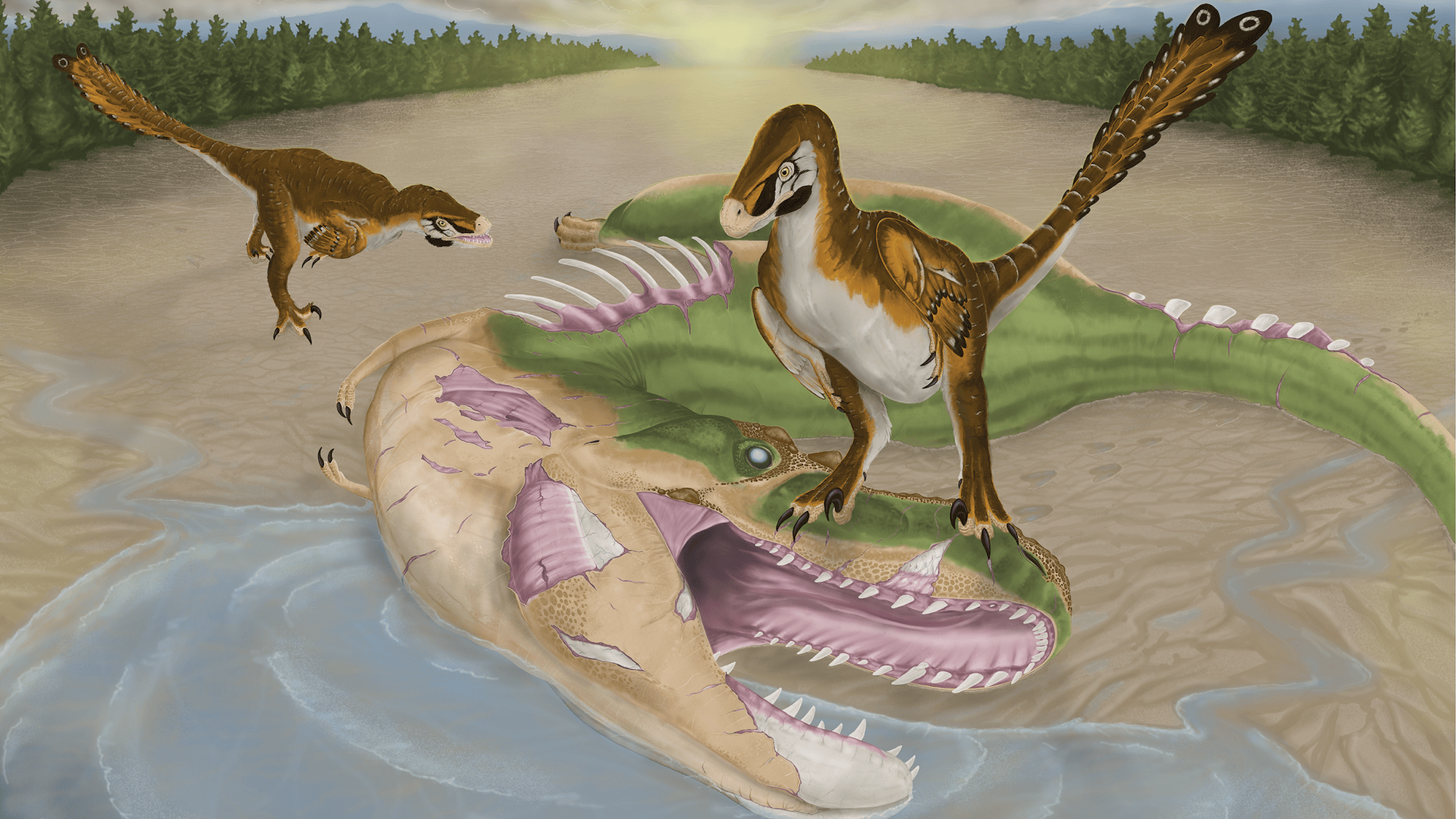
Paleontologists currently suspect the most likely explanation is that a pack of dromaeosauridae (raptors) chowed down on the dead Albertosaurus. Made famous by the dinosaurs depicted in the Jurassic Park franchise, these small-to-medium sized hunters included recognizable species like Velociraptor and Utahraptor. Another dromaeosaurid example is Albertavenator curriei, a feathered, sickle-clawed hunter who existed alongside Albertosaurus. 

While the authors believe the bite marks could point to A. curriei, they can’t rule out another, even more macabre possibility. Based on the distance between each individual tooth mark, an even younger Albertosaurus measuring about 6.5-foot-long is the only other plausible suspect.

“If it is a young Albertosaurus, this would be an event of cannibalism—by a baby,” said study co-author and UA paleontologist Joshua Doyon.

Incidents of cannibalism are common across evolutionary history, but finding direct paleontological evidence is extremely rare. No matter who ate the unlucky Albertosaurus—be it raptor or relative—the fossilized leftovers graphically reveal a complex prehistoric food chain.

The post A baby tyrannosaur possibly cannibalized its dead relative appeared first on Popular Science.

  •  

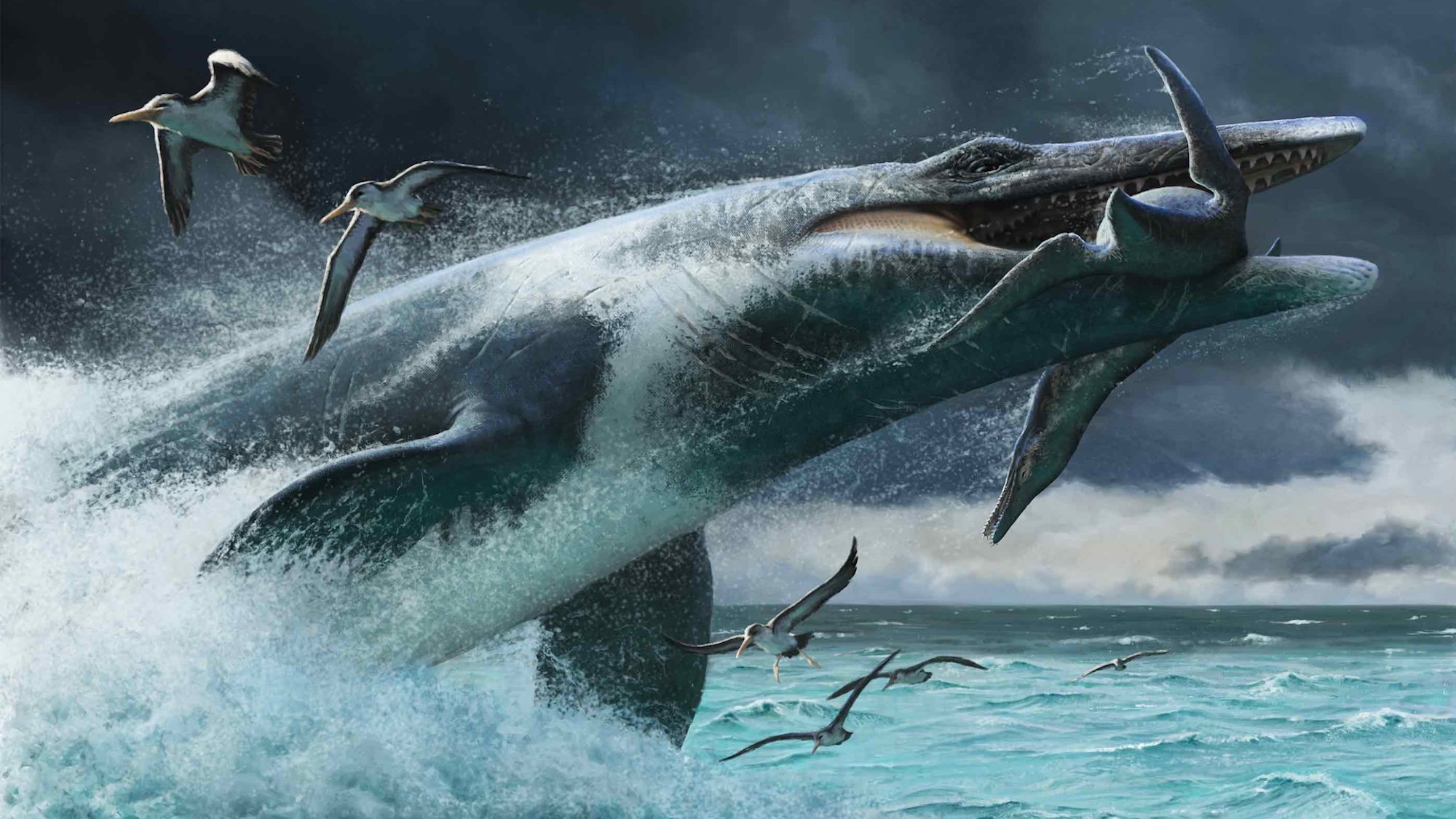
20,000-pound mosasaurs ambushed prey with sneak attacks

Mosasaurs are terrifying enough based on their fossils alone. The Cretaceous marine reptile family encompassed some of the undisputed apex predators of Earth’s ancient oceans (and possibly even some rivers). Species like Mosasaurus hoffmanii easily reached nearly 50-feet long, while weighing as much as 20,000 pounds—and there are many more mosasaurs just like them.

So what could possibly make them any scarier? Some of the ancient aquatic hunters employed speedy, “slam-start” sneak attacks to take down their prey. This new theory is detailed in a recent study for the journal Current Biology, and draws on anatomical fossil record reconstructions supplemented by the physiology of similar present-day predators like the Komodo dragon (Varanus komodoensis).

“Physics is physics,” Kiersten Formoso, an evolutionary paleontologist at Rutgers University, said in a recent profile.

Formoso and her colleagues focused on four types of mosasaurs, including the especially massive Tylosaurus. The nearly 10-ton carnivore that existed about 92 to 66 million years ago and grew to almost 45-feet long. Based on its overall anatomy and some basic physics principles, Formoso says Tylosaurus likely ambushed its prey. To accomplish this, the mosasaur relied on a single, immensely powerful sweep of the tail to launch it as fast as 15 miles per hour towards an unsuspecting target.

Tylosaurus and its close relatives belong to one of two primary branches in the mosasaur family tree that are separated by different tail anatomies. Their particular group featured tails with a longer, more flexible portion that provided further sweeping action. Formoso compared these “slam-start” attacks from predators like Tylosaurus and Platecarpus to a swimmer using their legs and feet to launch off a pool wall.

“It’s the tail itself pushing off the water,” she explained.

Of the four species Formoso examined, Mosasaurus and Plotosaurus probably preferred maintaining a comparatively steady speed in the open ocean, while Platecarpus and Tylosaurus often relied on slam-start ambushes in shallower water.

“That doesn’t mean Plotosaurus was slow,” clarified Formoso. “Its tail was [more] built for sustained, tuna-like swimming rather than sudden bursts.”

The team’s theory is further supported by existing knowledge of mosasaur fossil compositions, along with their tooth wear and estimated bite forces. Their data and tools are now available for free online so other researchers can examine other extinct marine species. But whoever those creatures might be, they likely weren’t nearly as imposing as the ocean’s largest—and sometimes sneaky—predators.

“At the same time dinosaurs like T. rex were ruling the land, mosasaurs were ruling the seas,” said Formoso.

The post 20,000-pound mosasaurs ambushed prey with sneak attacks appeared first on Popular Science.

  •  
❌