
❌

Reading view

The search for habitable worlds

The NASA Exoplanet Exploration Program (ExEP) has a curated list of 164 nearest Sun-like stars that are easily visible from Earth. This list represents the first targets for a proposed large space telescope specially designed to find life in the universe, currently known as the Habitable Worlds Observatory (HWO). 

After the HWO is completed, likely sometime in the 2040s, scientists will use the specialized telescope to directly image planets in those star systems. The telescope will search around Sun-like stars for planets in a region known as the habitable zone, where temperatures allow liquid water to exist. Scientists hope to find Earth-like planets with liquid water in the habitable zones of other stars.

While the 164 stars on ExEP’s list have qualities that make them good candidates for study, it remains unknown how many actually have terrestrial planets within their habitable zones. A team of scientists at Arizona State University used simulated data for ExEP’s 164 stars and their hypothetical planetary systems to assess which are most likely to have habitable worlds. Their results would help the HWO prioritize which star systems to observe.

The team started with a subset of 134 stars on ExEP’s list with no known exoplanets, giving researchers the freedom to simulate potential worlds around them. They used a software model called the DYNAmical Multi-planet Injection TEster (DYNAMITE) to predict the possibility that an unseen planet exists around each star by generating 100,000 simulated planetary systems around it. The simulations use mathematical formulas based on observations of real exoplanets to determine the sizes and orbital characteristics of hypothetical gas giants and rocky exoplanets. DYNAMITE then determines whether these planetary systems would be stable and include a terrestrial exoplanet in the star’s habitable zone.

The other 30 stars in the ExEP’s list have known exoplanets, but none of them are rocky planets in habitable zones. To predict whether these stars have unseen terrestrial planets in their habitable zones, the team used the same DYNAMITE process as before with the additional requirement that each star must have an exoplanet matching the one already found.
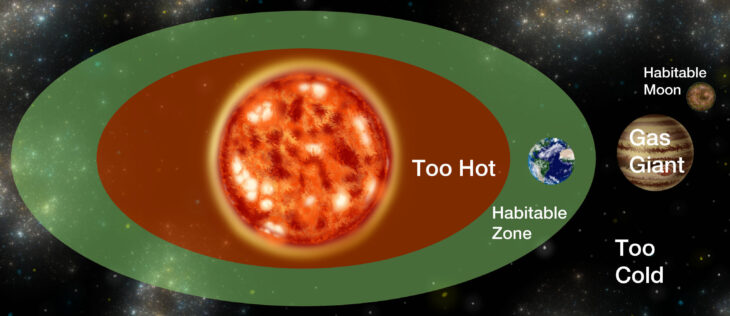
The space around a Sun-like star can be divided into three regions. The region closest to the star is too hot for liquid water to persist on an exoplanet’s surface, while the region farthest from the star is so cold that any water on an exoplanet would be frozen solid. Between these lies the habitable zone, where temperatures would allow liquid water to exist. However, it’s also possible that a combination of light and gravity could create habitable temperatures on large enough moons orbiting gas giants even beyond a star’s main habitable zone. Illustration by <a href="https://www.linkedin.com/in/andrew-bizal-ab14401ab/">Andrew Bizal</a>.

The space around a Sun-like star can be divided into three regions. The region closest to the star is too hot for liquid water to persist on an exoplanet’s surface, while the region farthest from the star is so cold that any water on an exoplanet would be frozen solid. Between these lies the habitable zone, where temperatures would allow liquid water to exist. However, it’s also possible that a combination of light and gravity could create habitable temperatures on large enough moons orbiting gas giants even beyond a star’s main habitable zone. Illustration by Andrew Bizal.

To increase the chances of finding a terrestrial planet in a habitable zone, the team also investigated potentially habitable moons orbiting gas giants in these systems. For each simulation that included a gas giant, the team inserted between 2 and 23 moons, with masses between 10% of Earth’s Moon and 50% of Earth. Then they simulated the surface temperatures of these moons based on how much starlight they receive and how strongly their host planet pulls on them. They deemed the moons potentially habitable if they were large enough to retain an atmosphere and had a temperature ideal for liquid water, even if they were not technically in their stars’ habitable zones.

For each star, the team calculated a metric based on the probabilities that the star had a terrestrial planet in its habitable zone, that the planet would remain in a stable habitable zone for at least 2 billion years, and that the star had a potentially habitable moon. They called this probability statistic a ranking metric and used it to compare star systems. 

Based on the ranking metric, the team found that the dimmer and cooler stars on their list generally had better chances of hosting a habitable-zone terrestrial planet than the brighter, hotter stars. They also found that stars without known exoplanets ranked more favorably. Around 70% of the stars with known exoplanets had less than a 1% probability of hosting a terrestrial planet in their respective habitable zones. Additionally, fewer than 0.1% of their simulated moons were habitable.

Overall, the researchers concluded that the HWO should prioritize observing cooler, Sun-like stars with no known exoplanets. They claimed that the exoplanets with known characteristics in their sample set were of sizes and in positions that made it unlikely for other exoplanets to be in their systems’ habitable zones. Even with expanded habitability criteria for moons, it would be very unlikely for HWO to find another Earth orbiting a gas-giant exoplanet. They ranked 47 stars in the highest-priority category (A Tier), 51 stars in the middle category (B Tier), and 66 stars in the lowest category (C Tier) to observe with HWO. 

At the end of their study, the team remarked that the proposed HWO represents a potential next step in the search for other Earths, but scientists still need to identify the best targets for this future telescope. The HWO telescope should be able to image rocky exoplanets directly, so thorough research to prepare a list of high-priority targets will help avoid overlooking other Earths.

The post The search for habitable worlds appeared first on Sciworthy.

  •  

Where did the galaxy get its carbon?

Carbon is the 4th most abundant element in the universe. It’s everywhere, from the air you breathe to the carbohydrates in your food to the petroleum in the Earth’s crust. Like most elements, carbon was not created by the Big Bang, but came from 2 different types of stars that fuse lighter elements together. 

Massive stars at least 8 times the Sun’s mass fuse 3 helium atoms into a carbon atom in their cores, through a mechanism called the triple-alpha process. They eventually expel this carbon into space, either through a stream of material called a stellar wind or at the end of their lives during a core-collapse supernova. 

Meanwhile, low-to-intermediate-sized stars between ½ and 8 times the Sun’s mass also induce the triple-alpha process. But unlike massive stars, they produce carbon not in their cores, but in a dense shell of helium that surrounds them during an advanced stage known as the asymptotic giant branch or AGB. AGB stars undergo cycles of swelling and contraction, during which they shed some of their material into space.

While scientists understand these processes, the contribution of each star type to the carbon supply in the universe remains uncertain. To address this, a team of scientists modeled how the chemical elements in the Milky Way Galaxy change over time with different contributions from the 2 carbon-creating processes. They then verified their findings by comparing them with the actual carbon concentration in the Milky Way.

To obtain the benchmark for the Milky Way Galaxy’s carbon content, the team turned to the catalog of stars observed by the Apache Point Observatory Galactic Evolution Experiment (APOGEE) survey. They selected 14,066 stars that were large and bright enough to yield reliable data but, unlike AGB and massive stars, were still at a stage of life when their newly produced carbon was still confined to their cores. The researchers used the carbon in the outer layers of these stars, known as subgiants, as a compositional record of the gas from which they formed, thereby estimating the Galaxy’s carbon content during their formation. 

The scientists started with a computer program developed by another team that models how the Milky Way’s chemistry changes over time. First, the team calculated the potential amount of carbon produced by different types of stars using estimates from earlier studies. Then, they incorporated these results into a model that accounts for how stars form, fuse elements, and release carbon into the Galaxy, using a simulation program called the Versatile Integrator for Chemical Evolution, or VICE. The researchers ran 14 versions of this model, each assuming a different contribution of carbon from AGB stars relative to massive stars.

In their computer model, the Milky Way Galaxy began as a set of 200 concentric rings, each containing its own population of stars, different speeds at which stars form, and varying amounts of gas available to form new stars. The team then stitched these rings together by having stars migrate between them. They allowed these model Galaxies to settle over 10 billion years, then picked a random sample of 14,066 simulated stars to compare their carbon content with carbon in the same number of observed subgiants from APOGEE.

The team’s model most closely reproduced the actual carbon content of the Milky Way’s subgiant stars when AGB stars contribute between 10% and 40% of the Galaxy’s carbon, with the strongest agreement occurring at 15% to 30%. Even though they found that massive stars are the dominant source of carbon, they also found that smaller AGB stars could produce carbon more efficiently than previously thought, though they take longer to become carbon sources than their larger counterparts.

The team concluded that their estimates of how much carbon comes from AGB and massive stars provide a benchmark for future studies, as the connection between the production of elements inside stars and the processes by which those same stars lose mass remains poorly understood. They suggested that future researchers analyze larger sample sizes, examine other galaxies, and use data from future surveys to better understand the chemical history of the universe.

The post Where did the galaxy get its carbon? appeared first on Sciworthy.

  •  

Finding alien life with light signals

Astronomers and astrobiologists use a wide range of tools in their search for extraterrestrial life. Probes, satellites, and rovers take photographs and collect data on the geology and chemistry of planets and moons in the solar system. Radio telescopes sweep the sky, looking for signals from intelligent civilizations. And telescopes like the JWST can observe the atmospheres of distant exoplanets, potentially finding ones similar to Earth’s. 

A limitation of these methods is that they assume life on other worlds is fundamentally similar to life on Earth, requiring the same balance of molecules in the atmosphere, producing the same chemicals for their metabolic processes, or developing technologies analogous to those humans make. While researchers use these assumptions as baseline markers to look for, assuming such similarities might lead them astray. Scientists looking for life using too narrow a set of parameters might miss life unlike Earthlings. Or they might mistake coincidentally similar geological, chemical, or astronomical processes for having been made by living things.

So, to complement techniques that assume alien life resembles life on Earth, scientists also consider approaches that detect signs of life while making as few assumptions as possible about what it could look like, known as agnostic biosignatures. One of these life signs with few assumptions is complexity. Though it can be difficult to quantify precisely, living things tend to create more complex systems than nonliving things. A team of researchers recently tested whether living and nonliving worlds could be distinguished solely by examining the complexity of the light-reflection patterns from their surfaces.

For this, the team treated Earth and Mars, similar planets but one with life and one without, as stand-ins for exoplanets around other stars. They collected data on the light reflected off both planets’ surfaces from a space station monitoring Earth, known as the Deep Space Climate Observatory or DSCOVR, and an orbiter around Mars observing its atmosphere, known as the Hope Probe. 

The team identified 3 nearly identical wavelengths of light that these machines observe from their respective planets. From the machine databases, they collected measurements of how much light each planet reflected, called its reflectance, at these 3 wavelengths over 486 local days. By using only individual wavelengths of light rather than full photographs, the team claimed that, if their test worked, researchers could apply it to distant exoplanets that cannot be photographed in detail.

Without looking for any particular chemical or signal, the team compared these measured reflectances using a series of statistical tests to determine the variation and randomness in their reflected light, which they considered representative of the complexity of the planets’ surfaces. The researchers found that of the 27 complexity metrics they tested, Earth scored higher than Mars on 25, Mars scored higher than Earth on 1, and the planets scored the same on 1. So, even though both planets have rocky surfaces with atmospheres, weather, and cyclical changes, the one with life is measurably more intricate and dynamic, and the researchers found this difference detectable even with a small stream of light at great distances.

The researchers claimed their test demonstrated that complexity could be a valid agnostic biosignature, with caveats. One is that Earth is quite distinct from Mars, in that it has oceans and a relatively thick atmosphere. This means that processes like making and dispersing clouds and the sharp contrast between land and water could add complexity to Earth’s measurements without direct ties to living things. 

They suggested 2 possible explanations for how these complicating factors relate to life on Earth. Either life allows Earth to have these factors, or Earth is inherently complex regardless of life, and therefore it can’t be used to assess how life leads to measurable complexity. To say which is the case, one would have to replicate this test with a lifeless copy of Earth. However, the team argued that Earth’s biosphere is unlikely to be wholly unrelated to its water cycle.

To bolster the validity of their methods, the team plans to expand their sample of planets to include Venus, Saturn’s moon Titan, and simulated exoplanets with modeled biochemistry and atmospheres. If the model holds up, their methodology could represent a new category of mission to find alien life, with long searches for variations in reflected light uncovering properties of distant worlds that would otherwise go unnoticed.

The post Finding alien life with light signals appeared first on Sciworthy.

  •  
❌