❌

Reading view

Manta rays inspire a smarter algorithm for cleaner, cheaper power grids

Every time a power grid operator decides how much electricity each generator should produce, a quiet balancing act takes place. Burning less fuel saves money, but it often means allowing more pollution, and cutting emissions usually drives costs up. Engineers have long searched for a way to satisfy both goals at once, a challenge known as combined economic emission dispatch, or CEED. Now, a team of researchers has turned to one of the ocean’s most graceful feeders, the manta ray, for inspiration, and the result is an optimization algorithm that outperforms a crowded field of competitors on both cost and cleanliness.

The study, published in the journal Results in Engineering by Yu-Feng Sun, Jie-Sheng Wang and colleagues, describes an enhanced version of the Manta Ray Foraging Optimization algorithm, or MRFO. The original algorithm, first introduced a few years ago, mimics the cooperative hunting strategies that manta rays use to harvest plankton. Because plankton drifts unpredictably with seasons and weather, manta rays have evolved three distinct foraging behaviors: chain foraging, in which animals line up in arcs so that each one catches food missed by the one ahead; spiral foraging, where the group coils around a dense patch of food; and somersaulting, in which individuals flip back and forth around a promising spot. Translated into mathematics, these behaviors become rules that move a population of candidate solutions around a search space, gradually converging on the best answer.

What makes the CEED problem so stubborn is its mathematical character. The relationship between a generator’s output and its fuel consumption follows a cubic curve, and the emissions of carbon dioxide, nitrogen oxides and sulfur dioxide each follow their own cubic functions. The combined objective is nonlinear, nonconvex and discontinuous, riddled with local minima that can trap classical techniques such as lambda iteration or gradient-based methods. To make matters harder, the problem is genuinely multi-objective, so the researchers converted it into a single objective by applying price penalty factors that fold the cost of each pollutant into one total figure in dollars per hour.

Constraint handling is where many algorithms stumble. Traditional approaches add a fixed penalty whenever a solution violates the power balance requirement, the equation demanding that total generation minus transmission losses equals demand. But a fixed penalty is a blunt instrument. Set it too low and the algorithm happily returns infeasible schedules; set it too high and the search becomes so restricted that it cannot explore properly. Finding the right value through trial and simulation is time-consuming and inefficient. The team’s answer was to make the penalty itself dynamic, drawing on five different mathematical functions: sinusoidal, hyperbolic tangent, arctangent, linear and hyperbolic secant. Each function is raised to an order that changes during the run, so the penalty strength adapts to both the size of the violation and the stage of the optimization. Early on, mild penalties preserve exploration; later, penalties tighten to push solutions toward feasibility.

The second major innovation targets the heart of the MRFO algorithm. In the original design, a parameter called C governs the switch between exploration, casting the net wide across the search space, and exploitation, homing in on the best solution found so far. This parameter rises monotonically from zero to one, a predictable march that can leave the algorithm poorly balanced at certain stages. The researchers replaced it with a chaotic switching factor, drawn from nine well-known chaotic maps including Chebyshev, logistic, tent, sine, Gauss and singer maps, combined with an exponential adjustment function. The result is a parameter that still trends upward but oscillates along the way, periodically reopening the search space and preventing the population from settling prematurely into a local optimum.

To find out which chaotic map worked best, the team ran all nine enhanced variants, named C1MRFO through C9MRFO, through the CEC-2022 benchmark suite of twelve test functions, using a population of thirty and five hundred iterations averaged over thirty independent runs. The Chebyshev-based variant, C1MRFO, emerged as the overall winner, ranking first among the nine and beating the original MRFO, which finished last. Wilcoxon rank-sum tests confirmed that most of the improvements were statistically significant, with p-values below the conventional 0.05 threshold. When C1MRFO was pitted against a roster of state-of-the-art metaheuristics, including the dhole optimization algorithm, evolutionary mating algorithm, dung beetle optimizer, snow geese algorithm, particle swarm optimization, grey wolf optimizer, sparrow search algorithm and marine predators algorithm, it achieved the best final rank, taking first place on many of the test functions while keeping computational times competitive.

The real test, however, came when the algorithm was applied to actual dispatch problems. The researchers simulated a six-unit power system under four load demands of 150, 175, 200 and 225 megawatts. Across all four scenarios, C1MRFO produced the lowest comprehensive total cost, which combines fuel cost with the weighted penalties for carbon dioxide, nitrogen oxide and sulfur dioxide emissions. At 150 megawatts, for example, it reached a total cost of about 10,137 dollars per hour, edging out the grey wolf optimizer and clearly beating algorithms such as the arithmetic optimization algorithm, Harris hawks optimization, whale optimization algorithm, sine cosine algorithm, particle swarm optimization and the lambda iteration method. The pattern held at every load level, with the margin over the weakest classical method growing to thousands of dollars per hour at 225 megawatts.

The dynamic penalty functions delivered a further, striking gain. When the sinusoidal penalty function was applied with the parameter order set to dy5, the total cost at 150 megawatts dropped from roughly 10,137 to 9,065.71 dollars per hour, and similar reductions appeared at the higher loads, reaching 14,621.45 dollars per hour at 225 megawatts. Comparing the five penalty shapes, the sinusoidal function consistently produced the lowest minimum costs, beating the hyperbolic tangent, arctangent, linear and hyperbolic secant alternatives by margins ranging from hundreds to nearly two thousand dollars per hour depending on the load. Notably, when the penalty order was fixed rather than dynamic, performance was worst across the board, confirming that the adaptivity of the penalty, not merely its presence, is what matters.

To verify that each improvement contributes on its own, the team conducted an ablation study on a much larger twenty-unit system with a total demand of 2,500 megawatts. The results formed a clear hierarchy: the original MRFO achieved 61,835.16 dollars per hour, the chaos-enhanced C1MRFO reached 61,826.11, and the fully improved version combining chaos with the optimal sinusoidal dynamic penalty, sin(dy5)MRFO, achieved the best figure of 61,807.36 dollars per hour. All three outperformed the phasor particle swarm optimization benchmark, which came in at 61,895.57 dollars per hour. The stepwise improvement demonstrates that the two enhancements are not redundant but superimpose their benefits, and that the framework scales to systems far larger than the six-unit case.

The authors are careful to note where the work goes next. The current approach converts the multi-objective problem into a single objective through price penalty factors, but future versions could adopt Pareto-based multi-objective optimization to generate full sets of non-dominated trade-off solutions. The test cases also assume deterministic demand, so extending the algorithm to stochastic dispatch with wind and solar integration is another goal, as is combining the dynamic penalty with feasibility-first constraint-handling strategies. For now, the study offers a compelling demonstration that borrowing the foraging logic of a filter-feeding fish, perturbing it with chaos, and teaching it to calibrate its own punishments can squeeze meaningful savings and emission reductions out of one of power engineering’s hardest scheduling problems.

Subject of Research: An improved manta ray foraging optimization algorithm with chaotic switching factors and dynamic penalty functions for solving the combined economic emission dispatch problem in power systems.

Article Title: Manta ray foraging optimization algorithm with dynamic penalty function and chaos switching factor to solve combined economic emission dispatch problem

Article References: Sun, Y.-F., Wang, J.-S., Zhang, X.-Y., Li, Y.-X., Guan, X.-Y., & Liu, X. (2026). Manta ray foraging optimization algorithm with dynamic penalty function and chaos switching factor to solve combined economic emission dispatch problem. Results in Engineering, 32, Article 113383. https://doi.org/10.1016/j.rineng.2026.113383

Image Credits: AI Generated

DOI: Not provided

Keywords: manta ray foraging optimization, combined economic emission dispatch, metaheuristic algorithms, chaotic maps, dynamic penalty function, power system optimization, emission reduction, fuel cost minimization, CEC-2022 benchmarks, swarm intelligence, constraint handling, Results in Engineering

  •  

AI Paints Building Schedules Out of Noise, Cutting Energy Use by Nearly 29 Percent

Buildings are responsible for an enormous share of global electricity demand, and the way their air conditioners, lights, and heating systems are scheduled can make the difference between a grid under strain and one running smoothly. For years, engineers have tried to optimize these schedules with evolutionary algorithms and reinforcement learning, but the problem becomes brutally hard when dozens of buildings share a single electrical network and must be coordinated simultaneously. A new study published in Discover Artificial Intelligence proposes a strikingly different approach: instead of searching step by step for the best schedule, a generative artificial intelligence model learns to paint one directly out of pure noise, guided by a map of how the buildings are physically wired together.

The framework, called DMCBO, short for Diffusion-driven Multi-objective Collaborative Optimization for Building Clusters, was developed by Yalan Zheng of Zhengzhou Technical College and Taixiang Yin of North China University of Water Resources and Electric Power. Their central insight is that the joint scheduling of equipment settings and load distribution across an entire cluster of buildings can be treated as a high-dimensional data sample, much like an image. Diffusion models, the same family of generative techniques behind modern text-to-image systems, work by progressively corrupting data with Gaussian noise and then learning to reverse that corruption. The researchers reformulated multi-objective building optimization as exactly this kind of conditional denoising process: starting from random noise, the model strips away noise step by step until a complete, Pareto-optimal collaborative schedule for every piece of equipment in every building emerges.

Technically, the forward diffusion process is a fixed Markov chain that adds tiny amounts of Gaussian noise to real scheduling data over one hundred steps, with the noise coefficient increasing linearly from 0.0001 to 0.02 until the original data becomes indistinguishable from standard Gaussian noise. A neural network is then trained to predict the noise that was added at each step, given the noisy schedule and a conditional encoding vector describing the current situation. Once trained, the model can generate fresh solutions at inference time by sampling pure noise and running the reverse process, refining it over one hundred denoising steps into a schedule tailored to the prevailing weather, occupancy, and grid conditions. Because this generation is a gradient-based learning process rather than an iterative search, it avoids the local optima traps that plague traditional multi-objective evolutionary algorithms and the reward oscillations that destabilize deep reinforcement learning.

What makes the system genuinely cluster-aware is its use of graph neural networks. The researchers model the building cluster as a graph mapped onto a radial distribution microgrid topology, where nodes represent buildings and edges encode physical constraints such as maximum line thermal capacities and transformer limits. A two-layer graph convolutional network passes messages between neighboring buildings, fusing spatial-topological dependencies and network constraints into a single graph embedding. This embedding is concatenated with an adjustable preference weight vector to form the condition that steers the denoising trajectory. In effect, when the model generates a control strategy for one building, it simultaneously perceives the state of its neighbors and the limits of the shared electrical infrastructure, suppressing systemic coordination errors from 0.18 down to 0.06 in the team’s experiments.

The multi-objective aspect is handled through an elegant scalarization trick. Each objective, such as energy consumption, operating cost, or thermal comfort, is normalized to a dimensionless value between zero and one using Min-Max normalization based on historical operational bounds. The normalized objectives are then blended into a single scalar condition via a weight vector whose components sum to one. During training, these weights are sampled from a uniform Dirichlet distribution, exposing the model to the entire space of possible preferences so it learns the distribution of the full Pareto front. At deployment, a decision maker can slide the weight vector like an adjustment knob, instantly generating schedules that emphasize energy saving, comfort, or a balanced compromise, all within the same trained model.

The denoising backbone itself is a U-Net adapted to process one- and two-dimensional building scheduling tensors. Diffusion time steps are embedded through sinusoidal positional encodings, while the graph-derived condition is injected into every residual block via Adaptive Layer Normalization. A bottleneck layer with multi-head self-attention captures long-range dependencies across the entire daily scheduling horizon, and symmetric skip connections preserve high-resolution information during reconstruction. The authors trained the model for 300 epochs on dual NVIDIA Tesla V100 GPUs, and the loss curves dropped from 0.75 to below 0.03 with training and validation curves closely coinciding, indicating no overfitting. As the reverse diffusion step count decreased from 90 to 10 during analysis, the noise-prediction error distribution became sharply concentrated at zero, demonstrating extremely high denoising precision at the end of generation.

Validation was carried out on the open-access Building Data Genome Project 2 dataset, which supplied real hourly weather records, operational schedules, and annual electricity, cooling, and heating load profiles across diverse climate zones. Because that dataset provides metered energy data rather than physical building models, the team used United States Department of Energy Commercial Reference Buildings as templates and calibrated them in EnergyPlus, a high-fidelity thermodynamic simulation platform, to create a digital twin consistent with the real data. All results were benchmarked against a rule-based control strategy with static thermostat setpoints of 25 degrees Celsius in summer and 22 degrees in winter, and every experiment was repeated ten independent times to confirm statistical significance.

The headline numbers are impressive. In high-demand summer conditions, DMCBO achieved an average energy-saving rate of 28.6 percent and cut peak load by 38.5 percent, shaving the afternoon peak from roughly 560 kilowatts down to about 440 kilowatts and saving approximately 142.80 US dollars per day. Cumulative daily power savings exceeded 1,000 kilowatt-hours, compared with 400 kilowatt-hours for a traditional collaborative strategy and just 120 kilowatt-hours without coordination. In winter, peak shaving and valley filling reached about 39 and 42 percent respectively, far above the 22 and 25 percent of conventional methods. When the solution sets were projected into objective space, DMCBO dominated the baselines: it reached a hypervolume indicator of 0.95 within 12,000 function evaluations, versus 0.85 for NSGA-II and 0.70 for MOPSO, while keeping operating costs between 140 and 160 dollars against more than 210 dollars for deep reinforcement learning and 260 to 300 dollars for a GAN-based generative approach.

Robustness and scalability proved equally compelling. Under injected stochastic disturbances mimicking sudden weather changes and occupancy swings, the framework confined power fluctuations to a narrow band of plus or minus 5 kilowatts, whereas the deep reinforcement learning baseline swung between minus 15 and plus 20 kilowatts. Scaling from 5 to 50 buildings, the global energy-saving rate actually rose from 28.5 to 31.2 percent, because larger clusters unlock more load-complementary opportunities that the graph encoder can safely exploit within encoded grid boundaries. Computation time grew to 9.8 seconds at the 50-building scale, but that remains comfortably within the 15-minute control horizon used by real building management systems, and the hypervolume index slipped only slightly to 0.88. Ablation experiments confirmed that both the graph neural network module and the choice of 100 diffusion steps, which yields a 50-millisecond inference latency, were essential to this balance of speed, accuracy, and stability.

The authors are candid about limitations. The framework has so far been validated only in simulation, and EnergyPlus simplifies sub-minute mechanical actuation latencies that real HVAC hardware would introduce; they propose cascading PID loops and predictive safety margins to absorb those delays in practice. Data quality, generalization to residential buildings and extreme climates, the computational cost of scaling to city-sized networks, and the black-box nature of the generative process all remain open challenges, with explainable AI and transfer learning flagged as future work. Still, the architecture is designed to slot into standard building management systems as a supervisory layer, transmitting setpoints over protocols such as BACnet or Modbus. If the simulation gains survive contact with physical buildings, the idea of generating optimal energy schedules from noise, guided by a graph of the grid itself, could become a powerful new tool in the push toward decarbonized cities.

Subject of Research: Conditional diffusion models with graph neural networks for multi-objective energy optimization in building clusters

Article Title: Diffusion model-driven multi-objective collaborative optimization for building energy management using graph neural networks

Article References: Zheng, Y., & Yin, T. (2026). Diffusion model-driven multi-objective collaborative optimization for building energy management using graph neural networks. Discover Artificial Intelligence, 6(1), Article 1383. https://doi.org/10.1007/s44163-026-02140-z

Image Credits: AI Generated

DOI: 10.1007/s44163-026-02140-z

Keywords: diffusion models, graph neural networks, building energy management, multi-objective optimization, EnergyPlus, smart buildings, Pareto optimization, deep learning, energy efficiency, HVAC control, microgrids, generative AI

  •  
  •  
  •  

Does written language speed up or slow down cultural change?

The written word is one of humanity's most important information technologies. Without it, mathematical and scientific discoveries would be lost to history. But it can also lock ideas in place long after they've stopped making sense.

So does writing speed up cultural change or slow it down?

Russell Gray, a professor in the Department of Linguistic and Cultural Evolution at the Max Planck Institute for Evolutionary Anthropology in Germany, heads a research project investigating how writing affects the way languages change. His team uses methods borrowed from evolutionary biology to trace languages through family trees — similar to the way biologists trace species.

Language is one element of culture that researchers can measure to determine whether writing speeds up or slows down cultural change.

"The obvious answer," Gray said, is that writing slows culture down because writing "is all codified and specified and people get trained in it." Gray doesn’t think the obvious answer is necessarily the right one. But other researchers agree that writing can lock in ways of thinking.

"Writing can lead to what learning psychologists sometimes call 'canalization,'" Charles Perreault, an associate professor in the School of Human Evolution and Social Change at Arizona State University, told Live Science in an email. "It can narrow the range of ways people think about a problem. When a rule, method, or story is written down, people may come to see it as the correct version … and may not even consider that a better or different way could exist."

Religious texts and legal codes are good examples. In both cases, the interpretation of rules written hundreds ‪—‬ or even thousands ‪—‬ of years ago shapes the way things are done, long after the circumstances that produced them have changed.

An old illustration of a monk holding a book sitting on a chair.

Eadwine the Scribe, from a 12th Century psalter written at Christ Church, Canterbury by Eadwine. For much of the Middle Ages and before the invention of the printing press, transcriptions written by monks were the primary cultural bridge preserving early Christian writings, and classic Greek and Latin texts, for posterity. (Image credit: UniversalImagesGroup via Getty Images)

This idea shows up in artistic expression, too: A 2017 analysis by ethnomusicologist Patrick Savage looked at more than 4,000 British-American ballads from the 16th through 20th centuries and found that written melodies changed less than those shared through oral tradition.

But there are also ways that writing may speed up cultural change.

"Before writing, much cultural knowledge had to be stored in people's brains," Perreault said. "That has obvious limits."

People forget things they don't study routinely, and when people die, their knowledge often dies with them. Because writing moves information storage beyond the human brain, it can reduce those losses, Perreault said.

"If writing prevents knowledge from being lost, and if it also helps information spread through a society, as with the printing press, then it could accelerate the ratchet effect of cumulative cultural evolution," Perreault said. "But this remains, to some extent, a hypothesis."

By the book

One reason the question of whether written language speeds or slows cultural evolution is that writing is hard to separate from everything that comes with it.

Writing has been separately invented only around four times in human history — although "some people argue there's a fifth in India," Gray said — which means nearly every writing system on Earth descends from that handful. Those systems spread through contact; trade, war, religion and the other ways humans intermingle had their own effects on cultural change that are hard to untangle from the effects of writing.

Also, "mass literacy is quite recent," Gray said. "If you've got these written varieties that are just used by, often, religious elites, that's potentially going to have much less impact."

So which force wins? Both experts think writing speeds up cultural change, though neither can prove it yet.

"I would say that writing probably speeds up cultural change overall," Perreault said. Gray agreed, though he acknowledged that most people would guess the opposite.

Still, Perreault cautioned, "these are empirical questions that have yet to be answered empirically."

  •  

South Korean 'robot dog' became first to run a marathon on a single battery charge — now we know how

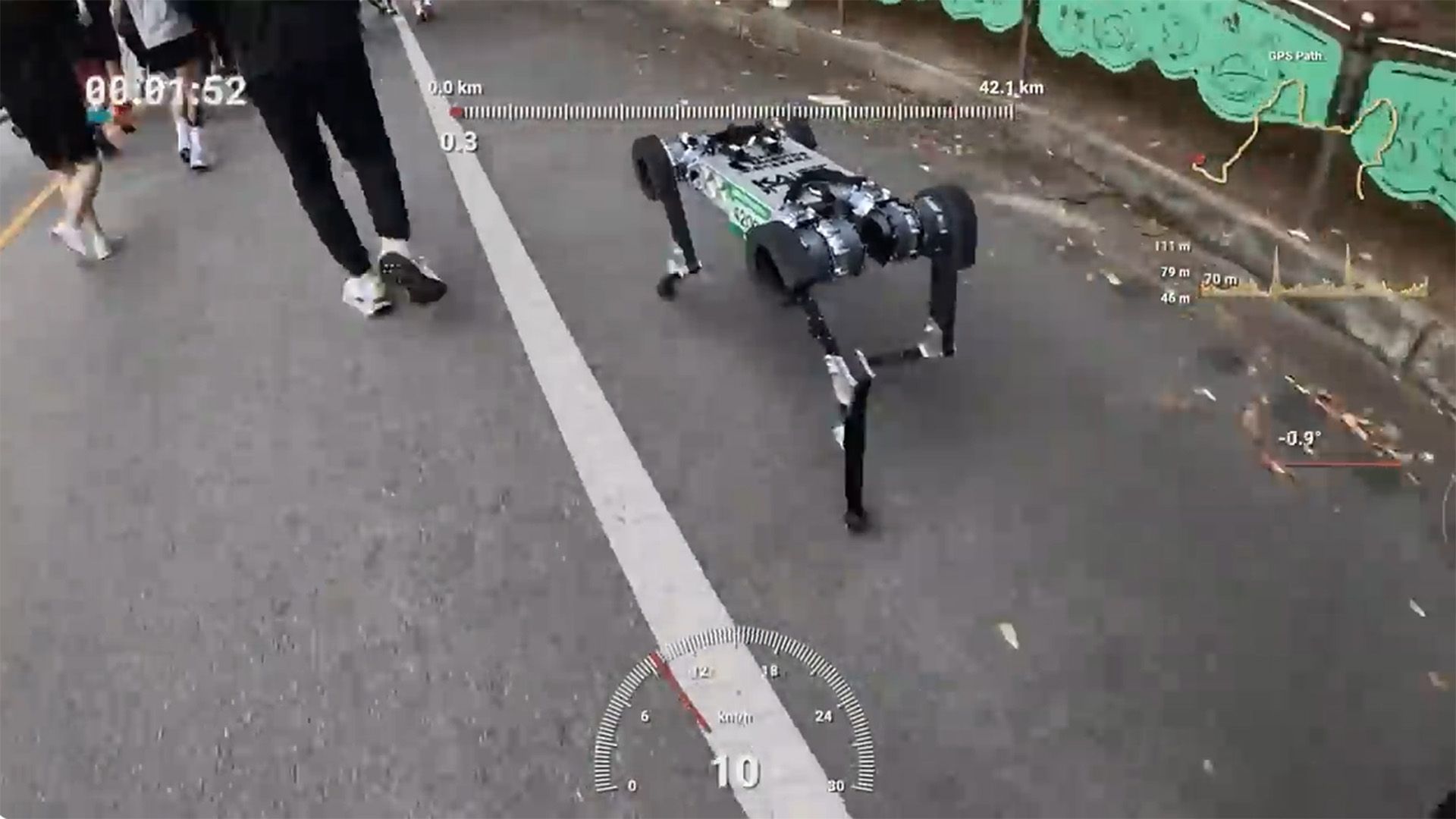
A four-legged robot completed a full marathon on a single battery charge, covering 26.2 miles (42.2 kilometers) on a hilly public-road course in South Korea two years ago. Now we know a lot more about how it achieved this record-breaking feat.

The dog-like robot, called RAIBO2, finished the 22nd annual Sangju Dried-Persimmon Marathon in just over 4 hours, 19 minutes. The bot's developers say it's the first quadruped robot to have completed an official marathon-distance event without stopping to recharge. They're commonly referred to as "robot dogs" because the movement of their joints in both front and hind legs resembles that of canines.

The scientists outlined their findings about the robot's feat, which it achieved Nov. 17, 2024, in a study published Sept. 23 in the journal Nature.

This achievement represented a new milestone in overcoming a critical limitation for quadruped robots: endurance. Although four-legged robots can cross difficult terrain that wheeled machines struggle to traverse (like stairs and rugged trails), their endurance has been limited because powering multiple joints while repeatedly lifting and stabilizing the machine's body consumes huge amounts of energy.

"Unlike wheeled robots, quadrupeds continuously expend energy at their joints to support body weight and incur kinetic energy losses during intermittent foot-ground contact," the researchers wrote in the study.

RAIBO2's race was a demanding real-world trial. It took place during the Sangju Dried-Persimmon Marathon, with the bot racing alongside human participants. The route covered two 50-meter [164 feet] elevation climbs, with slopes of up to 10 degrees. Those kinds of gradients put increased strain on the robot's energy resources, stress-testing the bot's battery management capabilities, the scientists said.

RAIBO2 had previously run a 26.7-mile (43 km), GPS-guided route across a flat athletic field, which it knocked out in 4 hours, 40 minutes on one charge. However, an earlier marathon attempt across uneven terrain against other competitors had to be aborted around the 23-mile (37 km) mark after the robot's battery ran out. The robot's developers attributed that shortfall in part to frequent pace changes as the machine attempted to adjust to the pace of nearby runners.

To compensate, the team boosted the robot's battery capacity by 33% and tinkered with the control system, including implementing joint-stiffness control at the actuator. This allowed the bot to soften its leg when it had to absorb an impact or it needed a stable, forceful push-off. After the adjustments, RAIBO2 expanded to a maximum range of 41.6 miles (67 km) on a single charge, albeit on straight paths, according to the researchers.

Another key metric was RAIBO2's total cost of transport — a measure of the energy required to move a body over a given distance, with lower values indicating less energy expended. Researchers reported that RAIBO2 achieved a total cost of transport of 0.25, compared with a human benchmark of 0.37. The researchers said their machine was the first quadruped robot to surpass that figure.

The team attributed that efficiency to several optimizations across RAIBO2's software and hardware. Especially vital were its lightweight mechanical components, which were capable of transmitting kinetic energy from its joints with very little interference. They also credited a low-loss motor-driving circuit and, on the software side, a locomotion policy specifically streamlined to limit energy use. The system was also trained using the team's simulation environment, called RaiSim, which includes models of slopes, stairs and icy roads.

Like many electric vehicles, RAIBO2 can regenerate some battery by capturing kinetic energy, particularly while traveling downhill. That capability allows it to offset some of the energy it expends while climbing, though it doesn't eliminate the extra cost of hilly terrain.

The researchers said RAIBO2 has more than three times the travel range per charge of existing quadruped robots, with a total battery capacity of 2,016 watt-hours. It's in part because of that capacity increase that the team now estimates that the robot could travel up to 15.5 miles (25 km) farther than its marathon stint, up to a total of 41.6 miles (67 km).

That kind of endurance could broaden the roles for quadruped robots in places where wheeled models are impractical, the developers added in the study. For example, they could be useful in disaster zones and mountainous areas, where a sufficiently mobile, high-endurance robot could carry cameras, sensors or communications gear across uneven terrain.

  •  
❌