Login

Viral ‘Human vs. Robot’ Fights Face Ban
California regulators sent a cease-and-desist letter to the promoters of a San Francisco cage fight pitting a human against several robot combatants.

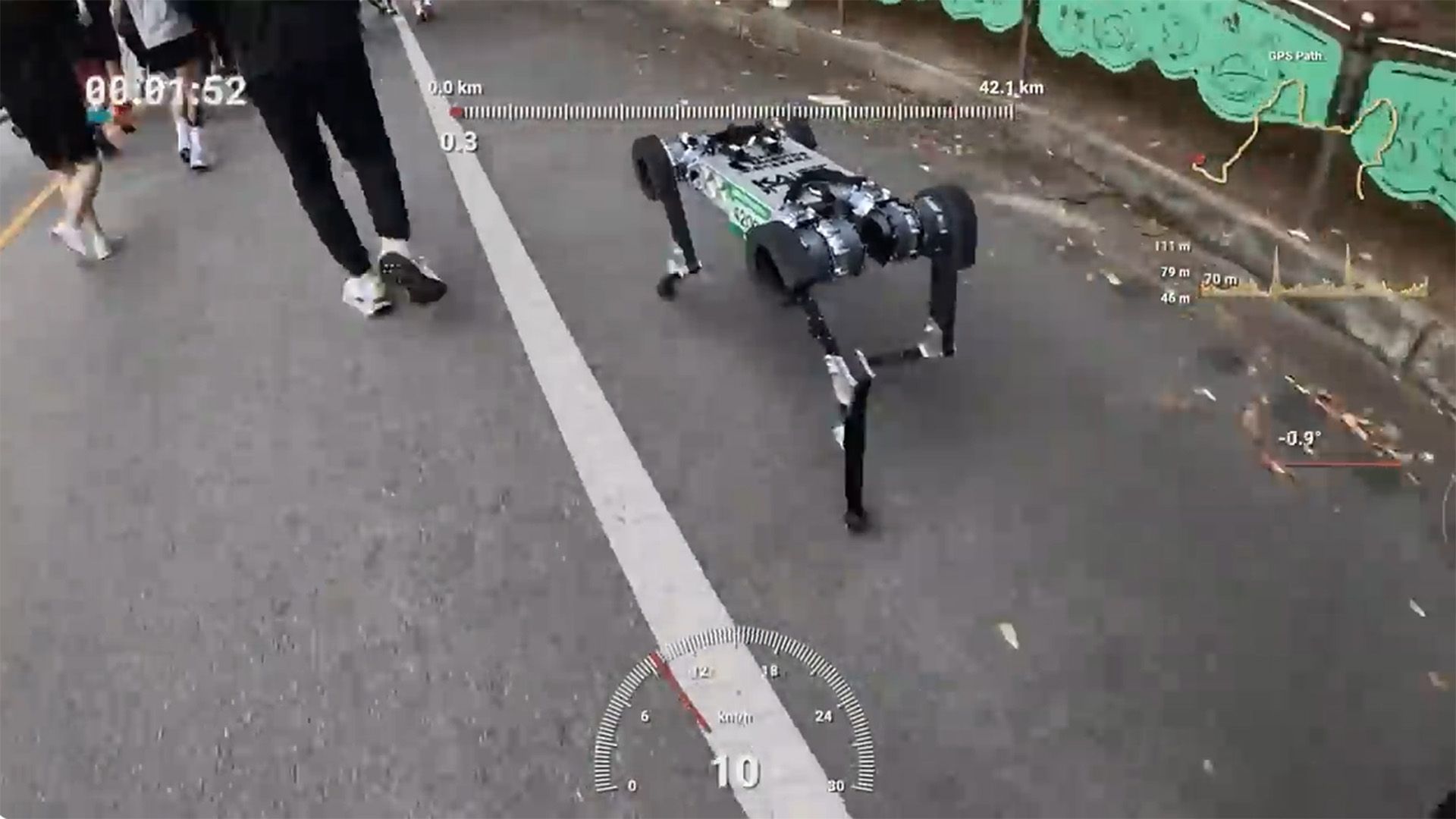
A four-legged robot completed a full marathon on a single battery charge, covering 26.2 miles (42.2 kilometers) on a hilly public-road course in South Korea two years ago. Now we know a lot more about how it achieved this record-breaking feat.
The dog-like robot, called RAIBO2, finished the 22nd annual Sangju Dried-Persimmon Marathon in just over 4 hours, 19 minutes. The bot's developers say it's the first quadruped robot to have completed an official marathon-distance event without stopping to recharge. They're commonly referred to as "robot dogs" because the movement of their joints in both front and hind legs resembles that of canines.
The scientists outlined their findings about the robot's feat, which it achieved Nov. 17, 2024, in a study published Sept. 23 in the journal Nature.
This achievement represented a new milestone in overcoming a critical limitation for quadruped robots: endurance. Although four-legged robots can cross difficult terrain that wheeled machines struggle to traverse (like stairs and rugged trails), their endurance has been limited because powering multiple joints while repeatedly lifting and stabilizing the machine's body consumes huge amounts of energy.
"Unlike wheeled robots, quadrupeds continuously expend energy at their joints to support body weight and incur kinetic energy losses during intermittent foot-ground contact," the researchers wrote in the study.
RAIBO2's race was a demanding real-world trial. It took place during the Sangju Dried-Persimmon Marathon, with the bot racing alongside human participants. The route covered two 50-meter [164 feet] elevation climbs, with slopes of up to 10 degrees. Those kinds of gradients put increased strain on the robot's energy resources, stress-testing the bot's battery management capabilities, the scientists said.
RAIBO2 had previously run a 26.7-mile (43 km), GPS-guided route across a flat athletic field, which it knocked out in 4 hours, 40 minutes on one charge. However, an earlier marathon attempt across uneven terrain against other competitors had to be aborted around the 23-mile (37 km) mark after the robot's battery ran out. The robot's developers attributed that shortfall in part to frequent pace changes as the machine attempted to adjust to the pace of nearby runners.
To compensate, the team boosted the robot's battery capacity by 33% and tinkered with the control system, including implementing joint-stiffness control at the actuator. This allowed the bot to soften its leg when it had to absorb an impact or it needed a stable, forceful push-off. After the adjustments, RAIBO2 expanded to a maximum range of 41.6 miles (67 km) on a single charge, albeit on straight paths, according to the researchers.
Another key metric was RAIBO2's total cost of transport — a measure of the energy required to move a body over a given distance, with lower values indicating less energy expended. Researchers reported that RAIBO2 achieved a total cost of transport of 0.25, compared with a human benchmark of 0.37. The researchers said their machine was the first quadruped robot to surpass that figure.
The team attributed that efficiency to several optimizations across RAIBO2's software and hardware. Especially vital were its lightweight mechanical components, which were capable of transmitting kinetic energy from its joints with very little interference. They also credited a low-loss motor-driving circuit and, on the software side, a locomotion policy specifically streamlined to limit energy use. The system was also trained using the team's simulation environment, called RaiSim, which includes models of slopes, stairs and icy roads.
Like many electric vehicles, RAIBO2 can regenerate some battery by capturing kinetic energy, particularly while traveling downhill. That capability allows it to offset some of the energy it expends while climbing, though it doesn't eliminate the extra cost of hilly terrain.
The researchers said RAIBO2 has more than three times the travel range per charge of existing quadruped robots, with a total battery capacity of 2,016 watt-hours. It's in part because of that capacity increase that the team now estimates that the robot could travel up to 15.5 miles (25 km) farther than its marathon stint, up to a total of 41.6 miles (67 km).
That kind of endurance could broaden the roles for quadruped robots in places where wheeled models are impractical, the developers added in the study. For example, they could be useful in disaster zones and mountainous areas, where a sufficiently mobile, high-endurance robot could carry cameras, sensors or communications gear across uneven terrain.
The animal kingdom has influenced several robot designs over the years to solve fundamental challenges in propulsion and movement — from horses to insects. Now, frogs are the latest creatures to inspire roboticists.
As seen in a new study published Sept. 18 in the journal Science Advances, researchers probed how twisting bent elastic rods could produce a "snapping motion" that enabled a small robot to hop or swim. This mechanism could be used to improve robots with limited power and ones that need to traverse rough terrain and even water, the scientists said in the study.
They also built a prototype to demonstrate the work. The palm-sized robot weighs just 3.4 ounces, or about as much as a deck of playing cards. It moves about three body lengths per second — launching itself forward with short jumps.
"The broader opportunity is to let the mechanics of the robot do some of the work that would otherwise require larger motors or more complicated control," Xiaonan (Sean) Huang, an assistant professor of robotics at the University of Michigan and co-first author of the study, said in a statement.
"By programming when an elastic structure stores and rapidly releases energy, we can give small robots access to powerful, repeatable motions without continuously demanding high output from the motor," Huang explained. "In the future, this principle could be useful for robots that must navigate cluttered terrain, overcome obstacles, reorient quickly, or operate across both land and water."
When a flexible rod bends and its ends are rotated, it can eventually reach a point where it changes shape to release built-up tension, the roboticists said. However, this change does not always happen in the same way. Some combinations of bending and twisting cause the rod to change shape gradually, while other combinations force it to snap rapidly from one shape to another, with the potential to provide a strong push.
The team used computer modeling and experimentation with a robotic arm to repeatedly deform the rods and find an optimal shape. In this case, they settled on a helix similar to a coiled spring to give the rod its maximum release of energy, the team reported.
With the ideal propulsion mechanism, the team then designed and built real robots that used the snapping rods to hop. They connected these rods to a rotating motor, with the bent rods twisted until they produced the snapping motion. Then, the motor unwound the twist and contorted the rod again.
"Because the design rules depend on the rod’s shape and how its ends are moved, they work across different sizes and scales," Khalid Jawed, an associate professor at UCLA's School of Engineering and co-first author of the study, said in the statement.. "This opens a promising path toward miniaturized robots just a few millimeters in size that turn small motor movements into powerful bursts of motion," said Jawed, whose lab worked on the simulation and robot arm experiments.
The final form of the prototype was a frog-like robot with a pair of snapping rods at the rear of its main body. Tests included hopping over a broad range of surfaces, including solid materials like wood and glass, as well as trickier soft and slippery surfaces that used materials like leather. The scientists also tested the robot outdoors on sand and grass, noting that it could even climb and descend steps and, with paddle attachments, swim.
By using only one of the snapping rods, the team enabled the robot to turn and, with a remote control, navigate a small obstacle course.