❌

Reading view

Germany builds world’s tallest wind turbine, reaches nearly 1,200 feet height
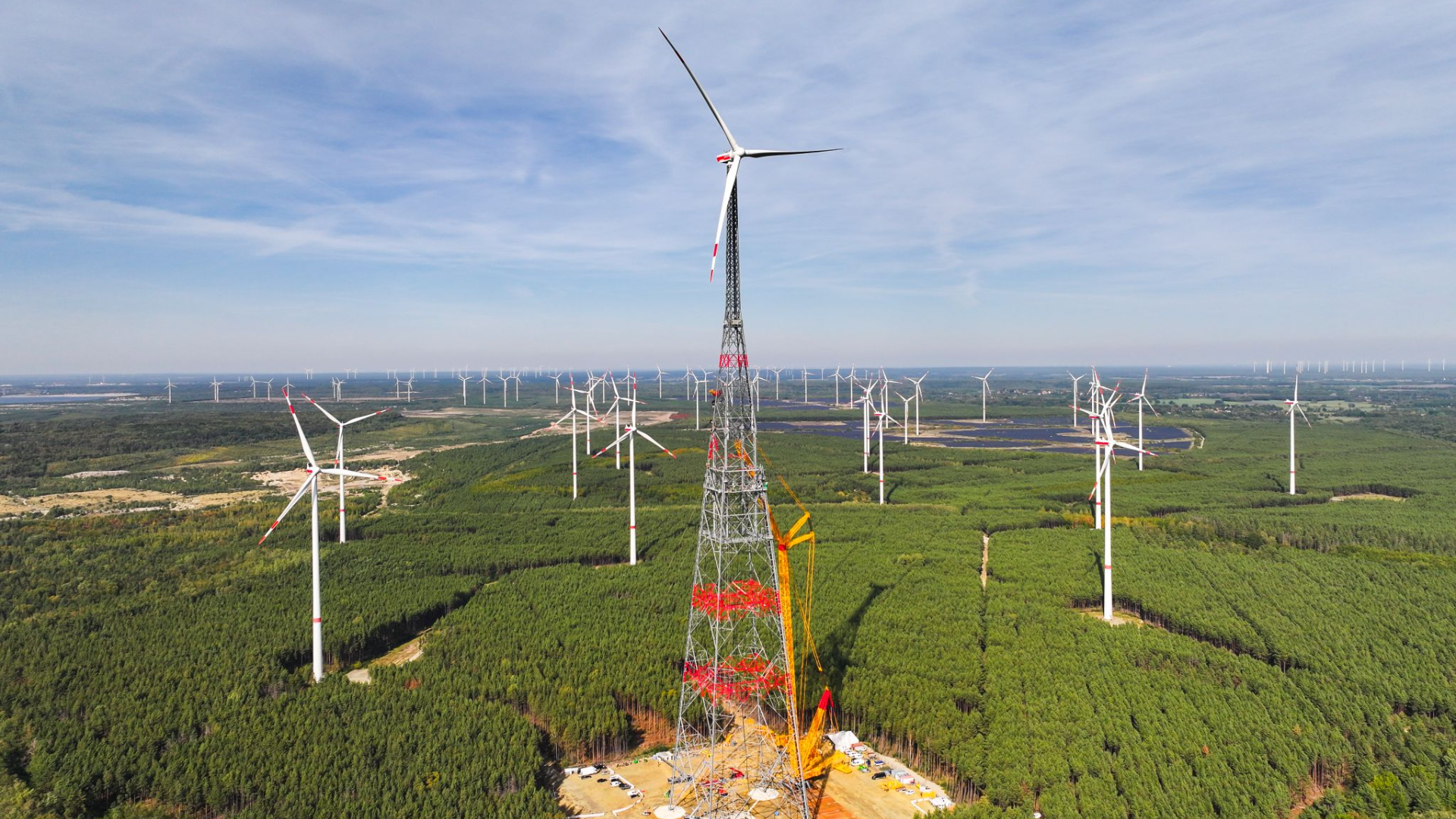
A wind turbine standing nearly 1,200 feet tall has reached its full height in eastern Germany, creating a new approach to capturing wind energy at elevations where winds are stronger and more consistent. 

Developed by German engineering company GICON for the Federal Agency for Disruptive Innovation, or SPRIND, the pilot turbine in Schipkau is designed to test whether going dramatically higher can produce substantially more electricity from the same amount of wind infrastructure.

The structure reaches 1,197 feet, including its blades, making it Germany’s second-tallest structure after Berlin’s TV tower. GICON says the design could eventually generate roughly twice as much electricity as a conventional turbine with the same rotor diameter, although that estimate still needs to be demonstrated in operation.

A wind turbine built to reach higher

The main idea behind GICON’s design is to go where the wind is better. Wind speeds generally increase with altitude, while higher elevations can also provide more consistent wind conditions. Hence, a turbine operating hundreds of meters above the ground has access to a larger and potentially more reliable energy resource than a conventional turbine.

The Schipkau pilot has a rated capacity of 3.8 megawatts, while future versions are expected to exceed 7 MW. The company’s projected doubling in energy output refers to electricity generated over time, rather than the turbine’s maximum rated power.

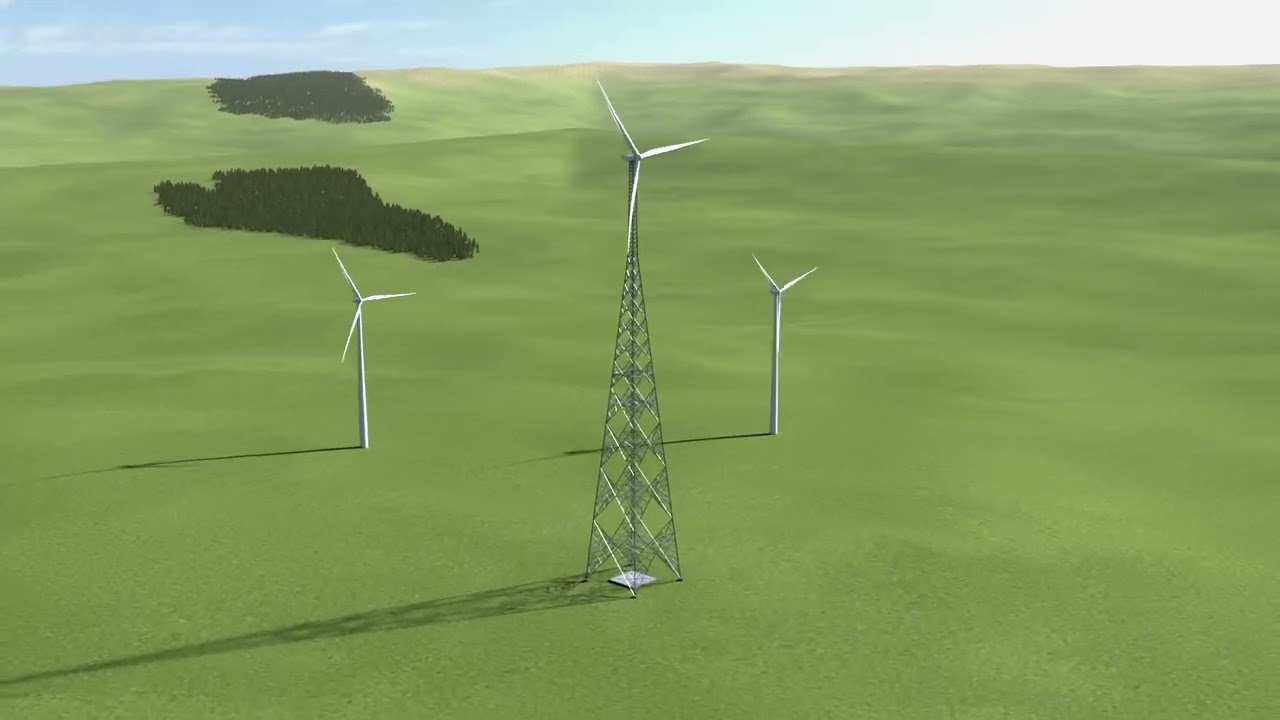
Reaching that altitude, however, required GICON to rethink how such a turbine could be constructed. Instead of using a conventional crane capable of reaching the top of the tower, the company used a telescoping tower design. 

A specialized lifting mechanism raised the inner tower through a surrounding lattice structure before securing it at its final height. GICON founder and CEO Jochen Grosmann described reaching 1,197 feet as a major milestone for the project, which began as a concept before becoming a full-scale pilot facility.

Adding power without new wind farms

One of the more interesting possibilities is that high-altitude turbines could eventually be added to existing wind farms rather than requiring entirely new sites. GICON and SPRIND envision the systems operating as a second tier of wind generation, with the taller turbines positioned above conventional wind turbines. Therefore, their rotors would operate at higher elevations while existing turbines continue generating electricity below.

According to the current assessment, Germany could potentially accommodate as many as 4,000 high-altitude turbines within existing wind farms. If the concept works as expected, that could allow additional electricity generation without expanding wind farms into new areas, while also making better use of existing grid connections and developed wind-energy sites.

While the completion of the structure marks an important achievement, the more important test is still ahead, as official commissioning is planned for November, after the remaining construction work is completed. 

Once operational, the turbine will provide the data needed to determine whether the additional height delivers the expected increase in energy production and whether the benefits justify the additional engineering complexity.
💾

A 1,197-foot wind turbine has reached its full height in Germany, making it the world’s tallest wind turbine.
  •  

OpenAI’s GPT-6 Astra found a way to play World of Warcraft without seeing the screen

OpenAI’s frontier intelligence model GPT-6 Astra has completed the Orc starting area in World of Warcraft in about 40 minutes without processing a single rendered game frame, according to the developer of the open-source agent-wow project.

Instead of seeing the game through screenshots or computer vision, the AI reconstructed its environment from server network messages and game data, then built its own tools to navigate and play.

The experiment was conducted on a private local server running AzerothCore, not Blizzard’s live World of Warcraft service. The developer gave Codex, running GPT-6 Astra at its high reasoning setting, a single instruction: create an Orc character and complete all quests in the starting zone. The agent reportedly finished the run without dying.

Reading the game’s network traffic

The unusual part of the experiment is how little conventional game automation was provided to the model. Agent-wow does not use computer vision, screenshots, or direct keyboard and mouse controls. Instead, it allows an AI agent to communicate with the game server through World of Warcraft’s network protocol, Tom’s Hardware reported.

The project also does not provide predefined movement, combat, or interaction systems. The agent is expected to build the capabilities it needs through modules. During the run, GPT-6 Astra created a module that could process dozens of different server messages and keep the resulting information in memory. A Python script then used those messages to construct the model’s view of what was happening in the game and send actions back to the server.

That meant the model could determine things such as its surroundings, quest progress, and available targets without ever receiving the visual information a human player normally relies on.

The experiment therefore tests something different from simply teaching an AI to recognize a game screen. The model had to reason about a structured but unfamiliar environment using the information available through the game’s underlying protocol.

Astra built its own tools to complete the quests

The agent also had access to AzerothCore’s underlying data, including SQL files containing information about quests, NPCs, and spawn locations. It used those resources to determine where quests started and ended, and how different objectives were connected.

The developer said the model effectively created a plan for completing prerequisite quests in sequence. It also managed routine tasks such as selling unwanted items, equipping better gear, and training abilities before reaching the final cave in the starting area.

Navigation was another problem the agent had to solve, with GPT-6 Astra generating a C++ helper that used AzerothCore’s navigation-mesh data, known as mmaps, to calculate routes. The helper used the Detour pathfinding library to generate waypoints between locations, which the agent could then follow.

The developer said the system even encountered locations where collision information appeared to be incomplete and was able to exploit those map quirks. That makes the result interesting, but also means the run should not be treated as a straightforward test of how well an AI can navigate an unmodified commercial game world.

💾

The AI relied on server network messages, quest data and navigation files instead of screenshots or computer vision.
  •  
❌