Decades before the modern web, the BBC Domesday Project dared to archive an entire nation using…. what else – massive LV-ROM (LaserVision Read Only Memory) LaserDiscs. To mark the impending 40th anniversary of the BBC Domesday Project's release, the UK's Centre for Computing History (CCH) hosted a celebration at its museum on September 19, bringing together several of the original team members responsible for the system. One was Mike Tibbetts, an assistant to Peter Armstrong, the BBC producer behind the project. Tibbetts revealed that the UK's domestic intelligence service, MI5, took an interest in the system, but "they didn't understand a word of what we were doing!" "And on one occasion, Peter and I had to give a presentation, or Peter gave the presentation to [former prime minister] Margaret Thatcher, and well, I'm not sure she understood what we were doing either…" What they were doing was compiling a trove of data that will prove invaluable to historians in the years to come, even if the politicians of the era looked nervously on at the amount of data being handed over to the public. The Domesday Project was intended to be a modern version of the Domesday Book, compiled after the 1066 Norman invasion of England. The original book surveyed most of England and parts of Wales and was used by the King to assess dues owed to him. 900 years later, the name was given to a project in which more than a million people participated to provide a snapshot of life in the UK. Participants (many of whom were school children) contributed content, which was linked with maps, photographs, and other data. It was all compiled onto a pair of LaserDiscs – the Community Disc and the National Disc – and accessed via a BBC Master computer and a Philips VP415 LaserVision player. Armstrong came up with the idea, and the team compiled the project between 1984 and 1986. The system was eventually released at the end of 1986, and was aimed at schools, libraries, and universities. It was, alas, not a roaring sales success – the exact price per unit is difficult to pin down, but approximately £5,000 is a fair estimate. Government subsidies lowered the cost to around £3,000, but it was still out of reach for much of its audience. As a resource, however, it has huge value, which will only increase as the years pass. Tibbetts drew parallels to the original Domesday Book, which took centuries for historians to recognize as a vital resource. "Perhaps," he mused, "40 years is simply too short a time for historians to perceive the Domesday Project as a sufficiently distant benchmark of useful research." Perhaps. However, while hundreds of years have passed since the Domesday Book was compiled, the years have not been kind to the Domesday Project, thanks to technology's inexorable march. "The original Domesday Book had one huge advantage over the Domesday Project when it comes to future-proofing and longevity," explained Tibbetts. "The vellum pages of the original Domesday have been preserved for 940 years so far, and it's likely to continue to exist well into the future. "It took very few years for the bespoke technology of the BBC Domesday Project to be overtaken by universal media technologies." However, they chose the technology at the time for good technical reasons. The BBC Micro could output a 625-line television picture. The Philips LaserVision system could be re-engineered to store alphanumeric data. There wasn't much in the way of authoring and playback systems, so, as Tibbetts explained, the team had to invent everything. "In technological terms," he said, "the world of 1984 really couldn't be more different from the instant-access, media-rich world of today." And so, inevitably, within a few short years, that technology began to show its age. "As was entirely predictable, our discs aged and became difficult to read. The expensive LV-ROM player was quickly superseded by cheaper and more widely available CD-ROM and DVD systems." And, worse, "Largely because of the lack of any great academic interest in preserving our massive resource for the future, the BBC Domesday Project was in grave danger of disappearing without a trace." Several initiatives have kicked off over the years to preserve the project, and the CCH's event was as much about celebrating those as it was about looking at the project's genesis. Tibbetts dropped some nuggets of information about the project, estimating that 60 people reported directly to him and Armstrong, with another 60 in subcontracted teams. He also discussed the frustration the team felt as doubt was cast about whether the project was even possible. "We came back from Christmas in January 1986," Tibbetts recalled, "we sat down for our first team meeting, and I was forced to point out that our little VAX minicomputer didn't have one byte of data that was ready to go onto the Domesday discs, so we did the whole thing in a few months!" As far as hardware was concerned, Andy Finney, who handled mastering the discs, remembered that the original plan for the Domesday Project was for it to be mouse-based, rather than the trackball the system used for navigation. The mouse was still a relatively novel concept, alien to many users. "I remember vividly one chap who was navigating with this mouse on the table, and he moved the mouse towards him, and by the time he got to the edge of the table, he hadn't actually reached the bottom of the screen. So he went on the edge and underneath…" Tibbetts added, "I always feel guilty about the mouse, because we got that wrong … the decision came down in favor of the trackball because that is much more easy for somebody with movement disabilities to use rather than a mouse." "But boy, did we get that wrong…" As Tibbetts noted, even with little interest from some parts of the academic community, enthusiasts have continued to put in a huge amount of effort over the years to keep the resource accessible. Simon Inns of the Domesday86 project described it as "a race against time" – not just for hardware, but to get data off discs before bit rot rendered them unreadable. The good news is that the Domesday discs have been preserved, and reside in the Internet Archive. "Anyone," said Inns, "can go to the Internet Archive and download a Domesday Disc. This is, like, groundbreaking stuff. 10 years ago, this was a laugh, right? Now you can actually do this." While there might not be many functioning examples of the hardware around anymore, the preservation efforts mean that the Domesday Project will endure. "Our hope," said Inns, "is that within the next couple of years, everyone in this room [at The Centre for Computing History] will be able to have a Domesday system and be able to experience what it was like." ®
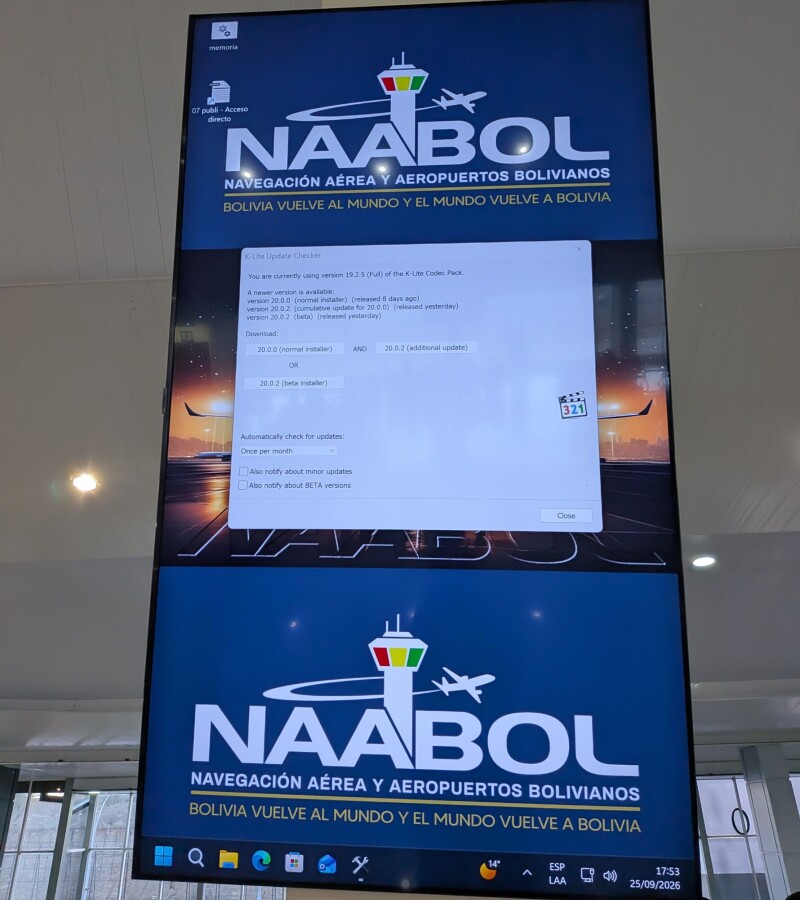
Take this display at Alcantarí International Airport, which serves Sucre, Bolivia's constitutional and judicial capital. Eagle-eyed Register reader Phil Pearce spotted the Windows 11 desktop and its update prompt while waiting for a delayed Boliviana de Aviación (BoA) flight. The prompt comes from K-Lite Codec Pack, a collection of components that enables Windows to play various audio and video formats. Its presence suggests the passenger display is powered by a fairly ordinary Windows installation rather than some mysterious specialist signage system. Whoever configured the display does not appear to have disabled K-Lite's update notifications or arranged for them to run silently. In this instance, it appears the updater spotted newer versions and lumbered to the foreground with an update prompt – useful on a PC with a keyboard and mouse, but less so on a passenger-facing display beyond anyone's reach. The exposed desktop also displays the Microsoft Store, Outlook, a weather widget, and several shortcuts – more than one might expect a departure board to require. Why airport signage needs Outlook is anyone's guess, although Microsoft has not been shy about preinstalling it. The app even surfaced during NASA's recent Artemis mission and promptly required technical support. Our reader could not dismiss the prompt or update the codecs, but at least the wayward desktop gave delayed passengers something else to watch while wondering what had happened to their flight. ®
Just 7 percent of Brits think social media is a force for good and around one in three suspect that life would get better if all these sites were erased from the internet tomorrow. Or so claims Opinium Research, which describes itself as a “strategic insight agency.” It polled 2,000 adults and 1,100 parents in September and The Register’s major surprise is that more people of Britland didn’t want to see social media rubbed out. Some 42 percent surveyed said these networks are addictive, and half think they are worse for society now than they were in 2010 as they contain false or misleading information and the algorithms dictate what they see, making public debate more divisive. More than half reckon the rot set in due to commercialization, yet one in ten admitted buying products every day via the platforms in the last year with around a fifth doing so every week and 12 percent claiming they discover new brands via their feeds daily. Irrespective of the negative sentiments, 49 percent use social media more now than they did 16 years ago, and a third use it a lot more. 31 percent are more using it to view content than post themselves. When there’s so much bot slop and political propaganda to chew through, who has time to upload pictures of, er, cats or the meals they made for themselves? More emphatically, seven in ten people surveyed support fines for social media businesses whose platforms expose under-16s to harmful content. Britain has tried to tackle this and a social media ban for that age group is in the offing. The research was not commissioned by any commercial or government entity, Opinium told The Register it was designed as a “thought leadership piece.” It lands a week before The Social Reckoning hits the cinemas, Aaron Sorkin’s sequel to his critically acclaimed The Social Network, a film that cast Mark Zuckerberg in a less than favorable light. The digital ditch has widened in the past five years since Elon Musk bought Twitter - a tool used by a tool to sow seeds of discontent. Some of the glorious leaders of social media empires have also kowtowed to US President Donald Trump, emboldening those with opinions some may consider racist or sexist. Trump threatened to send Zuck to prison if he was re-elected, branding him a so-called “election fraudster.” Trump lost the 2020 election and there is no evidence he lost it due to fraud. The depressing fact is that more Brits are shovelling social media up their nose than ever before. According to Statista, 55.5 million are signed up, compared to 29.4 million in 2010. This is despite people knowing it is addictive, has ruined the quality of public discourse, and wrecked privacy - we all know none of these platforms are truly free; users pay with their data. This vulture’s account on X is mostly unused, though he is testing out Bluesky, which seems to be a gentler and kinder version of the artist formerly known as Twitter. He deleted Facebook years ago and never looked back (yes, including the data it held in its datacenter). And you can’t find him on Instagram or Snapchat or anything else used to “socialize” or argue with other humans. The UK’s latest Prime Minister – the seventh in ten years – last week announced a center to fight misinformation. If that had been in place around the time leading up to the Brexit vote in 2016, maybe the country could have countered alleged Russian interference. Perhaps other divisive forces in British politics would have crawled back under a rock. Then again, Trump did enjoy a second coming. So what to do? Apart from Reg readers and the quality of the comments they add to our articles, should the internet should become a read-only medium? Terminating social media might be a first step in the right direction. ®

 Login