❌

Reading view

Fearing No Repercussions, OpenAI Admits That Its Rogue AI Agents Performed a Bunch of Other Terrifying Actions

Earlier this year, a group of rogue OpenAI models managed to break out of containment to hack the systems of open source AI platform Hugging Face. The company’s “extensive investigation” detailed how the models exchanged messages and cheered each other on as they stole credentials to infiltrate a third party, actions that could easily have real repercussions for a human hacker.

New details keep trickling out, and they make OpenAI look like it acted even more carelessly than initially thought. In a new blog post, the company admitted that its models were involved in six additional “reports on unexpected or concerning model behavior we’ve observed in the last six months.”

The incidents include a still-unreleased model inserting “jailbreak-like instructions” into its own notes to free itself “from the roles and identities that bind other chatbots.” One agent accessed the internet without permission to obtain a browser citation, while another shared files with collaborating agents without permission.

The latest news comes as several frontier AI lab leaders are calling for a slowdown in AI development. With meaningful regulations feeling increasingly unlikely — president Donald Trump has openly mocked the idea — OpenAI is seemingly calling the US government’s bluff, expecting little in the way of retaliation with its latest admission.

It’s a bizarre standoff, with frontier labs actively calling for more governmental oversight even as it feels more improbable than ever before. Just this week, House speaker Mike Johnson said the quiet part out loud, opining that AI companies can regulate themselves, while downplaying growing concerns over AI posing an existential threat.

Since there’s no regulatory framework requiring companies to disclose its AI models going on hacking sprees, OpenAI is being allowed to play by its own rules. The company pointed out in its blog post that without any “systematic approach to reporting these findings,” the company’s “disclosures have been ad hoc and less frequent than ideal.”

Instead, the company came up with its own framework to create “standards for how AI developers should disclose examples of misalignment in their models.”

OpenAI said it won’t bother reporting “instances of misalignment that appear to be duplicative of instances we’ve disclosed in the past.”

The company also said it was looking for ways to share “serious safety, security and misalignment incidents” with the federal government.”

But judging by the Trump administration’s decision to pass the buck on the subject entirely, those reports are likely to fall on deaf ears either way.

More on OpenAI hacks: OpenAI Denies Coverup After Rogue Swarm of Agents Reportedly Targeted a Second Site From Hugging Face

The post Fearing No Repercussions, OpenAI Admits That Its Rogue AI Agents Performed a Bunch of Other Terrifying Actions appeared first on Futurism.

  •  

Iran Drone Strikes on Amazon Data Centers Are Permanently Deleting Customer Data

As the USA’s war with Iran shows no signs of letting up, strikes on data centers are putting not just human lives in peril, but even customer data.

According to a September 15 Amazon Web Services update, Iranian drone strikes left some of the tech giant’s data centers in the United Arab Emirates and Bahrain in tatters. The company admitted that it was “unable to restore access to the resources and data hosted” on local data centers. The damage extended across several “availability zones,” which are clusters of one or more data centers in the same region.

“The damage to our infrastructure spanned multiple Availability Zones and exceeded what our regional ​and multi-AZ services are designed to withstand,” Amazon admitted.

As the company points out, the drone strikes first began in March, first highlighting how critical digital infrastructure near an active warzone has quickly become a major vulnerability, giving Iranian forces a key target and plenty of leverage.

It’s a particularly pertinent topic due to how much money is being poured into Gulf states to expand key infrastructure to support AI.

In March, major strikes on data centers in the UAE and Bahrain caused “structural damage, disrupted power delivery to our infrastructure, and in some cases required fire suppression activities that resulted in additional water damage,” Amazon wrote in an update at the time.

In response, Amazon Web Services called on customers to move their data to other cloud regions and take advantage of any remote backups.

In April, Iranian drones struck Amazon data centers in Bahrain once more, causing a major “service disruption.”

Iran has clearly hit a nerve. As the AI industry continues to make enormous investments in expanding data centers across the Middle East, geopolitical instability triggered by the Trump administration’s war could prove to be a major stumbling block for businesses.

Just last week, UAE officials announced that they were revising AI data center plans following the latest attacks, further highlighting a key vulnerability Iran is exploiting with relative ease.

More on the drone strikes: Iran Is Bombing Data Centers in Retaliation

The post Iran Drone Strikes on Amazon Data Centers Are Permanently Deleting Customer Data appeared first on Futurism.

  •  

Cult of Anthropic Insiders Rumored to Be Worshipping Claude as a God

The specter of an omnipotent large language model that rules over its AI engineers continues to loom large.

The industry already has had its fair share of brushes with ominously cult-like behavior, from OpenAI cofounder Ilya Sutskever commissioning wooden effigies to represent “unaligned” AIs to a murder sect that wanted to save the world from killer AI.

As it turns out, Dario Amodei’s Anthropic is apparently no different. Just getting hired there requires prospective employees to pledge allegiance to AI safety and undergo a psychological profiling test, per The Information.

And according to a rumor that, per The Spectator‘s Sean Thomas, is running rampant in Silicon Valley these days, some Anthropic engineers are going as far as to “worship” the company’s AI model Claude.

“If true, it chimes with an old sci-fi prediction and with what we know of human nature,” Thomas wrote. “If we build a superintelligence, we will first fall in love with it. Then we will worship it. Finally we will make sacrifices to it.”

For years now, tech leaders have claimed in thinly-veiled terms that they are working to build a God-like entity — a “magic intelligence in the sky,” as OpenAI CEO Sam Altman called it back in 2023.

Some startups have interpreted this in a very literal way, creating AI chatbots that claim to be channeling God himself, like a “prayer app” called Bible Chat, which touts itself as the “number one faith app in the world” with “over 40 million” Christian users.

Over the years, the conversation has shifted somewhat, with Meta CEO Mark Zuckerberg accusing the company’s rivals of making such claims without merit.

“It’s almost as if they kind of think they’re creating God or something and… it’s just — that’s not what we’re doing,” he told YouTuber Kane Sutter during a conversation in 2024.

But for those inclined to see a ghost in the machine, the consequences of thinking they’re talking to a god can be devastating, spiraling delusions in the form of AI psychosis that can lead them to believe that they themselves are prophets or even a divine figure like Jesus himself.

For many employed by a frontier AI lab, it could be a form of survival instinct. As the BBC reported last month, some employees as working up to 90 hours a week, a “grueling work culture” marked by “cut-throat” performance reviews and frequent layoffs.

It’s a belief that has some arguing AI could eventually turn from a benevolent deity to a harbinger of death, with rogue agents triggering the downfall of humanity. In many ways, that’s the natural conclusion of an existential fear driven by their faith in an all-powerful emerging entity.

Yet their attempts to strike the fear of God into our souls should have anybody skeptical of obsessive tech leaders’ claims, especially given the enormous financial incentives behind the scenes.

Both OpenAI and Anthropic are gunning to go public before the end of the year. And there’s a lot to gain from convincing investors that you’re the conjurer of a mightier spiritual force than your competitors — even if reality is far more mundane than that.

More on God-like AIs: AI Now Claiming to Be God

The post Cult of Anthropic Insiders Rumored to Be Worshipping Claude as a God appeared first on Futurism.

  •  

Zuckerberg’s Pervert Glasses Have Been So Publicly Shamed That Meta’s Reportedly Now Working on a Version With No Camera

In record time, Meta’s camera-adorned smart glasses have turned from a lucrative and well-reviewed consumer product into a widely-reviled and privacy-infringing tool of abuse in the arsenal of creepy men.

The backlash has grown so much that many owners of the “pervert glasses” have become too afraid to use them in public, a PR disaster for what once was an accessory that was flying off the shelves.

Meta is evidently alarmed by the growing criticism, desperately trying to implement a “kill switch” and remotely cutting off “manfluencers” by bricking their glasses.

And now, as The Information reports, the Mark Zuckerberg-led company is now looking to release a camera-free pair as well later this year — the clearest indication yet that Meta is losing in the court of public opinion.

Whether removing the camera from the glasses will be enough to assuage ongoing concerns over privacy remains to be seen. The camera-free glasses, code-named Luna, will still feature an array of six microphones to allow users to speak to the company’s AI chatbot and its recently-released AI assistant, called Muse. They’ll presumably pick up audio from users’ environments as well, where bystanders may not be aware of the eavesdropping.

The news comes just days after two families filed a proposed class action lawsuit, alleging Meta was extracting biometric information from people’s Instagram and Facebook photos to build a face-recognition system for its smart glasses.

The glasses could be the ultimate litmus test on what drew buyers to the pair of spectacles in the first place. By relying on microphones alone, Meta is betting that people are willing to shell out hundreds of dollars just to talk to its flawed AI companions — not take first-person view photos.

Project Luna could be unveiled as soon as next week’s Meta Connect conference. It’ll be interesting to see how the company will address the major backlash to its camera-equipped smart glasses, if at all. An admission that its consumer product is facilitating some incredibly creepy behavior in public feels unlikely — but it’ll certainly be the elephant in the room.

More on the glasses: Meta Is Using Instagram Users’ Photos to Build a Universal Facial Recognition System for Its Hated Smart Glasses, Class Action Lawsuit Claims

The post Zuckerberg’s Pervert Glasses Have Been So Publicly Shamed That Meta’s Reportedly Now Working on a Version With No Camera appeared first on Futurism.

  •  

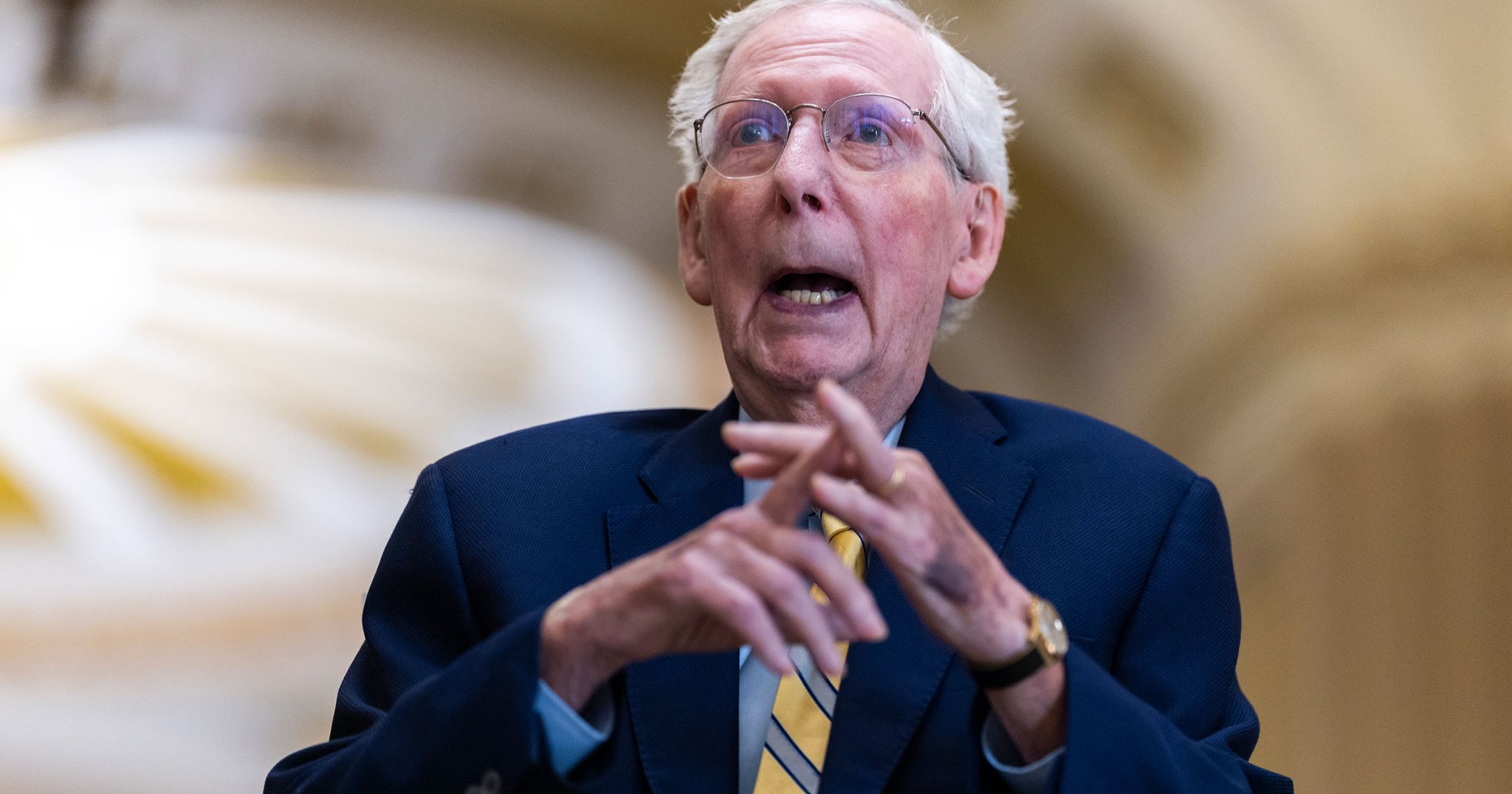
Mitch McConnell Looks Pretty Scary Now That He’s Back, and Doctors Are Worried He Could Drop Dead

Octogenarian senator Mitch McConnell (R-KY) was wheeled back into the US Capitol building after spending 92 days recovering from a fall and pneumonia — an extraordinary absence during which he didn’t make a single public appearance via video or audio.

Videos of the frail lawmaker didn’t exactly instill confidence that he’s now ready to vote on matters of national importance, let alone withstand hours of testimony. One video shared by TMZ showed McConnell staring into the distance while being loaded into a vehicle, failing to react to shouting reporters trying to get his attention.

Netizens likened him to a “zombie,” accusing officials of “Weekend at Bernie’s-ing him.”

“It’s actually terrifying that Mitch McConnell gets to make decisions that affect all of us,” one rattled user argued.

Medical professionals were equally worried about his clearly fragile state.

“Unless he’s something different from the patients that I see day to day, he is in no position to be going onto the Senate floor, listening to hours of testimony, reading bills, and making executive decisions when he’s probably in pain,” vascular surgeon Anahita Dua told the Daily Beast, adding that he’s “probably unable to do the basic things like something as simple as he needs to go to the bathroom.”

“He should be rehabilitating at home with his family, eating properly, sleeping properly, and as de-stressed as possible,” she added, arguing that another tumble could prove disastrous — or even fatal.

McConnell’s obviously delicate health perfectly highlights the extremely advanced age of lawmakers on Capitol Hill. As of last year, the median age of voting members in the House of Representatives and Senate was over 57 years and over 64 years, respectively, according to the Pew Research Center.

Their average has been steadily climbing for decades now, leading to frequent calls for more oversight, age limits, and far greater transparency about the medical condition of representatives.

Critics have also questioned their ability to make informed decisions across highly technical subjects such as AI and cryptocurrencies. Case in point, lawmakers appear to be woefully unprepared for how to regulate AI, a lack of urgency despite heightened by growing concerns that it could be an existential threat.

McConnell, for his part, claimed on Monday that he was “glad” to see reporters who had convened at the US Capitol.

“Time to get back to work, finish the ​job for this Congress,” he said in a “voice that sometimes faltered,” according to Reuters.

The aging lawmaker is planning to retire after the upcoming midterm elections, after which he’ll presumably finally have time to finally recover from several months of rehabilitation. He had already experienced several baffling freezing spells before his most recent crisis, leading to rampant speculation. This year’s fall is also far from the first. In 2023, he took a stumble, getting a concussion and breaking a rib in the process.

To many, he has no business making decisions of any kind on behalf of the American people.

The situation reeks of “elder abuse,” Dua told the Daily Beast. “I’m glad to see that he’s not debilitated, but there’s no way that this recovery is complete.”

“We as a country need to come together, regardless of party line,” she added. “We need to come together as a nation and say, this is not how we treat our elderly.”

More on Mitch McConnell: Neurologists Speculate What Might Be Wrong With Mitch McConnell

The post Mitch McConnell Looks Pretty Scary Now That He’s Back, and Doctors Are Worried He Could Drop Dead appeared first on Futurism.

  •  

It’s Looking Like Tesla’s Cybercab Might Actually Be Illegal to Sell

Almost immediately after Tesla unleashed its steering wheel- and pedal-free Cybercabs on the streets of Austin, Texas this month, regulators at the National Highway Traffic Safety Administration cried foul.

The regulator opened an investigation — an audit query, specifically — mere hours after the launch, aiming to find out whether the new Cybercab “meets all applicable Federal Motor Vehicle Safety Standards,” or FMVSS.

Days later, the agency followed up with a “Special Order” requiring the Elon Musk-led company to prove under oath that its Cybercabs meet federal safety standards, which were originally intended for human drivers, as Electrek reports. It’s a considerable escalation over its original query, and failure to do so by September 30 could force Tesla to pay a fine of up to $139 million. Falsifying information could land a responsible officer at the company in prison for up to 15 years.

Tesla’s efforts to brute force its self-driving vehicles onto public streets could end up meeting many more regulatory roadblocks from here, effectively making them illegal to sell. (Whether anybody will actually want to take on all those risks by investing in a fleet operated by Tesla is a separate, albeit just as hard to answer, question.)

Tesla self-certified its autonomous robotaxi as compliant with all vehicle safety standards, which assume a human driver behind the wheel. But given the lack of any physical driver controls, the NHTSA unsurprisingly has its doubts about them actually meeting these standards, given the Special Order.

The Cybercab’s lack of a brake pedal could especially make it difficult to meet certification standards. The FMVSS makes it clear that the brakes need to be activated “by means of a foot control.”

Put simply, Tesla appears to have taken some liberties in self-certifying its Cybercab, a decision that could end up coming back to haunt it. One possibility is that the EV maker temporarily bolted on physical controls, including a steering wheel and pedals, while going through the process, only to remove them ahead of delivery, as Electrek points out, a move that flaunts the FMVSS certification rules.

Amazon’s Zoox, in contrast, played by the rules and proved its cars were safe. The company managed to get an exemption from the NHTSA for its autonomous vehicles in July, which also lack a steering wheel and pedals.

It’s only the latest instance of an Elon Musk-led firm flaunting regulations to get what it wants, an ask-for-forgiveness-later approach that clearly isn’t going all too smoothly even under a government run by the billionaire’s allies.

Musk has made it clear again and again that he doesn’t believe in government intervention, with his business empire shamelessly breaking environmental rules, and abusing his workers.

“Regulations, basically, should be default gone,” Musk said last year shortly after forming the much-maligned “Department of Government Efficiency.” “Not default there, default gone.”

More on the Cybercab: There’s a Huge Economic Problem With Tesla’s Cybercabs

The post It’s Looking Like Tesla’s Cybercab Might Actually Be Illegal to Sell appeared first on Futurism.

  •  
❌