❌

Reading view

In 1949, researchers testing underwater acoustics off Bermuda lowered an early recording system into the water and kept the unexplained sounds it picked up. Seventy-seven years later they were identified as what may be the oldest preserved recording of a whale singing, made before scientists understood humpback whale song.
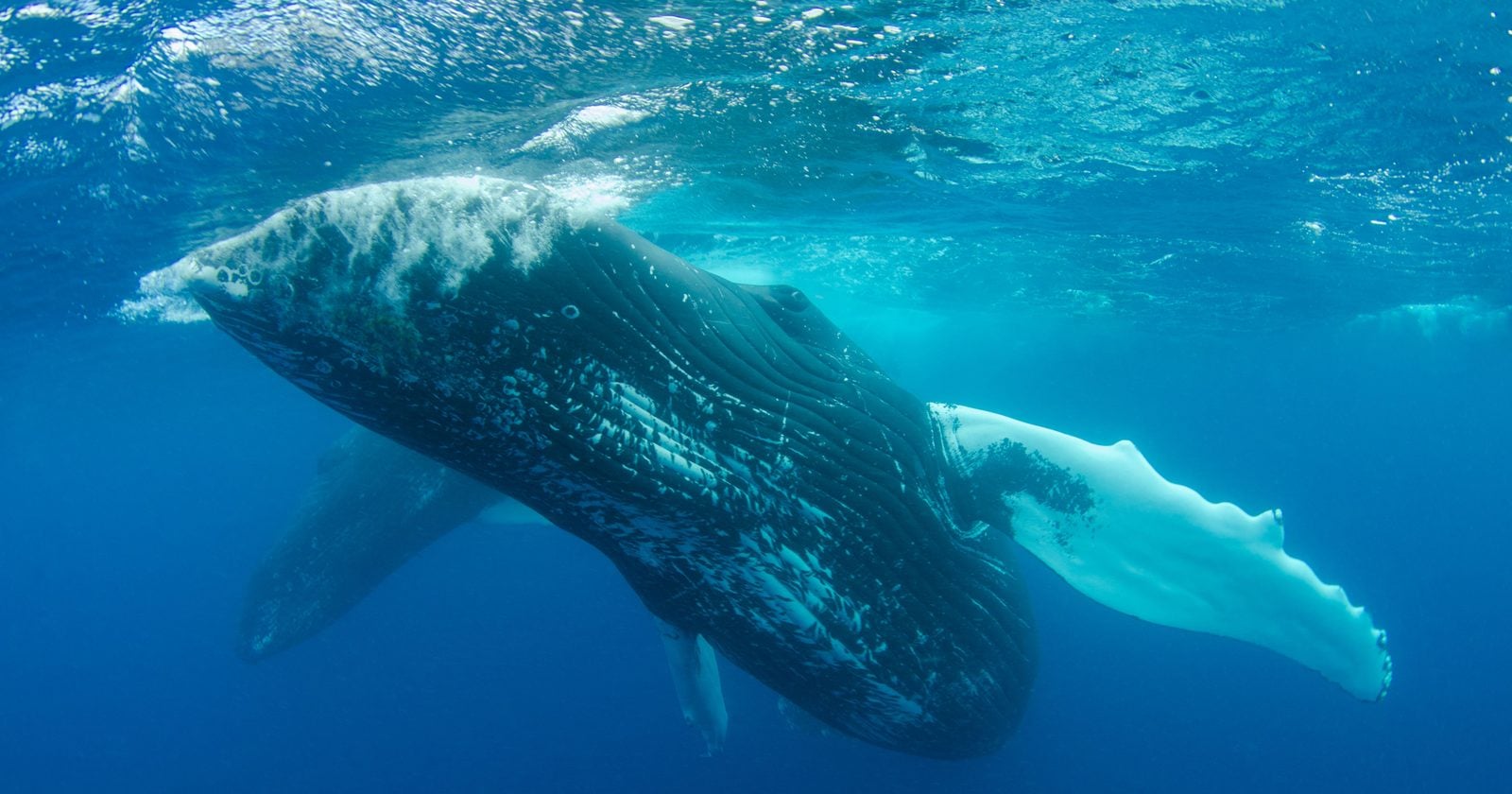
A stunning underwater photograph of a humpback whale swimming gracefully in the deep blue ocean.

A man’s voice reads a date onto a plastic disc. “The date, 7 March, 1949,” he says, as reported by Smithsonian Magazine. Underneath the announcement there is something else: a low, looping sound with a shape to it, rising and falling. It came up through the water off Bermuda into an experimental rig the researchers had lowered over the side.

They did not know what it was. They kept it anyway.

What they had captured, as noted by Woods Hole Oceanographic Institution, was the song of a humpback whale and it sat in a drawer for the better part of a century before anyone could say so.

A sound nobody could place

The recording came out of ordinary work. In March 1949, researchers aboard WHOI’s research vessel, the R/V Atlantis, were off Bermuda testing sonar for the U.S. Office of Naval Research.

The gear was makeshift by later standards: an early underwater setup and a Gray Audograph, an office dictation machine that etched sound onto thin plastic discs. Into that they fed noises coming up from below that they could not explain.

WHOI’s announcement in February 2026 identified that March 7, 1949 disc as what may be the earliest preserved recording of a whale. The hedging in that sentence matters, and we’ll come back to it. The striking part, for now, is the gap. The people at the rail heard the sound as they made it. The people who understood it were born, in some cases, decades later.

Why it sat unheard for seventy-seven years

The disc survived partly by luck of material. Magnetic tape from that era tends to break down; plastic holds up better. As Ashley Jester, WHOI’s director of research data and library services, put it, “these audograph discs survived because of their material and careful preservation.”

The 1949 disc is one of more than 200 audograph discs in WHOI’s archives, only a handful of which have been listened to so far. Digitizing the collection was funded by a $10,000 award from the National Recording Preservation Foundation. It took someone deliberately going back through old plastic, disc by disc, for the unexplained sound of 1949 to become the humpback song of 2026.

Made before we knew what whale song was

What makes the timing land is what came after it. The idea that humpbacks sing structured, repeating songs is usually traced to the 1960s. Navy engineer Frank Watlington recorded humpbacks off Bermuda in 1964 and shared his tapes with Roger and Katharine Payne. That work led to the album “Songs of the Humpback Whale,” which put the idea into the public mind that these animals compose.

The 1949 disc predates all of that by fifteen years. The researchers who saved it had no framework to hear it with. To them it was noise worth keeping, not song worth studying, because the idea of humpback song as a thing to study did not yet exist.

That gap is also what gives the old recording its value now. Laela Sayigh, a marine bioacoustician at WHOI, framed the scarcity plainly: “Data from this time period simply don’t exist in most cases,” she said. Her point, as we read it, is not that no mid-century ocean audio survives anywhere, but that this window is close to blank, which is what makes a single clean disc worth so much.

Sayigh suggested the recording “can provide insight into how humpback whale sounds have changed over time, as well as serving as a baseline for measuring how human activity shapes the ocean soundscape.” 

Peter Tyack, an emeritus research scholar at WHOI, made the same point about what the disc lets you hear beyond the whale. The recordings, Tyack said, “not only allow us to follow whale sounds, but they also tell us what the ocean soundscape was like in the late 1940s,” adding, “That’s very difficult to reconstruct otherwise.”

Why “may be the oldest” is the careful phrasing

WHOI has been careful, and we think that care is worth keeping. “May be the earliest preserved recording of a whale” is not the same claim as “is the oldest whale recording.” Older discs could be sitting unlistened-to in the same collection, or in someone else’s. The institution is describing what it has found and verified, not making a claim about everything that ever existed. When a headline flattens that into a superlative, it drops the part of the sentence that’s actually accurate.

That caution reflects how thin the evidence is. For context, WHOI points to other archives, including the Ocean Alliance collection of more than 2,400 recordings of whale and ocean sound from the 1950s through the 1990s. Even so, the 1940s remain close to silent in the record. A hedge isn’t weakness in a claim like this. It’s the accurate shape of what’s known.

The case for keeping what you can’t explain

Nobody in 1949 filed that disc thinking they’d captured the oldest whale song on record. They filed it because it was data, and you keep data. The understanding arrived seventy-seven years late, delivered to people the original researchers never met.

Jester put it plainly. “These recordings remind us why we collect data, even when we don’t immediately know what it means,” she said, and framed it as a duty across time: “preserving data when it is created is an investment in the future of science.”

The post In 1949, researchers testing underwater acoustics off Bermuda lowered an early recording system into the water and kept the unexplained sounds it picked up. Seventy-seven years later they were identified as what may be the oldest preserved recording of a whale singing, made before scientists understood humpback whale song. appeared first on Space Daily.
  •  

Young fish are dropped from a small airplane over Utah’s mountain lakes, poured out of one tank divided into seven chambers so the fish fall the last stretch through open air. More than 300 lakes inaccessible by vehicle are stocked this way each year, a practice Utah has used since 1956.

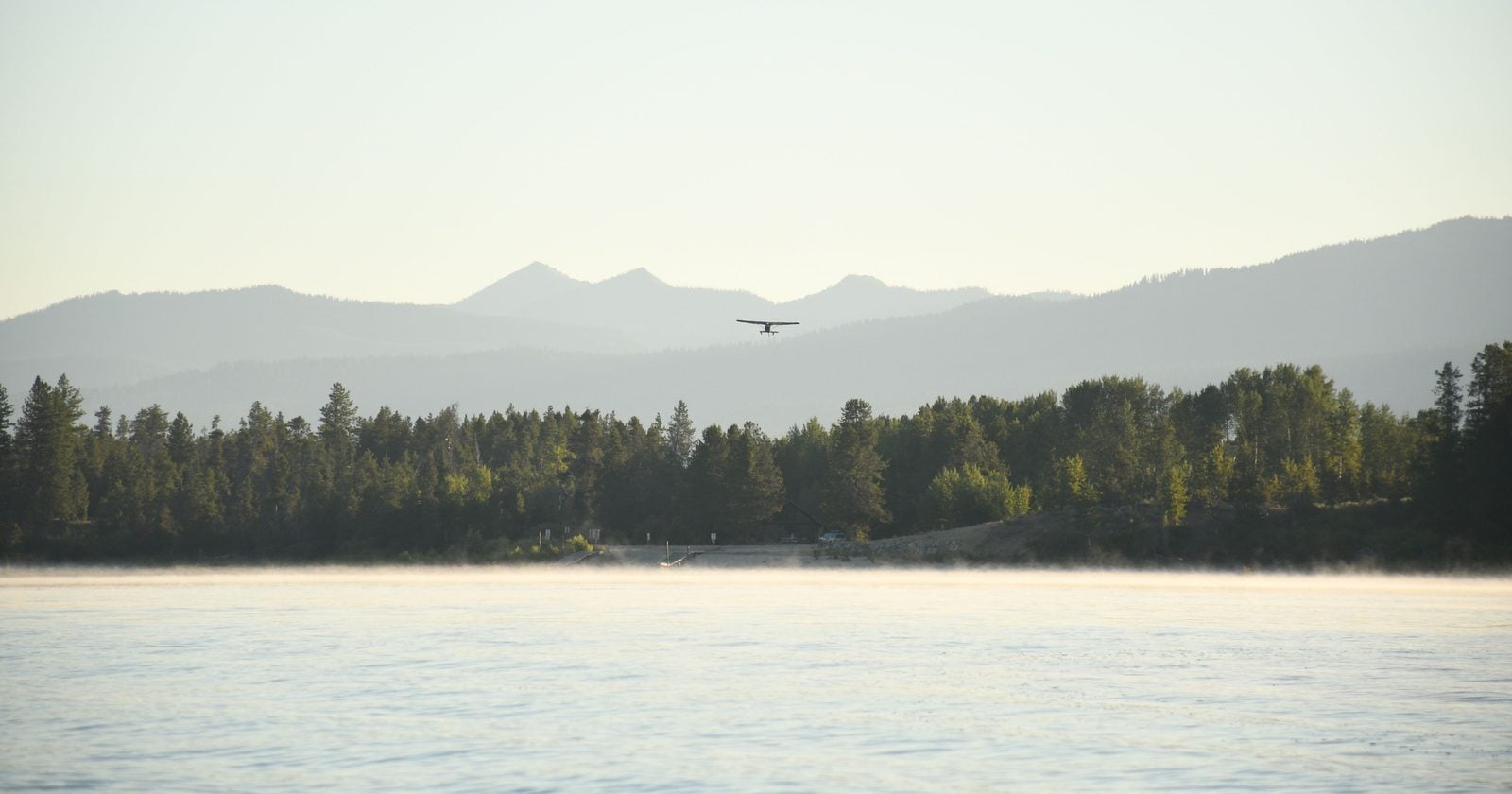
A small airplane soars above a tranquil mountain lake with misty waters and lush forests below.

You want to put fish into a high mountain lake, one with no road and no short trail to it. Fish need water to travel in, water is heavy, and no truck can get up there. So how do you do it?

Utah’s answer, worked out over decades, is to skip the ground entirely. The fish arrive by air, and for the final stretch they arrive through open air, falling out of an airplane into the lake below.

The method: a Cessna, seven chambers, and a low pass

The plane doing this work is a small single-engine aircraft, and its cargo hold is the clever part. The Utah Division of Wildlife Resources describes a plane that “can carry the pilot and a copilot, plus one fish tank that has seven chambers, allowing the aircraft to stock seven different lakes in one flight.” Seven chambers, seven lakes, one loop through the mountains before the plane comes back to reload.

The plane comes in low and slow over the lake, about 50 to 150 feet above the water, and releases the fish from one chamber so they tumble the last stretch down. Then on to the next lake, the next chamber. A single flight can carry over 10,000 fish before anyone needs to land and refill.

Why the fish survive a fall from a plane

This is the part that stops most people. A fall from a hundred feet or more, into water, sounds like the end of the fish. It mostly isn’t, and the reason comes down to size.

The fish being dropped are tiny. They are fingerlings, young fish only 1 to 3 inches long, and at that scale the physics works in their favor. The DWR’s own explanation is that “the young fish — called fingerlings — are so small (ranging from 1-3 inches long) that the air slows their drop. The slower fall allows the fish to survive.” A body that small weighs very little for its size, so air resistance slows it fast. Instead of dropping like a stone, the fish flutter down more the way a leaf does.

We are not fish biologists, and this is the agency’s account of its own program rather than an independent study, so it reads better as the DWR’s reasoning than as settled fact. The agency is clear about the size limit, though. If you tried this with bigger fish, the DWR says, “if the fish were larger, the survival rate would not be as high.” The whole method depends on keeping the fish small enough to fall gently.

How long this has gone on, and how far it reaches

Dropping fish from planes is not a recent experiment. Utah has done it since as early as 1956, and it wasn’t the first method anyone tried. Matt McKell, a biologist with the DWR’s Northern Region, has written about the earlier, more awkward approaches. In the early days, McKell has written, the fish were carried up in metal milk cans on horseback. A horse can only carry so much water so far up a mountain.

Aircraft solved the reach problem, and they stuck. McKell writes that “by the 1950s, small airplanes became the preferred method for stocking fish into backcountry lakes, which is actually still the case today.” Seventy years on, the plane handles the long-distance work, while backpacks, buckets, and four-wheelers still cover the lakes a person can walk or drive to.

The scale now is large. The DWR reports that “more than 300 lakes are aerially stocked in Utah each year. These lakes range in size from smaller than 5 acres up to 500 acres.” Independent reporting puts the figure at roughly 300 high-elevation lakes as well, so the number is not just an agency talking point.

Why bother stocking a barren lake at all

There is a fair question underneath all of this. Many of these high lakes hold no fish naturally. Steep outlets and long winters mean fish often can’t reach them or can’t breed once there, which is exactly why they require frequent stocking rather than a one-time drop. So why put fish in a place that can’t keep them going on its own?

The plain answer is recreation. These are backcountry fishing spots, and a lake with no fish is a long hike to nothing for an angler. Stocking keeps hundreds of remote lakes worth the walk.

What makes the whole operation possible circles back to the fingerlings. The airplane, the seven chambers, the low pass over the water, all of it works only because the fish are small enough that falling a hundred feet does them little harm. Grow them a few inches and the physics turns against you. The program depends, in the end, on dropping a creature light enough to be caught by the air on the way down.

The post Young fish are dropped from a small airplane over Utah’s mountain lakes, poured out of one tank divided into seven chambers so the fish fall the last stretch through open air. More than 300 lakes inaccessible by vehicle are stocked this way each year, a practice Utah has used since 1956. appeared first on Space Daily.

  •  

In 1869, a French entomologist trying to breed a hardier silkworm let a batch of moth larvae escape his Massachusetts yard. Twenty years later they had defoliated 360 square miles nearby, and the species can still strip a million acres in a single bad year.

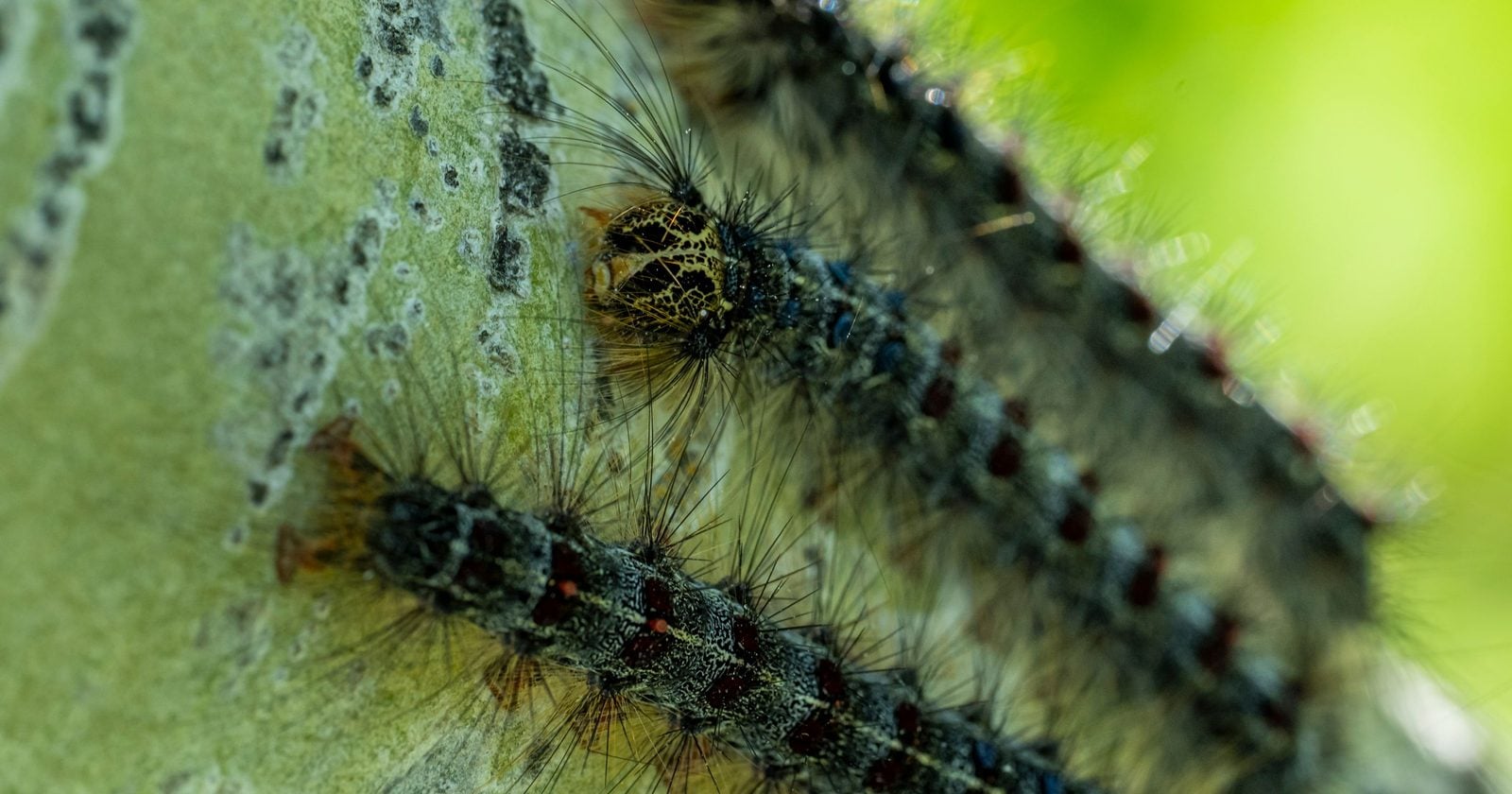
Macro shot of caterpillars on a lichen-covered tree branch in Rouyn-Noranda, Québec, Canada.

One amateur naturalist, working in a modest backyard outside Boston, kept a colony of caterpillars behind his house. A windstorm scattered some of them into the woods and a little over a century later, the descendants of those loose larvae had become one of the most expensive forest pests on the continent, able to chew bare more than a million acres of trees in a single bad year.

How does one careless moment on a residential lot in 1869 turn into that?

The short answer: it took twenty years to look like anything at all. That delay is what makes the story worth telling. So let us walk it forward from the yard.

Who Trouvelot was, and what he was trying to do

The man in the yard was Étienne Léopold Trouvelot, a French amateur naturalist and artist who had settled in Medford, Massachusetts. He was not trying to unleash anything. He was experimenting with silk production. Trouvelot wanted to breed a silk-spinning caterpillar more resistant to disease than the domesticated silkworm.

For that he turned to the European gypsy moth, a species the Entomological Society of America formally renamed the “spongy moth” in 2022.

As the education service EEK tells it, some of Trouvelot’s moths escaped in 1868–1869 and subsequently multiplied in a vacant lot next to his home in Medford, Massachusetts. Not a secret rogue experiment. A hobbyist’s version of a reasonable farming bet, gone wrong in the most ordinary way imaginable.

The escape

It is often said that eggs got loose. The record does not quite support that. Trouvelot had imported clumps of eggs, but what escaped were the caterpillars he was actively raising behind his house.

According to historical accounts, a windstorm damaged his nets and scattered the caterpillars. Smithsonian magazine’s account of the episode traces the whole invasion back to insects escaping from nets and cages in that backyard.

Two things about the insect made the accident far worse than it should have been. It had few natural predators in North America. And the female of this species cannot fly, which sounds as though it should have limited the spread. But the young caterpillars compensate by floating on threads of silk carried by the wind, giving the moth almost nothing eating it and a quiet, wind-driven way of moving across the landscape.

The twenty-year fuse

For roughly two decades, not much visibly happened. That is the part that trips up our intuition. We expect consequences to arrive on the same timescale as the mistake, and invasions rarely oblige. The population built generation after generation until it crossed a threshold.

The first recorded major outbreak came around 1889, about twenty years after the escape. Caterpillars stripped the leaves off fruit and shade trees across a 360-square-mile area around Medford. 

Massachusetts launched a campaign to wipe the moth out, and the methods of the day were blunt. Ken Gooch, forest health program director at the Massachusetts Department of Conservation and Recreation, described that early era to the Daily Hampshire Gazette: “They did an incredible amount of really, really toxic pesticide spraying.” 

The effort failed. The moth kept moving, spreading through the Northeast, the Mid-Atlantic and the Midwest over the following century. Reporting from Grist puts that historical march at roughly 13 miles per year for over a century, and the total damage between 1970 and 2013 at 81 million acres stripped of leaves.

Why it still matters

The caterpillars are not fussy eaters. The USDA notes they feed on more than 300 species of trees and shrubs, which is a large part of why the damage scales the way it does.

Losing leaves for one summer does not usually kill a mature tree. Repeated years do real harm. Brian Eshenaur, a plant pathologist with Cornell University’s Integrated Pest Management Program, explained the strain to Grist: “When trees are defoliated like this right at this time of year, they are using reserves that are in the trunk and in the roots to put out a second flush of growth.” A stripped tree burns through its stored energy to grow a new set of leaves. Drain those reserves year after year and the tree weakens.

The same reporting notes that after two straight years of feeding, up to 80 percent of the trees in a hardwood forest can die. That is a cited figure, not a guarantee, and how far it plays out depends on drought, tree species and how healthy the forest was to begin with.

The financial toll is large too. Missouri’s Department of Conservation puts the yearly cost of damage nationwide at an estimated $868 million.

Wiping the moth out is off the table now. The goal is containment, run through the federal Slow the Spread program. It pairs a network of traps with two other tools: chemical scents that disrupt mating, and treatment sprayed from aircraft. A natural ally also arrived on its own in 1989, when a fungus, Entomophaga maimaiga, was found attacking the caterpillars and has since helped knock back some outbreaks.

What stays with us is the shape of the timeline. Slow-fuse invasions teach the hardest lesson precisely because there is no alarm at the moment it matters. A colony scattered by a storm in 1869 sat almost invisibly in the woods for two decades before it announced itself across 360 square miles. More than 150 years later, a multi-state partnership is still spending money and effort to hold the line against it. The gap between the small careless moment and the long tail of its consequences is enormous, and nothing about the yard in 1869 would have let anyone see it coming.

The post In 1869, a French entomologist trying to breed a hardier silkworm let a batch of moth larvae escape his Massachusetts yard. Twenty years later they had defoliated 360 square miles nearby, and the species can still strip a million acres in a single bad year. appeared first on Space Daily.

  •  

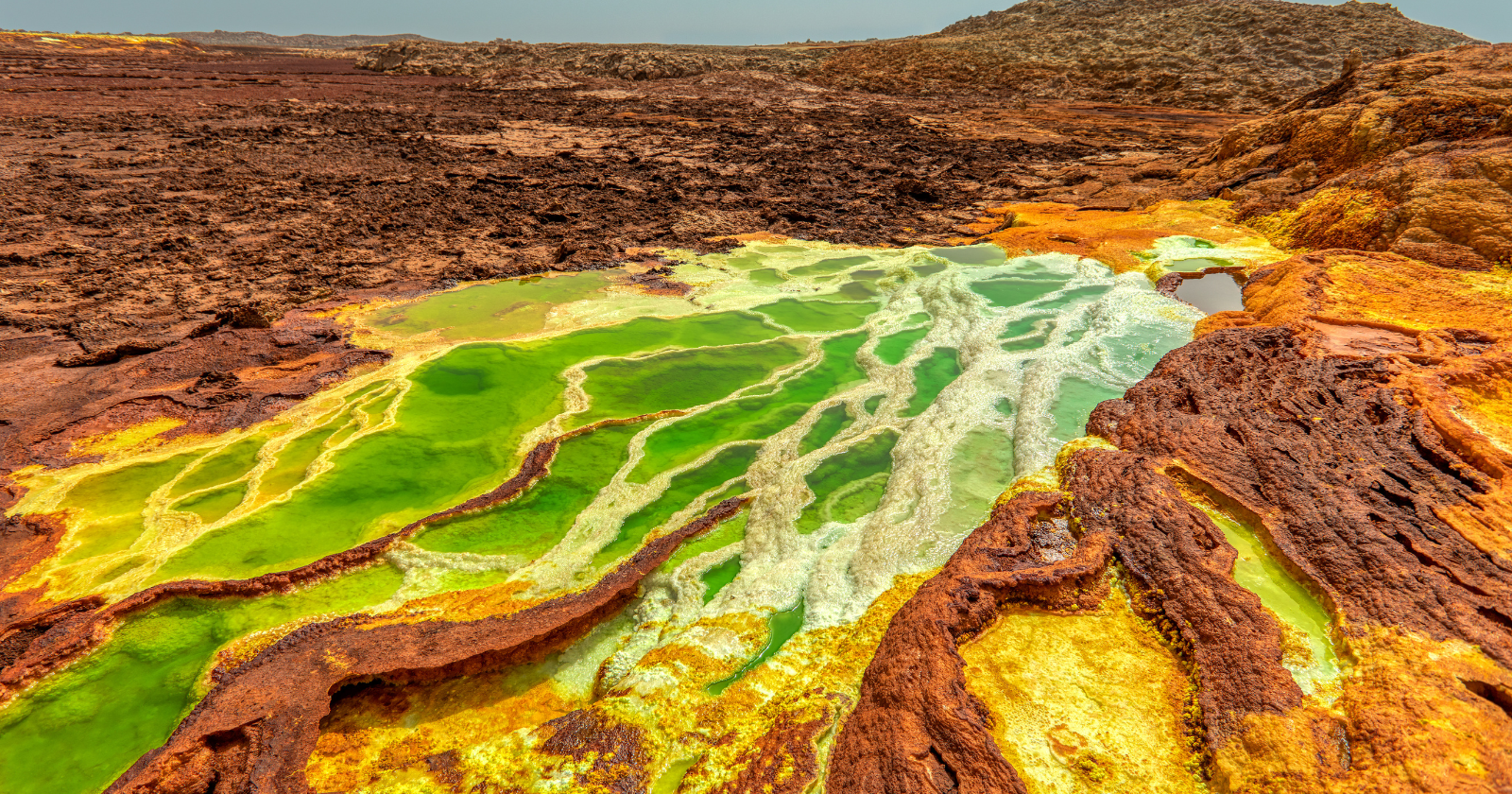
A pond in Ethiopia’s Danakil Depression has a measured salinity of 433 grams per kilogram — roughly twelve times saltier than the open ocean and saltier than the Dead Sea — sitting inside one of the hottest, most hostile landscapes on the planet

Bright green and yellow mineral pools in the Danakil Depression

Near the base of the Dallol hydrothermal field in Ethiopia’s Afar region sits a pond barely 60 meters long, its water tinted pale yellow by dissolved iron. Chemists who sampled it found a total dissolved solids concentration of 433 grams per kilogram — 43.3 percent by weight — making it, by current measurement, the record for saltiest lake documented anywhere on Earth. The pond is known locally as Gaet’ale, and the figure comes from a 2017 study by Pérez and Chebude of Addis Ababa University’s Department of Chemistry, published in the journal Aquatic Geochemistry.

For context, the world’s oceans average about 35 grams of dissolved salt per liter, according to NOAA ocean salinity data and the USGS salinity reference — putting Gaet’ale at roughly twelve times ocean salinity. That figure is also higher than the Dead Sea, whose salinity is commonly cited around 340 grams per liter in recent measurements, though older or differently calculated figures put it lower — Guinness’s own comparison table, for instance, lists it at 23.1 percent by weight.

Ordinary seawater’s salt is mostly sodium chloride, or ordinary table salt. Gaet’ale’s brine is instead built around calcium chloride and magnesium chloride, at concentrations of roughly 2.72 moles per kilogram and 1.43 moles per kilogram respectively, according to Pérez and Chebude’s analysis, with trace sodium, potassium, nitrate and iron(III) complexes responsible for the water’s yellow cast. The researchers noted the pond’s chemistry closely resembles that of Don Juan Pond in Antarctica’s Dry Valleys, another calcium-chloride-dominated hypersaline pool long studied as one of Earth’s most extreme aquatic environments, though Gaet’ale’s higher temperature allows it to hold even more dissolved salt before reaching saturation.

The pond itself is shallow and crescent-shaped, sitting at around 50 to 55 degrees Celsius, with no inflowing or outflowing stream. According to the Gaet’ale Pond entry, local accounts attribute the pond’s formation to a January 2005 earthquake that reactivated a dormant thermal spring. The broader depression sits more than 100 meters below sea level in places, part of a tectonically stretched landscape laced with active volcanoes, sulfur vents and salt flats left behind by an ancient sea that repeatedly flooded and evaporated over geological time. The nearby Dallol hydrothermal field, roughly four kilometers northwest of the pond, is famous for acid ponds in shades of green, orange and yellow, produced when magma-heated groundwater dissolves the buried salt and mineral layers and pushes the resulting brine back to the surface.

A natural laboratory for other worlds

The combination of heat, acidity and salinity has made the region a working laboratory for scientists who study the outer edges of habitability. A multinational research effort coordinated through the Europlanet research infrastructure has sent microbiologists, geologists and planetary scientists to the depression in recent years. Karen Olsson-Francis and Vincent Rennie of the Open University sampled acidic, saline channels there for signs of microbial survival; Hugo Moors and Mieke De Craen of Belgium’s SCK CEN nuclear research center used the site to test methods relevant to how microbes might behave around deep nuclear waste repositories; and planetary geologists Daniel Mège of the Polish Academy of Sciences and Ernst Hauber of the German Aerospace Center studied Danakil’s salt-and-magma hydrothermal structures as an analog for Martian rift systems, work feeding into ongoing observations from the ExoMars Trace Gas Orbiter.

Jani Radebaugh of Brigham Young University and Ralph Lorenz of Johns Hopkins University’s Applied Physics Laboratory have separately used terrain models from the depression to interpret surface roughness data relevant to Saturn’s moon Titan.

Where even extremophiles give up

The scientific interest in the region’s brine pools goes beyond geology. A 2019 study led by Purificación López-García of the French National Centre for Scientific Research (CNRS), working with researchers from Spain’s Geological and Mining Institute and the Autonomous University of Madrid, searched the most extreme pools in the Dallol field — hyperacidic, near-boiling and saturated with salt simultaneously — for any trace of microbial life. Using genetic sequencing, culturing attempts, flow cytometry and electron microscopy, the team reported finding none, a result summarized by Phys.org as evidence that liquid water alone does not guarantee habitability. The researchers concluded that the pools’ combination of high magnesium and calcium concentrations, extreme acidity and heat produces a “chaotropic” chemical environment that actively breaks down biological molecules instead of simply placing them under stress.

That finding matters for astrobiology because it complicates a common assumption: that any environment with liquid water, however extreme, should host at least some microbial life. A separate 2021 study of nearby, slightly less extreme hypersaline lakes in the Danakil Depression, published in Environmental Microbiology by researchers including members of the same French-Spanish collaboration, found the opposite — diverse communities of salt-loving archaea thriving right up to the edge of what those less punishing pools could support. Gaet’ale itself is hot and dominated by chaotropic calcium and magnesium salts, not the sodium chloride of ordinary seawater. Pérez and Chebude’s 2017 paper focused on the pond’s chemistry rather than a dedicated search for microbial life, but a separate 2021 metagenomic study of Gaet’ale specifically found it dominated by bacteria — unlike the sterile conditions found in Dallol’s most extreme pools.

Together, the pond’s chemistry and its surrounding hydrothermal field illustrate why the Danakil Depression continues to draw researchers from chemistry, microbiology and planetary science alike. A 60-meter pool of scalding, mineral-saturated brine is, on its own, a curiosity of extreme terrestrial chemistry. Set inside a landscape already used to model early Earth, present-day Mars and the hydrocarbon lakes of Titan, it becomes a reference point for a broader question: how much stress a chemical system can absorb before it stops being able to host life at all.

The post A pond in Ethiopia’s Danakil Depression has a measured salinity of 433 grams per kilogram — roughly twelve times saltier than the open ocean and saltier than the Dead Sea — sitting inside one of the hottest, most hostile landscapes on the planet appeared first on Space Daily.

  •  
❌