❌

Reading view

Study: Famous ‘Space Weather’ Train Delay Actually Happened Seven Years Later
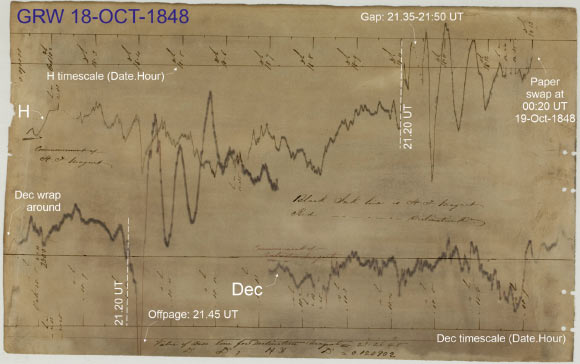
The magnetogram recorded at Greenwich Magnetic Observatory (London) from 11:20 UT on 18 October 1848 to 00:20 UT on 19 October 1848. Powerful geomagnetic disturbances are apparent on the evening of 18 October 1848 from 21:20 UT. Image credit: Wild et al., doi: 10.1029/2026SW005239.

Although the famous Carrington Event of 1859 is often described as the first major space weather event to affect technology, earlier incidents did occur. Historical records show that telegraph systems were disrupted by geomagnetic storms as early as the late 1840s.

The post Study: Famous ‘Space Weather’ Train Delay Actually Happened Seven Years Later appeared first on Sci.News: Breaking Science News.
  •  

Amendment 74: A.14 Atmosphere Research Program Due Date Delay and Clarification Regarding the use of Generative AI

Through ROSES-25 A.14 Atmosphere NASA is soliciting proposals for data analysis and modeling of NASA supported airborne campaign data. NASA’s Earth Science Division has supported numerous airborne campaigns during the last few years, see Section 2 of the program element text.

A.14 Atmosphere required a mandatory Notice of Intent (NOI) to propose. Proposers who have not already submitted a compliant NOI are not eligible to submit a proposal.

ROSES-2025 Amendment 74 delays the due date for A.14 Atmosphere to December 2, 2026. Also, Section 4.3.3 “Use of Generative AI” now mentions a related NSPIRES cover page question on the use of AI. An updated FAQ has been posted under “Other Documents” on the NSPIRES page for this program element.

Questions concerning A.14 Atmosphere may be directed to Ken Jucks at kenneth.w.jucks@nasa.gov, Emma Knowland at  k.e.knowland@nasa.gov, and the other points of contact that appear in Section 4 of the text.

The post Amendment 74: A.14 Atmosphere Research Program Due Date Delay and Clarification Regarding the use of Generative AI appeared first on NASA Science.

  •  

La couche d’ozone devrait être rétablie dans quelques décennies, selon les experts : alors pourquoi les UV montent-ils en Europe ?

La couche d’ozone, notre bouclier naturel contre les ultraviolets, va mieux. Pourtant, en Europe, les UV gagnent du terrain. Une apparente contradiction qui raconte une autre transformation de notre atmosphère.

  •  
❌