❌

Reading view

ChatGPT transcripts are reportedly read by humans to improve responses, including those with personal information β€” 'Project Lilly' has seen OpenAI hire hundreds of contractors to manually review logs

AI companies don't have a great track record in areas like copyright or user privacy β€” unless they're the ones on the short end of the stick, that is β€” but it's generally known that the chat logs from platforms like ChatGPT are used for improving models. The mechanism as to how this happens was still a mystery until today. 404 Media just published a report about OpenAI's process of human review for chat transcripts, explaining how the review process works, and how it involves other humans sometimes reading private information.

The rating project's name at OpenAI is Project Lily. The publication got information on the project's instruction guides, Slack channels, real ChatGPT conversations, and, of course, the rating system to classify conversations. The operators are called "prompt reviewers," and their job is fairly simple: look at anonymized real-world chats, and judge the quality of ChatGPT's responses to assess whether they actually answer the question, and that the text doesn't overuse "AI-speak," patronizing tones, emojis, or sycophancy, among other parameters. Anthropomorphizing and stating "personal" experiences are both off the table, meaning that while it's OK for ChatGPT to say "I found some information," it's not OK for it to say "as a chef, I like to..." or "I know what that's like."

The work is "very rote," according to a reviewer, but at reportedly over $50 an hour, it's a high rate for what looks like reasonably simple work. The reviewer also said that their guidelines keep changing and are often self-contradictory, a feeling most software developers should easily identify with.

The person doesn't think that most users are aware their chats are being read by others, though, something that's particularly troubling when many use ChatGPT as an impromptu friend or therapist and put deep secrets in words for the bot to read.

While the chats allegedly go through an anonymization pass and reviewers don't see usernames, OpenAI admitted to 404 Media that the filtering may let some personal data through, especially in shorter chats. The site notes that in many conversations, the user asks ChatGPT to keep the contents secret, as well. The version of the chat handed to reviewers also reportedly includes a "user memories summary," containing a summary of the users' questions and interests, context, and potentially even location.

Crucially, Project Lily does not grade the chats' actual factual accuracy other than flagging obvious mistakes, implying that there's likely at least one more team (or several) doing separate evaluations. Likewise, this reviewing is separate from manual safety checks that ascertain if someone might be looking to hurt someone else (or, presumably, themselves).

The existence of the project also indicates that contrary to these image AI companies try to cultivate, the models don't improve just with technological advancement and better training sets β€” it appears you still need more than a few competent humans in the mix.

By now you may be wondering about the "allow us to use your chats to improve our product" (paraphrased) setting present in most consumer-facing chat bots. That setting is turned on by default in every bot we can think of, even with many paid plans. In ChatGPT's case, it does default to off in Enterprise, Business, and Educational customers.

That toggle switch does not work retroactively, though, so any chats already in ChatGPT's database will remain there unless the user requests deletion. Also, said deletion is also not retroactive, meaning that deleted chats may have already been hoovered and anonymized, and possibly reside in a dataset somewhere.

Although OpenAI initially had no answer to 404 Media's inquiry on whether users were explicitly informed that their chats could be read by humans, the company eventually offered a link to one of its FAQ pages that discusses human review for the purpose of model improvement. We verified ourselves that said notice is at least two years old, and likely older. After the publication of the exposΓ©, the firm changed its help page explaining how people can opt out of data collection, but there's no mention of human operators in that text.

This type of data collection and review is a running theme across most providers. Google Gemini clearly states that "humans may review some saved chats" in its Privacy Hub. Anthropic's stance is similar, with a page dedicated to this topic. Perplexity's stance, meanwhile, is unclear, as its Privacy Notice doesn't confirm or deny human access to chat logs.


  •  

Microsoft rolls out emergency update for Windows 11's latest patch β€” recent update causes crashes on AMD graphics, Explorer hang-ups, and broken third-party integrations

Microsoft has issued an out-of-band update for its recent Windows 11 patch, which has caused a number of bugs and issues. The September 2026 update was just released last Tuesday, and although it packs a number of new features and fixes nearly 1000 security flaws (commonplace in this day and age), there are also a few unfortunate regressions.

The 25H2 update finally reintroduces a movable taskbar, just like we've had since Windows 95, with an option to make the height smaller for compact displays. Likewise, the Start menu now has multiple configurable layouts, and you can toggle each main section on or off. Microsoft also revamped Windows Search β€” perhaps to finally be useful β€” and users can now choose to only have it display local results. Explorer got a handy tweak in the form of using KB, MB, GB size indicators, as well.

The update has also surfaced some serious bugs. First off, PCs with AMD Radeon GPUs are crashing, apparently due to the update provoking driver instability. Reinstalling the driver doesn't appear to help, and the reports unfortunately cover most contemporary AMD graphics cards. Microsoft did not mention AMD GPUs specifically in its latest update.

Microsoft noted that it has fixed an issue with Remote Desktop Services where RDS might become unstable, causing connection and sign-in failures.

Microsoft is also aware of an issue with audio output and microphone input going dead. Additionally, there are seemingly reports of audio devices starting up with a botched configuration, like tweaked 3D audio settings or speaker setups. The apparent workaround seems to be putting audio in a standard 2.0 configuration, but Microsoft has now addressed this issue in the emergency patch.

Explorer may display a black screen after logging in, leaving you with a perfectly functioning operating system but no visible UI. The File History backup feature is reportedly not detecting external drives, effectively making it useless. Of particular concern to enterprises, systems administrators, and homelabs, the Remote Desktop Service is also experiencing issues. Last but not least, Microsoft says it has addressed an issue where Claude Cowork is nonfunctional due to the update breaking HC-managed Linux VMs with Plan9 shared folders

Owners of HP and Lenovo systems are also advised to consider holding off on this update. Ever since the August 2026 patch (and now, cumulatively, with the September update), there are reportedly serious issues on both camps. On the HP side, there are instances of the update triggering BIOS corruption, leading to a failed install with no ability to recover the OS β€” though seemingly the OEM has published a new BIOS revision, so it's hard to say which side is to blame. Meanwhile, Lenovo users might have their machines black-screen or shut down out of the blue, seemingly due to power mismanagement.

While it's heartening to see that Microsoft has significantly increased its Windows development speed and is seemingly listening to customer feedback, a string of bugs after a major feature update are still common.

  •  

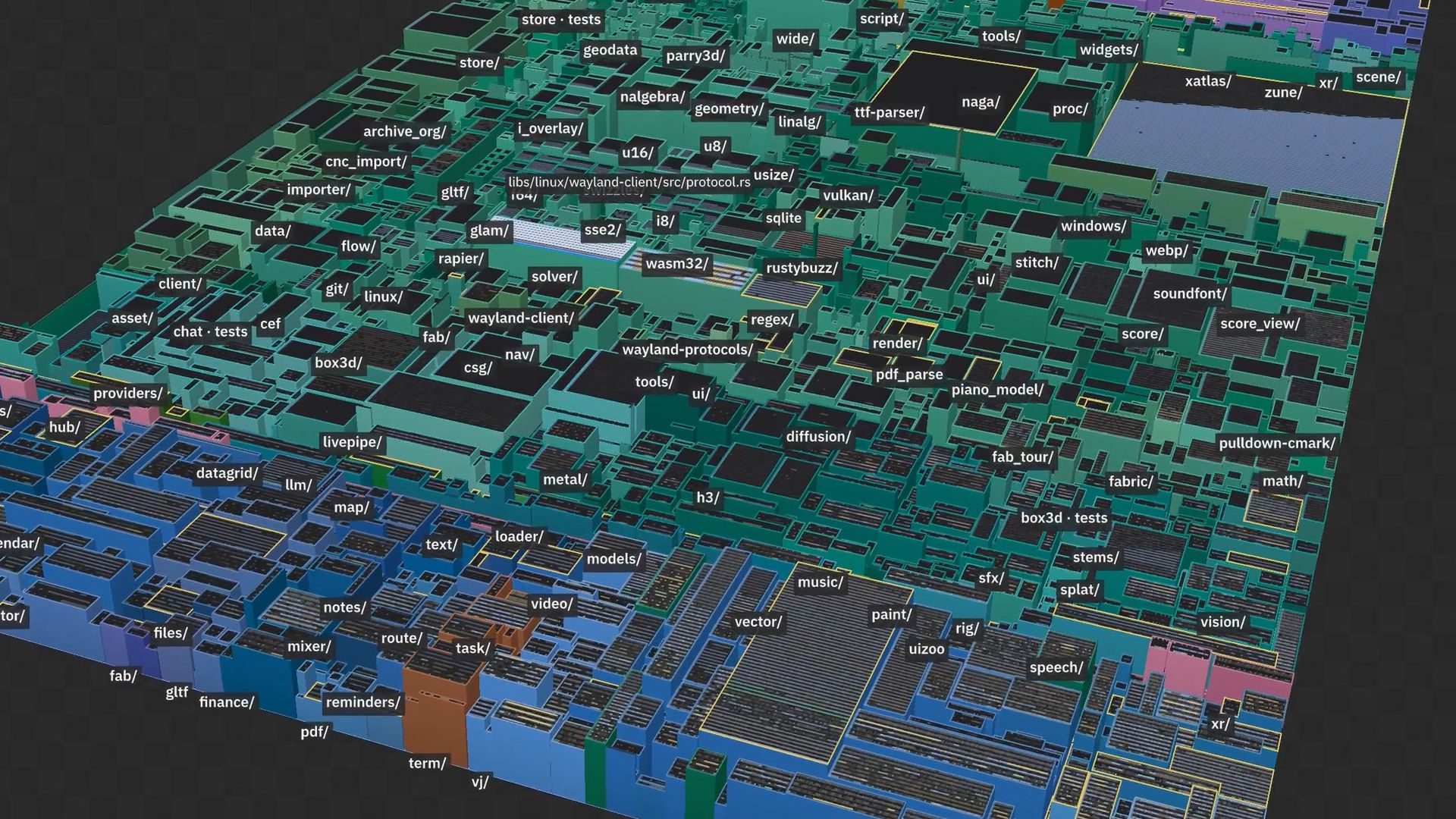
Developer builds viral 3D source code visualizer that consumes 21GB of RAM β€” flies around 2.5 million lines of code at over 120 frames per second

The immortal line "it's a Unix system, I know this" is forever entrenched in many a techie's brain. In the Jurassic Park movie, the visualization software in question was Silicon Graphics' File System Navigator for IRIX, an actual piece of software running on a real SG workstation. The concept of viewing files in 3D space never truly caught on, but the horsepower available in contemporary machines may change that. Makepad creator Rik Arends created his own 3D flyable source code visualizer that he claims handles 2.5 million lines with ease, at 120+ FPS, no less.

Ironed out the last performance issues with my full 2.5m line codebase explorer. 120hz awesomeness. Can only upload 60fps video tho. Much nicer uncompressed pic.twitter.com/LUsrmVaI6LSeptember 12, 2026

Although the published video is only at 60 FPS due to X's limitation, the navigation looks smooth indeed, and it's impressive to see all the actual source code in a reasonably readable manner. Arends says the visualization initially took 21 GB of RAM (in this economy?!), but that after judicious application of indexes and streaming compression, he got memory usage down to a much more palatable 3.5 GB. Although he remarked that he's yet to fully optimize the visualizer, he did try to load Chromium's entire source tree (51 million lines) in only 60 seconds at one point.

While one can argue that the 3D visualization of the code itself is probably really fun to look at, its practical use is also questionable, at least as-is. A commenter remarked that adding a time element would help immensely, by displaying changes to the source files. 3D tracking of dependencies would probably be handy, too. There's already an actual full-fledged commercial tool called CodeCharta that visualizes changes and hotspots in 3D, though the flybys aren't quite as impressive.

Arends says that he intends to turn this visualization tool into a product and charge a small fee for it, though he admits that the usefulness of the visualization may be limited. When asked why he created this, he simply said, "because I could." The jury is still out on whether he should.

  •  

Anthropic says AI can boost U.S. GDP by 32%, up to $44.4 trillion in four years β€” economics model predicts that displaced employees 'may have to switch to jobs like electrician and nurse'

Last week, Anthropic published its prediction of what the economic impact of AI on the U.S. economy is going to be for the next few years. The company thinks the U.S. can reach a $44.4 trillion GDP or higher by 2030, provided, of course, it conveniently adopts AI at a rapid pace. Having said that, Anthropic admits "the challenge is making sure that the gains are broadly shared."

The interactive post has a simulator where readers can plug in their estimates on key factors and get their own future predictions, within the firm's analysis and perspective. That's definitely interesting to play around with, but perhaps the most relevant piece of information is the lens through which Anthropic views the world.

Anthropic establishes its reasoning by first placing tasks in broad categories and using a nurse's workday as an example. They removed tasks, including those that will disappear naturally as technology progresses, like collecting data on paper or physically visiting the patient to collect basic vitals β€” neither happens anymore as remote monitoring becomes commonplace. However, some new tasks are added, like keeping an eye on dashboards for the aforementioned AI-powered monitoring.

Then, there are naturally the tasks that a bot can't perform, like bathing a patient. Augmented tasks include those that require a human, but can be made more efficient with AI: helping with triage, planning schedules, and assisting with dashboard data. Some tasks may be fully automated, like keeping supply closets full or scheduling follow-up patient visits. Finally, AI usage can introduce some tasks of its own, like reviewing automated triaging or double-checking dashboard alerts β€” perhaps even impromptu data recovery.

The company's predictions broadly hinge on how ubiquitous AI usage becomes, and therefore, the number of tasks transitioning into fully or partially automated. Unsurprisingly, Anthropic believes that the more entrenched AI gets, the more value the country creates, though at greater risk β€” and on an exponential scale, no less

Three models are presented, from "modest" economical impact to "extreme." The modest model establishes a 1.6% GDP rise to $34.1 trillion, an impact Anthropic says is in line with that of new technologies like the internet, and crucially, doesn't imply tectonic shifts to unemployment rates or wages.

For the "substantial impact" scenario, although AI is predicted to be able to do half of "knowledge work," mostly without intervention, adoption remains limited. This scenario foresees twice the normal economic growth, this time +8.3% to $36.3 trillion.

This future marks the inflection point at which Anthropic believes knowledge workers see their wages remain steady instead of growing, though it's not clear if the firm accounts for inflation. Additionally, the firm states that "knowledge workers may see a lot of automation and displacement [...] coders and call service center agents may have to switch to jobs like electrician and nurse", a statement some might argue is already true. In that sense, Anthropic expects other workers to start seeing more cash.

The eyebrow-raising prediction for both the above scenarios, though, is that Anthropic expects unemployment to "stay within ranges history has seen before," an odd statement given modern U.S. history contains events like the Great Depression. The company does note that it expects job churn to increase, but also that while "this process can be painful, [it] works relatively well from a macroeconomic perspective." Average wages are expected to rise across all three scenarios, though the increase is expected to go towards workers outside of knowledge areas.

In the "extreme" scenario, Anthropic expects significant changes. Should AI be super-widely adopted, the GDP can increase by 32.4%, corresponding to a cool $44.4 trillion, a "profound economic transformation." This is the point at which the firm expects that AI becomes more productive than humans for most knowledge work, and does so with near-autonomy. Equally worryingly, it's expected that there will be "essentially no" new knowledge tasks created.

Anthropic notes that to reach this kind of stage, the country would "likely require" recursively self-improving AI (using the AI to make better AI). There's a significant catch, however, as though the U.S. would be "far richer than [it's] ever been," knowledge workers would be the hardest hit with a 10% wage drop, plus overall unemployment would climb "beyond typical recessionary levels." Manual labor would be prized, though, given that "as AI increases productivity within knowledge work, the demand for manual work that benefits from that productivity will increase."

Scenarios aside, the one big question is: How would all that GDP money land in people's pockets? Anthropic admits this problem is a "challenge" and offers little solution for it. Such a high amount of future AI penetration might prove a hard sell, considering wealth inequality in the U.S. already sits at its highest level for the last few decades and is trending in that direction in most developed nations. Others might argue with Anthropic's assessment that unemployment levels would remain somewhat in the less extreme scenarios, seeing as job cuts are rampant across many sectors and have hit technology-related fields the hardest.

To its credit, Anthropic clearly highlights part of the wealth-inequality issue. The company admits that more AI automation might skew the current 60/40% balance between labor and capital, respectively, strongly tilting the scale in favor of capital ownership and increasing inequality. Many argue that's already happening today. There's also the matter that the prediction appears to assume little competition from other countries, nor does it offer insight as to what would happen to "AI-less" nations.

The interactive blog post and its simulator are worth a good read and fiddling with, regardless. Anthropic published the technical details on the mathematical model used in a separate article and published its Economic Policy Framework last June.

  •  
❌