❌

Reading view

China's open-weight AI models are now just 4 months behind frontier US offerings, Mozilla report claims — models still lag in some benchmarks but are drastically cheaper to use

Mozilla has published version 1.1 of its State of Open Source AI report on Sept. 15 using data current to Sept. 1, revealing that many of the best Chinese open-weight AI models are closing the gap with U.S. frontier offerings. The best open model trailed the closed leader on the Artificial Analysis Intelligence Index by three points at 60% of the price and two points behind Claude Fable 5 at 30%. Mozilla’s fit on METR task-horizon data puts the open-closed gap at around 4.4 months, in line with Epoch AI’s four-month estimate.

Mozilla is the nonprofit behind the Firefox web browser, and its report is a recurring assessment first published on July 14 on the Mozilla blog. It’s built on a Mozilla/SlashData survey of roughly 1,400 developers along with OpenRouter traffic data and third-party benchmark indices. Mozilla is an advocate for open models, and TIME reported on July 14 that Raffi Krikorian, Mozilla’s chief technology officer, described the report as partly advocacy. “Open weights” in this context means downloadable weights rather than training data or code. The report counts 16 notable open releases, but none delivers the data recipe required by the Open Source Initiative’s definition.

The four-month figure rests on METR, which is a research nonprofit that scores models by the length of task, in human working time, they complete half the time. By Mozilla’s fitted estimate, closed models handle tasks that take human experts 8 to 12 hours. Open models reach that about four months later, with open capability doubling every 3.9 months versus 5.5 for closed, by Mozilla’s computation. Mozilla also charted vals.ai’s Terminal-Bench 2.1 results, which run every model through the same harness, or software layer that offers a model its tools. On that board, Z.ai’s GLM-5.2 scored within a point of Claude Opus 4.7 and about four points behind Opus 4.8, at less than one-fifth the cost per test. On OpenRouter, a marketplace that routes developer traffic to hundreds of models, Mozilla counted eight of the top ten models by August token volume as open weights, seven of them Chinese-built. Nevertheless, closed providers took 96% of model-layer revenue on OpenRouter from May–September 2025, the Linux Foundation reported. “We see the decision to pay for closed [models] as workload-specific rather than organization-specific,” Krikorian told Ars Technica in an email.
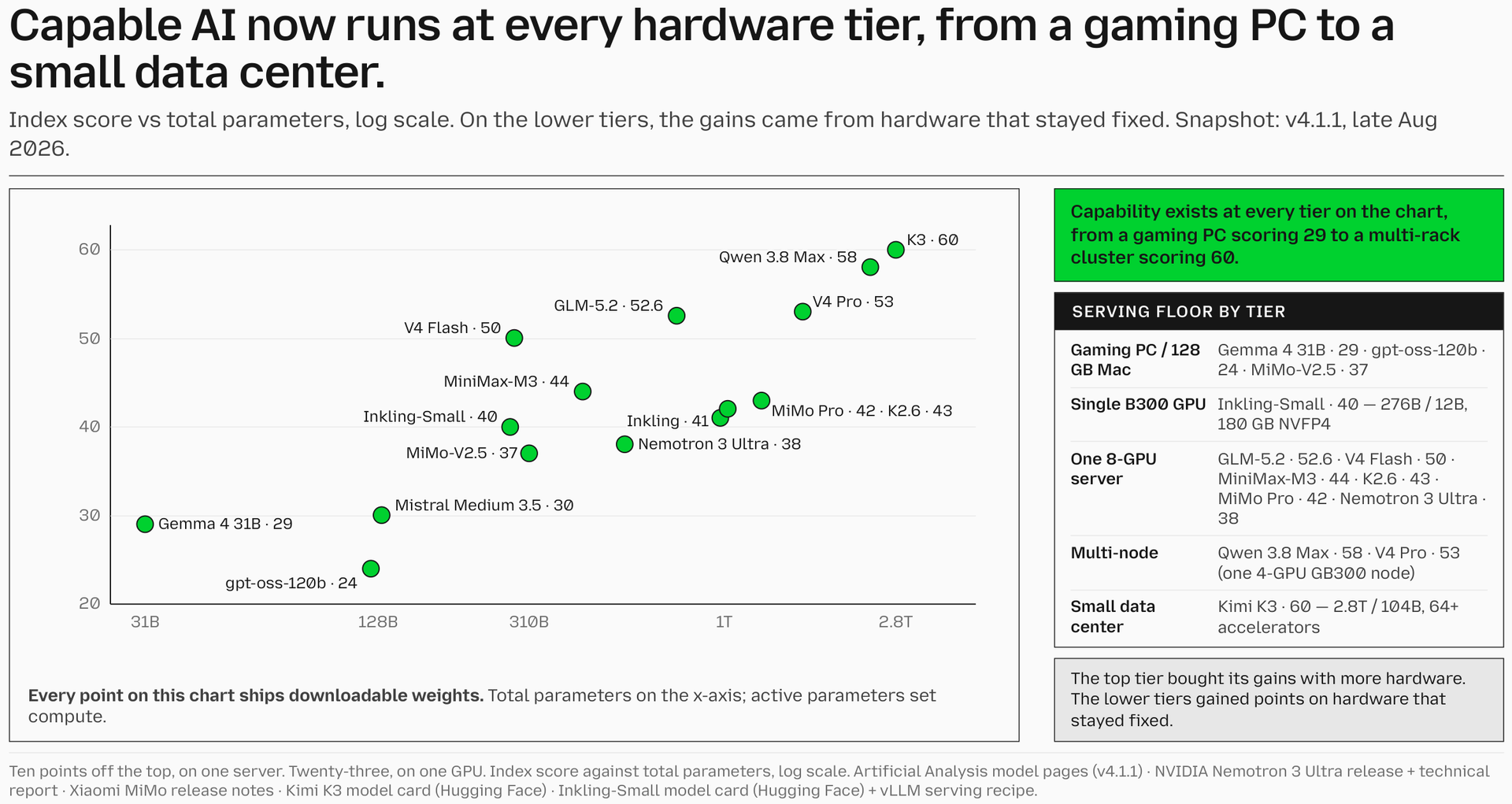
Mozilla chart of the best open-weight model score at each hardware tier.

(Image credit: Mozilla)

One caveat is that the four-month gap and the 30% token price figure are measured API to API on hosted endpoints and at list price. The report’s own hardware chart puts the best open model that fits one server at 52.6 and the best on one GPU at 40. The drop from the top is 10 and 23 points, respectively, a larger gap than the reported four months. Kimi K3’s native MXFP4 checkpoint runs about 1.56TB across 96 shards, and Mozilla’s serving configuration lists 64 or more accelerators, while vLLM calls for at least eight GB300 GPUs, with multiple nodes for production traffic. The report describes this as open but not runnable by most who hold it, and Tom’s Hardware put the memory need near 1.5TB in July. One example exception is Thinking Machines’ Inkling-Small model, under the Apache 2.0 license, whose NVFP4 version fits one B300 at a 180GB floor.

The report’s data stops at Sept. 1. Since then, Artificial Analysis has moved its index to v4.3 with a different evaluation set. The live board has Claude Fable 5.1 at 53 on its highest effort setting with Kimi K3 at 44, not comparable to the v4.1.1 numbers Mozilla plotted. vals.ai’s Terminal-Bench 2.1 board, updated Sept. 11, is now led by GPT-6 Astra at 87.27% with Fable 5.1 at 85.02%. Mozilla’s own chart caption reads: “the gap resets every release cycle.” K3 also carries an allegation detailed in the Sept. 8 NSA/CISA/FBI joint advisory (AA26-251A). The claim, which Mozilla’s report states as “asserted, and unshown,” is that Moonshot extracted Claude Fable 5 data to train K3 through distillation, the practice of training one model on another model’s outputs. On July 17, Artificial Analysis had K3 at 57 versus Fable 5’s 60, while on Sept. 1, Mozilla had it two points back.

  •  

Devastated father says his 9-year-old son spent $118,000 on YouTube ad campaigns for his Minecraft channel using a company credit card — bill racked up in just three weeks was supposed to be one $20 promotion

A father says his 9-year-old son spent $118,000 on YouTube ad campaigns for his Minecraft and Roblox gameplay videos over about three weeks, all charged to a company credit card the father had saved to his own Google account, which his son also used. The father, who identifies himself only as Dave, described the incident in a video titled “Message from Dad…Mighty Mike Plays is Over.” posted to the boy’s channel on Sept. 15. Dave said he was called into a meeting with his manager, corporate staff, and finance and shown the advertising charges.

Mighty Mike Plays (@MightyMikePlays67) is a 9-year-old’s Minecraft and Roblox gameplay channel with about 24,000 subscribers and 182 uploads as of early Sept. 16. Dave said it started when the boy was around 8, streaming straight from a PS5 with a cheap headset and no editing. Early videos got 5 to 11 views, he said. Dave said he entered the company card himself to buy Robux for his son, and it then sat saved on the Google account that also carries his work email, calendar, and files. Dave did not say why he used the company card for that purchase.

Dave said that after the boy complained about views, he set up a roughly $20 promotion and talked through the steps aloud: set a budget, select who sees the ads, hit run. The boy then created his own campaigns, and Dave said his son did not understand the $20 as a limit. “The credit card, it just says approved every single time,” Dave said in the video. Finance showed him three weeks of ad spend totaling $118,000 on campaigns titled “Mighty Mike,” “Epic Roblox,” and Minecraft gameplay.

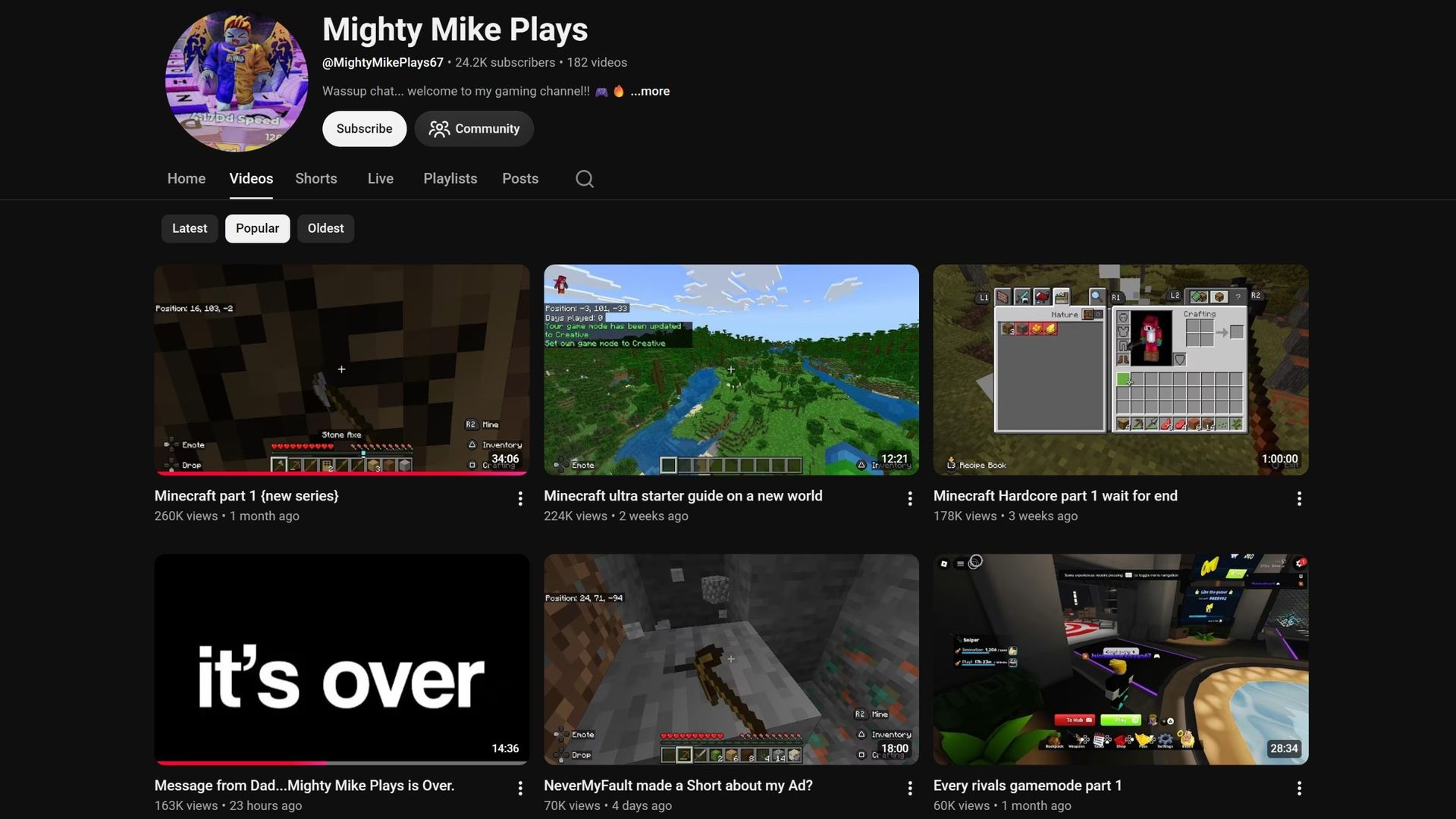
Three of the promoted videos reached around 200,000 views. As of a check at 12:26 a.m. ET on Sept. 16, the channel’s three most-viewed gameplay videos stood at 260,000, 224,000, and 178,000 views, with a run of uploads above 1,000 views and most of the rest under 100. Four days before Dave’s video, the boy had posted a video titled “NeverMyFault made a Short about my Ad?” about another creator noticing one of his promotions; it had about 70,000 views.

The Mighty Mike Plays channel's Popular tab as of 12:26 a.m. ET Sept. 16.

(Image credit: YouTube / Mighty Mike Plays)

Dave said the matter has been escalated and he does not yet know whether he will get to keep his job or have to repay the costs.

Google’s own help pages say a payment method entered for any Google purchase is stored in a payments profile tied to the Google Account and is offered again for the next purchase. The profile is also shared across Google Ads and other Google products. YouTube’s Promote tool, which Google describes as a simplified version of Google Ads, walks a creator through a goal, an audience, a budget, and an end date. Dave did not say which interface his son used, but the steps he described match Promote’s. Google Ads does not allow users under 18, but the account was the father’s.

In a separate case, the FTC announced on Sept. 4, 2014, that Google would refund at least $19 million to parents billed for children’s unauthorized in-app purchases on Google Play, and required it to get express consent before billing. That covered Google Play, not Google Ads. Dave said the family will remove saved payment details, add spending caps, and set up parental controls, and that the channel is paused until “real guard rails” are in place.

  •  

Perplexity’s local AI agent comes to Windows, but only for RTX GPUs with at least 24GB of VRAM — Portable Computer brings AI for multistep tasks to compatible PCs

Perplexity has released Portable Computer for Windows, in partnership with Nvidia, via the existing Perplexity app for Windows. Previously, this functionality was only available on Linux-based operating systems. The hardware requirements remain, meaning the host system must have at least 24GB of VRAM with a GeForce RTX or RTX PRO GPU. Likewise, a Pro or Max Perplexity subscription is required. Portable Computer was originally launched on the DGX Spark as a fully local AI agent platform.

Portable Computer, launched originally for Linux on Aug. 25, is a local version of Perplexity Computer, which is the company’s agent for multistep tasks. Perplexity Computer can plan, run subtasks through connectors and tools, and produce a result other than a simple chat response. This runs in Perplexity’s cloud and consumes Computer credits. Portable Computer is the same agent but with features running on your local PC instead of in the cloud. Local work does not consume credits, but the agent can send tasks to cloud models with explicit permission if necessary, the company said. Nvidia said on Sept. 3 that Windows support was coming soon.

Perplexity Portable Computer open on a Windows laptop, showing the empty task composer

(Image credit: Perplexity)

Portable Computer for Windows comes with some new features. These include scheduled recurring tasks and local MCP servers for desktop apps, according to Perplexity. Nvidia listed connectors for Microsoft Word, Google Drive, Gmail, Slack, and GitHub. The app also includes a dropdown for downloading a local model with one click. Nvidia named Qwen 3.8 27B as an example local model. DGX Station support is expected soon, Nvidia said.

Aravind Srinivas, CEO of Perplexity, wrote on X on Sept. 14 that with this release comes “unmetered local intelligence on every Windows PC running on Nvidia hardware and Perplexity harness.” The 24GB requirement is a VRAM gate more than a generation gate, cutting across Nvidia’s consumer lineup. Cards that meet the stated 24GB+ VRAM requirement include the RTX 3090 and 3090 Ti (24GB), the RTX 4090 (24GB), and the 5090 (32GB). The RTX 5090 Laptop GPU at 24GB has not explicitly been mentioned by either company. RTX PRO Blackwell cards that qualify are the 4000 (24GB), 4500 (32GB), 5000 (48GB or 72GB), and 6000 (96GB).

We're expanding our work with @nvidia to bring fully local AI to Microsoft Windows PCs with RTX GPUs. Unmetered local intelligence on every Windows PC running on NVIDIA hardware and Perplexity harness. Enjoy!September 14, 2026

In a Sept. 3 post ahead of IFA, the consumer electronics trade show in Berlin, Nvidia indicated more plans along these lines. The post stated that RTX Spark Windows PCs from Lenovo and Acer are expected in October and that two local agents, Hermes Agent and OpenClaw, are getting the same simplified local setup. For users who already own a qualifying RTX PC, the Windows release removes the need to buy a separate system. Upgrading a compatible desktop with a used qualifying card could also cost less than buying the DGX Spark Founders Edition at its $4,699 price.

  •  
❌