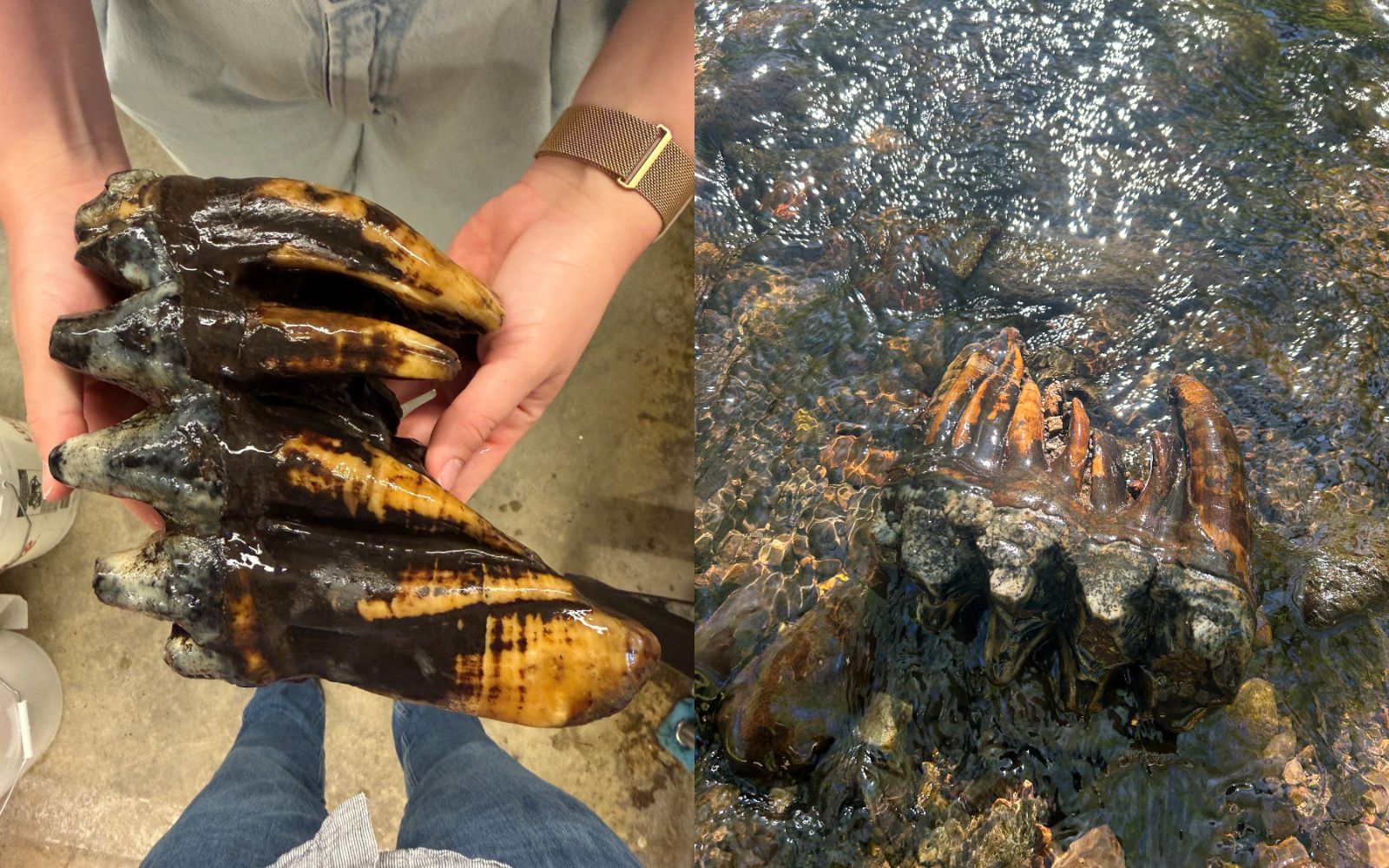
An exceptionally well-preserved fossilized molar belonging to an adult Pacific mastodon has surfaced in a nature preserve near San Francisco.
Upon first glance, the ancient tooth looked like an "oddly shaped rock" to geologists who were conducting fieldwork in the area, according to a statement from the Midpeninsula Regional Open Space (Midpen), which runs the preserve. But the find was quickly unmasked as a valuable fossil from the last ice age and was sent to scientists at Stanford University for carbon dating.
"The tooth itself is in immaculate condition," Wayne Thompson, a paleontologist and the CEO of Pacific Paleontology, a consulting firm that carried out a preliminary analysis, said in the statement. "It's the most complete mastodon molar from our area, and the most spectacular mastodon molar that I've ever seen. I had chills and shivers up and down my spine."
Brigid Lynch, a geomorphologist with the California-based hydrology consulting firm Balance Hydrologics, found the molar this summer while surveying a creek bed. "As a geologist, I've gone out and seen stuff in the field, but definitely nothing as exciting as this," Lynch said in the statement.
Lynch's team was working on a habitat enhancement project to support the threatened California red-legged frog (Rana draytonii) inside the preserve, which is located on the San Francisco Peninsula in San Mateo County. The fossil was a complete surprise and dates to at least 10,000 years ago, when the Pacific mastodon (Mammut pacificus) is thought to have gone extinct.
Mastodons are extinct, elephant-like creatures that lived during the last ice age. (Image credit: Midpen (left); Balance Hydrologics (right))
The Pacific mastodon was first recognized as a species in 2019. It was closely related to the American mastodon (Mammut americanum). Both elephant-like creatures lived in North America during the Pleistocene epoch (2.6 million to 11,700 years ago), but the Pacific mastodon inhabited regions farther west than its cousin, roaming parts of present-day Mexico, California, Oregon and the northern Rocky Mountains of the western U.S., according to the statement.
Pacific and American mastodon fossils reveal slight differences between the species, including a narrower third molar, thicker hind-leg bones and occasionally absent lower-jaw tusks in the Pacific mastodon, according to the Royal Alberta Museum.
The newfound tooth is "another puzzle in the Ice Age saga that we can put into place," Thompson said. To get a precise date for the fossil, Midpen donated it to Stanford University's Doerr School of Sustainability in July, the Los Angeles Times reported.
Researchers will produce a 3D copy of the molar that Midpen plans to use for public outreach and education, according to the statement.
Weakening Atlantic Ocean currents could cripple agriculture in some of the world's major breadbaskets, threatening global food security and raising the price of basic commodities, new research finds.
The study, which hasn't been peer-reviewed yet, investigated how a roughly 60% decline in the Atlantic Meridional Overturning Circulation (AMOC) would impact global food production. The AMOC is a system of ocean currents that regulates the global climate and brings heat from the tropics to the Northern Hemisphere.
In the new study, researchers used a computer model to simulate the AMOC's future decline. They modeled 100 years of change, assuming 3.6 degrees Fahrenheit (2 degrees Celsius) of warming above preindustrial levels. The team forced an AMOC slowdown over the first 50 years in one simulation but didn't modify the circulation in a second experiment, which enabled them to compare the world with and without an AMOC failure.
The model's outcomes mirrored the results of previous studies, showing broad cooling in the Northern Hemisphere and a southward shift of the belt of clouds and rain that encircles the globe near the equator. As in past studies, these effects were irreversible on human timescales, said study co-author Michael Hinge, a senior economist at the nonprofit Alliance to Feed the Earth in Disasters (ALLFED).
"Once the damage is inflicted, it stays there," Hinge told Live Science, adding that in the 50 years after the peak rate of AMOC slowdown in the model, the circulation weakened by an extra 20%. The study was posted on ALLFED's website July 7.
An agricultural "shock"
Hinge and his colleagues ran three models to look at the most common varieties of wheat, maize and rice, layering these models on top of the AMOC simulations. They found that global yields for these crops decreased by 5.3% by the 50-year mark, once the AMOC had weakened substantially.
"Lots of these effects manifest earlier, so it's a moving target," Hinge said.
He added that the results were based on a single warming scenario that was run once and used monthly rather than daily data, so they should be interpreted as a proof of concept. "We've set up a pipeline that is ready to take pretty much any AMOC scenario that can generate high-resolution climate data and see what it implies for crops," Hinge said.
While there was a 5.3% decrease overall, that global metric concealed huge differences between regions. For example, countries like Germany and Ukraine lost up to 19% of their cereal yields due to sudden, sharp cooling, while Canada showed a 12% decline in production for the same reason.
"Scandinavia, the United Kingdom and Canada are particularly exposed," Hinge said, "but there are many other [vulnerable] locations, some of which may be surprising even to the people who are living there."
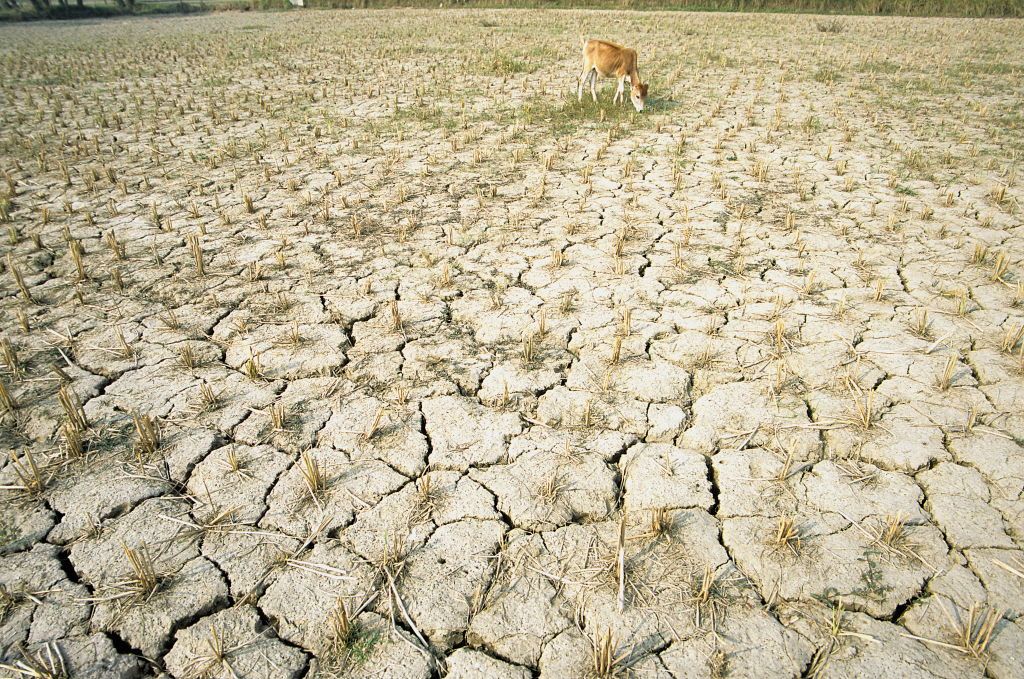
For instance, the model produced a "very nasty brown splodge" of reduced precipitation over India, Pakistan and big parts of China, he said. Iran, Sudan and Eritrea, which are already water-stressed countries, also exhibited severe declines in rainfall, indicating that a portion of the agriculture there may not survive an AMOC collapse.
The 5.3% result also hides variability among years, Hinge said, because it's an average. So there may be years when global cereal losses reach 10% or more, which would bump up food prices, in part because countries might stockpile crops instead of trading them.
Global response
The regional effects of an AMOC slowdown would interact with climate change, triggering unpredictable outcomes. In particular, maladaptation — taking actions that end up backfiring — is a worry, Hinge said.
"You're preparing and setting up for much hotter temperatures or trying to develop areas for these temperatures and the trends you're seeing, and suddenly you see something different," he said. "That may cause an even larger compounding effect [on agriculture]."
The findings build on prior research led by Paul Ritchie, a climate scientist at the University of Exeter in the U.K., whose team explored the effects of an AMOC collapse on agriculture in Great Britain. That study, published in 2020, had similar limitations as the new one, so it's best to interpret both papers as a suggestion of what might happen rather than a precise forecast, Ritchie told Live Science in an email.
"I think the new study is valuable in showing the potential scale and geographic distribution of the initial agricultural shock," said Ritchie, who was not involved in the latest work. "What that would ultimately mean for food production and food security is more uncertain, because there are many possible responses by farmers, markets and governments." For that reason, the regional predictions may be more informative than the 5.3% global average, he said.
An AMOC collapse could reduce rainfall over the Indian subcontinent, crippling agriculture in this region. (Image credit: Bhaswaran Bhattacharya/IndiaPictures/Universal Images Group via Getty Images)
Average food prices worldwide could rise by 17% to 40% if the AMOC weakens to the extent it did in the model, the study predicts. The level of increase depends on how countries respond to the shock and their degree of preparedness, as well as on whether agriculture can be sustainably expanded in places like the African Sahel (the semi-arid zone directly south of the Sahara Desert) and Brazil, the analysis suggests.
The U.S. would not be spared from this price jump, and the model indicated that the country could see crop losses of about 3% for domestic wheat and corn. This loss would likely impact other foods that rely on cereal inputs, like meat, Hinge said. "The variety of foods available in the stores may well diminish for periods," he added.
An AMOC collapse would fundamentally deepen the need for countries to trade with each other, because some regions — such as the Indian subcontinent, China, Iran, Russia, Ukraine and Canada — could endure this giant shift only if they imported more food, Hinge said.
"Should countries turn inwards and start to restrict exports in an effort to ensure access for their own citizens first, or deal with the uncertainty, or offset concerns, then this will massively magnify the effects of AMOC," he said.
If governments behave as they have during past shocks, such as the 2008 financial crisis and the COVID-19 pandemic, they may restrict trade and start stockpiling food if and when the effects of AMOC weakening begin to show, Hinge predicted. The researchers hope their work and future modeling can help people understand the need to take swift, effective action if a collapse were to occur, he said.
Currently, "if that warning light starts flashing, we're not sure what to do with it," Hinge said. "There are no easy answers here; an AMOC [collapse] would be deeply catastrophic."

 Login