Where it is: 160,000 light-years away, in the constellation Dorado
When it was shared: Sept. 3, 2026
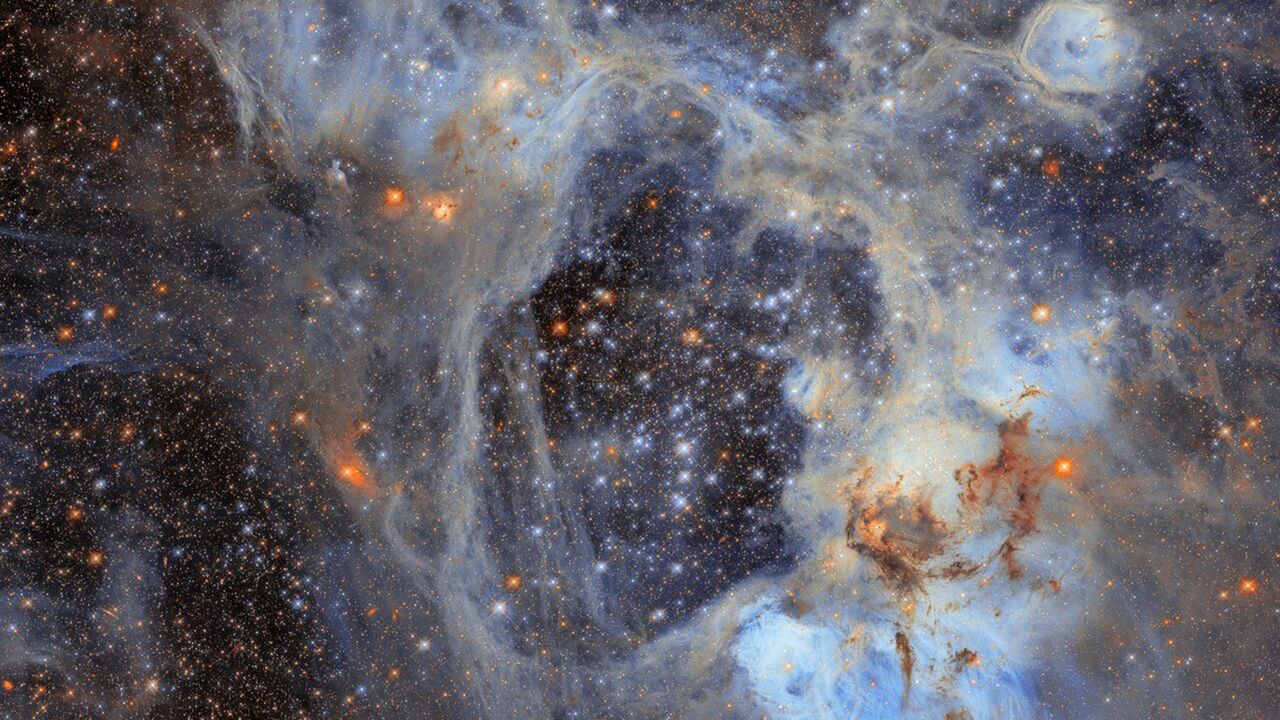
It looks like a gigantic hole punched through a cloud, but this spectacular new image from the Hubble Space Telescope captures something more complicated: a cosmic cycle of destruction and creation, with one generation of stars tearing apart its birthplace while simultaneously helping a new generation form.
LHA 120-N44 (N44, for short) is a nebula that lies about 160,000 light-years away in the Large Magellanic Cloud, a small galaxy that orbits the Milky Way. From Earth, it appears in the constellation Dorado. This enormous, empty-looking region measures roughly 210 by 140 light-years. To put that into context, consider that Alpha Centauri, the closest star system to ours, is a mere 4.4 light-years distant. Thanks to that giant, hole-like appearance, this nebula is known as a superbubble, a cavity carved out by a cluster of hot, massive stars near its center.
Those stars are bent on destruction. Just like our star's solar wind, which creates auroras on Earth and defines the extent of the solar system, these stars' powerful winds blast material into space. Meanwhile, the most massive of these stars eventually explode as supernovas, pushing even more gas aside. The collective radiation from both these old and young stars carves the nebula's giant cavity.
So what happened to that expelled gas? Most of it has been pushed outward and compressed into a dense shell of gas and dust surrounding the superbubble. Within that shell, new stars are forming — so the same massive stars that destroy the gas cloud that created them also may help to produce their replacements.
This is known as "stellar feedback" — when massive stars heat, ionize and disperse the gas and dust around them, making star formation impossible in their vicinity. Meanwhile, their winds can squeeze neighboring gas clouds until they become dense enough to collapse under their own gravity and make new stars.
This Hubble image of N44 contains almost half a million stars, including those in the nebula and some lying along the same line of sight. About 30,000 of them are young stars yet to fuse hydrogen in their cores — the reaction that powers stars like the sun. With so many young protostars not yet hot and dense enough to become full-fledged main-sequence stars, N44 gives astronomers a rare opportunity to attempt an answer to what may seem like a very simple question: how long does it take to make a star?
Some stargazing feels like you know exactly what you are looking for, but you're still slightly unsure whether you are actually seeing it. Zodiacal light — meaning "light from the circle of animals" — is often like that.
I have chased this so-called "false dawn" for years, and the first few minutes are always the same. I stare toward the horizon and wonder whether the sky is genuinely brighter there, or whether I am simply seeing distant light pollution, the first hint of morning twilight, or something my eyes have invented because I badly want to see it.
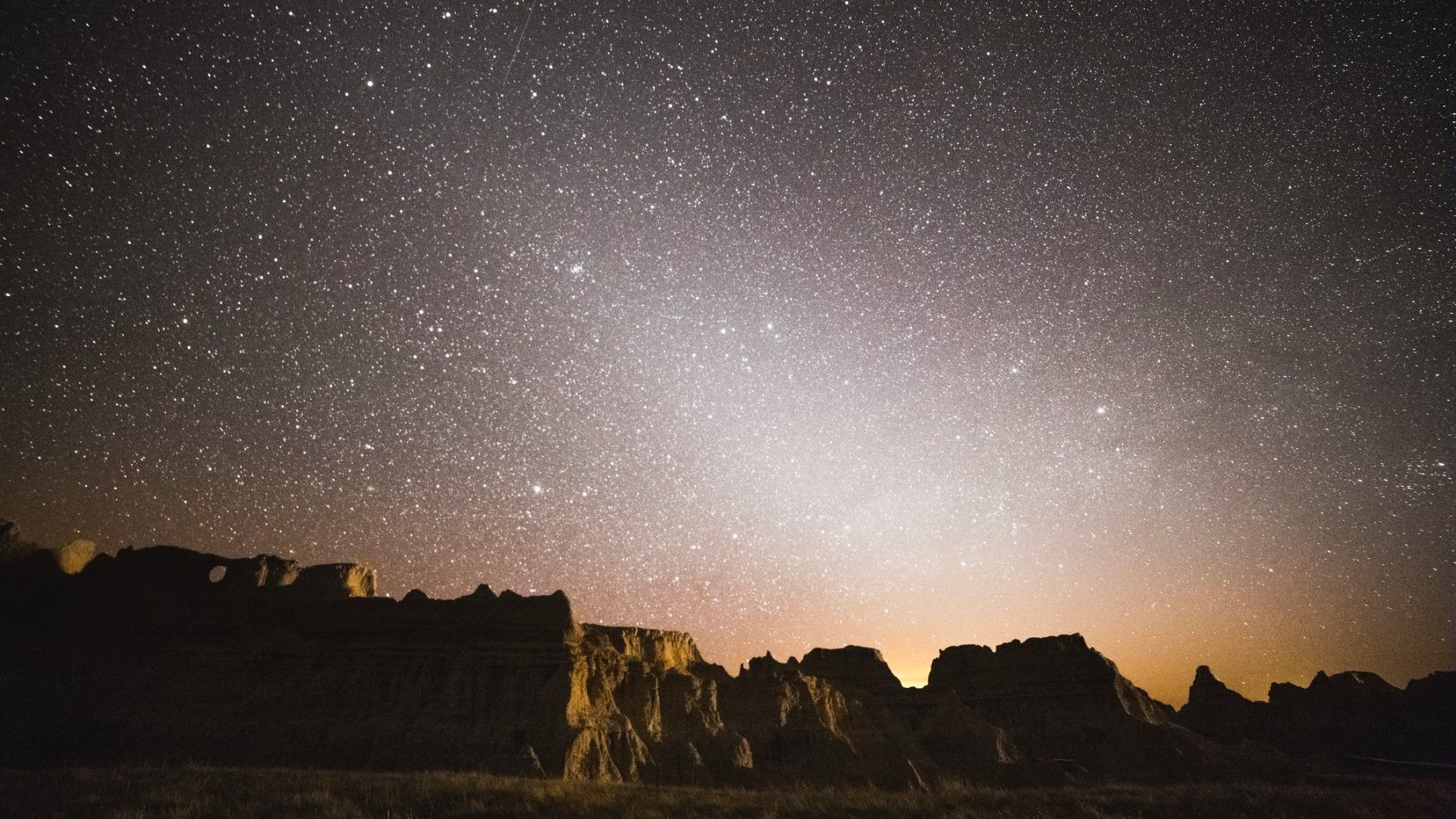
However, under a genuinely dark sky — and particularly in a long-exposure image — its cone shape becomes obvious.
Zodiacal light is enormous. It appears as a broad, softly glowing pyramid rising from the horizon. It can be fainter than the Milky Way and has no hard edges, which is precisely why it is so easy to overlook.
This week is a particularly good time to try because the new moon occurs on Sept. 10-11. With no moonlight interfering with the predawn sky, the main problems become familiar ones to any skywatcher: clouds, haze and artificial light.
The phenomenon itself could hardly be more epic. Zodiacal light is sunlight scattered by dust spread through the inner solar system, concentrated broadly around the plane in which the planets orbit. From Earth, we see that dusty structure edge-on along the ecliptic — the path through the sky followed by the sun, moon and planets. It's home, of course, to the 12 (actually 13) constellations of the zodiac — from Pisces the fish to Leo the lion. This is the circle of animals.
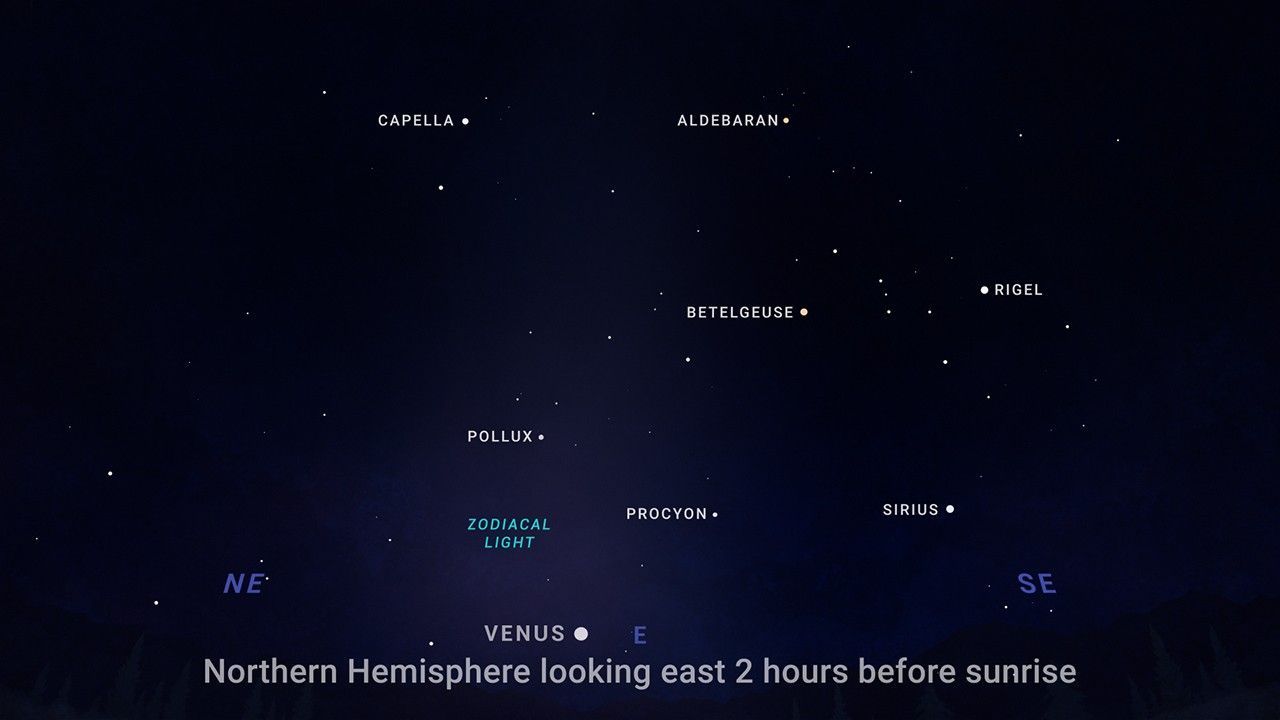
From the Northern Hemisphere around the September equinox, dust-hunting observers should look east before morning twilight, when the ecliptic rises steeply away from the horizon, and the faint glow becomes easier to separate from the murk below. It will reach about 30 to 40 degrees above the horizon.
Zodiacal light is the solar system itself made faintly visible — and one of the most subtle and strangest sky sights of all.
What's happening and when to look
Zodiacal light is a faint pillar of brightness stretching upward from the horizon. (Image credit: NASA/JPL-Caltech)
For observers at mid-northern latitudes, September mornings offer one of the year's best windows for spotting the "false dawn" — but it's not easy to see. The essential ingredients are an unobstructed eastern horizon (preferably over the ocean or a large body of water) and no light pollution. You'll need to start looking before astronomical twilight begins rather than waiting until the sky is already visibly brightening, which means getting up very early in a very dark place.
Check the time astronomical twilight begins at your location and aim to be outside before then, giving your eyes at least 20 to 30 minutes to adapt to the darkness. The zodiacal light should appear as a broad triangular glow, widest and brightest close to the horizon and narrowing as it climbs.
It's easy to confuse it with a distant town, but artificial skyglow tends to form a rounded dome above one location on the horizon. In contrast, zodiacal light reaches diagonally — or almost vertically upward — along the ecliptic.
Give your eyes time and save up that one vital ingredient, a vanishing human trait any skywatcher must constantly nurture — patience. Zodiacal light is not something you can walk outside and instantly see. It comes only to those who work for it.
How and when I'm photographing it
Zodiacal light is a faint pillar of brightness stretching upward from the horizon. (Image credit: Mike Hollingshead via Getty Images)
A little like a faint aurora, a camera almost always detects zodiacal light before your eyes become completely convinced. The easiest way is to use a tripod and a wide-angle lens, preferably something around 14-24mm, compose with plenty of eastern sky and include a simple foreground to make the triangular shape obvious. A starting point of around f/2.8, ISO 1600, and an exposure of roughly 10-20 seconds usually puts you in useful territory, though sky brightness and lens speed change everything.
Shoot RAW, focus manually on a bright star and capture a series of images. Then, once you've photographed it, try to stop looking at the screen — the entire point is to see it with your own eyes.
Stargazer's corner: September 11-18, 2026
With a new moon on Sept. 10, this week sees a run of dark evenings before our natural satellite gradually returns. On Sept. 14, look shortly after sunset for a slender waxing crescent moon beside Venus, extremely low in the western twilight. By Sept. 16-17, the moon moves on towards Antares, a reddish star at the heart of Scorpius. Then Sept. 18 brings a first quarter moon (perfect for exploring with binoculars or a small telescope) and Venus at the greatest brilliancy of its current apparition as the "Evening Star."
Constellation of the week: Orion
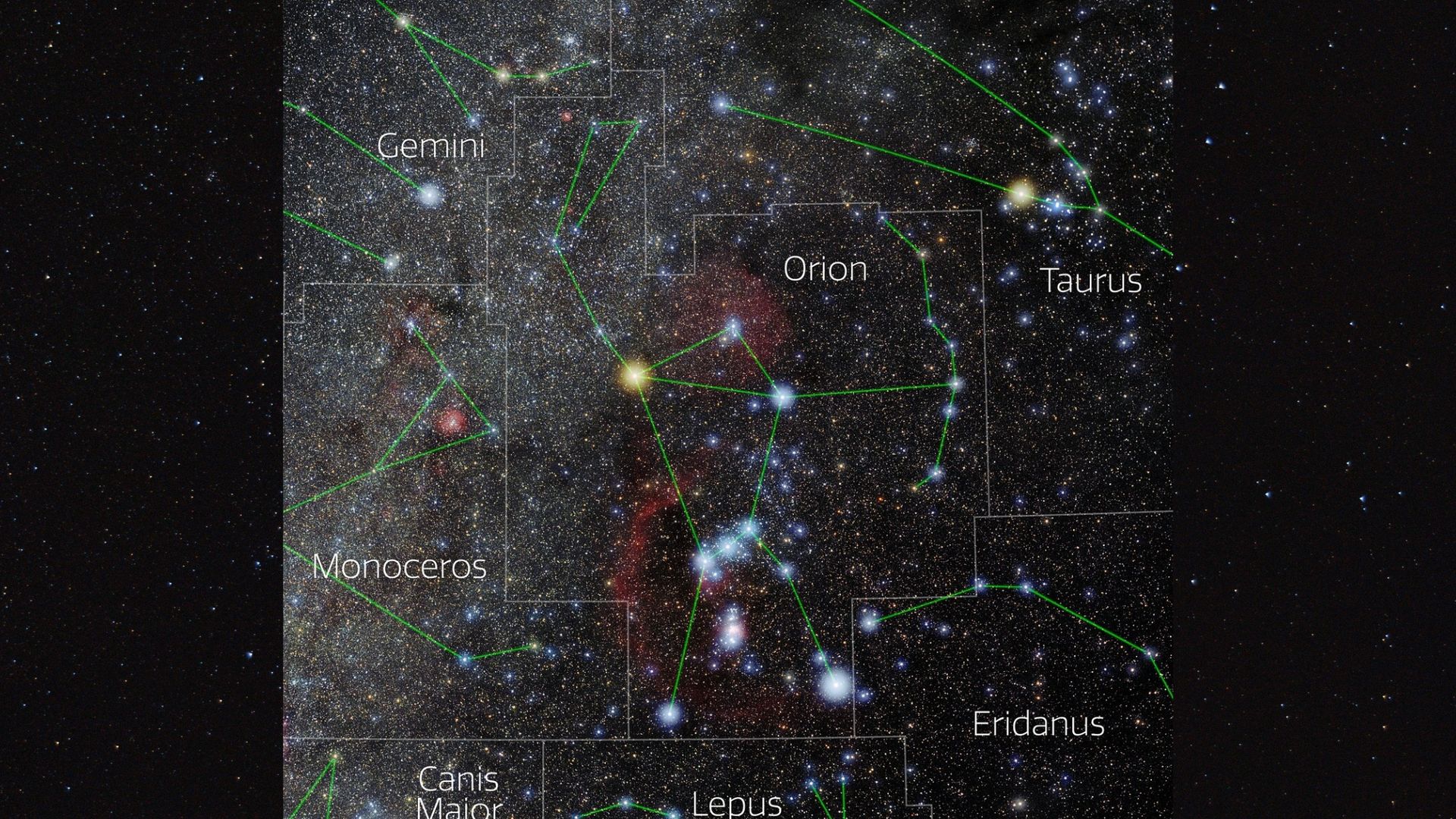
Orion, "The Hunter," is now visible in the east before sunrise. (Image credit: E. Slawik/NOIRLab/NSF/AURA/M. Zamani, background added in Canva Pro)
Orion is normally thought of as a winter constellation, so September seems an odd time to go looking for it. However, if you're venturing out to an extremely dark place to look for zodiacal light, you're going to be staring Orion in the face. In September, the Hunter is in the eastern sky before dawn, where its stars sit along the same general strip of sky occupied by the zodiacal light. Its famous belt stars will be up, as will be bright Sirius, below. This is one of the pleasures of observing before sunrise. The sky is effectively showing you a preview of another season. The constellations climbing in the September dawn are the ones Earth will face during winter evenings a few months from now. Jupiter and Mars will also be visible — right on the ecliptic where you'll also — hopefully — spy the "false dawn".
An extraordinary exploding star has been spotted in a distant galaxy, and astrophotographers are racing to capture it before it fades from view.
The supernova, called SN 2026aaiv, was first seen by the ATLAS survey on Sept. 1 in NGC 7331 (also known as Caldwell 30), a spiral galaxy about 45 million light-years away in the constellation Pegasus, visible in the Northern Hemisphere and at mid-latitudes in the Southern Hemisphere.
That makes this supernova a prime target for amateur astrophotographers and astronomers worldwide to capture an image of this rare event.
Hundreds of astrophotographers have already captured it, including Andrew McCarthy, who postedhis image on Instagram on Sept. 7 with the message, "As luck would have it, I happened to be in the middle of a massive project with this galaxy, and caught the supernova." He shot four hours of data, two before and two after the supernova, as part of a 100-hour project. "The final image will be EPIC!" he said.
At magnitude 15.7 on Sept. 11, 2026, SN 2026aaiv is relatively dim, but still brightening. Many of the images posted online were captured with large professional telescopes or remote telescopes in dark regions. However, you can find and photograph SN 2026aaiv with relatively modest equipment. You'll need a telescope or large binoculars to see NGC 7331 (at magnitude 10) at all, but the supernova is dramatically more challenging visually. To have a chance of seeing SN 2026aaiv, a large telescope is recommended (observers have confirmed seeing it using a 14-inch Schmidt-Cassegrain telescope). Use the averted vision technique: look slightly to the side of the galaxy's core so the eye's more light-sensitive rod cells can reveal faint detail.
The easiest way is to use a smart telescope, which can quickly find and image the host galaxy NGC 7331. According to Seestar (Official ZWO Group) on Facebook, users of the Seestar S50 have managed to image the SN 2026aaiv with about two hours of 10-second exposures (the default mode).
How to find SN 2026aaiv
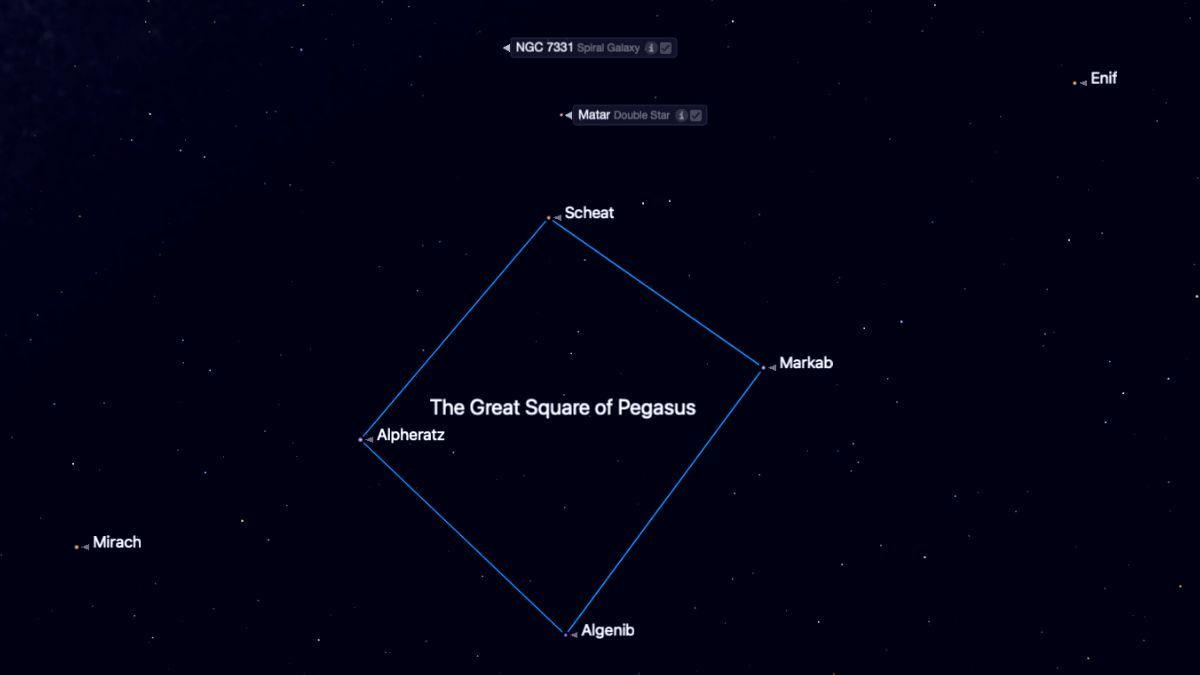
SN 2026aaiv can be found in NGC 7331, close to the Great Square of Pegasus, right after dark in the east from the Northern Hemisphere. (Image credit: Starry Night)
SN 2026aaiv has the coordinates RA 22h 37m 05.618s, Dec +34° 24′ 35.37″. From the Northern Hemisphere, turn toward the east after dark, and you'll see four large, bright stars rising in a vast diamond shape. This is the Great Square of Pegasus, part of the constellation Pegasus. At the northwestern corner of the Great Square is Scheat. Just above it, outside the square, is a dimmer star called Matar. NGC 7331 is close by. In light-polluted skies, only the central core of the galaxy is visible, according to NASA. The galaxy, which we see partially edge-on, has spectacular spiral arms that swirl around a bright central region.
What we know about SN 2026aaiv
SN 2026aaiv is a Type Ia supernova, a catastrophic explosion that occurs when a white dwarf in a binary star system gains enough material from its companion to trigger a runaway thermonuclear reaction, destroying the white dwarf. Remarkably, another Type Ia supernova, SN 2025rbs, was found in the same galaxy on July 14, 2025.
NGC 7331, imaged by the Hubble Space Telescope in 2018, was first found in 1784 by British astronomer William Herschel, who cataloged over 2,500 deep-sky objects and discovered Uranus and its two largest moons. NGC 7331 is similar in size, shape and mass to the Milky Way.

 Login