❌

Reading view

New Polish jet-powered drone looks a lot like a miniature B-2 Spirit stealth bomber, and there's a good reason why

  • Poland's new loitering munition borrows stealth aviation's shape for practical battlefield reasons
  • A turbojet gives Gladius 2 a different propulsion approach from earlier Warmate variants
  • The 30kg warhead places Gladius 2 between several established Warmate configurations

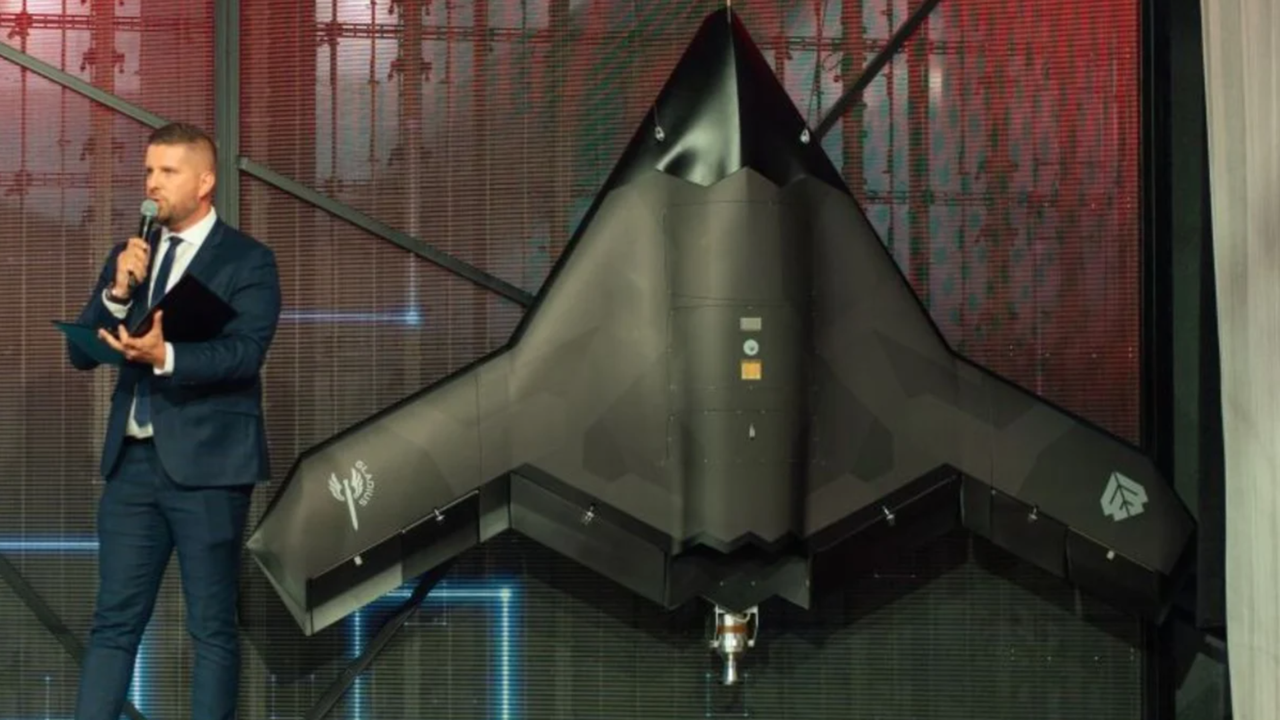
Polish defense manufacturer WB Group has revealed a new loitering munition whose flattened, wing-shaped body echoes the American B-2 Spirit bomber.

Gladius 2, also called Warmate 30, uses that shape mainly to cut down on radar and heat signatures rather than for looks.

Flying wing designs scatter radar waves more efficiently than boxy airframes, which is exactly why stealth bombers adopted the same silhouette decades ago.

A shape borrowed from stealth aviation, not aesthetics

The munition runs on a turbojet engine, giving it a faster run toward its objective than earlier electrically powered Warmate versions.

It carries an interchangeable 30 kg (66 lb) warhead and can launch from a shipping container or a dedicated vehicle.

WB Group designed the weapon to operate within its wider Gladius reconnaissance strike system rather than as a standalone munition alone.

That system pairs the FT-5 ŁoΕ› reconnaissance drone with separate strike effectors, all coordinated through a software platform called Topaz.

This arrangement lets one operator locate an objective using the reconnaissance aircraft, then destroy it with a separate strike weapon.

According to the company, it started developing this newer variant back in September 2022, drawing lessons from the ongoing conflict in Ukraine.

Poland is already investing heavily in the drone family

The new weapon arrives as Poland continues spending heavily on domestically produced unmanned systems and loitering munitions.

In May 2026, Poland's Armaments Agency signed agreements covering more than 400 Warmate systems and nearly 200 FlyEye reconnaissance drones.

The same contracts included 12 Gladius fire modules, with financing partly supplied through the European Union's SAFE defence lending programme.

WB Group has not confirmed whether Gladius 2 or Warmate 30 forms part of those existing procurement agreements.

That distinction matters because the newly shown aircraft could remain a future offering rather than an immediately contracted Polish military system.

WB Group has previously described several Warmate variants using payload categories, including models associated with 5kg, 20kg, and 50kg warheads.

Warmate 30 therefore fits between those larger and smaller configurations while carrying a 30kg payload of its own.

The earlier Warmate 3 reportedly carries a smaller warhead while reaching distances of up to 70km, or 43 miles.

The original Gladius system has also been offered with earlier electrically powered Warmate variants capable of exceeding 100km, or 62 miles.

However, those figures should not be treated as specifications for Gladius 2 until WB Group releases its own performance data.

Whether Gladius 2 performs as well as its shape suggests will remain unclear until WB Group releases actual test figures.

This bomber simply copies a proven stealth silhouette, which makes practical sense for a country expanding its arsenal under real wartime pressure.

Via Defence Blog

Google logo on a black background next to text reading 'Click to follow TechRadar'

  •  

Desperate attempt or marketing genius? Microsoft's Project Zenith is a confusing attempt to get those who can afford an expensive PC to buy one

  • Project Zenith adds developer tools before users have to install them manually
  • The required 64GB memory immediately pushes Zenith beyond ordinary Windows hardware
  • Microsoft wants Zenith machines ready for local AI development

Microsoft has unveiled Project Zenith, introducing specially configured Windows 11 machines aimed at developers and local artificial intelligence work.

The idea sounds practical until you consider the hardware required, because Zenith begins with computers that already sit firmly above mainstream prices.

That makes the project feel less like Windows optimization and more like an attempt to give expensive computers another reason to exist

Microsoft is creating another category for expensive PCs

Zenith is not a separate Windows edition, despite how Microsoft's announcement could initially make the concept sound.

Instead, Microsoft is changing the default software configuration and hardware requirements for computers intended for people developing applications and AI systems.

Eligible machines need at least 64GB of unified memory and 250GB/s of memory bandwidth before receiving the Zenith configuration.

Microsoft also wants these systems capable of running models exceeding 30B parameters locally without metered usage restrictions, according to its announcement.

Windows Terminal and Visual Studio Code come pinned, while GitHub Copilot, PowerToys, WinAppCLI, and Windows Dev Skills arrive preinstalled.

File Explorer also starts with extensions, hidden files, complete paths, and other settings that developers might otherwise configure themselves.

Microsoft describes the objective as providing a β€œready-to-code distraction-free Windows experience” for people using developer-class hardware.

That sounds sensible for professionals who repeatedly configure similar machines, especially when those machines are deployed across larger development teams.

However, most ordinary Windows users have little reason to want these settings or applications occupying their computers from the beginning.

The expensive machine gets another reason to sell

The timing makes the strategy particularly interesting because Microsoft is effectively attaching specialized software treatment to increasingly costly hardware.

This resembles the way manufacturers increasingly describe premium laptops as AI or creative machines, even when professionals remain their obvious buyers.

Zenith appears to take that familiar approach further by defining a software experience around hardware specifications that most consumers will never require.

The first systems will use AMD Ryzen AI Halo processors, with other platforms expected to receive support during subsequent months.

That requirement immediately narrows the field because 64GB of unified memory is far beyond what typical Windows laptops currently provide.

There is nevertheless a straightforward benefit for developers because several hours of repetitive setup can disappear when the computer starts ready for work.

Microsoft's configuration also does not lock these conveniences behind Zenith hardware, since existing Windows 11 installations can receive many changes manually.

That creates an awkward question about why someone should purchase an expensive Zenith machine when much of its software setup remains reproducible.

For companies managing many developer computers, the standardized configuration could save administrative time and reduce repeated setup work across machines.

For an individual buyer, however, the financial argument becomes considerably harder when the main advantage involves settings that require little effort manually.

Microsoft may therefore be selling convenience to people who already have compelling reasons to buy powerful hardware in the first place.

That makes Zenith look less like an entirely new Windows experience and more like a carefully packaged justification for expensive developer computers.

Via Windows Central

Google logo on a black background next to text reading 'Click to follow TechRadar'

  •  

AI on Intel MacBook laptop uses webcam and mirror to rewrite and debug its own AMD Radeon driver code live and direct β€” without a programmer in the loop

  • A webcam and mirror replace human eyes during Radeon driver testing
  • The laptop watches its own screen via a mirrored image
  • Schroeder's setup targets AMD Radeon compatibility inside Omarchy Linux

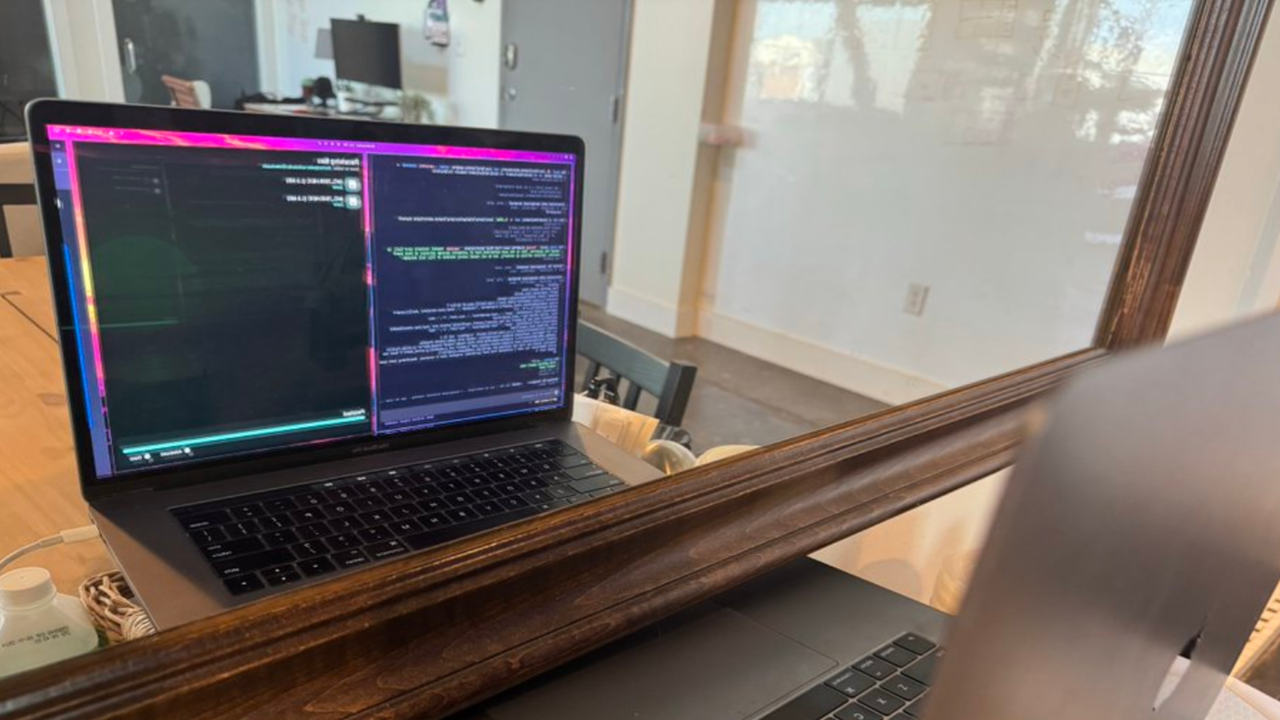
Justin Schroeder, a Linux developer, built an unusual setup pairing an older Intel MacBook with a mirror and camera.

The setup uses the laptop's camera, a mirror, and its display to let the software inspect graphics changes without human checking during development.

This process was demonstrated while working on Omarchy, an open-source Linux distribution that is being adapted for Radeon graphics hardware.

A camera becomes the agent's eyes

The experiment turns the laptop's webcam into an unusual inspection tool by directing its view toward a mirror facing the display.

That reflected image gives the programming agent access to visual information about what happens after changes are made to graphics code.

Instead of relying entirely on textual output, the system can inspect visible rendering problems that appear directly on the laptop's screen.

Those problems can include distorted images, flickering displays, incorrect resolutions, or other changes that indicate graphics software is malfunctioning during testing.

The arrangement is unusual because the computer is effectively using its own camera to observe an image produced by itself.

Schroeder's demonstration concerns AMD Radeon support within Omarchy, where driver compatibility requires changes that can affect actual display output.

The camera and mirror therefore provide a physical feedback path between the software agent and the graphics hardware it is modifying during each test.

Schroeder said the agent could β€œsee” the altered screen, giving its coding process information from direct visual feedback during testing.

Driver changes can be checked through the display

Conventional graphics driver work normally requires programmers to alter code, compile it, restart relevant services, and inspect results manually.

The experiment instead gives the AI programming agent a way to inspect the outcome after modifying, rebuilding, and testing its graphics driver code.

This means visual verification can occur directly on the physical machine rather than depending only on compiler messages or textual diagnostics.

For Radeon support, that distinction matters because successful compilation does not necessarily mean the resulting graphics output will appear correctly.

A driver may build successfully while producing visible artifacts, unstable rendering, incorrect display settings, or other problems during actual operation.

The demonstrated workflow allows the agent to identify those visual changes and use them when deciding what code requires further adjustment.

It also allows repeated testing without requiring a programmer to inspect every intermediate result produced during the graphics development cycle.

Schroeder's experiment therefore connects automated programming with direct observation of hardware output, although the available demonstration does not establish how reliably this scales.

The setup also does not show that the agent independently created an entire production-ready Radeon driver without direct human involvement.

Instead, it shows a development method where an AI system can modify driver code and receive visual information from the resulting display.

That distinction is important because driver development involves many functions that cannot be evaluated solely through what appears on one screen

Google logo on a black background next to text reading 'Click to follow TechRadar'

  •  
❌