 Login

SK Hynix reportedly in talks with Intel to build memory chips in US
SK Hynix told TechCrunch the company hasn't finalized any plans or arrangements yet.



Read more of this story at Slashdot.
A extensão Dash to Panel 74 traz suporte ao GNOME 51, facilitando a atualização do seu desktop GNOME sem perder a configuração do painel.
O post Dash to Panel 74 já oferece compatibilidade total com o GNOME 51 apareceu primeiro em Blog do Edivaldo - Informações e Notícias sobre Linux.
University of Bern simulations and ESA Hera observations point to one non-destructive asteroid impact as the source of Deimos’ southern depression and dusty surface.
The post A Single Asteroid Impact May Have Shaped Mars’ Moon Deimos appeared first on Curiosmos.

Assinantes do Apple TV já podem conferir o primeiro episódio da aguardada sexta temporada de “Slow Horses”, série de espionagem estrelada por Gary Oldman, que retorna hoje.
Aos que nunca deram uma chance para a série, “Slow Horses” acompanha uma equipe de agentes da inteligência britânica, os quais servem em um departamento do MI5 conhecido como Slough House. Oldman assume o papel de Lamb, o brilhante (mas rabugento) líder dos espiões, que acabam indo para a Slough House devido a erros que acabaram com suas carreiras.
Reveja o trailer da sexta temporada a seguir:
A nova parte da produção acompanhará a fuga dessa equipe, enquanto Diana Taverner (interpretada por Kristin Scott Thomas) os envolve em um jogo de retaliação e vingança com riscos e consequências fatais.
Mesmo que a sexta temporada só esteja chegando agora ao Apple TV, já sabemos que “Slow Horses” terá pelo menos mais duas temporadas, já que a Maçã anunciou mais uma renovação adiantada da produção — que tem sido, há anos, uma das mais premiadas do serviço. Nesta semana, inclusive, a série faturou o prêmio de Melhor Direção de Série de Drama (recebido por Saul Metzstein) nos Primetime Emmy Awards 2026.
Além de Scott Thomas e Oldman, o elenco inclui Jack Lowden, Saskia Reeves, Christopher Chung, Rosalind Eleazar, Joanna Scanlan, Samuel West, Ruth Bradley, Hugo Weaving, Lenny Rush, Aimee-Ffion Edwards, James Callis, Tom Brooke, Jonathan Pryce e Olivia Cooke. Oldman também assina a produção executiva, ao lado de Jamie Laurenson, Hakan Kousetta, Julian Stevens, Iain Canning, Emile Sherman, Gail Mutrux, Douglas Urbanski, Gaby Chiappe e Adam Randall, que retorna também à direção.
Alguns desses nomes, vale notar, marcaram presença na première da sexta temporada, organizada pelo Apple TV na última sexta-feira (11/9) no TIFF Lightbox Theater, em Toronto (Canadá):


Como dito, apenas o primeiro dos seis episódios da sexta temporada foi liberado hoje. Os capítulos remanescentes serão disponibilizados semanalmente, às quartas-feiras, até 21 de outubro.
O Apple TV está disponível no aplicativo Apple TV em mais de 100 países e regiões, seja em iPhones, iPads, Apple TVs, Macs, dispositivos Android, smart TVs ou online — além de estar em aparelhos como Roku, Amazon Fire TV, Chromecast com Google TV, consoles PlayStation e Xbox. O serviço custa R$34,90 por mês, com um período de teste gratuito de 7 dias. Por tempo limitado, quem comprar e ativar um novo iPhone, iPad, Apple TV ou Mac ganha 3 meses do Apple TV. Ele também faz parte do pacote de assinaturas da empresa, o Apple One.
NOTA DE TRANSPARÊNCIA: O MacMagazine recebe uma pequena comissão sobre vendas concluídas por meio de links deste post, mas você, como consumidor, não paga nada mais pelos produtos/serviços usando os nossos links de afiliado.


Descubra as novidades do Android 17 QPR1, com melhorias em multitarefa, personalização, controles de mídia e ferramentas de bem-estar.
O post Android 17 QPR1 traz melhorias em multitarefa, mídia e bem-estar digital apareceu primeiro em Blog do Edivaldo - Informações e Notícias sobre Linux.
The boss of HBO has revealed that only one DC Universe (DCU) TV show is officially in the works — and now I'm afraid for the future of Lanterns.
Speaking to Deadline, Casey Bloys confirmed that The People v Gorilla Grodd (TPvGG), aka the recently announced Superman TV spin-off, is the only TV series in active development at DC Studios.
Asked for a status update on DC's myriad television productions, Bloys replied: "People read about development, and they assume that those are greenlit shows and they're [already in] development. And everybody knows that development is just that — you're trying things, you take big swings, [and] not everything comes through.
"I would say our track record in DC, from Watchmen to Peacemaker to Penguin and now Lanterns, is pretty good. We're very selective. We're careful about what we do, nothing has changed. You'll read about development, but focus on what we're greenlighting."
Pressed on whether any other show was in active development, Bloys added: "No, not right now, obviously you've got [The People v] Gorilla Grodd, which I'm very happy about, [they're] doing something different, and I think it's a really fun idea. They just started shooting."

For fans who've immersed themselves in the DCU since day one, Bloys' comments will be of concern.
Indeed, when DC Studios co-head James Gunn revealed the official lineup for DCU Chapter One in January 2023, six small-screen projects were unveiled as part of the rebooted cinematic franchise's initial slate.
Since then, four more series have been added to the list of potential TV candidates, but only one — The People v Gorilla Grodd — has been greenlit. Meanwhile, some shows that were named as part of Gunn's initial announcement, including Waller and Paradise Lost, have reportedly been shelved. Others, such as Booster Gold, have been trapped in development hell.

With Bloys outright confirming TPvGG is all that DC Studios' TV division is actively working on, it's not surprising that fans — myself included — are fearing for Lanterns' future.
The Aaron Pierre and Kyle Chandler-led sci-fi crime drama, which has seen its audience share seemingly grow week-on-week amid positive word of mouth, is one of the most popular shows on television right now. With three more episodes of its debut season yet to air (at the time of publication, anyway), I'm convinced that its viewership will increase in the weeks to come, too.
Considering that HBO's Green Lantern TV show has been such a hit, it's inevitable that a second season will be made, right? Not if we believe Bloys. After all, there are numerous examples of hugely successful shows — on HBO, HBO Max, and otherwise — that haven't returned for another round. There's no guarantee, then, that Lanterns season 2 will be a thing.
That said, DC Studios has assembled a writers room for Lanterns season 2 to kick around potential story ideas. That doesn't mean DC and HBO have pledged to make another season of the DCU Chapter One program, but it does offer hope that, if the right story angle can be found, another eight-part installment might be *ahem* constructed.
As I said at the start of this article, though, I am worried for Lanterns' fate. Bloys is likely playing it coy, but I'm of the opinion that he would've had something positive to say about Lanterns' future if a sophomore season was more likely to happen than not. Right now, then, I'm reluctantly confident that it'll be a one and done scenario.
Mind you, that doesn't mean we won't see Pierre's John Stewart — and, potentially, Chandler's Hal Jordan — again in the DCU. Pierre's Stewart is already set to play a role in Man of Tomorrow, aka next July's follow-up to Gunn's Superman sequel. Meanwhile, there are unsubstantiated rumors floating around that a DCU Green Lantern movie might be fast-tracked because of how popular Lanterns has proven to be.
If, and it's a big if, we get a big-screen Lanterns follow-up to the hit comic book-inspired show, you certainly won't hear me complaining about the decision not to make a second season.
For now, find out everything we know so far about Man of Tomorrow, get the full lowdown on The People v Gorilla Grodd, and learn all there is to know about Clayface.


Descubra as novidades do Krita 5.3.4 e 6.0.4, incluindo renderização no Android e melhorias com Qt 6 para Linux.
O post Krita 5.3.4 e 6.0.4 chegam com exportação de vídeo e suporte Qt 6 no Android apareceu primeiro em Blog do Edivaldo - Informações e Notícias sobre Linux.
Descubra as melhorias do Tails 7.13, que traz Tor Browser 15.0.23 e um processo de desligamento mais ágil e simplificado.
O post Tails 7.13 lançado com Tor Browser atualizado e desligamento mais rápido apareceu primeiro em Blog do Edivaldo - Informações e Notícias sobre Linux.

Problemas relacionados com páginas ou aplicações que demoram muito tempo a carregar e quedas de ligação curtas e streaming de vídeo são os três casos mais frequentes reportados pelos utilizadores.
The post Internet rápida não chega. Falhas que interrompem trabalho e lazer deixam portugueses frustrados appeared first on Tek Notícias.
Small RC cars often have to make a compromise between portability and driving performance. The ZLL SG616 PRO/MAX takes a different approach, packing four-wheel drive, proportional controls and a relatively aggressive power system into a 1:24-scale chassis.
1:24 scale also changes where the car makes the most sense. Rather than requiring a large dedicated driving area, its compact dimensions make it easier to use on driveways, compact outdoor spaces and other locations where a larger 4WD RC car would be inconvenient.
What makes this model particularly interesting is that buyers can choose between a brushed version and a brushless version. The brushed model is rated for up to 30 km/h, while the brushless configuration raises the claimed top speed to 38 km/h.

At 208 × 113 × 80 mm, the SG616 is small enough to transport easily, but its specifications are closer to what enthusiasts expect from a performance-oriented RC vehicle than a basic toy-grade car.
The 1:24 scale also changes where the car makes the most sense. Rather than requiring a large dedicated driving area, its compact dimensions make it easier to use on driveways, compact outdoor spaces and other locations where a larger RC truck would be inconvenient.
The 12 mm ground clearance is modest, so the SG616 is not designed to behave like a full-size crawler. Its appeal is instead centered on quick acceleration, directional control and short off-road runs.
The biggest difference between the SG616 PRO and MAX configurations is the power system.
The brushed version uses an RC180 motor and has a claimed maximum speed of 30 km/h. The brushless version moves to a 2030 4500KV motor and is rated for up to 38 km/h. Both configurations use an integrated 35A ESC.
That distinction matters because the brushless model is not simply a cosmetic upgrade. Its higher claimed speed makes it more suitable for users who want a faster RC driving experience, while the brushed version may make more sense for someone who values a simpler setup.
The brushless configuration also gets an all-metal driveshaft, giving it a mechanical upgrade beyond the motor itself.
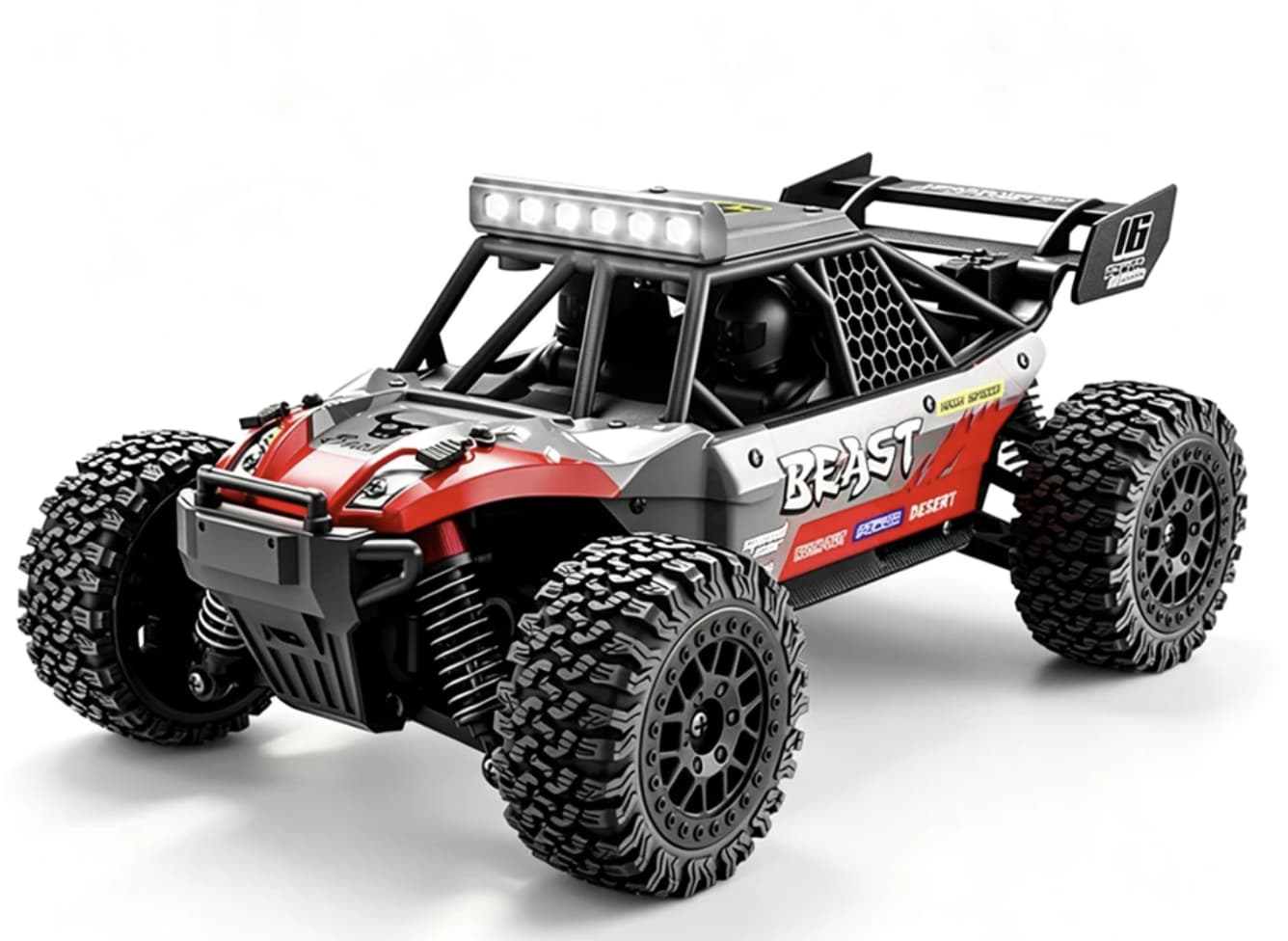
The SG616 uses a 4WD drivetrain with planetary differential gearing and independent suspension. Combined with a 45-degree steering angle, these features are intended to give the small chassis more flexibility when changing direction or dealing with uneven surfaces.
The car also uses ball bearings throughout, while an aluminum motor heatsink helps manage heat around the power system.
This combination is more important than the headline speed. A fast RC car is only enjoyable when the chassis can translate that power into controllable movement. The SG616’s proportional throttle and four-wheel-drive layout are therefore two of its more meaningful features.
The included 2.4GHz transmitter provides four control channels and a claimed control distance of around 80 to 100 meters, depending on the configuration or listing specification.
More importantly, the car supports full-proportional control. Instead of limiting the vehicle to simple forward, reverse and steering commands, proportional control allows the driver to vary throttle input more precisely.
That is useful when moving through tighter spaces. It also gives the SG616 a more controllable feel when approaching corners or transitioning between slower technical driving and high-speed runs.

The SG616 uses a 7.4V Li-ion battery, with the brushed and brushless versions using 500mAh and 800mAh capacities respectively according to the current listing. Charging takes approximately 1.5 hours, while the advertised running time is around 30 to 40 minutes.
These numbers suggest that the car is better suited to several relatively short driving sessions than continuous long-distance running.
The included USB charging cable also keeps the package straightforward. Buyers receive the car, battery, transmitter, charging cable, manual, spare R-clips and screwdriver, so there is no need to assemble a separate basic control system before getting started.
The SG616 has several details aimed at reducing the limitations of a compact RC chassis.
Its circuit board and steering servo are listed as waterproof, while the front bumper integrates LED lights for a more distinctive appearance during low-light driving. The 47 mm tires and independent suspension also help the car deal with surfaces that are less predictable than a smooth indoor floor.
However, waterproof electronics should not automatically be interpreted as a license for deep-water driving. The practical advantage is better resistance to splashes and wet conditions rather than treating the car as a fully submersible vehicle.
The ZLL SG616 PRO/MAX occupies an interesting middle ground.
It is substantially more performance-focused than a basic toy RC car, yet its 1:24 scale keeps it much easier to carry and deploy than a larger hobby-grade truck. The brushless version is particularly notable for its claimed 38 km/h maximum speed, while the proportional controls and 4WD system give the driver more control than a simple entry-level model.
For buyers deciding between the two versions, the choice largely comes down to driving priorities. The brushed model provides a lower-speed configuration, while the brushless model targets users who specifically want more speed and the additional mechanical hardware that comes with that configuration.
ZLL SG616 PRO/MAX is interesting because it does not rely on one headline specification. Its appeal comes from how several features work together: a compact 1:24 chassis, 4WD, independent suspension, proportional throttle, 2.4GHz control and two different motor configurations.
The brushless version’s 38 km/h claim is certainly the attention-grabbing number, but the proportional controls, drivetrain design and compact dimensions may ultimately have a greater impact on everyday usability.
For shoppers comparing small off-road RC cars, the SG616 is therefore worth looking at as a performance-focused compact model rather than simply another inexpensive remote-control toy.
The post ZLL SG616 PRO/MAX Review: A 1:24 4WD RC Car Built for Fast Off-Road Runs appeared first on IGeeKphone China Phone, Tablet PC, VR, RC Drone News, Reviews.
AULA F75 MAX keyboard is designed for users who want more than a basic compact mechanical gaming keyboard. Instead of focusing on a single headline feature, it combines a space-saving 75% layout with a dedicated TFT screen, rotary knob, hot-swappable switches, gasket mounting and three connection modes.
That combination makes the F75 MAX interesting for both gaming and everyday desktop use. Its design also reflects a broader trend in mechanical keyboards: smaller layouts are becoming more feature-rich without completely sacrificing the controls that PC users rely on.
The F75 MAX uses an 80-key 75% layout, keeping the function row and arrow-key cluster while removing the large gaps and dedicated number pad found on full-size keyboards.
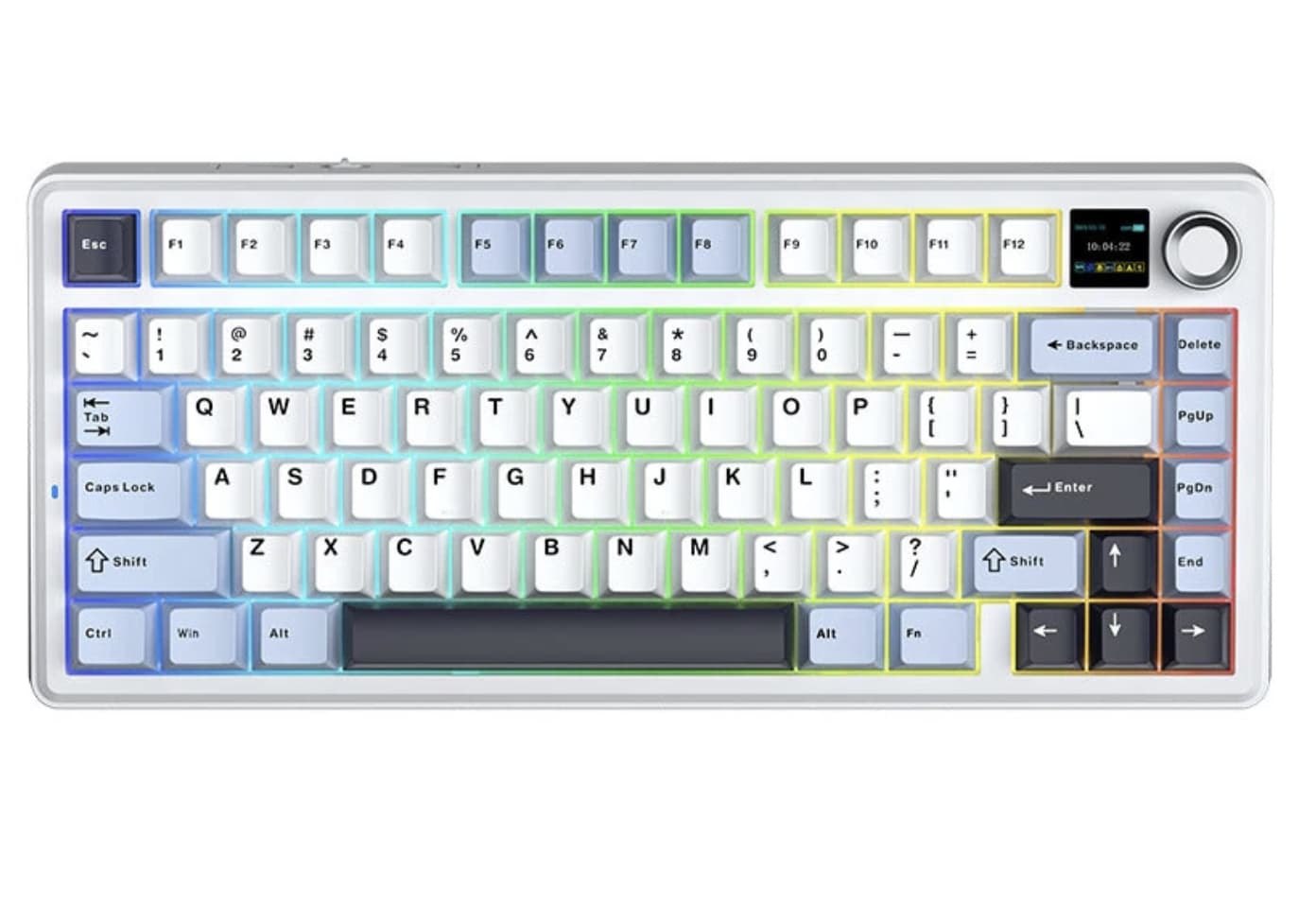
For a gaming setup, this layout can free up more desk space for mouse movement. At the same time, it remains practical for productivity because users do not have to give up the dedicated arrow keys and function row.
The trade-off is the missing number pad. Anyone who regularly enters large amounts of numerical data may still prefer a full-size keyboard, but for gaming, general typing and compact workstations, the 75% format is a useful middle ground.
One of the F75 MAX’s most noticeable design elements is its built-in TFT screen. Instead of relying entirely on RGB lighting for visual customization, the keyboard adds a small display that gives the top section a more personalized appearance. Banggood specifically lists a GIF-capable TFT screen interface.
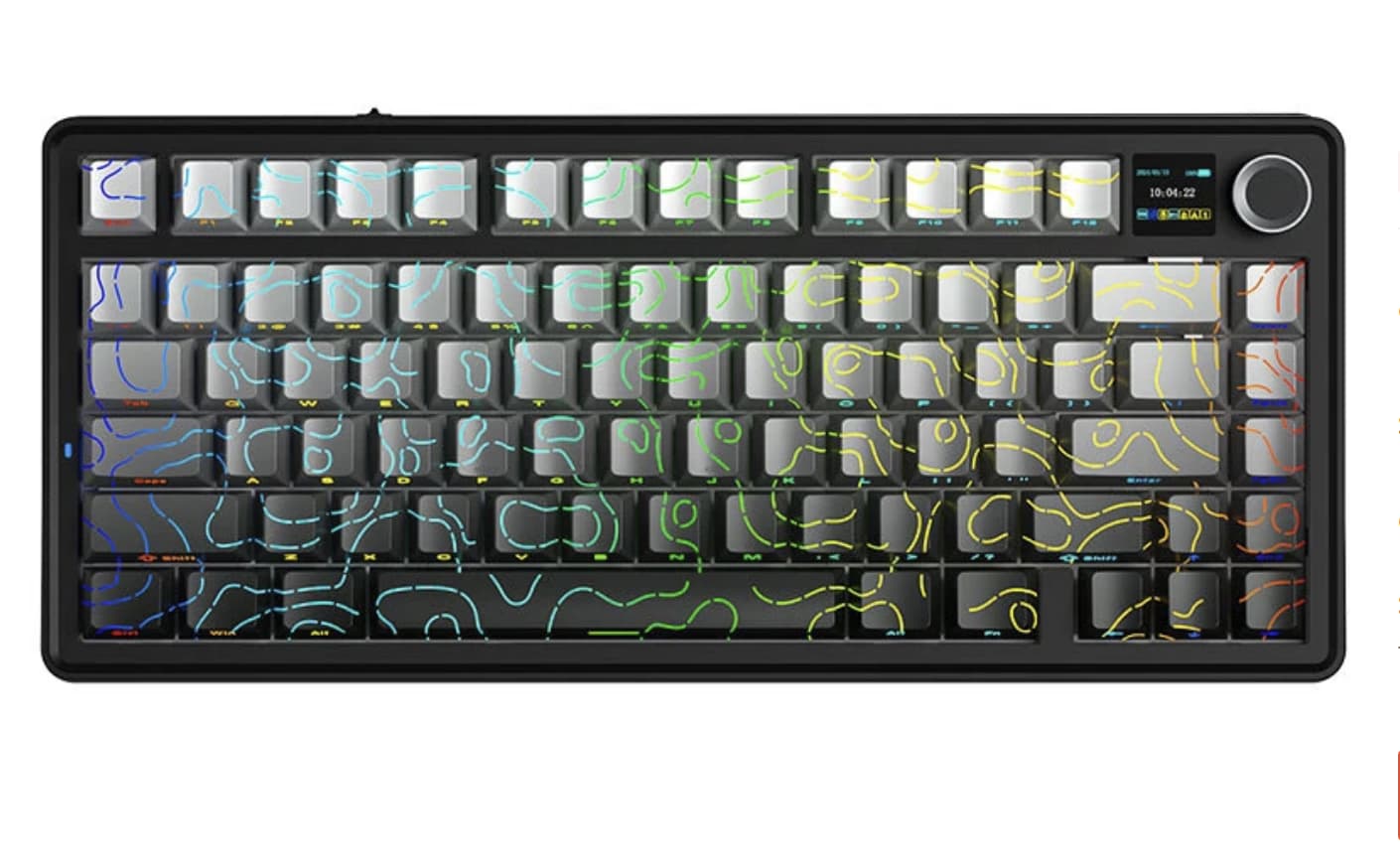
This feature does not fundamentally change typing performance, but it gives the keyboard a distinct identity. For users who enjoy customizing their desktop setup, the screen can make the F75 MAX feel more like a configurable gadget than a conventional mechanical keyboard.
The separate metal knob also adds a practical control point, giving users a physical way to interact with supported functions instead of relying entirely on keyboard shortcuts.
The keyboard uses a gasket-mounted structure with multiple layers of sound-dampening material. AULA lists five layers of dampening, while the product listing describes a six-layer sound-absorbing structure, so the exact terminology varies between listings.
The important part is what this construction is intended to achieve. A gasket-mounted keyboard isolates the plate from parts of the case, allowing slightly more flex while reducing some of the direct vibration transferred through the chassis.
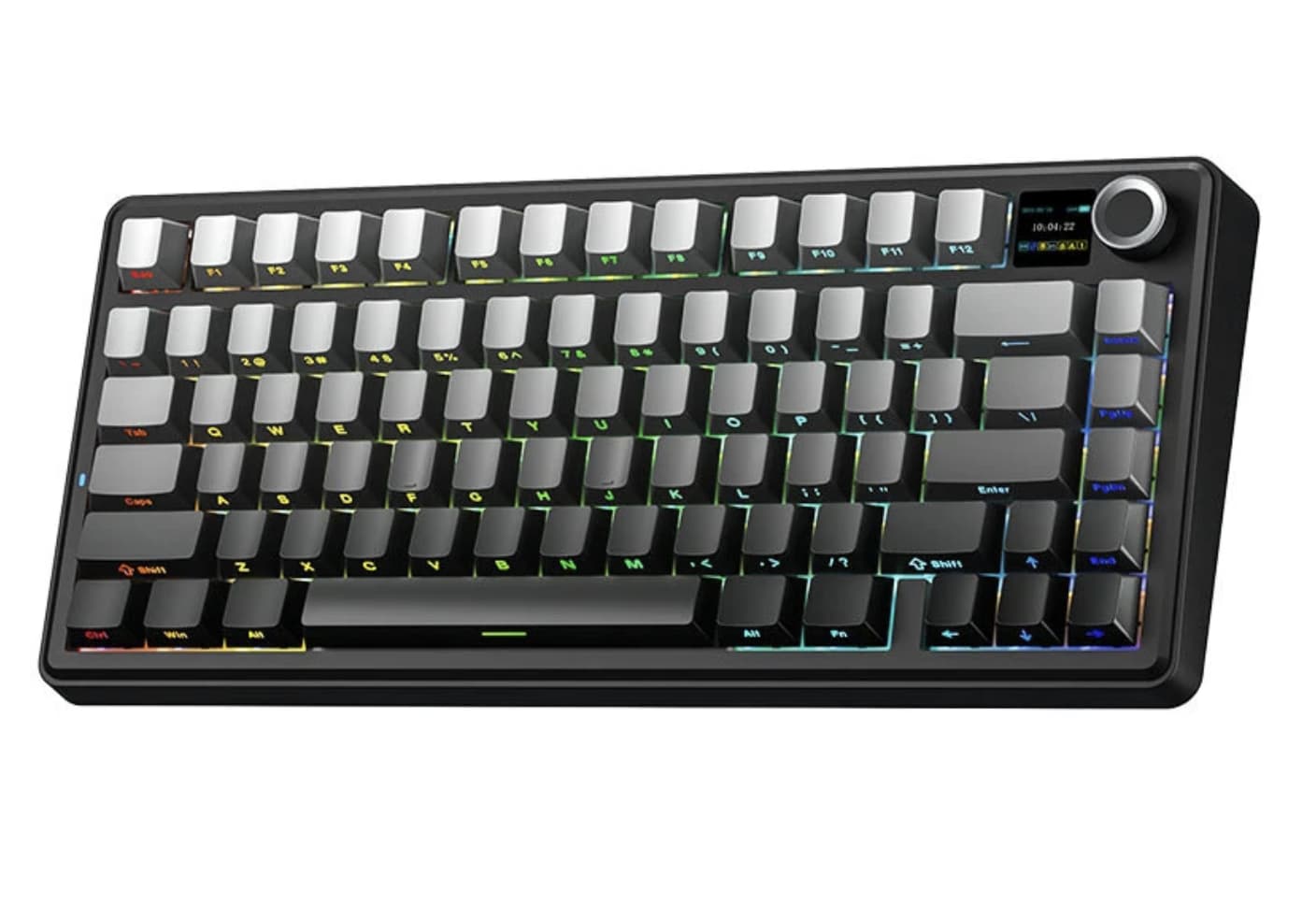
Combined with the F75 MAX’s foam and silicone layers, the design is aimed at producing a deeper and less harsh typing sound than a basic rigid keyboard.
That makes the keyboard potentially more appealing to people who care about typing acoustics as well as gaming performance.
Another useful feature is the hot-swappable PCB, which supports 3-pin and 5-pin mechanical switches according to AULA’s specifications.
This means owners are not necessarily locked into the factory switch configuration. Users who prefer a lighter linear feel, a different actuation characteristic or another sound profile can experiment with compatible switches without replacing the entire keyboard.
The F75 MAX comes with LEOBOG Reaper linear switches. AULA lists them as factory-lubed, while EPOMAKER’s specifications give the switch a 45±3gf trigger force and 3.6±0.3mm total travel.
For someone buying a mechanical keyboard as a long-term platform, this upgradeability may be more meaningful than RGB effects alone.
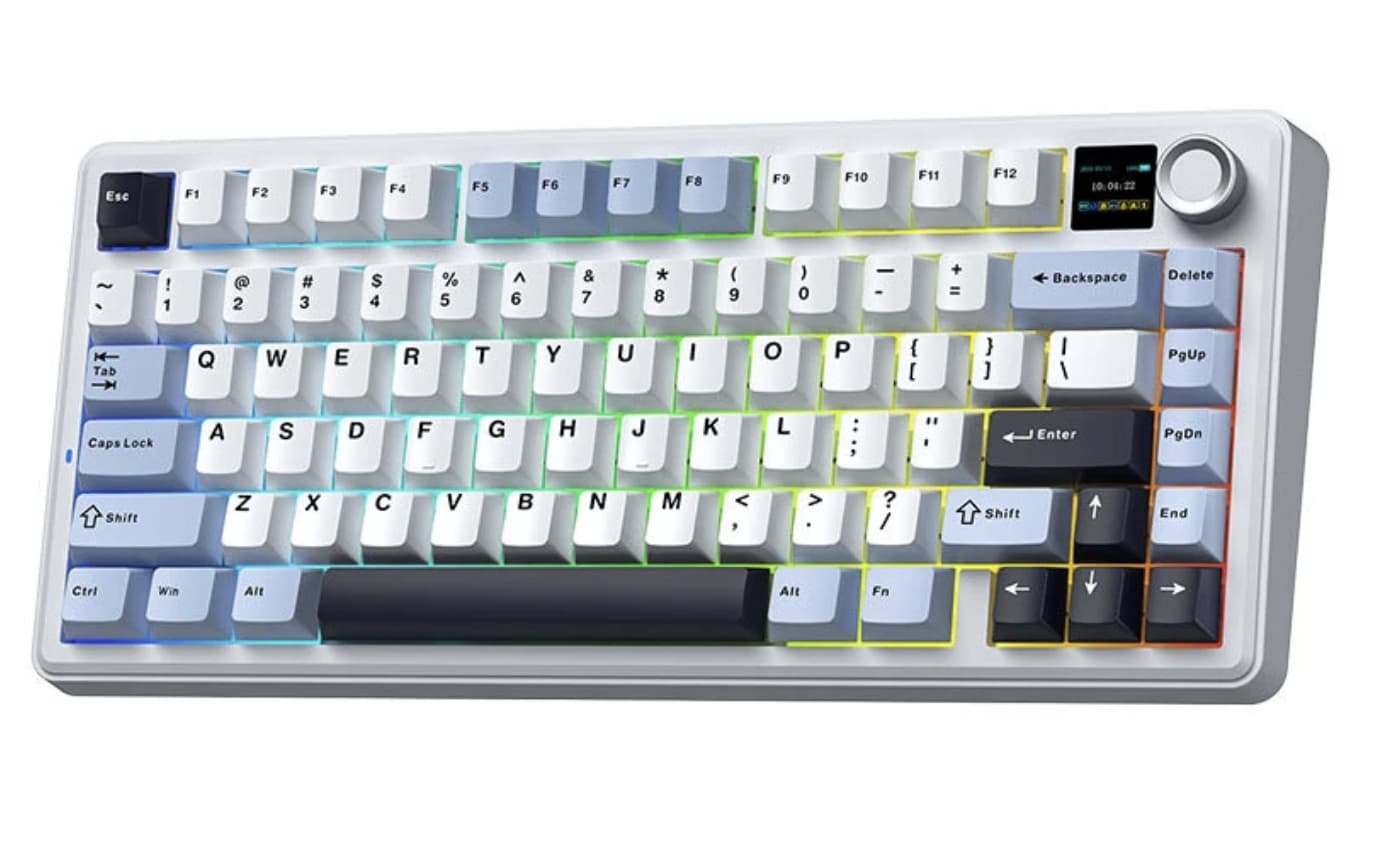
The F75 MAX supports USB-C wired, 2.4GHz wireless and Bluetooth 5.0 connections.
That gives the keyboard three distinct use cases. Wired mode is suitable for a desktop gaming setup, 2.4GHz wireless keeps the desk cleaner while maintaining a low-latency connection, and Bluetooth is convenient when switching between compatible computers or mobile devices.
AULA rates the keyboard at up to 1000Hz polling through USB and 2.4GHz, while Bluetooth is listed at 125Hz. The manufacturer also lists latency of around 3ms over USB, 7ms via 2.4GHz and 18ms through Bluetooth.
For competitive gaming, the wired and 2.4GHz modes are therefore the more relevant choices.
The built-in 4000mAh battery is another reason the F75 MAX works well as a wireless desktop keyboard. AULA rates battery life at approximately 30.5 hours with the RGB backlight enabled and up to 80 hours with the lighting switched off.
Actual endurance will depend on lighting brightness, connection mode and usage patterns, so these figures should be treated as manufacturer ratings rather than guaranteed real-world results.
Still, the option to turn off RGB lighting when maximum battery life matters gives users more control over how they use the keyboard.
The F75 MAX uses double-shot PBT keycaps and south-facing per-key RGB lighting.
PBT is commonly chosen for mechanical keyboards because it generally resists the glossy wear that can develop on frequently used ABS keycaps. The south-facing RGB arrangement also works well with the keyboard’s overall enthusiast-oriented design.
AULA lists support for more than 16 million RGB colors and multiple lighting effects, although the visual customization is ultimately secondary to the keyboard’s typing and connectivity features.
AULA F75 MAX is best understood as a feature-rich 75% mechanical keyboard rather than simply another RGB gaming board.
Its strongest combination is the compact layout, gasket construction, hot-swappable PCB and tri-mode connectivity. The TFT display and rotary knob then add a layer of customization that separates it from more conventional 75% keyboards.
For gamers, the 2.4GHz connection and 1000Hz polling rate give the keyboard a performance-oriented side. For enthusiasts, the hot-swap PCB and gasket structure leave room for future customization. And for everyday users, the 75% layout provides a useful balance between desk space and functionality.
The main compromise is straightforward: users who need a dedicated number pad will need a larger keyboard. But for anyone comfortable with the 75% format, the AULA F75 MAX offers a combination of customization, wireless flexibility and enthusiast-style construction that makes it worth considering.
For the latest specifications and software information, buyers should also check the official AULA product page before ordering, since configurations and regional listings can vary.
The post AULA F75 MAX Review: A 75% Mechanical Keyboard With TFT Screen and Tri-Mode Wireless appeared first on IGeeKphone China Phone, Tablet PC, VR, RC Drone News, Reviews.
Lenovo has started teasing YOGA Pro 15 Spark, a new China-market laptop built around NVIDIA’s RTX Spark platform. The company has not yet revealed the full domestic configuration or pricing, but the latest teaser suggests that more details are coming soon.
The new laptop is closely related to Lenovo’s recently announced AI laptop Yoga Pro 9n, which debuted internationally at IFA 2026. Lenovo lists the Yoga Pro 9n as a 15-inch premium creator laptop powered by NVIDIA RTX Spark, while the Chinese-market version is called the YOGA Pro 15 Spark.
The YOGA Pro 15 Spark has now entered the domestic preheating phase, indicating that Lenovo is preparing to introduce its NVIDIA RTX Spark-powered laptop to the Chinese market.
Rather than relying on a conventional Intel or AMD processor paired with a separate graphics card, the RTX Spark platform combines a Grace CPU and Blackwell RTX GPU into a single superchip. Lenovo says the platform is designed for demanding local AI workloads, content creation and software development.
This architecture is one of the most notable aspects of the new Yoga laptop because the CPU and GPU can share a large pool of unified memory. That design is particularly relevant to AI applications that require substantial memory capacity.

The RTX Spark N1X platform used by Lenovo’s announced systems can integrate a 20-core NVIDIA Grace CPU with a Blackwell RTX GPU containing up to 6,144 CUDA cores. The platform can also support up to 128GB of unified memory and deliver up to 1 PFLOPS of AI performance at FP4 precision, according to Lenovo’s China-market information.
For users, the significance goes beyond raw specifications. Large unified memory capacity can allow the CPU and GPU to access the same memory pool, making the architecture particularly suited to running demanding AI models locally rather than depending entirely on cloud processing.
NVIDIA has also described RTX Spark PCs as Windows-on-Arm systems, with the first machines scheduled to arrive in October 2026.
Lenovo’s international Yoga Pro 9n provides an indication of what to expect from the China-market YOGA Pro 15 Spark.
The Yoga Pro 9n features a 15.3-inch 2.5K OLED display with a refresh rate of up to 165Hz. It can also be configured with up to 128GB of LPDDR5X memory and up to 4TB of storage. Lenovo positions the machine toward creators and developers who need high local computing performance.
The laptop also uses an aluminum chassis and measures as little as 16.7mm thick, while its cooling architecture supports an 80W TDP configuration.
However, Lenovo has not yet confirmed whether every specification of the international Yoga Pro 9n will carry over unchanged to the Chinese YOGA Pro 15 Spark.
At this stage, Lenovo has confirmed the domestic preheating of the YOGA Pro 15 Spark, but key details such as its Chinese pricing, exact configuration and retail launch date have not yet been announced.
The new model could become an interesting option for users looking for a relatively portable laptop capable of handling local AI workloads, creative applications and GPU-accelerated tasks.
For now, the main takeaway is clear: Lenovo is bringing its RTX Spark N1X-powered Yoga platform to the Chinese market, with the YOGA Pro 15 Spark expected to receive more official details in the near future.
The post Lenovo YOGA Pro 15 Spark Teased With NVIDIA RTX Spark N1X Superchip appeared first on IGeeKphone China Phone, Tablet PC, VR, RC Drone News, Reviews.
NASA's Nancy Grace Roman Space Telescope is gliding toward its distant observation post on a pinpoint trajectory so precise that engineers estimate the spacecraft's fuel load will last twice as long as their initial expectations, the space agency confirmed Monday.
The $4.3 billion observatory's designers originally planned to load enough propellant into Roman's four fuel tanks for a minimum lifetime of five years, plus a potential five-year mission extension. That was a conservative estimate. NASA officials knew an on-target launch and perfect execution of the observatory's first post-launch course correction maneuver would leave Roman with a hearty fuel reserve.
"As a result of exquisite planning by our orbital dynamics team, brilliant execution by the operations team, and a precise launch from SpaceX, Roman has fuel for at least 22 years of potential science operations," Jamie Dunn, center director at NASA's Goddard Space Flight Center, said in a press release.
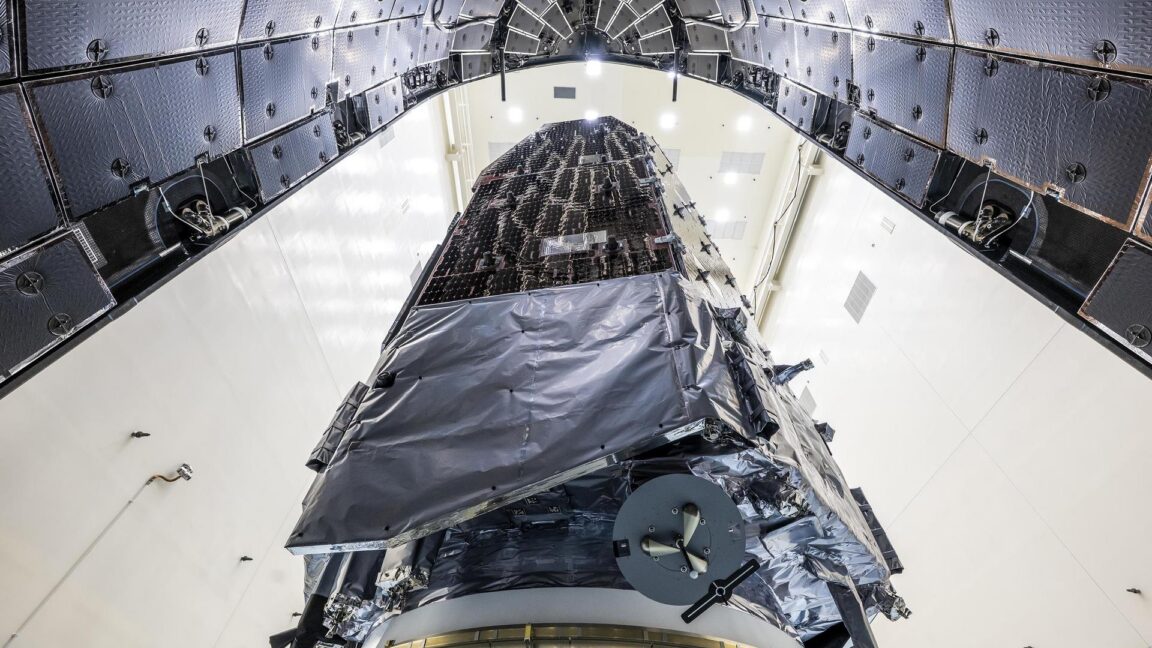
© SpaceX
NASA's Nancy Grace Roman Space Telescope is gliding toward its distant observation post on a pinpoint trajectory so precise that engineers estimate the spacecraft's fuel load will last twice as long as their initial expectations, the space agency confirmed Monday.
The $4.3 billion observatory's designers originally planned to load enough propellant into Roman's four fuel tanks for a minimum lifetime of five years, plus a potential five-year mission extension. That was a conservative estimate. NASA officials knew an on-target launch and perfect execution of the observatory's first post-launch course correction maneuver would leave Roman with a hearty fuel reserve.
"As a result of exquisite planning by our orbital dynamics team, brilliant execution by the operations team, and a precise launch from SpaceX, Roman has fuel for at least 22 years of potential science operations," Jamie Dunn, center director at NASA's Goddard Space Flight Center, said in a press release.
© SpaceX

Average wait times for Apple’s new iPhone 18 Pro models have lengthened to 2.6 weeks across eight countries just three days into pre-orders, a jump that veteran Apple watcher Gene Munster called a historically favorable sign for demand.
Munster, managing partner at Deepwater Asset Management, posted his latest tracker Monday. Lead times rose from 1.6 weeks the day before to 2.6 weeks, matching where last year’s Pro models stood at the same point in the cycle. Part of the one-day surge, he noted, came from buyers returning to their computers after pre-orders opened on Saturday rather than the usual Friday. The more important takeaway, he said, is that wait times are moving higher.
iPhone Lead Time Tracker 3 days into Pre-Orders: We’re seeing average lead times of 2.6 weeks across 8 countries. That’s in line with where the Pro models were last year.
My take: Most importantly, the lead times jumped from 1.6 weeks yesterday to 2.6 weeks today. Part of that jump is people are back in front of their computers (pre-orders started on Saturday). The important part is lead times are going up, which has historically been a favorable sign for demand.
Pre-orders for the iPhone 18 Pro and iPhone 18 Pro Max began September 12. The phones go on sale Friday, September 18. This year’s launch is unusually narrow: Apple skipped the standard iPhone 18 and iPhone Air, delaying those models until 2027 amid memory and chip shortages, and scheduled its first foldable, the iPhone Duo, for pre-order on October 16 and availability October 23. Only the two Pro models are available now, at starting prices of $1,199 and $1,299.
Some configurations, especially popular Pro Max storage and color combinations, already show delivery windows stretching into early October. That tightening inventory is what Munster’s tracker is capturing. Rising lead times have often preceded stronger-than-expected iPhone units in past cycles, which is why he flagged the move as constructive for Apple.
Not every analyst reads the same data the same way. Bank of America and JPMorgan have noted that some year-over-year comparisons look shorter than last year’s iPhone 17 Pro cycle, and GF Securities’ Jeff Pu described initial demand as “lukewarm,” citing limited spec upgrades, higher prices, and buyers who may be waiting for the Duo. Munster’s point is narrower and more sequential: the fact that waits lengthened from one day to the next still matters.
The Duo, starting at $1,999, is expected to siphon some high-end buyers who would otherwise have chosen a Pro Max. How large that substitution effect becomes will only become clear after October 16. For now, Munster’s tracker suggests the phones that are on sale are finding buyers quickly enough to push delivery dates later.
MacDailyNews Take: Munster’s data showing lengthening wait times is meaningful. The other analysts’ looking just at YoY lead times do not have enoguh data to draw any meaningful conclusions.
You cannot measure demand based on shipping times without knowing how much supply Apple has in hand… and where and how those supplies are allocated in each geographic area. – MacDailyNews, September 17, 2024
Please help support MacDailyNews — and enjoy subscriber-only articles, comments, chat, and more — by subscribing to our Substack: macdailynews.substack.com. Thank you!
Support MacDailyNews at no extra cost to you by using this link to shop at Amazon.
The post Rising iPhone 18 Pro lead times point to solid early demand – Gene Munster appeared first on MacDailyNews.
