Login

This Bird Flew 13,560 Kilometers Across the Pacific Without Eating or Stopping Even Once
 The tiny godwit stayed in the air for 11 days, breaking all previously known records of nonstop flight.
 The tiny godwit stayed in the air for 11 days, breaking all previously known records of nonstop flight.
Scientists investigating a 66-million-year-old mystery have revealed that a bird feather embedded in fossilized dinosaur excrement suggests that the ancestors of modern birds who survived the dinosaur-killing asteroid that also wiped out all other ancient bird species benefited from the waterproofing properties of their feathers.
The newly analyzed bird feather fossil that provided the missing clues comes from an extinct bird group called Hesperornithiforms and not from the ancestor of modern birds, Neornithes.
However, the team said subtle differences between the species suggest previous theories crediting adaptation to water diving as the key to Neornithes’ survival were likely on the right track.
When a huge piece of space rock slammed into Earth, killing off virtually all dinosaur species save the ancestors of modern birds, the event also left behind a 66-million-year-old mystery. How did these ancient avians survive this apocalyptic event, resulting in every bird species we see today?
Jingmai O’Connor, the associate curator of fossil reptiles at the Field Museum in Chicago, said her career has been spent analyzing fossils to try to answer this single, critical question. However, unlike the new poop-encased bird feathers, most were not so ‘naturally’ protected from the ravages of time.
“It’s such a beautiful, well-preserved feather, from such an unexpected source, and it’s exciting that it could help us answer this huge question in paleontology,” explained the lead author of a study detailing the new analysis. “As far as I know, no one has ever thought to look for feathers or to study feathers in coprolites, so this project was really exciting.”
Researchers discovered the ancient bird feather in 2016 in Montana. Although she initially suspected it could be a coprolite rock (fossilized feces), O’Connor said she couldn’t confirm the theory for a decade.

The situation changed when O’Connor and Nate Carroll, a co-author of the paper and paleontologist at the Carter County Museum in Ekalaka, Montana, gained access to the micro-CT scanner at USC’s medical campus in Los Angeles, California. According to O’Connor, that’s when “the full feathery fabric of this fossil feces” started to finally reveal itself.
“Every hour processing the data revealed another feather, another scale, another bone—in stunning 3D,” Carrol also recalled.

Along with multiple feathers and tiny fish scales, the ancient dinosaur poop, which may have come from a Tyrannosaurus Rex, also contained legs from a hesperonithiform bird.
O’Connor said hesperonithiforms were ancient aquatic birds with similarities to modern loons. Critically, these cousins of the modern bird ancestor group had evolved specialized feet to hunt for fish by diving deep into the water.
“The feathers showed adaptations for being underwater that we see in living aquatic birds,” O’Connor explained.
Notably, the team said this evolution likely cost ancient hesperonithiforms like the one that was consumed by a dinosaur the ability to fly.
Although the bird group represented by the fossilized feather did not survive the dinosaur-killing asteroid, its connection to the ancestor of modern birds appears to support a previously proposed theory that adaptation to water may have helped Neornithes survive. O’Connor said she thinks that small differences in the feathers of the two ancient bird species hold the answer to a 66-million-year-old mystery.
“We think the types of feathers that these birds had, and/or the way they molted those feathers, may have been one of the underlying causes of the selectivity of the end-Cretaceous mass extinction,” the researcher explained, adding that this is “essentially why some birds died out and why others survived.”
Specifically, O’Connor pointed to the “smaller, fuzzy, primitive body feathers” found on the extinct bird “that we associate with dinosaurs and enantiornithines” alongside more modern-looking waterproof adaptations.
The team said that these evolutionary relics suggest that hesperornithiforms like the one that left behind its feathers were an evolutionary bridge between older bird groups and the Neornithes that survived the cosmic collision. Even more critically, the team said these earlier feather structures may not have retained heat as effectively as Neornithes feathers, allowing one species to survive the asteroid and another to die in the extreme cold that followed.
“The hesperornithiforms retain primitive feather types that may not have been as efficient for insulation as modern plumaceous feathers, and that could explain why they went extinct along with the enantiornithines,” O’Connor explained.
The study “Bird feathers from a Late Cretaceous coprolite” was published in Current Biology.
Christopher Plain has spent the last six years as Associate News Editor and Head Science Reporter at The Debrief. Follow and connect with him on X, learn about his novels at plainfiction.com, or email him at christopher@thedebrief.org.
Wild condor parents usually make a great parenting team. But when one female California condor (Gymnogyps californianus) in Pinnacles National Park in Central California found herself in the role of a single mother, park biologists stepped in to help.
The condor mother wasn’t able to provide sufficient care and food for her chick while on her own. Field biologists realized that when hunting for food, she returned to the nest less frequently. The chick needed more nutrition to grow and develop appropriately.
“Based on her behavior, she had largely abandoned the nest, and the chick was unlikely to survive without intervention,” a spokesperson for the San Diego Zoo Wildlife Alliance tells Popular Science.
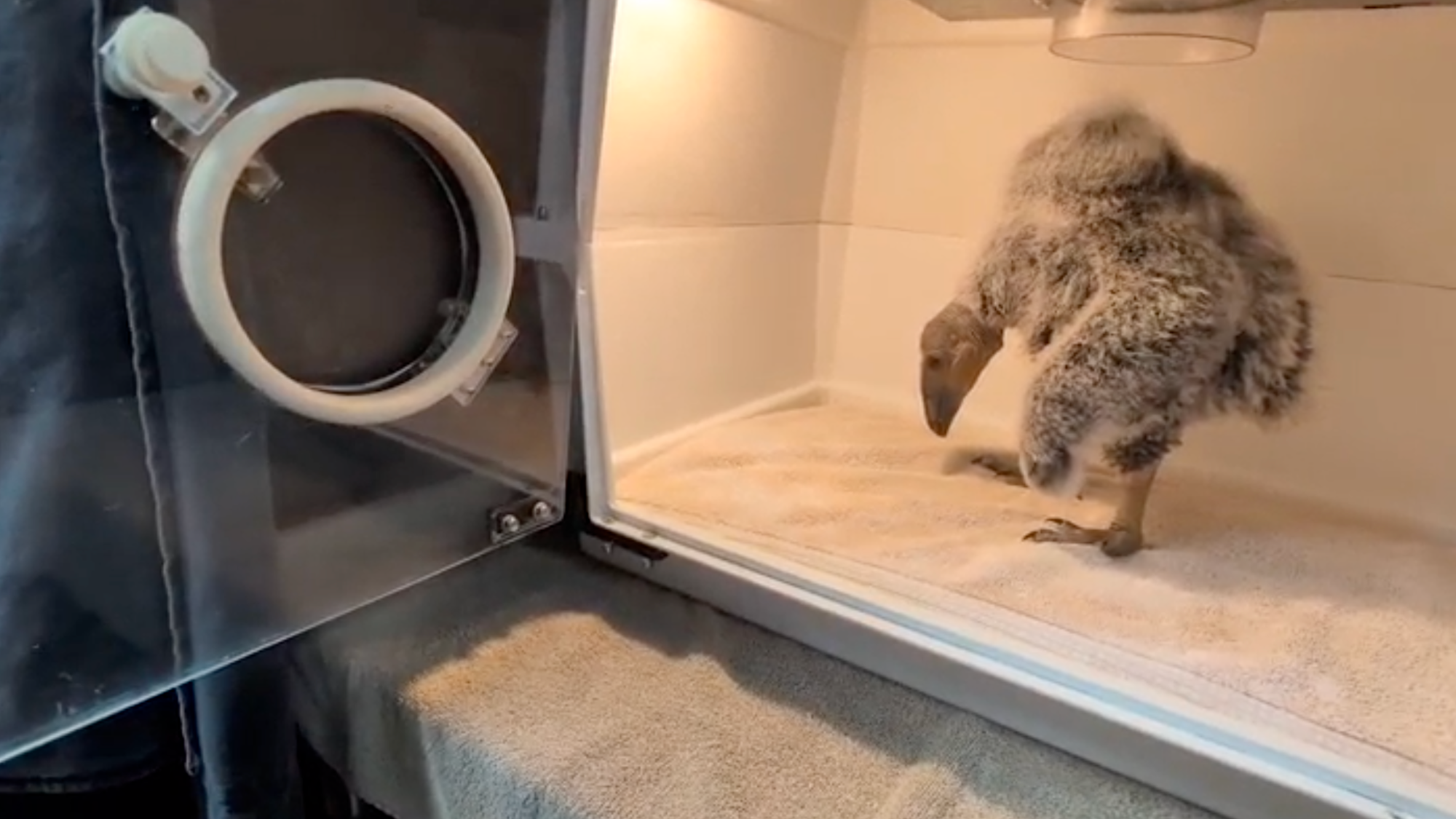
Pinnacles National Park biologists took the chick when it was around one month old and sent him to the San Diego Zoo Safari Park’s California condor breeding facility. There, he’s receiving care in a specialized puppet-rearing program.
“The puppet-rearing program is a specialized care method used to raise young California condor chicks without allowing them to see or bond with human caretakers,” says the spokesperson. “Wildlife care specialists use hand-crafted puppets that resemble adult California condors and completely cover the caretaker’s hands and arms. Caretakers use the puppet’s beak to deliver food directly to the chick, mimicking the way an adult condor parent would feed its young in the nest.”
The chick was named Cayic (pronounced Chai-eech), meaning “strong” in the Mutsun language of the Indigenous people of California’s Central Coast. Thankfully, Cayic is demonstrating normal growth and development, and experts plan on returning him to the wild next fall.California condors are still considered critically endangered, after nearly going extinct.
As for the chick’s father, he had stopped returning to the nest and eventually died while receiving treatment for suspected lead poisoning. Lead poisoning is the greatest cause of death for California condors and a severe obstacle in the species’ recovery. The species is also threatened by the consumption of microtrash.
California condors, or “thunderbirds” for Native Americans, are North America’s largest flying birds. Their wingspan is almost ten feet long, but their mighty reach didn’t keep them from reaching the brink of extinction. During the 1980s, there were fewer than two dozen of them in the wild. In 1986, the U.S. Fish and Wildlife Service put them all in a captive breeding and release program, including at the San Diego Zoo Safari Park. Six years later, the program had bred enough chicks to return the first condors to the wild.
As of the end of 2025, there are 607 California condors in the world, 392 of which are in the wild. One of them is Cayic’s mom.
“The mother may go on to pair with another male, and we hope she will have another opportunity to breed during a future breeding season,” says the spokesperson.
The post Single California condor mother gets help raising her chick appeared first on Popular Science.