Many of the world’s greatest scientific minds remain in startling disagreement with one another about the nature of reality itself. After conducting what is likely the largest survey of its kind, researchers reported that a vast majority of physicists suspect the big bang doesn’t necessarily mark the beginning of time. And as their additional responses indicate, scientists diverge even more when it comes to other hot-button cosmological topics.
In 2025, researchers put out an international open call for their Big Mysteries in Physics survey. Anyone could partake in the questionnaire, but responses from self-identifying physicists were later separated and reviewed to identify any particularly striking areas of agreement or disagreement. After reviewing answers from over 1,600 physicists, the questionnaire’s authors published their key takeaways earlier this year in Physics Magazine.
The results? Physicists are very divided on explanations for some of the universe’s fundamental operations.
The most dramatic relates to the big-bang theory (technically known as the Lambda Cold Dark Matter theory). About 68 percent of respondents said they don’t think the famous moment necessarily marks the beginning of time. Some of this has to do with how the big bang is presented in popular culture—contrary to many depictions, the theory specifically explains how the universe expanded from a single extremely hot, dense prior state of existence. This means it technically may have very little to do with the beginning of time.
The only other majority opinion pertains to the immediate moments following the big bang. Only 51 percent of physicists agreed that the immediate moments following the big bang involved an incomprehensibly fast period of expansion commonly known as inflation.
Subjects got far more contentious from there, although some of it was understandable. Given how much remains to still learn about dark matter, 17 percent of survey takers think the mysterious material is composed of an undiscovered particle or particles. Around 12 percent argued it could be explained by tweaking the theory of gravity. At best, barely 21 percent of physicists hypothesized it may be some combination of these and other answers.
Quantum physics continues the chaos. Nearly 19 percent of scientists think string theory is likely the best way to integrate gravity into quantum physics, while only 12 percent offered loop quantum gravity as an alternative. Meanwhile, 18 percent lean towards the suspicion that gravity can’t be integrated in any way.
If the survey presents one clear takeaway, it’s that these diverse theories are in no way an indictment of the present-day state of physics. These aren’t amateurs—they’re researchers who base their arguments on volumes’ worth of data, calculations, and scientific testing.
“Consensus, or its absence, tells us where the evidence feels settled and where researchers still see room for radically different ideas,” Niayesh Afshordi, a University of Waterloo physicist and study co-author, explained in a statement. “In this sense, lack of consensus can be a clue. It marks places where better data, sharper theory, or new connections between subfields may be needed”
Afshordi noted that unlike other polls, scientific reality isn’t settled by a majority vote. It’s supported by clear, demonstrable evidence.
“The interesting point is not that physicists are confused. It is that the frontier is genuinely alive,” he added.
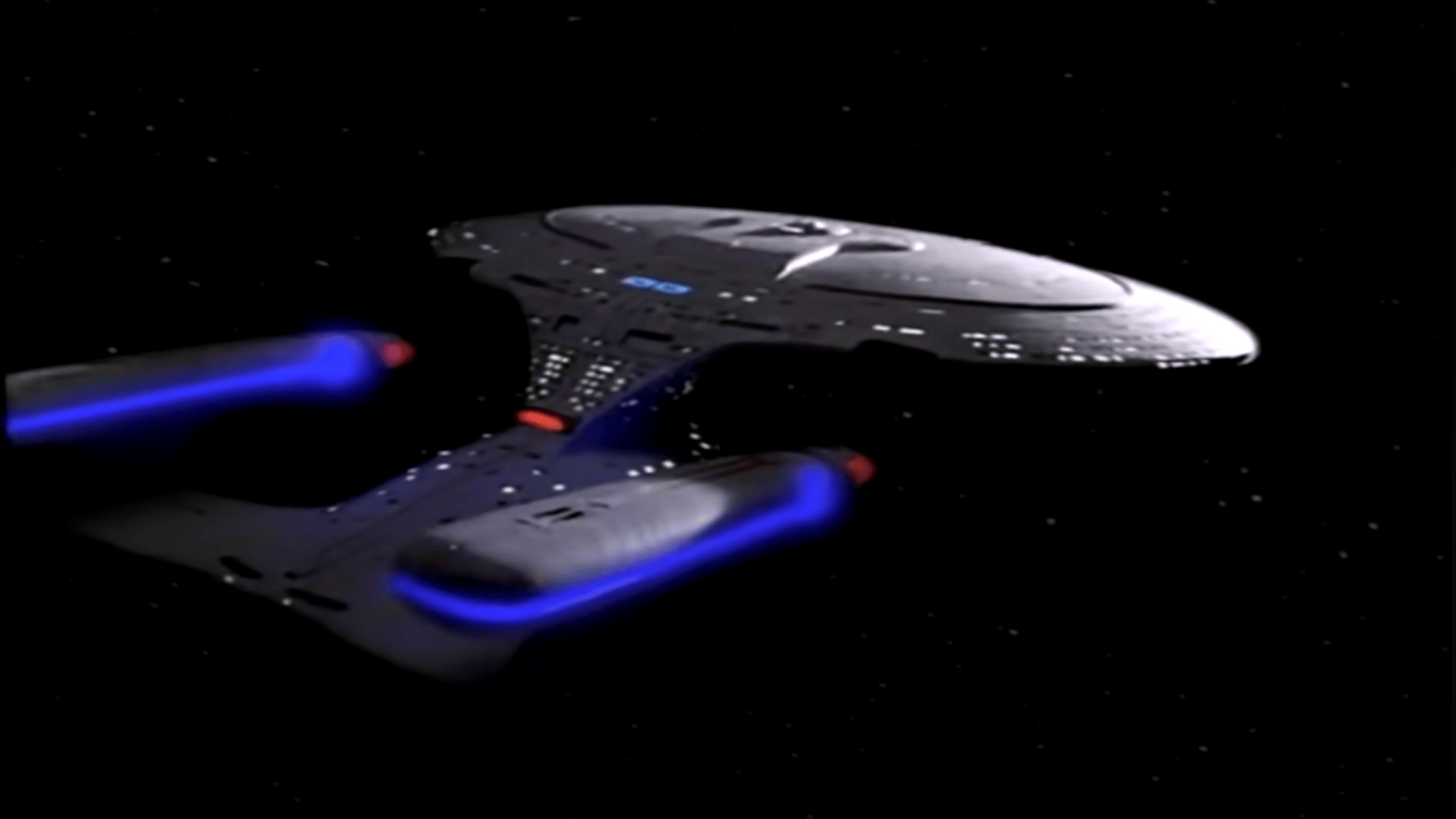
The most impressive science fiction stories emphasize “science” over spectacle. The Star Trek franchise has featured plenty of examples since the original series premiered 60 years ago this month, but one of its most famous sci-fi moments may prove even more fascinating than fans realized. At Brazil’s Federal University of ABC, physicist Níckolas de Aguiar Alves determined that an early episode of Star Trek: The Next Generation demonstrates an aspect to the theory of relativity even better than its creators likely anticipated.
Season One’s ninth episode, “The Battle,” introduces a bit of backstory to Jean-Luc Picard’s illustrious career in the Federation. Years before he became captain of the USS Enterprise, Picard oversaw a ship called the Stargazer when it came under fire from an unknown assailant. Picard needed to navigate closer to the mystery attacker before responding, but the Enterprise’s shields were down.
The captain then quickly improvised what later became known as the “Picard Maneuver.” He ordered his crew to rush their foe at warp speed (faster than the speed of light) then quickly halt and begin firing. Relativistic physics dictated that if Stargazer traveled faster than visible light, it would technically generate two images of the ship from their attacker’s point of view—one Stargazer at the location just prior to warp speed, then a Stargazer where it halted. The operation was risky, but it gave Picard and his crew a 50/50 chance that the enemy would continue firing on an afterimage of Stargazer.
Traveling faster than lightspeed is widely considered impossible, but the underlying principles of Picard’s Maneuver don’t only hold up to expert scrutiny—its depiction in Star Trek is hypothetically less accurate than it should be. According to de Aguiar Alves, Picard’s odds technically would be even higher in such a scenario. But while a fan of the series, the physicist wasn’t intentionally trying to stress test the episode’s logic. Instead, de Aguiar Alves was working on an actual particle physics problem that involved a slower light speed. At one point, he began sketching out the scenario to double check his work.
“And after I drew one or two diagrams, I started noticing, ‘Hey, I think I’ve thought about something like this before,’” de Aguiar Alves said in a recent interview with Ars Technica.
In actuality, Picard’s Maneuver wouldn’t result in two Stargazer ships; it would make three of them. This is because Picard’s crew didn’t travel at a constant speed during the gambit–they first sped up, then stopped closer to their opponent. That means Stargazer technically accelerated not once, but twice. This makes all the difference.
The physicist doesn’t hold it against the episode’s writers. If anything, the overall conceit is an excellent scenario to ponder while studying theoretical physics.
“The main thing they got perfectly, and I think it is a great illustration,” he said.
By the time naval architecture firm George G. Sharp tasked Jack Heaney with the design of the world’s first nuclear-powered merchant ship, the Glasgow-born designer had already broken many styling norms. In the mid-1940s, Heaney transformed routine ocean transport into a festive occasion when he designed the interiors of the SS President Wilson and SS President Cleveland with Hawaiian murals, carved glass panels, and a smoking lounge dressed in playful, exotic wall art. His gift for making the mundane desirable wasn’t confined to ocean liners—New York’s Museum of Modern Art had already put one of his stackable aluminum chairs on display in 1947. But nothing in Heaney’s career had prepared him for the commission that reached his drawing board in 1957.
At the time, the shadow of 1945, when the world first witnessed the terrifying power of the atom, loomed large. Following World War II, the United States and Soviet Union were locked in a nuclear arms race, and the public associated splitting atoms with annihilation. Atoms meant war.
To shift that sentiment, President Eisenhower launched his Atoms for Peace initiative, aimed at demonstrating the civilian benefits of nuclear technology—and the NS Savannah, or Nuclear Ship Savannah, was to be its flagship. Heaney suddenly had a much more daunting task than usual; he would have to make the feared desirable.
More than half a century since theSavannah was decommissioned in 1971, there is no nuclear-powered merchant ship in active commercial service anywhere in the world. Four nations have tried. None succeeded, mostly because the economics were not compelling enough and no one trusted nuclear ships.
In the interim, nuclear reactors have only become smaller and safer. Now, as the true cost of burning oil at sea comes due—commercial shipping produces more than three percent of global greenhouse gas emissions—the economics of nuclear-powered merchant ships may finally be compelling. But the problem Heaney was hired to solve in 1957 still stands in the way, persuading people to trust what they fear.
The making of a maritime designer
John “Jack” Heaney was born in Glasgow in 1904. He grew up during a time when the River Clyde, which runs through the heart of Glasgow, served as the world’s premiere shipbuilding hub, with nearly 40 shipyards situated on its banks. Heaney studied naval architecture at the University of Glasgow, while taking classes at the Glasgow School of Art and apprenticing at the Fairfield Shipbuilding and Engineering Company.
When Heaney emigrated to New York in 1926, he worked a string of jobs, including a brief stint as a door-to-door refrigerator salesman, before joining the New York City-based naval architecture firm George G. Sharp, Inc. in 1937. At Sharp, Heaney quickly developed a reputation for having an engineer’s eye and artist’s hand, helping design the interiors of several prominent passenger-cargo ships—a specialized form of merchant ship that is part cruise liner, part cargo vessel—including the Robin Line, the Delta Line, and the American President Lines. In 1947, the same year MoMA put his chair on display, Heaney opened his own design firm on West 54th Street in Manhattan. A decade later, the Savannah project came across his bow.
Originally tasked with the ship’s exterior design, Heaney eventually assumed responsibility for the ship’s interior styling, too. From stem to stern, it was Heaney’s job to design a nuclear-powered ship that passengers would want to cruise on for pleasure, and that businesses would want to ship merchandise on for commerce.
The NS Savannah was the first nuclear-powered merchant ship. Image: Contributor / Getty Images / Mondadori Portfolio
Atoms for Peace
Eisenhower had announced the Atoms for Peace initiative four years earlier, in a December 1953 address to the United Nations. The atom, he argued, should be turned from a great destructive force “into a great boon, for the benefit of all mankind.” Under Eisenhower, the U.S. began sharing reactor technology and medical isotopes with allied nations. Atoms for Peace sought to prove that the technology that had obliterated two cities could also light homes, treat cancer, build harbors, and move ships.
The U.S. Navy, meanwhile, saw the advantages of a vessel that could continuously plow the ocean without refueling for months, or even years. The USS Nautilus was the first atomic-powered vessel, a sub, launching in 1955. By the time Sharp signed Heaney to the Savannah project, two more atomic-powered subs were patrolling the world’s oceans (USS Skate and USS Seawolf). But military vessels primarily keep to military ports, so the public rarely saw them.
Eisenhower needed a civilian showcase that would disassociate atom-splitting from mushroom clouds. That showcase would be Heaney’s NS Savannah. As a passenger-cargo ship, the Savannah would routinely sail into commercial harbors like Rotterdam, Le Havre, and New York, normalizing nuclear reactors and demonstrating their safety. At least, that was the goal.
How safe is our A-ship?
In 1959, the same year the Savannah launched, Popular Science ran a short feature designed to quell readers’ fears: “How Safe Is Our A-Ship Savannah?” The staff-written story read more like a safety brief than an objective review. While boasting about its efficiency—“on a single loading of A-fuel, the Savannah will have a range of 350,000 nautical miles”—the article focused mainly on the “worst possible accidents that might befall the first atomic merchant vessel.” Such caution seemed justified. That same year, Denmark canceled a scheduled visit by the USSSkate to Copenhagen, and England agreed to receive visiting nuclear submarines only at the remote Isle of Portland, population 12,000, rather than major ports.
Popular Science’s initial coverage was not anomalous. “Passengers will receive no more radiation on the Savannah than they receive from normal background radiation of the earth in their day-to-day lives,” The New York Times reassured its readers.
By 1961, however, as the Savannah prepared to begin its cargo and passenger service, which commenced in 1962, Popular Science’s editors were fully onboard, launching a four-part series that spanned four consecutive issues and more than a dozen pages. The do-it-yourself mini-manual provided detailed instructions for readers to build and sail their own four-foot model of the ship. Four different writers and editors took part in the project: hull casting one month, superstructure the next, then a working steam turbine, and finally radio controls. Even as Popular Science promoted its features, the real Savannah was being fitted with Heaney’s final touches.
The January 1961 issue of Popular Science shows a model of the NS Savannah assembled with screws and dowels. Image: Popular Science, January 1961 issue
Domesticating the atom
On a conventional ship, fuel is stored low in the hull, in tanks that any port can refill with diesel by hose. But Savannah’s single, massive fuel core had to sit in the hull’s center, beneath an opening in the deck, so it could be accessible by overhead crane for refueling. Heaney’s answer to this exterior design problem became the ship’s signature: a streamlined, teardrop-shaped superstructure. Popular Science’s writers praised Savannah’s sleek, futuristic lines as “graceful as a racing yacht’s,” and called its reactor housing “a well-placed superstructure [that] blends airfoil curves with sharply angled planes for a dazzling effect.”
Below decks, Heaney took the fear problem head on, weaving Atomic Age motifs into the ship’s interior. In the veranda, the cocktail bar’s backlit wine rack depicted the trilinear chart of the nuclides in blue, red, and yellow glass; the tables ringing the dance floor glowed, their tops lit by “panelescent,” or electrically charged luminescent panels. Even the floor tiles in the main stairwell carried the atomic theme. A separate lounge nearby offered passengers a closed-circuit television view into the reactor containment vessel. Overhead light beamed down through light fixtures adorned with stylized atoms.
In the dining room, sculptor Pierre Bourdelle installed a wall mural titled “Fission.” Nearby, suspended in glass, hung a small gold model of the NSSavannah’s namesake, the 1819 steamship SSSavannah, the first ship to cross the Atlantic under sail and steam. Heaney hoped such Old World symbolism would make people feel comfortable dining, dancing, and sleeping no more than a dozen yards from a nuclear reactor.
As a design achievement, Savannah was a triumph. Her passenger cabins were mostly full from 1962 to 1965, and more than 1.4 million people toured the ship across 46 ports in 13 countries.
Even the plates and silverware used on the NS Savannah had an atomic motif. Image: Baltimore Sun / Contributor / Getty Images / Kim Hairston
Sunk by economics—and fear
But novelty was never going to be enough to move public sentiment or make Savannah pay for itself. The combined ship-and-reactor construction cost ran to roughly $46 million, three to four times what a comparable conventional freighter cost at the time, and the ship’s specialized nuclear crew commanded specialized wages. No private insurer would touch a nuclear-powered merchant ship; the U.S. government had to indemnify it instead, extending $500 million in federal liability coverage just to get foreign ports to receive the ship. Every port call required a small diplomatic mission of its own, negotiated weeks in advance, with tugs standing by in case of an accident. Some countries, like Australia, New Zealand, and Japan, never accepted Savannah.
By the end of the 1960s, the U.S. Defense Department, one of merchant shipping’s largest customers, had concluded that conventional freighters remained the better bet. With no federal appetite left to continue funding a revenue-losing program, Savannah was withdrawn from service in late 1971 with no plans to build another.
The timing proved fateful. Two years after Savannah was decommissioned, the 1973 oil embargo sent fuel prices soaring; had it still been sailing, the ship’s independence from oil might have tipped the scales for commercial customers, even if the public remained fearful.
Fear kills future “A-ships”
In 1979, the partial meltdown at Three Mile Island—eight years after Savannah’s own retirement—hardened American public fear of nuclear power for more than a generation. The Soviet Union’s Chernobyl accident in 1986 and Japan’s Fukushima accident in 2011 reinforced that fear.
Three other nations tried what the U.S. attempted with Savannah, and each ran into the same wall. West Germany’s nuclear-powered merchant ship Otto Hahn logged 650,000 nautical miles over a decade before port restrictions and rising costs forced her conversion to diesel in 1979—the same year as Three Mile Island.
Japan’s nuclear-powered Mutsu fared worse. Local fishermen blockaded it in harbor for two years before the ship could even sail, and when its reactor went online in 1974, it leaked. The crew had to improvise radiation shielding using boiled rice and old socks.
The Soviet Union’s nuclear-powered Sevmorput, the last of the four and the only one to operate into the 21st century, has sat idle at a dock in Murmansk since 2024. As of today, not a single nuclear-powered merchant ship plows the seas anywhere on Earth.
And yet, military fleets have proven the technology works. The U.S. Navy alone has logged more than 6,200 accident-free reactor-years since 1955. What’s more, reactor designs have advanced significantly since Heaney’s day. Small modular reactors, or SMRs, have been engineered to be smaller, safer, and simpler to certify than anything available in 1959. SMRs are now in active development for maritime use, including a Norwegian consortium’s NuProShip program, and a molten-chloride test reactor that Core Power and TerraPower are building at the Idaho National Laboratory.
The pressure to act has intensified, too. Commercial shipping produces more than three percent of global greenhouse gas emissions—a share that could climb to 10 percent by 2050 if the industry does nothing while the rest of the world decarbonizes. In 2023, the International Maritime Organization, which governs commercial shipping, committed its member states to a net-zero target by 2050, a goal serious enough that the IMO is now weighing previously unthinkable measures like SMRs.
But none of it matters if nuclear-powered merchant ships remain taboo.
Sixty-five years after Jack Heaney tried to make the atom desirable, the real problem with nuclear reactors was less about the technology and more about public perception. Unfortunately, that perception has kept a viable climate solution off the table for more than half a century, at a cost now measurable in our planet’s atmosphere. As the shipping industry searches for a way to shed its considerable share of global carbon emissions, it is not physics but persuasion that remains unsolved.
In A Century in Motion, Popular Science revisits fascinating transportation stories from our archives, from hybrid cars to moving sidewalks, and explores how these inventions are re-emerging today in surprising ways.
Almost a hundred years ago, physicists theorized out what free fall should do to a quantum wave. If the solution they came up with is wrong, quantum mechanics and Einstein's theory of gravity flatly contradict each other. But testing it has been impossible because nobody has managed to build an interferometer that could perform the necessary measurement.
Now, a team led by Ron Folman, a physicist at Ben-Gurion University of the Negev, with collaborators in Germany, the UK, and the US, including Nobel laureate Roger Penrose, has done it. They built a new interferometer that gives a single atom two possible paths at once: one that involves a free fall, and another where it is held perfectly still. Both paths end at the same place at the same moment, allowing the team to measure what the fall does to a wave-like property of the atom.
Long time coming
Ever since Galileo, physicists have known how to describe a falling object—where it is, how fast it goes, or how quickly it accelerates. Quantum mechanics, though, insists that every object is also a wave. “Every particle, doesn't matter if it's a car or a spaceship or an atom, is a wave,” Folman says. “Everything that is a wave, like sea waves or sound waves, goes up and down. And if you're up or down, this is measured by something called a phase. A phase just tells you if you are at the top of the wave or at the bottom.”

 Login