❌

Reading view

AI/ML STIG Lecture Series, 21 Sept 2026

AI/ML STIG Lecture Series

Artificial Intelligence & Machine Learning Science and Technology Interest Group

AI/ML STIG about AI/ML STIG Lecture Series

Location

Virtual

dates

21 September 2026
4:00pm ET

Community

AI/ML STIG

Type

Lecture

Hands-On Session I: Agentic Coding and Research Tools

Speaker

Christopher Stubbs, Harvard University

Meeting Connection

Join the Lecture

News Straight to Your Inbox

Subscribe to your community email news list

We will never share your email address.

Privacy Policy

Sign Up
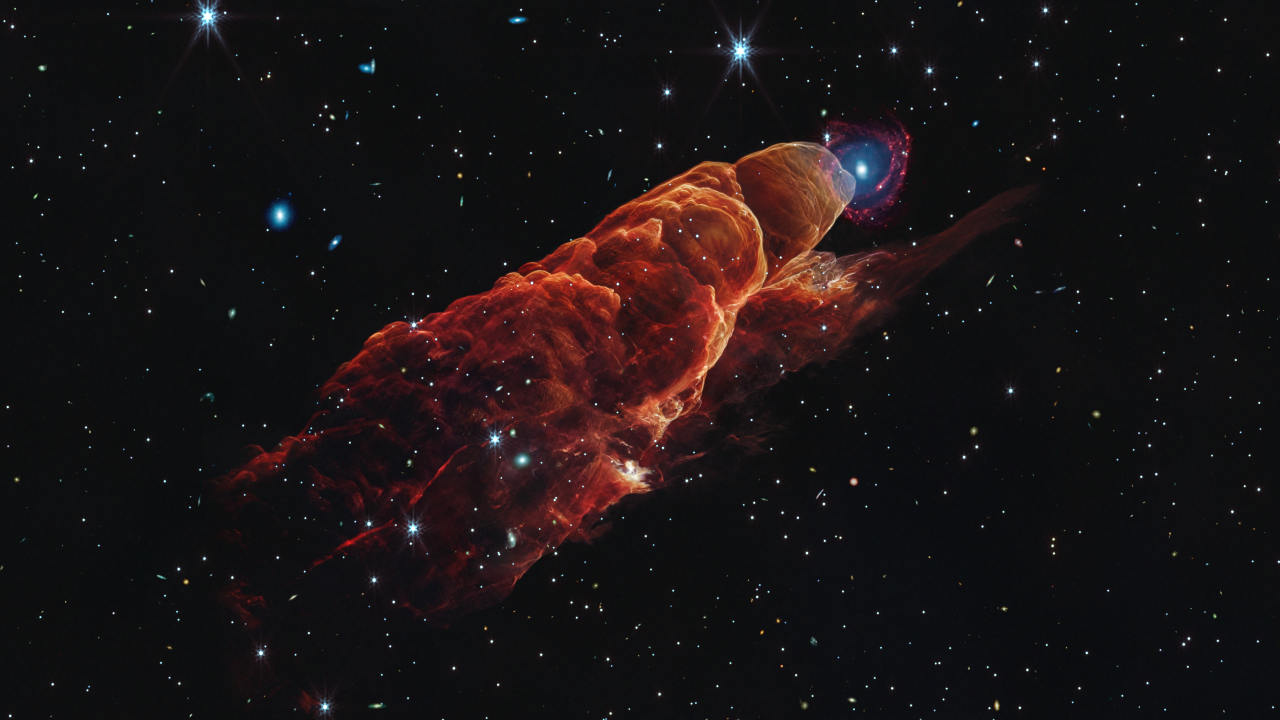
Angled from the upper left corner to the lower right corner is a cone-shaped orange-red cloud known as Herbig-Haro 49/50. This feature takes up about three-fourths of the length of this angle. The upper left end of this feature has a translucent, rounded end. The conical feature widens slightly from the rounded end at the upper right down to the lower right. Along the cone there are additional rounded edges, like edges of a wave, and intricate foamy-like details, as well as a clearer view of the black background of space. In the upper left, overlapping with the rounded end of Herbig-Haro 49/50, is a background spiral galaxy with a concentrated blue center that fades outward to blend with red spiral arms. The background of space is speckled with some white stars and smaller, more numerous, fainter white galaxies throughout.

The post AI/ML STIG Lecture Series, 21 Sept 2026 appeared first on NASA Science.

  •  

Cosmic Origins Community Meeting, 22 Sept 2026

Cosmic Origins Community Meeting

Location

Virtual

Dates

22 September 2026
12:00pm – 1:00pm ET

Community

Cosmic Origins

Type

Meeting

Post-Ad ASTRA Community Science Workshop Update

Hosted by the COPAG Leadership

This community meeting aims to provide you with an overview and explanation of the processes and plans for mission concepts submitted to the Ad ASTRA workshop. The meeting will include a description of how the NASA Astrophysics Division will use the information gathered at the workshop. Additionally, this meeting aims to collect feedback and questions that the COPAG community may have regarding the process and plans that further mission concept selections.Β 

Please use this form to submit any comments, questions, or feedback for the COPAG community meeting: https://forms.gle/puBBTk1mo34WiGwP7Β 

Meeting Connection

Join the Meeting

News Straight to Your Inbox

Subscribe to your community email news list

We will never share your email address.

Privacy Policy

Sign Up
Angled from the upper left corner to the lower right corner is a cone-shaped orange-red cloud known as Herbig-Haro 49/50. This feature takes up about three-fourths of the length of this angle. The upper left end of this feature has a translucent, rounded end. The conical feature widens slightly from the rounded end at the upper right down to the lower right. Along the cone there are additional rounded edges, like edges of a wave, and intricate foamy-like details, as well as a clearer view of the black background of space. In the upper left, overlapping with the rounded end of Herbig-Haro 49/50, is a background spiral galaxy with a concentrated blue center that fades outward to blend with red spiral arms. The background of space is speckled with some white stars and smaller, more numerous, fainter white galaxies throughout.

The post Cosmic Origins Community Meeting, 22 Sept 2026 appeared first on NASA Science.

  •  

AGN SIG Spotlight Series, 22 Sept 2026

AGN SIG Spotlight Series

Active Galactic Nuclei Science Interest Group

Our Spotlight Series highlights recent advances in AGN science, with a strong emphasis on participation from early-career researchers, and includes plenty of time for community discussion following the presentations.Β 

AGN SIG about AGN SIG Spotlight Series

Location

Virtual

Dates

22 September 2026
1:00pm ET / 10:00am PT

Community

AGN SIG

Type

Seminar

Unveiling the Role of Multi-Phase AGN Outflows with MIRACLE

Speaker

Dr. Matteo Ceci (UniversitΓ  di Firenze)

Abstract

Galaxy evolution is tightly connected to Active Galactic Nuclei (AGN) through feedback processes in which gas accretion onto the supermassive black hole drives powerful multiphase outflows. Detailed studies in the local Universe are crucial to resolve the physical scales and gas phases involved, enabling a comprehensive view of AGN-host interactions. I will present first results from the MIRACLE (Mid-IR Activity of Circumnuclear Line Emission) program, combining JWST/MIRI, MUSE, and ALMA observations of seven nearby Seyfert galaxies. Thanks to JWST’s spatial resolution (50-150 pc), we probe atomic and molecular gas in the circumnuclear regions and assess the impact of AGN activity on their host galaxies. Focusing on NGC 1365, we trace the ionized outflow up to kiloparsec scales and constrain its energetics and effects on star formation (SF). By combining mid-IR diagnostics with advanced photoionization and kinematic models, we reproduce ~60 optical and mid-IR emission lines, disentangling AGN- and SF-driven components and providing robust estimates of gas density, ionization, extinction, and outflow mass. We show that classical methods commonly adopted in the literature can underestimate outflow masses by up to an order of magnitude.

Disk Reflection as the Origin of the X-ray Polarization of NGC 4151 with IXPE

Speaker

Dr. Elias Kammoun (California Institute of Technology)Β 

Abstract

The geometry of the X-ray emitting region around accreting supermassive black holes remains poorly constrained, but X-ray polarimetry now offers a new and direct perspective on it. I will present a spectro-polarimetric study of the nearby type-1 AGN NGC 4151, combining two long IXPE observations from 2022 and 2024 with simultaneous XMM-Newton and NuSTAR spectroscopy. IXPE reveals a polarization degree of 6–7% above 4 keV aligned with the radio jet, plus a distinct low-energy component at a different angle, providing evidence for at least two polarized components in the 2–8 keV band. While earlier work read the hard X-ray signal as a radially extended, slab-like corona, I will test an alternative: that the polarization is instead dominated by relativistic reflection from an accretion disk illuminated by a compact, lamp-post corona. Fitting the IXPE Stokes spectra with recently developed models, we find the data favor a low coronal height and a wide torus opening angle, with disk reflection supplying ~20% of the 2–8 keV flux. The same configuration reproduces the full 0.4–79 keV spectrum, showing that disk reprocessing by a compact corona can account for both the polarization and the broadband spectral properties of NGC 4151.

Seminar Connection

Zoom Registration, you will receive connection details by email after registration:Β 

https://alaska.zoom.us/meeting/register/V1okit8uSk2ql97gegbdzg

News Straight to Your Inbox

Subscribe to your community email news list

We will never share your email address.

Privacy Policy

Sign Up
Angled from the upper left corner to the lower right corner is a cone-shaped orange-red cloud known as Herbig-Haro 49/50. This feature takes up about three-fourths of the length of this angle. The upper left end of this feature has a translucent, rounded end. The conical feature widens slightly from the rounded end at the upper right down to the lower right. Along the cone there are additional rounded edges, like edges of a wave, and intricate foamy-like details, as well as a clearer view of the black background of space. In the upper left, overlapping with the rounded end of Herbig-Haro 49/50, is a background spiral galaxy with a concentrated blue center that fades outward to blend with red spiral arms. The background of space is speckled with some white stars and smaller, more numerous, fainter white galaxies throughout.

The post AGN SIG Spotlight Series, 22 Sept 2026 appeared first on NASA Science.

  •  

DGCE SIG Seminar, 24 Sept 2026

DGCE SIG Seminar

Diffuse Gas in Cosmic Ecosystems Science Interest Group

DGCE SIG about DGCE SIG Seminar

Location

Virtual

Dates

24 September 2026
4:00pm ET / 1:00pm PT

Community

DGCE SIG

Type

Seminar

How the Faint Radio Sky is Changing Our Understanding of Star Formation and Galactic Outflows

Speaker

Allison Matthews (Carnegie Observatories)

Abstract

In the last decade, with the commissioning of high sensitivity radio telescopes, we have opened a new window into the faint radio sky. These novel facilities probe fundamental physical processes that regulate star formation and characterize star formation in normal galaxies like our Milky Way over nearly all cosmic time. Deep observations from MeerKAT and LOFAR have revealed that prior observations may have missed half the star formation at all cosmic times. This discrepancy has critical implications across astrophysics: estimates of gravitational wave events, the frequency of astrophysical transients, and the chemical evolution of galaxies. These same high-sensitivity radio facilities are simultaneously placing critical constraints on the physical drivers of galactic winds that we believe regulate star formation across all of cosmic time. In this talk, I will present these findings and outline programs with next generation radio facilities that will improve our observational constraints on the rate and regulation of star formation across cosmic time.

Seminar Connection

Join the Seminar

News Straight to Your Inbox

Subscribe to your community email news list

We will never share your email address.

Privacy Policy

Sign Up
Angled from the upper left corner to the lower right corner is a cone-shaped orange-red cloud known as Herbig-Haro 49/50. This feature takes up about three-fourths of the length of this angle. The upper left end of this feature has a translucent, rounded end. The conical feature widens slightly from the rounded end at the upper right down to the lower right. Along the cone there are additional rounded edges, like edges of a wave, and intricate foamy-like details, as well as a clearer view of the black background of space. In the upper left, overlapping with the rounded end of Herbig-Haro 49/50, is a background spiral galaxy with a concentrated blue center that fades outward to blend with red spiral arms. The background of space is speckled with some white stars and smaller, more numerous, fainter white galaxies throughout.

The post DGCE SIG Seminar, 24 Sept 2026 appeared first on NASA Science.

  •  
❌