❌

Reading view

Black Holes and Revel-AI-tions - Meta's new personal AI agent accused of stealing social media handles from top British band Muse

  • Meta launches Muse personal AI agent - and seemingly takes social media accounts too
  • British rock icons Muse seemingly shifted to @Museband
  • However changeover seems not to apply to older tweets

After Meta recently launched Muse, its new "personal AI agent", the company has apparently already run into difficulties securing the social media handles for its new project.

Both the Instagram and Threads handle for @Muse previously belonged to iconic British rock trio Muse, but now appear to be under the control of Meta.

The former has apparently been shunted out to @Museband, despite having been around a lot longer than Meta's latest misguided AI boondoggle - with the move alarming fans and industry observers around the world.

Just a load of Hysteria?

One of Britain's most successful rock exports, Muse (the band) trademarked its name in 1999, and had used the @muse account on Instagram and on X for many years.

However The Independent noticed that in July 2026, this changed, with Meta's platform taking over on both websites. This has caused some unfortunate cross-referencing for some user's tweets, causing Meta executives (including Mark Zuckerberg himself) to apparently hail the performance of @Museband as "the best AI agent I've tried".

best bug in twitter history pic.twitter.com/0VORftYfPnSeptember 8, 2026

Muse are well known for their dramatic performances and musical innovation, but the band has also hit out against the creeping influence of technology in the modern world, including how it might be used for government surveillance or warfare purposes.

Neither the band or Meta have responded to press inquiries, and all accounts seem to still be in place.

Of course, there might only be a limited number of words and names available for new projects and products, especially with terms as historic and iconic as Muse (which dates back to Ancient Greece), but Meta's move does raise concerns about the ability of powerful organizations to dominate and commandeer entities such as usernames.

Engadget points out that the @Meta Instagram handle had been used by an independent motorcycle magazine of the same name since 20214, before Zuckerberg's company acquired it, forcing the former to change its name. And when Meta launched its Threads network in 2023, the @threads handle on Instagram quietly changed from a small fashion retailer called American Threads to Meta's control a month later.

If Meta is able to kick off one of the most famous bands of the last few decades in favor of what will likely be a short-lived misadventure, where will it all end?


Google logo on a black background next to text reading 'Click to follow TechRadar'

  •  

IBM is launching a new open source AI model to get NASA back to the Moon β€” and making petabytes of lunar data available to study

  • IBM and NASA launch open source AI model to help further lunar research
  • Researchers will be able to better analyze petabytes of Moon data from last five decades
  • IBM and NASA also release dataset for public usage and analysis

IBM has launched a new open source AI model it hopes will help spur on NASA researchers in their push to get humanity back to the Moon.

The new NASA-IBM Lunar Foundation model, available on Hugging Face, will allow researchers to analyze decades of lunar observation data, and identify geological features that are critical to understand for NASA as it looks to build a sustained human presence on the Moon.

The model has been trained by IBM and NASA researchers on a huge, multimodal NASA dataset, which will also be released alongside the model, providing wider access to the latest advanced AI systems in a bid to push on wider progress in lunar exploration.

To the Moon (and beyond)

At its most obvious level, the model will allow a much easier way for researchers to study petabytes of data gathered on the Moon's surface for potentially hazardous locations such as ice deposits or craters.

Currently, scientists often rely on manual analysis or low-resolution, task-specific AI models, which can be not only computationally demanding, but also often lack the accuracy needed for detailed geographic analysis.

The new release will now mean that instead of needing to build a new AI model for every potential issue, scientists can now adapt a single foundation model to investigate a range of lunar geologic features.

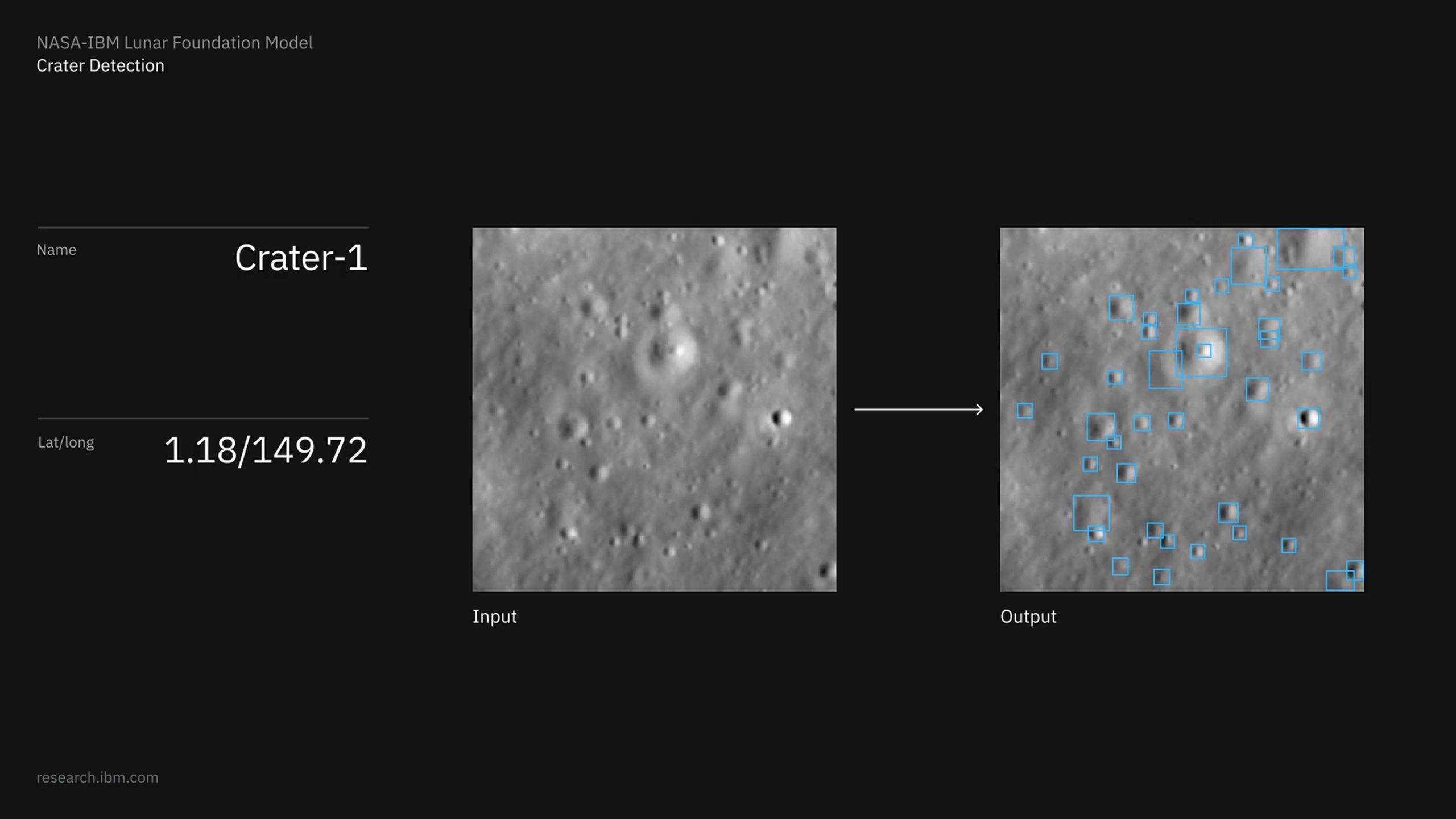
The model has already proved useful, identifying craters and volcanic features far more accurately (see below) and significantly reducing errors in locating potential ice deposits.

IBM NASA AI scanning crater detection on Moon

(Image credit: IBM)

IBM, which has worked with NASA for over five decades, including on the Apollo missions, believes the model could help future astronauts navigate safely and even find essential resources, as well as helping scientists better understand the Moon's geological history.

β€œUncovering the mysteries of the Moon requires an ability to learn from an extraordinary volume of scientific data,” said Juan Bernabe-Moreno, Director of IBM Research Europe, UK and Ireland.

β€œThe NASA-IBM Lunar Foundation Model gives scientists a foundation to explore the Moon at scale, connecting observations across instruments, revealing patterns that are difficult to see in isolation, and providing an open platform the global research community can build on.”

The release of the dataset will mark the first time a unified, publicly-available cache has been made available and ready for machine learning. It brings together over 30 spatially aligned layers from nine instruments across four missions, including tens of thousands of images and maps showing unique geophysical properties of the lunar surface from NASA’s Lunar Reconnaissance Orbiter (LRO) and NASA’s GRAIL mission.

Identifying lunar ice deposits could be particularly vital, as the presence of both water and oxygen will be crucial to establishing a human base on the Moon, and even creating rocket fuel for future Mars missions.

Scanning the Moon's volcanic features, known as Iregular Mare Patches, can allow scientists to better understand the Moon's volcanic history and thermal evolution, as well as helping identify potential sites for landing and other surface operations.

Finally, studying the Moon's craters can offer a wealth of information on its history, including the age of different terrains, their geology, and even the chemical composition of the early lunar interior - as well as again helping to identify safe landing sites without hazards such as steep slopes and boulders.

Google logo on a black background next to text reading 'Click to follow TechRadar'

  •  

Looking for advice on growing your small business? Lenovo wants you to call Eva Longoria

  • Lenovo offers up Eva Longoria to help solve your SMB woes
  • Desperate Housewives star is an entrepreneur and serial investor herself
  • Users can submit questions now, with Longoria answering on her Instagram page

If you're looking for that extra bit of business support and advice, you might seek out a mentor, someone who's been there and done it all - but how about a well-known TV and film icon?

Lenovo has teamed up with Desperate Housewives star Eva Longoria, who both owns her own business, and has invested in companies involved in everything from food and beverages to media, to offer her unique advice on the issues affecting fellow entrepreneurs.

Entrants will be able to submit their burning questions to the star via a special phone number or through CallEvaNow.com, with Longoria providing assistance at a later date.

Call Eva

The "Call Eva" idea is part of Lenovo’s global Backing Every Business program, which looks to "connect entrepreneurs across the world who are facing similar business challenges, creating peer-to-peer relationships where they can exchange experiences, perspectives and practical advice".

Entrepreneurs in Brazil, France, India, Japan, Mexico, the United Kingdom and the United States will be able to take part, with Longoria selecting the most pressing to answer on her personal Instagram feed on September 16, 2026.

β€œOne of the biggest lessons I’ve learned as an entrepreneur is that you don’t have to have all the answers yourself. Some of the best decisions start with asking someone you trust for insights, a fresh perspective or even just reassurance that you’re heading in the right direction,” Longoria said

β€œThat’s what I love about Lenovo’s Backing Every Business initiative and now Call Eva. We’re giving entrepreneurs a place to bring the questions they’re really wrestling with, because chances are, another business owner has faced similar dilemmas. If something I’ve learned along the way can help someone better navigate a challenge, make a tough decision or take their next step with more confidence, that’s incredibly meaningful to me.”

Eva Longoria for Lenovo's Call Eva program

(Image credit: Lenovo)

β€œTechnology can unlock enormous opportunities for small businesses, but technology alone doesn’t build a business. Entrepreneurs also need access to trusted advice, shared experiences and a community that understands the realities of building and growing a business,” said Emily Ketchen, Senior Vice President and Chief Marketing Officer, Intelligent Devices Group and International Markets, Lenovo.

β€œBacking Every Business brings those pieces together and Call Eva gives us a new avenue to extend that support while listening directly to entrepreneurs about the challenges they’re navigating. By understanding their questions, we can continue to find meaningful ways to help small businesses move forward and grow with confidence.”

Google logo on a black background next to text reading 'Click to follow TechRadar'

  •  
❌