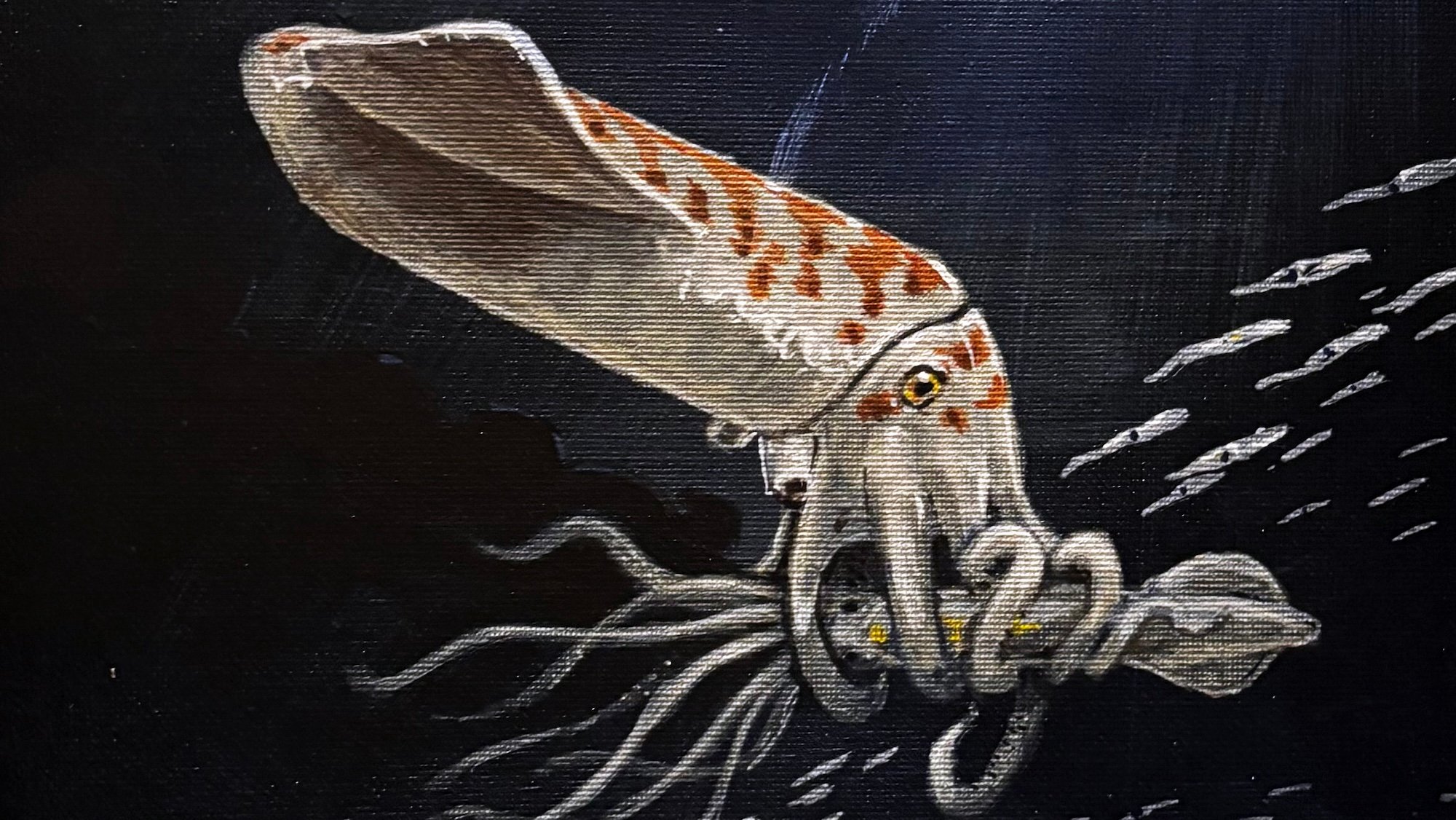
Thanks to having the “chunkiest squid butt” ever seen on an ancient cephalopod, paleontologists have discovered a 160-million-year-old octopus cousin. The newly identified fossils are described by an international research team in their study recently published in Papers in Palaeontology, which also includes a potential explanation for Wyoteuthis linsterorum’s hefty proportions. Just like today’s tentacled ocean dwellers, the Mesozoic squid ancestor likely had no problem devouring its relatives—or even members of its own species.
W. linsterorum is a belemnite, a group of prehistoric cephalopods who left behind some of paleontology’s most common fossils. Examples of their bullet-shaped structures known as a rostrum have regularly shown up at dig sites around the world for over 200 years. This includes the Sundance Formation in present-day Wyoming, which was covered by an inland sea millions of years ago.
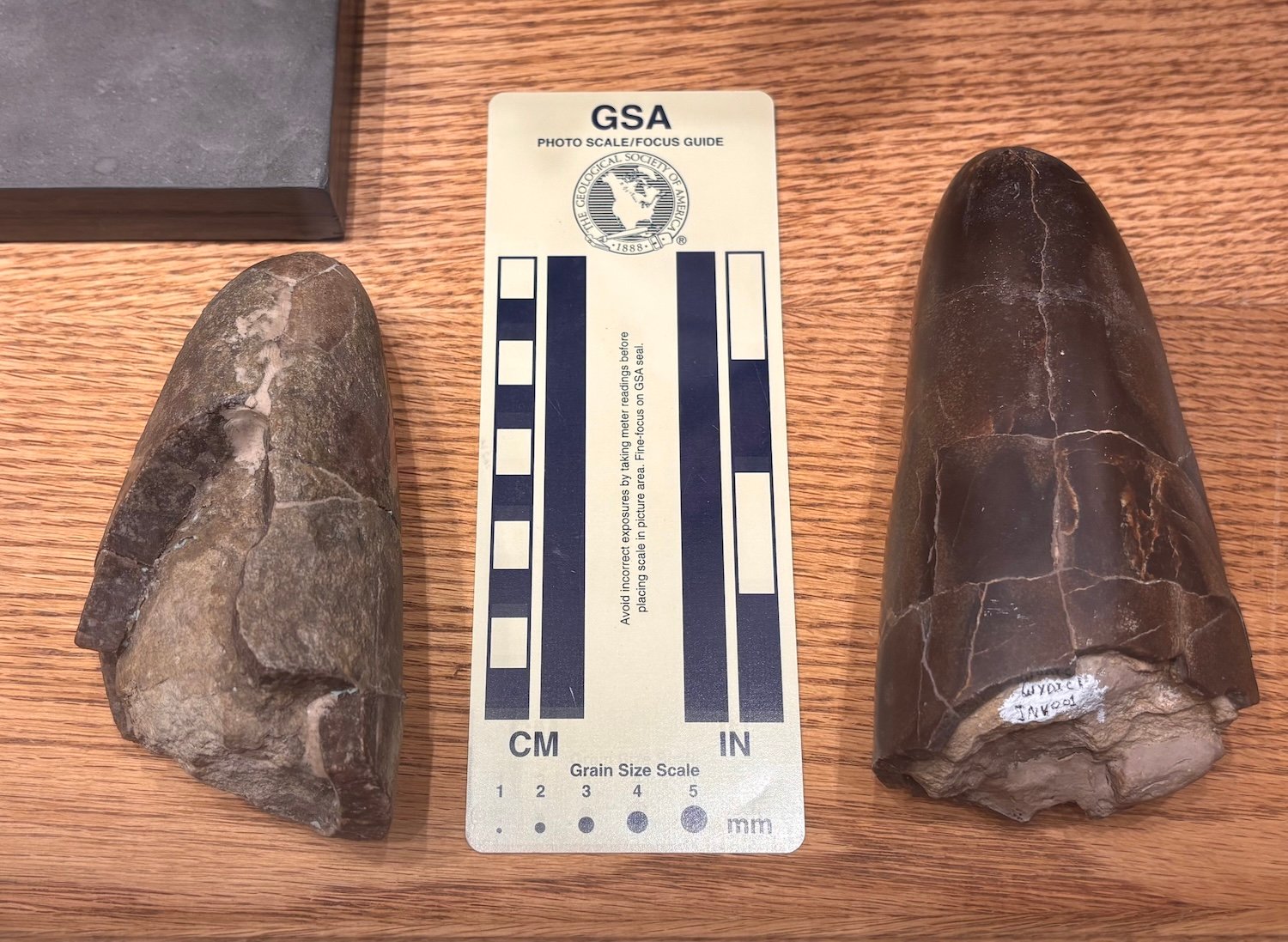
Most of Wyoming’s belemnites are comparatively tiny—usually about two-to-four inches long and less than one inch wide. But about 30 years ago, Wyoming Dinosaur Center founder Burkhard Pohl found a fossil that “stuck out like a sore thumb,” according to study co-author Bill Wahl. While the preserved belemnite rostrum was about as long as other examples, it measured about 2.4 inches wide. Based on what they knew of belemnite proportions, paleontologists estimated this specimen’s entire body probably reached nearly two feet long.
The two ‘W. linsterorum’ fossils were discovered over 30 years apart. Credit: Jessica Lippincott
Without any comparable examples, the thick squid butt remained in storage for nearly three decades. In 2019, fossil collector Cliff Linster finally discovered a similar cephalopod near Ten Sleep, Wyoming. He soon donated it to the Wyoming Dinosaur Center, and researchers began analyzing this pair of mystery fossils.
Computed tomography (CT) scanning allowed the team to inspect the remains without damaging them. The results confirmed the ancient sea creatures were never-before-seen belemnites.What’s more, they belonged to a family researchers previously believed went extinct millions of years earlier.
“After spending years fossil hunting in Wyoming and collecting countless fossils of the common Pachyteuthis belemnites here in Wyoming, this one is unlike anything I have ever seen,” Jessica Lippincott, a paleontologist and study co-author, said in a statement.
But why did W. linsterorum evolve to reach such bulky proportions? The team believes the answer lies in the diets of many present-day cephalopods.
“A possible explanation is that their relatively large size gave them an advantage when hunting co-occurring smaller belemnites of the genus Pachyteuthis,” explained paleontologist Alexey Ippolitov, a study co-author now at New Zealand’s Victoria University. “Modern squid, after all, are hardly picky when it comes to prey: they readily hunt not only other species of cephalopods, but sometimes even their own kind.”
An unexpected and surprising species, W. linsterorum is named in honor of Cliff Linster, who died in June 2026. While he didn’t live to see the dedication, Linster was well aware that the team was working to describe the animal he helped discover.
“It goes to show that we are still finding new species of fossils all the time, and people who rockhound or collect invertebrate fossils can also contribute to science,” said Lippincott.
We humans love our mind-altering substances. Cultures around the world have discovered, ritualized, and simply experimented with alcoholic drinks and ingestible drugs for millennia. However, recent archaeological evidence indicates humanity possibly began utilizing psychoactive plantsmuch earlier than previously believed. Based on findings published in the journal Science Advances, some communities in present-day Indonesia enjoyed the effects of betel nuts as long as 25,000 years ago. This pushes the timeline over 23,000 years back from documented Neolithic and Bronze Age uses circa 1,500 BCE.
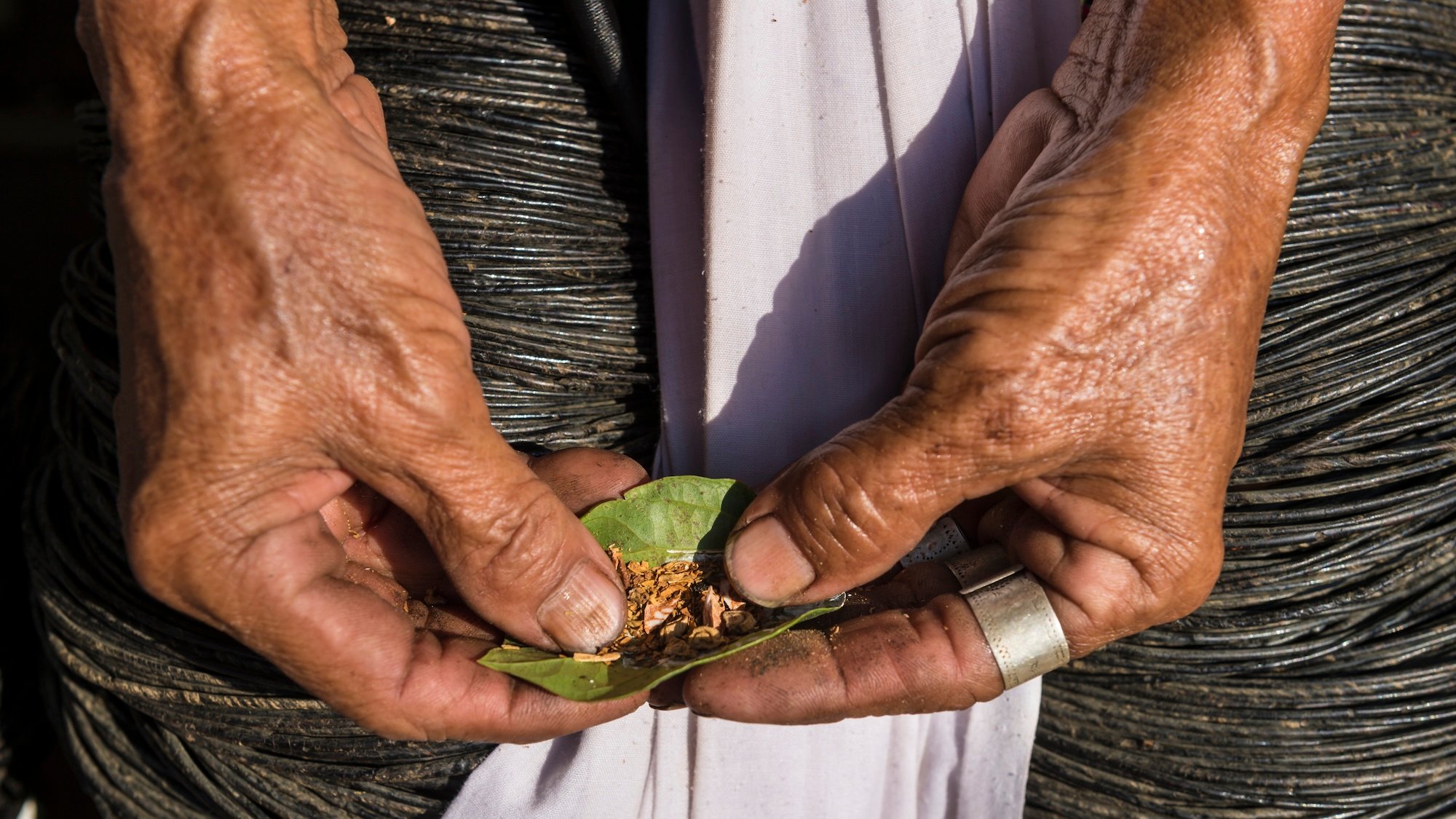
The areca nut (Areca catechu), better known as the betel nut, isn’t widely known in the United States, but it’s one of the world’s most popular intoxicants. Most frequently seen across southeast Asia cultures, its global usage only trails behind alcohol, caffeine, and nicotine. Betel nuts are prepared by grinding and processing the plant seeds with slaked lime (calcium hydroxide). This fine powder is often combined with additional ingredients such as flavoring spices or tobacco to make a “quid,” that is then chewed as a stimulant. There are millions of betel users today, with some estimates putting the global total at 1-in-10 people.
Many researchers contend that most human intoxicant use began with fermented alcoholic drinks, amid the rise of farming during the Neolithic era about 13,000 years ago. Adam Brumm, one of the study’s co-author and an archaeologist at Australia’s Griffith University, believes otherwise.
“This theory fails to account for the possibility that very ancient drug-taking lies at the roots of our most commonly used psychoactive substances,” he explained in a university profile.
Brumm and his team cite evidence gathered from the extremely rare skeletal remains of two early human foragers discovered on the Indonesian island of Sulawesi. The older of the two lived between 25,000 and 16,000 years ago, while the younger individual is 7,600 to 6,300 years old. Unlike many other documented skeletons from the region, these hunter-gathers both exhibit rarely seen dental damage in the form of deep, curved grooves in the teeth. Researchers theorized this unexpected deterioration stemmed from a never-before-identified practice of regularly sucking on entire betel nuts.
But there was a problem—this hypothesis contradicted earlier studies of betel nut usage. Many scientists believe the drug’s primary neuroactive alkaloid, called arecoline, is only noticeable after chewing betel nuts processed with slaked lime. Lab experiments conducted by Brumm’s group suggest this isn’t necessarily always the case. To test their theory, researchers soaked betel nuts in artificial saliva, then introduced the mixtures to exposed cloned human receptors grown from frog egg cells. These receptors included specific proteins that function as molecular switches overseeing neural activity.
The study authors discovered that even simply sucking on whole betel nuts is all it takes to release enough arecoline to elicit altered neural activity and physiological effects. To further bolster their findings, biochemists even flagged arceoline traces in the dental tissue of both hunter-gatherers.
However, the ancient humans living on Sulawesi didn’t necessarily ingest betel nuts for recreational use. Unprocessed nuts likely offer milder effects, but arceoline remains a natural analgesic. Knowing this, the study’s authors surmise these betel nut habits were self-reinforcing.
“Sucking these hard, abrasive seeds wore down the foragers’ teeth so badly that in some cases the inner pulp chamber became completely exposed,” explained Brumm. “So while this habit may have been a remedy for toothache, years of prolonged nut-sucking eventually caused much worse dental health problems, creating a cycle of continued habitual use.”
The implications go far beyond revising the timeline of humanity’s relationship with mind-altering substances. If true, this means at least some ancient hunter-gatherer cultures discovered psychoactive properties before the development of agriculture.
“The study implies that some modern drug-taking behaviors are deeply rooted in forager traditions,” added Brumm.
In order to survive, the first humans to reach Mars will immediately need a safe and reliable place to set up shop. But building on Earth’s neighbor is immensely more challenging than construction projects at home. The Martian surface is a practically airless vacuum, constantly bombarded with radiation, and regularly reaches temperatures as low as -81 degrees Fahrenheit.
However, there is a very specific process on Earth that approximates similar conditions to the Red Planet: freeze-drying. According to researchers at The Hong Kong University of Science and Technology, the same method used to preserve perishable foods could also inspire sturdy and even recyclable 3D-printed houses on Mars. The secret ingredients? Everyday gelatin and yeast. The novel approach is detailed in a study published today in the journal Chem Circularity.
“My inspiration came from freeze-dried fruits that become harder. So I asked myself if we can take advantage of that and make some materials,” Jishen Qiu, a study co-author and civil engineer, said in a statement.
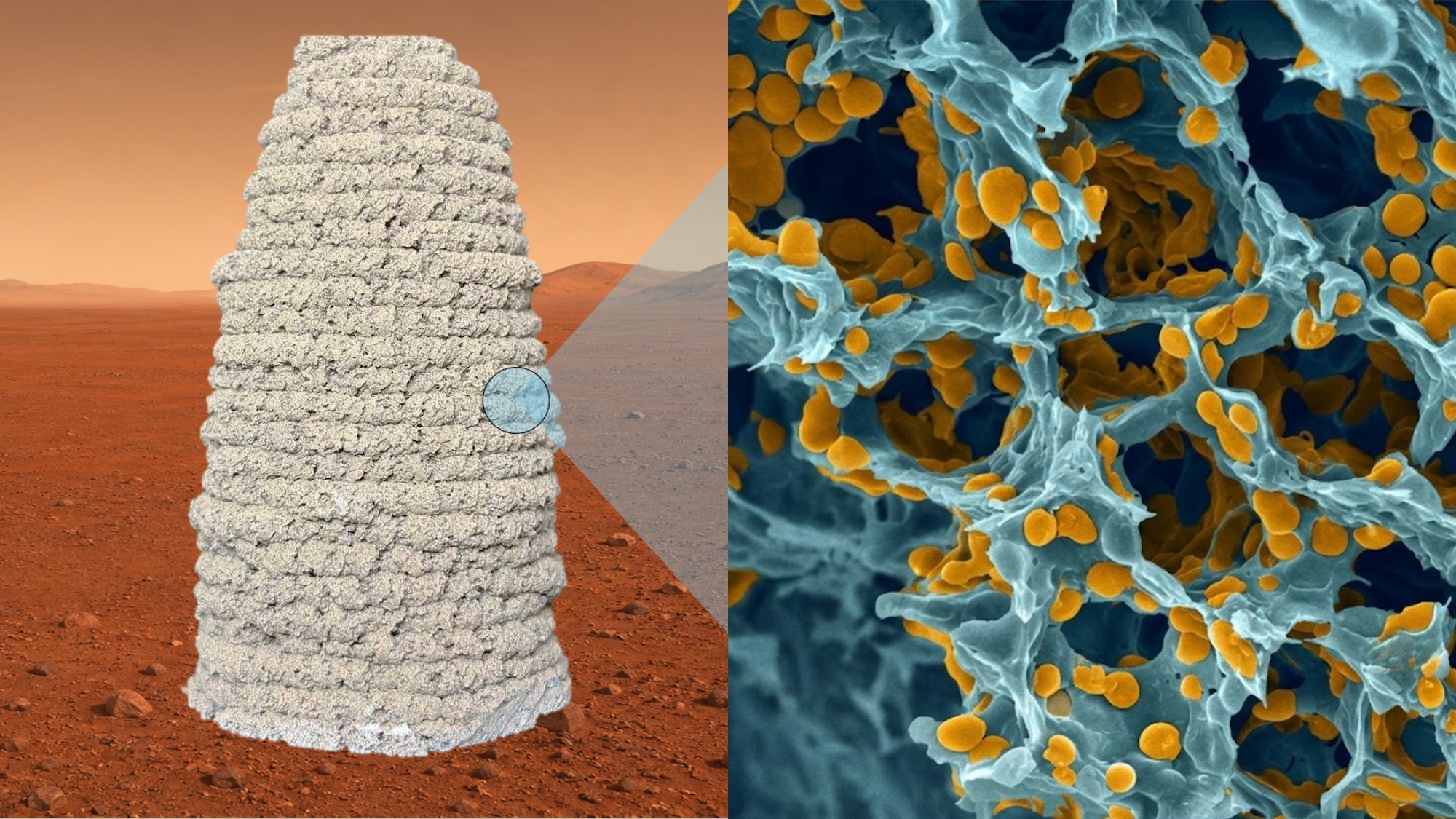
The combination of materials are simple: sand and an adhesive binder. Since gluing tiny rocks together requires specialized stickiness, Qiu’s team invented a new concoction from gelatin and lab engineered yeast. When mixed, the yeast microbes become coated with adhesive proteins similar to those used by mussels to anchor on stones underwater. The goop is then extruded through a 3D printer nozzle into an extremely cold, low-pressure environment, where it solidifies as the water instantly freezes and converts from ice to vapor. The final result is a light, porous, foam-like material that remains very resilient.
“This is actually strong enough to build a one- or two-story building on Earth—whose gravity is three times that of Mars,” explained Qiu. “So, you can probably easily build a multistory building on Mars with the material.”
Qiu and his collaborators know they must first start small before expanding to Martian neighborhoods. Their prototype domes are only about the size of a wine cork at this point, but their compressive strength is comparable to low-grade concrete.
Engineers have experimented with 3D-printed structures to use on the moon and Mars for years, but many of these still require steps like melting down rocks or lunar regolith. These methods usually require a lot of extra energy, which may limit their utility. Qiu’s technique requires comparatively little energy, although he admits it’s still unclear if yeasts can withstand life on Mars. That said, the team’s early results are a promising step towards simple, efficient, and sturdy buildings beyond Earth. If nothing else, yeast also lends itself to trial-and-error.
“As long as there’s one yeast that’s still alive, you can grow them again,” added Qiu.
A new virus emerges in rural China. Although those who contract it initially display moderate, flu-like symptoms, their health quickly declines. The mortality rate is unclear, but one aspect is immediately obvious—it’s very contagious. Within three months, nations around the world are planning lockdown protocols and quarantine measures. Politicians seem completely out of their league and ill-equipped.
The world eventually recovers from the ordeal, but consequences of the virus linger for decades.While society pushes forward, there’s no promise that an even deadlier virus isn’t already lurking out of sight.
This isn’t about COVID-19, by the way. It’s the plot to the novel World War Z—arguably the most realistic depiction of a zombie apocalypse ever created. Released 20 years ago this week, the horror novel by Max Brooks quickly became one of the undisputed cornerstones of walking dead canon. Readers and critics devoured the book (no pun intended), but their responses often worry Brooks. Much like the reception to his first book, The Zombie Survival Guide, many fans seem to misunderstand his intentions. These projects weren’t simply intended to entertain. Max Brooks was trying to warn everyone about the looming threats we would prefer to ignore.
While the 54-year-old writer ostensibly writes books about zombies, Sasquatch, and (soon) an alien invasion, his attention to disaster details and hyperrealism has earned him a parallel career as a security and threat analyst for some of the world’s most respected geopolitical think tanks.
To celebrate World War Z’s 20th anniversary, Popular Science recently spoke with Brooks about the book’s massive impact.
This interview has been edited for length and clarity.
Andrew Paul: Did you anticipate World War Z attaining the legacy it now has in popular culture?
Max Brooks: Oh, God no. Of course not. Especially because I’m never tapped into pop culture. I don’t know what anybody else is doing—even when it was my job writing for Saturday Night Live! I’m good at thinking about what I think about.
AP: Before World War Z, you wrote an actual preparedness handbook called The Zombie Survival Guide. What prompted you to take a hyperreal approach to such a seemingly outlandish subject?
MB: The reason I wrote [them] was because all the zombie stories, even to this day, tend to focus around small groups. To me, it’s like trying to understand World War II from watching Saving Private Ryan. I had big picture questions nobody was answering.
I think the best zombie movie ever made was Dawn of the Dead. To me, the most interesting part was when they’re holed up in the mall watching the news. That window into the wider world was so fascinating, and I wanted more.
AP: But there was a time when World War Z almost never happened, right?
MB: [The publisher] didn’t know what to do with The Zombie Survival Guide. Their marketing strategy almost killed my career before it even launched. They thought, “Well, no one is clearly that much of a loser that he’s actually spent this much time thinking about [zombies]. Clearly, he’s a cool guy making fun of those losers. And because he’s Mel Brooks’ son and he’s coming off SNL, we’re gonna position him as Mel Brooks, Jr. writing Younger Frankenstein.”
But The Zombie Survival Guide really is a disaster preparedness manual. It’s why [soldiers] took it to Afghanistan; people told me it saved their lives when they were lost in the woods. I didn’t make anything up. It’s not Hollywood stuff—it’s all about dehydration and dry socks and shelter.
But [these books were] legitimately the product of years of thinking, “If I was in a zombie world, how would I survive?”It really set me on this path of asking, “What happens when the grown-ups drop the ball?”
AP: And now it’s your job to worry professionally.
MB: I’ve now been part of three military and national security think tanks—the Atlantic Council, the Center for Strategic and International Studies, and the Modern War Institute at West Point. I’m a non-resident senior fellow at all three of them, and it’s my job to study real threats.
For some reason, I was not blessed with the wall of denial. Like, I can’t just say, “That would never happen and I’m just going to go about my merry way.” I’m already terrified! And the way to reduce my anxiety is to study the threat so that it’s not nebulous.
AP: What was the most difficult part in preparing to write World War Z?
MB: You don’t know what you don’t know, so you don’t know what you’re missing. There’s always a fear of groping around in the dark; of not even knowing who to talk to. That was a real struggle, because I’m an insular guy. I’m not a social guy. Part of it was talking to experts, but part of it was reading books—and I’m fully dyslexic. So that was a real slog.
It was also about never trusting the internet. I used it once or twice, like, to research laser weaponry. I literally went to a company’s website, saw their demonstration video, and was like, “Yeah, okay. That is not a practical weapon for hunting zombies. I see how long it takes to burn through something.”
AP: Obviously humanity’s most terrifying challenge in the last 20 years was the COVID-19 pandemic. How do you view that real-world horror in the context of World War Z?
MB: COVID was scary because I knew it was coming thanks to my friends in the military and biodefense community. I was part of what was called the Blue Ribbon Biodefense Panel for germ attacks way before COVID. So I already had at my fingertips the ability to tell the difference between panic porn in the media and the real deal. I also had to study diseases enough to write about a zombie plague. But also, it came from being on the receiving end of a bioterror attack. When I worked at SNL [from 2001 to 2003], we had the anthrax letters delivered to our building [in October 2001].
So, I knew this was coming, but the question was how to warn people. I had people laughing at me. Ironically, the people who are the worst minds to reach are the smarty-smarts because they think they know everything.
AP: Were you expecting COVID to be much worse than it was?
MB: Oh, much worse. It got me into trouble, because I was prepping for, like, tanks on the street, you know? I was ready for that. I stocked my home with food that would last the longest as opposed to food that my wife would actually eat.
But the irony is, had it been worse, we might have actually done better. Studying diseases over the years—it’s sort of like the slow zombie versus the fast zombie. The fast zombie is so scary you have to react. The slow zombie gives you the false sense of security. Like, “Oh, I can take ‘em out.” COVID was the slow zombie. It allowed us to be arrogant and dismiss it: “Oh, it’s no worse than the flu.”
AP: How did you see that play out during the quarantine?
MB: It goes back to when COVID hit New York City. I had written a book called The Harlem Hellfighters, which was a true story of African American soldiers in World War I. They’re still an active unit in the National Guard, and I’m friends with their chief medical officer. Their job was to pick up the dead bodies around New York.
He said to me, “If those bodies had been stacked up on the street for everyone to see them, there would have been no argument about masking or distancing or taking the vaccine.” The hiding of it is what allowed naysayers to get way more people killed.
AP: Where did the grown-ups “drop the ball,” as you say?
MB: I think the greatest failure on the part of leadership at every level was not publicizing the dead. Maybe they were afraid of angry letters and backlash and didn’t want to cause a panic, but that’s exactly what they should have done.
A doctor in Los Angeles told me they converted hospital rooms into morgues. He said, “You don’t believe the amount of bodies. We’ve got pyramids of body bags.” And I’m like, “Well, then why is this not on the news every night?”
AP: After experiencing an actual global plague, how do you feel about World War Z’s overall accuracy?
MB: I think it was accurate for the time. I would still have the plague coming from China, 100 percent. I would love to say that was my genius futuristic prediction, but no. I based it on SARS. And this is why it’s unforgivable that it happened again. If I wrote it today, I would really highlight why it was allowed to be [downplayed]—and the reason is our greed. All of our stuff is made in China.
I would also really change the politicization of information. We’re living in a time where all facts have become tribalized. We’ve had 20 years of such dumbing down that I think it would be a central tenant of the book.
AP: Would you change how the United States responded to a zombie outbreak?
MB: I still firmly believe we are a moderate country, but I don’t know how brave we are. In order for a crime to be committed, you don’t need 100 bullies. You just need one bully and 99 cowards.
The psycho fanatics have a microphone now, which was inconceivable 20 years ago. They are hate merchants, and the erosion of our education system has created a demand that the merchants supply.
AP: So you think we would have handled COVID differently in 2006?
MB: If COVID happened 20 years earlier, we would all have gotten vaccinated, because of all the grandmas and grandpas who grew up before the polio vaccine.
AP: What else has changed?
MB: When I talk to people in power, I try to educate them about what I call “uphill influence” versus “downhill influence.” Downhill influence is when there’s a pre-existing bias that you just need to hijack and ride downhill. There’s gravity already there, and that’s not necessarily a bad thing. It was an established fact 20 or 30 years ago that vaccines kept you safe. So, if you were rolling out a vaccine, you could already just ride that existence acceptance downhill. The gravity was with you.
Uphill is when you have to educate before you can even start to persuade. You first have to educate people about just the world that you’re trying to explain. Vaccines have gone from downhill to uphill. The [subjects] we all had to try to stay awake through in seventh grade science class aren’t even there anymore.
I understand [MAHA supporters] want a clean planet, food, and water, and all of that will make you healthier. However, in 1491, the people who lived on this continent had all that, right? The moment the first Javier Bardem-looking Spaniard coughed on them, whole civilizations died.
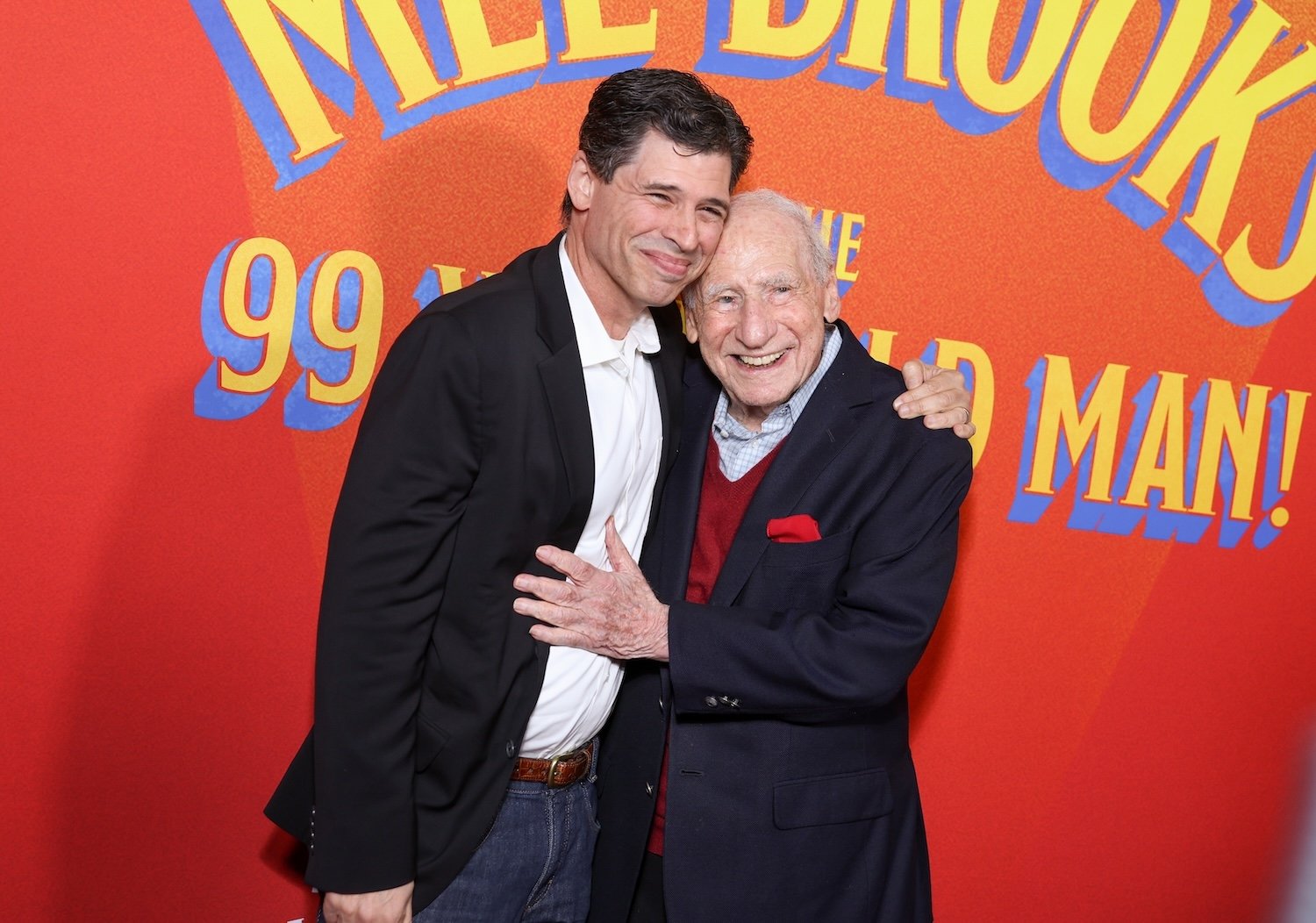
Max Brooks and Mel Brooks at the Los Angeles premiere of HBO Documentary Films’ Mel Brooks: 99 Year Old Man! on January 20, 2026 in Los Angeles, California. Credit: Chad Salvador/Variety via Getty Images Chad Salvador
AP: Both of your zombie books hinge on public education, and that’s now a major aspect of your threat analysis work. Do you know why you keep returning to this theme?
MB: I think one of the reasons I’m so obsessed with education is because I was not a good student. I have such ferocious learning disabilities. I never felt instantly comfortable learning, and I’ve always had to find workarounds. My mother had to help me find workarounds so I could learn. So when I research, it takes so much time and effort and [there’s] so much insecurity. I understand how hard it is to teach something to someone who doesn’t naturally pick it up.
I’m very lucky that I come from two parents who had no formal education, but were both very smart. Most importantly, they were very curious. I became very comfortable with the idea of approaching something as an absolute beginner.
AP: It took 14 years between World War Z and your follow-up sci-fi novel, Devolution. Your next book, The First Hundred Hours: A Story of Alien Invasion, comes out in 2027. Is there a reason for such long pauses between these projects?
MB: I’m not a natural scientist. The amount I’ve had to study for this new book has been excruciating. But it’s very humbling having to talk to the experts and say things like, “Please talk to me like I’m a third grader—and not a smart third grader.”
AP: Would you end World War Z the same if it was set in 2026?
MB: I would still end it on a positive note, and I think that has to do with being an American. We don’t have the luxury of abandoning our ideals, because that’s all we are. We’re not a nation-state—the ideals in America are all that hold this mutt [of a] nation together. We all come from different places and tribes, and we all agree to live under a certain set of guidelines. It’s really critical that we fight for those guidelines.
If there is one takeaway, it’s the central reason I wrote the book in the first place. We’re all stuck on the same planet together, and that planet is not that big anymore. What affects some of us could potentially affect all of us. I think America has some amazing cultural strengths, but one of our weaknesses is our isolationism. That’s built on an outdated notion that we are somehow protected by two oceans and our geography. That’s not true anymore.

 Login