❌

Reading view

Fat Bear Week kicks off September 22

The salmon? Eaten. The days? Shorter. The bears? Fatter. 

After spending the summer eating the fatty pink salmon swimming through Katmai National Park and Preserve in Alaska, it’s time to celebrate the park’s iconic brown bears (Ursus arctos). Fat Bear Week begins on Tuesday, September 22, and here is everything you need to know. 

What is Fat Bear Week?

Think March Madness, just without the basketball and significantly more bears. Fat Bear Week is a single-elimination tournament, where bear enthusiasts from around the world can vote online for their favorite chunky bear. After each round, the bear with the most votes advances until the winner is announced on September 29. According to the Katmai Conservancy, the event began as a one-day event in 2014 with 1,700 votes cast. Only 10 years later, 1.2 million votes were cast from over 100 countries.

The brown bears return to Brooks Falls for the salmon migration every year in late June, where viewers can watch them on explore.org’s livestream. There, they will feast to fatten up for the long winter ahead. By late summer, the nutritious fish will spawn and then begin to die. The bears will then move to the lower Brooks River in September and October to eat the dead and dying salmon near the river’s mouth.

Eating all of this salmon is important because the heftier the bear, the better chance they will survive their long winter hibernation. Despite being the poster species for winter hibernation, bears are not “deep hibernators,” they way that squirrels, bats, and bees are. Bears enter a state called torpor, which is an involuntary state primarily triggered by lack of food. During this time, the bears rely on stored fat reserves for energy. A torpid bear’s eating, drinking, and waste functions will cease, as its body metabolizes these stores it put on over the summer. 

When is Fat Bear Week 2026?

This year, Fat Bear Week begins on Tuesday, September 22, and a winner will be crowned on Tuesday, September 29. 

How can I vote?

Votes may be cast from noon to 9 p.m. EDT (9 a.m. to 6 p.m. PDT and 8 a.m. to 5 p.m. ADT)

from September 22 and 29 at fatbearweek.org.

Photographs comparing the bears from earlier in the summer and later in the summer will be shown, so voters can get an idea of just how much weight the bears put on during their salmon fest. An adult male bear can go from roughly 700 pounds in the early summer to over 1,200 pounds by fall. 

Voters are also encouraged to get familiar with each bear’s life history and the unique challenges they face to survive.

Which bears are competing this year?

The 2026 Fat Bear Week Bracket will be released on Friday, September 18. 

In 2025, Bear #32 (Chunk) took the crown, despite beginning the salmon run with a freshly broken jaw. He was likely injured while fighting with another bear for a mate, but he still managed to catch plenty of fish. Chunk is known for his dominance and size, but also narrow-set eyes, dark fur, a prominent brow ridge, and a distinctive scar across his muzzle. 
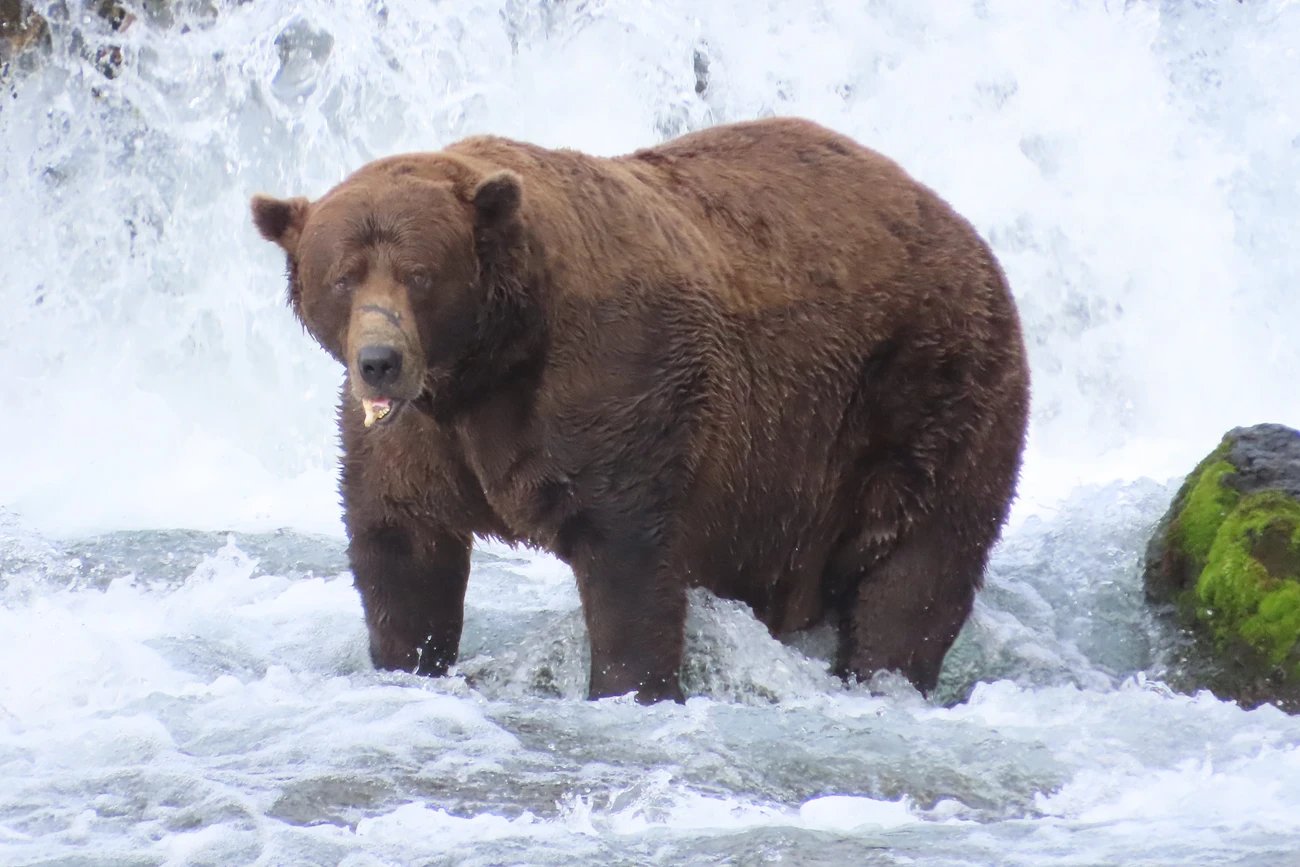
a large bear stands near a waterfall
Fat Bear Week 2025 champion Chunk. Image: NPS/ T. Carmack

How can I support Katmai’s bears?

Donations can be made to Katmai Conservancy’s Otis Fund. The Otis Fund is named after Bear #480 (Otis), who won four Fat Bear Week titles before his death around 2024.  All donations made between September 22 and October 3 will be matched by explore.org. 

What happened with the bears this summer?

This year’s livestream featured an example of how wild (and upsetting to humans) nature can be. On Tuesday, July 28, the live-cams captured a young brown bear cub being killed and eaten by an unrelated mother bear (Bear #806). The deceased cub was born this spring and the child of Bear #909, a 10-year-old brown bear. Bear #909 started the season with two cubs, but now lost both. 

On Sunday, August 2, one of Bear #335’s (Jolly) cubs died, after following three unrelated cubs up a tree. The mother of the cubs already in the tree attacked Bear #335’s cub, who did not survive the encounter. The identity of the mother bear who killed the spring cub was not confirmed. 

Following the first cub’s death, naturalist Mike Fitz and park rangers Christine Loberg and Sarah Bruce said this likely the first documented case occurring at Brooks River. While there is no one answer as to why mother bears are killing cubs, some experts suspect bear adoption, food scarcity, and fights for dominance all play a role. 

Additionally, this year also saw the cub with silver-hued fur, a cub who hopefully learned important lesson about porcupine quill safety, the unique fishing stylings of Bear #164 (Bucky Dent), and Bear #284’s (Electra) family who can “walk on water.”

The post Fat Bear Week kicks off September 22 appeared first on Popular Science.
  •  

Captive Crocodiles Released Into the Wild Did Something Researchers Didn’t Expect

Saltwater Crocodile Mouth OpenCaptive-reared crocodiles adapted well after release, but a translocated wild crocodile showed strong homing instincts, offering new insights for conservation planning. A new study suggests that saltwater crocodiles born or raised in captivity may successfully adapt to life in the wild without returning to the facilities where they were bred. Researchers say the findings could [...]
  •  

Gray Wolf Spotted in Mendocino National Forest for First Time in 15 Years

Gray Wolf Spotted in Mendocino National Forest for First Time in 15 Years

A gray wolf has been confirmed roaming California’s Mendocino National Forest, marking the first verified sighting there since the species made its comeback to the state 15 years ago. Wildlife officials say the discovery signals the predator’s continued expansion across California’s wild landscapes.

The sighting was reported in late August in the far northern reaches of Lake County, roughly two hours north of San Francisco. After receiving multiple reports from residents and observers, the California Department of Fish and Wildlife investigated and officially verified a wolf’s presence in the area, according to a statement from county officials.

Gray wolves were once hunted to extinction within California’s borders, disappearing from the state for nearly a century. Their return began in earnest around 2011, when a lone wolf known as OR-7 crossed into California from Oregon, reigniting hopes for the species’ natural recovery. Since then, small numbers of wolves have gradually reestablished territory across parts of Northern California, with packs forming in areas such as Lassen and Siskiyou counties.

The latest sighting in Mendocino National Forest suggests the animals are pushing further into new territory, a development conservationists view as an encouraging sign of ecological resilience. Wolves play a critical role in maintaining balanced ecosystems by regulating prey populations and influencing the behavior of other wildlife. Wildlife officials say they will continue monitoring the region to better understand the wolf’s movements and determine whether it may be part of a larger pack venturing into unfamiliar terrain.

The post Gray Wolf Spotted in Mendocino National Forest for First Time in 15 Years first appeared on EnviroLink Network.

  •  

Can a Whole Arctic Ecosystem Evolve Fast Enough to Survive Climate Change?

Can a Whole Arctic Ecosystem Evolve Fast Enough to Survive Climate Change?

On Alaska’s remote North Slope, researchers are picking their way across spongy tussock grasses toward Galbraith Creek, a rushing meltwater stream fed by the snowy peaks of the Brooks Range. There, they carefully string up mist nets to catch white-crowned sparrows that have just completed their long migration from warmer latitudes. The birds have only a brief window to stake out territory, find mates, and raise chicks—all fueled by the explosive burst of insects that emerges each summer across the tundra.

From every bird captured, scientists collect blood, feather, and fecal samples to track what the sparrows are eating and how their diets shift as the short Arctic summer progresses. This detailed data collection is part of a groundbreaking research effort seeking to understand something far bigger than individual birds: whether an entire ecosystem—spanning streams, tundra, insects, and wildlife—can adapt fast enough, together, to survive rapid climate change.

Unlike traditional studies that examine how single species adjust to warming conditions, this project treats the Arctic as an interconnected web where the timing of ice melt, insect emergence, plant growth, and animal migration must all stay in sync. As the region warms at a pace several times faster than the global average, that synchronization is increasingly at risk. If insects hatch earlier but sparrows arrive on their usual schedule, birds could miss their crucial food window—a mismatch that could ripple through the entire food chain.

Scientists hope their findings will reveal whether coordinated, ecosystem-wide adaptation is possible, offering a preview of how fragile Arctic systems—and the species that depend on them—might fare as the climate crisis accelerates.

The post Can a Whole Arctic Ecosystem Evolve Fast Enough to Survive Climate Change? first appeared on EnviroLink Network.

  •  

Victoria’s Koala Population Half Previous Estimates, Report Reveals Chronic Poor Health

Victoria’s Koala Population Half Previous Estimates, Report Reveals Chronic Poor Health

A landmark scientific review has revealed that Victoria’s koala population is in significantly worse condition than previously believed, with numbers roughly half of earlier estimates and the animals suffering from chronic poor health. The Victorian government sat on these findings for more than a year before making them public.

The comprehensive study, conducted by the state’s Arthur Rylah Institute in partnership with researchers from major universities, was completed in June 2025 but was withheld from public release for over 12 months. The delay has raised questions about transparency in how the government handles critical wildlife data, particularly for a species considered an icon of Australian biodiversity.

The findings paint a troubling picture of koala welfare across the state, pointing to systemic health issues affecting the marsupials rather than isolated incidents. Combined with the sharp downward revision in population numbers, the report suggests previous conservation strategies may have been built on overly optimistic assumptions about how many koalas remain and how well they’re faring.

Conservationists and wildlife advocates are likely to press the government for immediate action following the report’s release, including questions about habitat loss, disease prevalence, and the adequacy of current protection measures. The revelation adds to mounting concerns about the long-term survival of koala populations in parts of Australia, where habitat destruction, bushfires, and disease have already taken a significant toll on the species in recent years.

The post Victoria’s Koala Population Half Previous Estimates, Report Reveals Chronic Poor Health first appeared on EnviroLink Network.

  •  

Great Koala National Park Carbon Credit Deal Clears Senate Despite Internal Party Revolt

Great Koala National Park Carbon Credit Deal Clears Senate Despite Internal Party Revolt

A contentious plan allowing major polluting industries to use carbon credits generated from a new koala national park in New South Wales to offset their emissions will proceed, after a deal was struck between the governing party and the Greens. The agreement means the Greens declined to join a Coalition-backed effort to block the arrangement in the Senate.

The plan has drawn criticism from environmental advocates who argue that using a protected wildlife sanctuary to generate offset credits undermines the conservation purpose of the park and allows heavy emitters to continue polluting rather than cutting emissions at the source. Supporters of the deal counter that it secures funding and formal protection for critical koala habitat that might otherwise remain vulnerable to logging or development.

The agreement did not have unanimous support within the Greens party room. Three senators — two from Tasmania and one from Western Australia — broke ranks to cross the floor and vote against the deal when it came before the Senate on Thursday afternoon. Their dissent highlights ongoing tension within the party over how far to compromise on environmental protections in pursuit of broader legislative wins, and raises fresh questions about the long-term ecological trade-offs of carbon offset schemes tied to national parks.

The koala park itself has been championed as a landmark conservation project, aiming to protect one of the last strongholds of the vulnerable species amid ongoing habitat loss from land clearing, bushfires, and climate change.

The post Great Koala National Park Carbon Credit Deal Clears Senate Despite Internal Party Revolt first appeared on EnviroLink Network.

  •  
❌