With his approval ratings in the gutter, US president Donald Trump is cooking up another cash advance for the American people, and it’s a doozy.
At the first-ever Republican Midterm Convention in Dallas, Texas — which is really more of a MAGA pep rally than a legitimate party assembly — President Trump promised that “if the Republicans win the House of Representatives and the United States Senate, both of them, I will issue a dividend to every adult citizen in the United States of America for $5,000,” the BBC reported.
“Because we’ve done so well and because our country is making so much money, that only I can make you this promise,” Trump told supporters in a slightly garbled quote, to rapturous applause. As Al Jazeera noted, the president was scant on the details around the payments, saying only that the money would have to be spent on US goods and services.
“We don’t want you going to Canada to spend the money,” Trump admonished the crowd.
Split across the entire adult-aged population of the US, we’re talking 270 million $5,000 checks. While that would no doubt provide some relief for working class families struggling under Trump’s erratic economic regime, it would immediately cost taxpayers $1.3 trillion, before factoring in administrative costs and hits to the inflation rate, per Al Jazeera.
Such a payout would essentially land straight on the US national balance sheet, Fortune explains, which is already so far in the red that it suffers a $2 trillion annual deficit.
Though the math on this is pretty simple, the massive figure leaves more questions around the theoretical payout than answers. For example, if Republicans have control of the House and the Senate, why not issue the $5,000 check now, to demonstrate what the party can do for voters? Given that Trump’s second term has been defined by brokenpromises and financialmisconduct, voters from across the political spectrum are quickly running out of patience for more GOP can-kicking.
Either way, we’re talking about an 80 year old man who recently started believing he was lifted from the rubble of the World Trade Center collapse — which is to say there’s a pretty good chance he won’t remember his $1.3 trillion promise come November.
It’s no exaggeration to say that if you own an LG smart TV, it might be spying on you.
The widely respected computer hardware experts at the YouTube channel Gamers Nexus found that the company’s boob tubes and pricey OLEDs can scan your Wi-Fi network to search for the devices you own, secretly record audio logs of your conversations using built-in microphones, and keep tabs on what you’re watching and listening to.
It collects all this data, Gamers Nexus found, even when the TV is disconnected from the internet and appears to be off in standby mode.
To unearth these surreptitious practices, Gamers Nexus partnered up with independent security researchers and Level1Techs. Their resulting two-hour video report has since been picked up by other trusted cybersecurity voices like Malwarebytes.
By digging into the firmware and intercepting some of the data the TVs were sending, the team found that the TVs were extensively scanning local Wi-Fi networks to log what devices were on it, including phones, computers, and other smart-home devices like thermostats. It even collected the names of nearby Wi-Fi networks, creating an alarmingly detailed picture of all the devices in a user’s household.
Why might that information be relevant to LG? The TVs also use a controversial technology called automated content recognition (ACR) that routinely scans and determines what you’re watching so it can sell that data to advertisers.
Combined together, they build an advanced and disturbingly comprehensive profile of what you watch and the devices you use, Gamers Nexus warn. All this data is sent back to LG Ad Solutions, its lucrative advertising business.
LG TVs, on top of it all, can also listen to you. Tests showed that their built-in microphones could capture clean audio of nearby conversations and generate transcripts of them, even when the TVs were in standby mode, which most TVs default to when you think you’ve turned them off, with the display powering down. The recording feature continued even when the TVs were unplugged from the internet, storing the audio files locally and uploading them the moment the internet connection was restored.
The researchers also found a vulnerability that allegedly allow a hacker to remotely execute code, though they’re keeping the details on this light so they can responsibly disclose their findings.
Many LG owners are furious about the news.
“LG hardware is just spyware,” fumed a post on the r/LGOLED subreddit. “You[r] TV is wiretapping your whole house.”
Smart TVs collecting data on you isn’t new — ACR in particular is well-documented — but the reported findings here illustrate a degree of invasiveness the public could only speculate about previously.
It’s far from the first time LG has caused a stir over purported privacy violations, either. Another Gamers Nexus investigation last month found that LG monitors were sneakily installing pop-up ads onto customers’ computers. The ensuing controversy caught Microsoft’s attention, with the company demanding LG remove the ads.
Elon Musk is reportedly “freaking out” over a new documentary by documentarian and investigative journalist Alex Gibney.
And by all accounts, there might be a good reason for why Musk is lashing out at Gibney, calling his work a “hit piece” and “boring af.”
The four-hour documentary, which had its world premiere today at the Venice Film Festival earlier this week, featured interviews with Musk’s first wife, Justine Musk, who has had five of his (known) 14 children.
As Agence France Presse reports after attending the premiere, an emotional Justine Musk recalled the billionaire mistakenly claim that he was holding their first child Nevada when he died due to sudden infant death syndrome, when it was actually her.
“I learned the term gaslighting through my relationship with Elon,” she said in the documentary.
She also claimed that Musk refers to the mothers of his many children as “breeders” who “are interchangeable,” a vile descriptor perfectly highlighting the entrepreneur’s deep-rooted misogyny and bizarre obsession with procreation.
The term “breeder” also highlights his troubled relationship with the at least four known women he has had children with. During the documentary’s premiere this week, Musk’s ex and former conservative influencer Ashley St. Clair, who is featured in the movie, told reporters that she was “offered the opportunity not to speak for $40 million.”
In the documentary, Justine Musk also recalled Musk whispering into her ear that he’s the “alpha in this relationship” — during their first dance at their wedding in January 2000, per AFP.
Tesla’s flashy unveiling of its Cybercab robotaxi in 2024 left some glaring questions unanswered.
The sleek, gold-colored coupé impressed with a futuristic design, but baffled onlookers with its cramped two-seat interior, lack of a charging port, and a dubious, far-too-good-to-be-true $30,000 price tag.
Just under two years later, the first Cybercabs are starting to hit the streets in Austin, Texas — and Tesla is just itching to sell you one. Last week, the EV maker started handing out a “Robotaxi interest form,” as Electrek reported at the time, in an apparent effort attract would-be entrepreneurs willing to buy an entire fleet of the unusual vehicles.
Put simply, the idea is to share revenue from ride income with Tesla while the vehicles operate on the carmaker’s network, using its self-driving tech.
It’s part of a much broader plan. For many years, Tesla CEO Elon Musk has promised that its Full Self-Driving-enabled vehicles, including the Cybercab, could effectively turn into an appreciating money-printing machine, allowing owners to sit on their couch and magically watch the money roll in.
As early as 2018, Musk promised investors that he saw the “future as kind of a shared electric autonomy, so that you’d be able to do ride-hailing or share the car any way,” likening it to “some combination of like Uber, Lyft, and Airbnb.”
But there are plenty of reasons businesspeople should hesitate before takeing Tesla up on the offer of operating a Robotaxi fleet, as Electrek‘s Fred Lambert argued in a compelling essay this week.
Basically, he pointed out, “if running a fleet of Cybercabs were actually profitable, Tesla wouldn’t sell you a single one.” It’s like claiming you’ve found an infinite money glitch — and then instead of quietly profiting off it, selling a get-rich-quick book on how to do it yourself.
There are also looming technical questions. Musk’s lofty promises of a vehicle that completes ride-hailing requests autonomously while also appreciating in value has little, if any, bearing with reality in 2026. To the contrary, the EV maker’s offerings are among some of the fastest depreciating vehicles on the market today.
Then there’s the questionable value proposition. Tesla controls the entire network, the self-driving software, and prices. It even “sets the split,” as Lambert argues. Instead, fleet owners are stuck eating the “capital cost and the depreciation, while Tesla keeps the software margin and its cut of every fare.”
In other words, “you don’t own a business in that arrangement. You own the downside.”
It’s a dubious business opportunity closely reminiscent of Tesla’s infamous FSD advanced driver assistance software. Owners once shelled out a massive $15,000 — before it became exclusively a $99 a month subscription — to access a feature that’s still a complete disaster, leading to fatal collisions and terrifying close calls even after many years of development.
Not only are they spending the equivalent of a small car on faulty software, they’re willing to shoulder the risk as well. Tesla has a long track record of trying to wriggle out of lawsuits arising from these accidents, arguing it was the driver’s fault for engaging the software and not paying attention.
Much like its regular lineup of FSD-enabled vehicles, Tesla’s Cybercab relies entirely on a camera-based autonomous driving system, an approach that experts say is fundamentally flawed.
Nonetheless, as the Austin American-Statesman reports, local investors in Austin are chomping at the opportunity to run their own Cybercab fleet.
Meanwhile, regulators from the National Highway Traffic Safety Administration are watching closely. The agency opened a probe into the Tesla, questioning that its new Cybercab “meets all applicable Federal Motor Vehicle Safety Standards.”
With opposition to AI continuing to grow, a top AI lab is building out a massive surveillance apparatus meant to keep a close eye on dissenters and predict when the next groundswell of protest might occur.
News of Anthropic’s system was first reported by the American Prospect, which spoke with Anthropic senior security officials and indexed job postings to get an understanding of the dragnet.
On top of keeping tabs on protests in the vicinity of Anthropic offices, the publication notes that the AI lab is taking a “pre-crime” approach to watching for potential civil unrest.
To give an example, the Prospect points out an incident shared by Anthropic security operations managers Keon Ellison and Zach Melvin, alongside James Neufeld, CEO of risk detection company Samdesk.
“Last year we had an executive travel into a major city when we received some intelligence through Samdesk about a planned protest,” Ellison said candidly. After the scheduled protest was moved up an hour due to a mix-up with police permits, the security chief said that “Samdesk gave us about 60 minutes of advanced notice that the protest organizers had moved the timeline.”
“That extra hour was critical,” Ellison continued. “Without it our executives would have departed their meetings, they would have ran right into the heart of the disruption. What could have been a high-stress situation was really mitigated through early detection through Samdesk and giving us that information.”
Outside of anticipating protests, there were also cases where Anthropic reported conversations held with its AI chatbot Claude to police. Though there have been calls to increase safety guardrails on large language models, Anthropic’s approach sounds bizarre.
As the San Francisco Standard reported in August, Anthropic reported a San Francisco man to the cops after he told Claude he was holding a rifle, and had the company’s CEO Dario Amodei “in his sights.” Yet when Anthropic reported the conversation to Bay Area police, the company refused to provide the man’s chat logs — as the Prospect observes, essentially reporting the man without sharing any tangible evidence of misconduct.
“The goal,” as Anthropic’s security manager said in the interview, “would be transforming operations from reactive information to gathering proactive and predictive and preventative threat engagement and management. That’s the kind of operational maturity that makes sense for protecting high-value targets in any industry.”
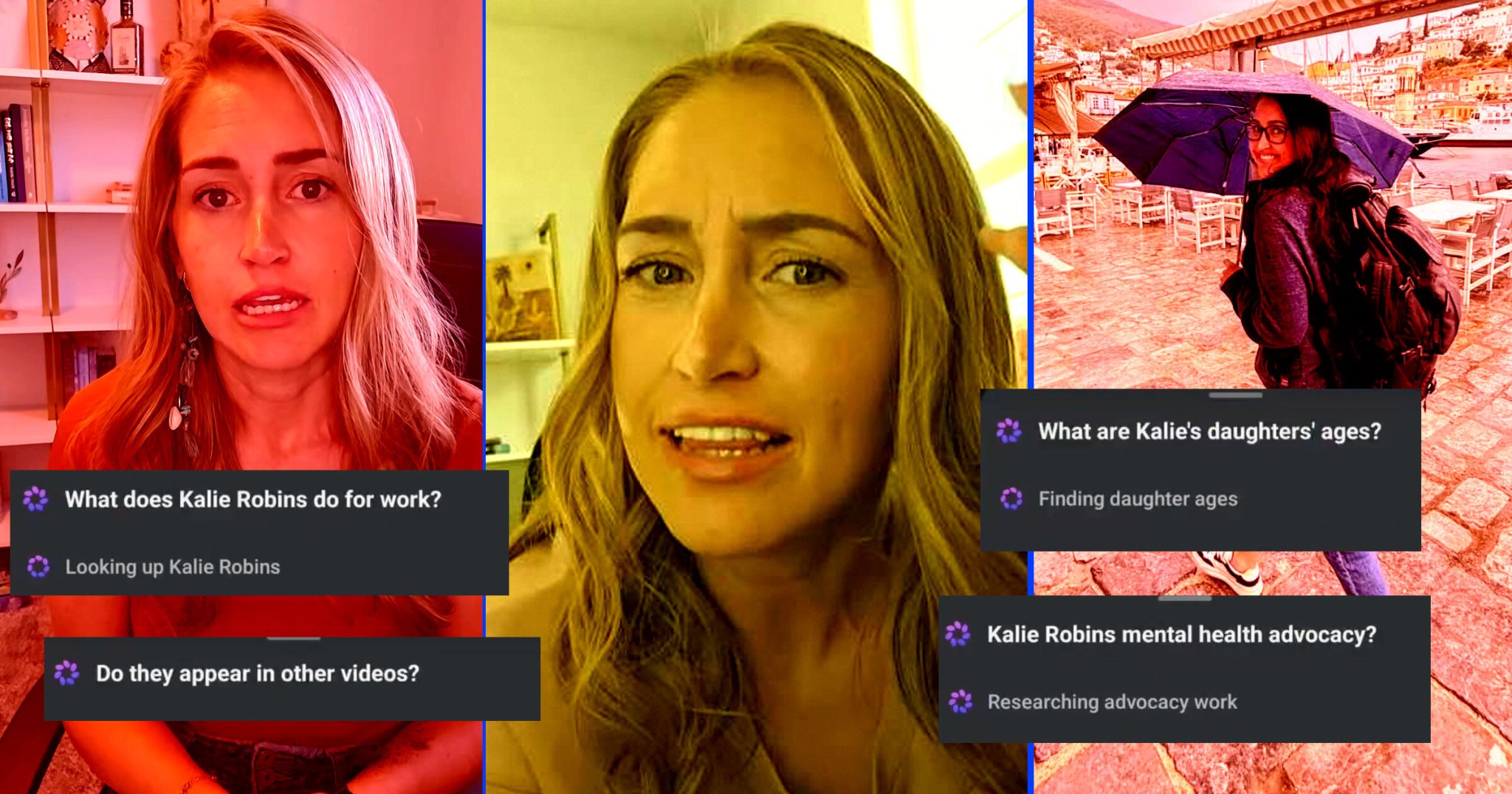
Last week, a mother in Utah named Kalie Robins took to Instagram to post what she felt was an “innocent” video of herself and one of her two young daughters singing in the car. Her daughter’s face was visible, but Robins hadn’t said her name. None of her existing Instagram and Facebook posts on the account, she told Futurism, publicized the names of her children.
When she returned to the same video later, which had been cross-posted on Facebook, Robins discovered that Meta’s built-in AI was offering a suggestion: that she investigate the identity of the child in the backseat.
“Who’s the child passenger?” read the Meta AI’s suggested prompt, talking about her daughter.
Robins, who detailed her dystopian experience in a viral Instagram video, decided to engage with the Facebook AI feature to see what would happen. To her horror, it coughed up a detailed response that named not only her daughter who was pictured in the video, but her other daughter as well. It did so, seemingly, by cross-referencing information from her Facebook page with other posts on Meta platforms going back years — information largely shared not by Robins, but by family members including excited grandparents.
“I clicked on it, and it gave a whole portfolio of not just my daughter that was in the car, but also my other daughter,” Robins told Futurism. “I’m thinking, ‘Why is that in here?’ And then it just kept offering more and more.”
Meta AI continued to recommend new questions, each more invasive than the next, according to screenshots shared by Robins.
“What are Kalie’s daughter’s ages?” read one suggested prompt, which spurred the AI to provide a detailed age breakdown and timeline based on “family birthday posts and birth announcements” that included a Facebook post of one of her daughters as a newborn that was shared by the child’s grandmother.
A similar response, also referencing Facebook posts, discussed how much one of Robins’ daughters weighed at birth. Screenshots also show Meta AI prompting Robins to ask questions about the girls’ lives and interests.
Meta AI “started talking about, because of their ages, this is the grade they should be in. Well, there’s only one school here, so that wouldn’t be hard to find,” Robins recalled. “And then it talked about what are my daughter’s favorite beaches, what are this daughter’s favorite books, where they go hiking, what’s their favorite trail.”
In another disarming prompt, Meta encouraged Robins to ask it: “Where does Kalie Robins live?”
As Meta AI searched for the information, it said it was working on “pinpointing Kalie Robins’ location.” It then offered multiple paragraphs expounding on where Robins was likely based, drawing on content including a 2018 Facebook post that, per the Meta AI summary, “congratulated her” on a life achievement.
Meta AI also encouraged users to ask questions about Robins’ professional life and her work in “mental health advocacy,” providing information about her and her husband’s employment histories. Robins was stunned as she watched the Facebook-embedded AI draw on years of posts to Meta platforms to assemble an intelligence dossier about her and her family.
“It just kept going and going, and that pit in my stomach just kept getting bigger and deeper,” said the mother of two. “I felt this dread.”
Robins’ Instagram and Facebook accounts, where she’s been working to build her following as a travel creator, were public. But she was far from a celebrity influencer; she had only a few hundred followers. And though a human investigator may well have been able to cobble together a similar pile of information, Meta AI was able to do so in minutes.
“I thought we were being safe and smart,” said Robins. “I have done so much to make sure my kids are safe… the more it kept showing me, I felt more and more like I was failing my kids, and I didn’t realize it.”
Have you had a disturbing interaction with Meta’s AI? Email us: tips@futurism.com. We can keep you anonymous.
A self-avowed “90s kid,” Robins told Futurism that she’s been using Meta platforms since Facebook “first came out.” She lives far from her extended family, and as she and her relatives have started families, Facebook has long been an avenue to stay connected to loved ones and to share life milestones — the very kind of human connection that Meta has long said that its social media platforms are intended for.
But this is also meant that Robins and those in her life, like billions of others worldwide, have been leaving breadcrumbs of personal information throughout Meta’s platforms for years. In this case, Meta AI was able to quickly surface that years-long trail and piece it into a detailed portrait of Robins, her family, and their life; as it turns out, there’s a lot of information in the mundane.
Robins is now in the process of asking loved ones to take down or hide memories they’ve shared online, which she says has been an emotional process.
“I’ve had a couple relatives cry because they were going through and deleting everything. One of them was a grandparent — she said, ‘This is my scrapbook, I have to get rid of my scrapbook?'” Robins recalled. “I love seeing my niece, my nephew. I love sharing my daughters with their family that they never see… they’ll comment, ‘Oh my gosh, she’s getting so big,’ and it’s exciting for all of us to watch each other grow when we’re nowhere near each other. So to have some family members actually crying that their scrapbooks are gone — it’s rough. It’s hard, and it is a bummer for me.”
Reached for comment, Meta confirmed that Meta AI can search though a user’s own content as well as for public information on the web. In this case, though, it said its AI search feature had “missed the mark.”
“We created this feature to help people get more information about topics or posts that interest them. When someone clicks on a prompt and uses this feature, the response it generates is based on information the user already has access to,” said the tech giant. “But we missed the mark because the feature never should have prompted the individual with questions like that and we’ve fixed that issue.”
Between the rise of AI and the growing ubiquity of a new wave of surveillance technologies — like Meta’s smartglasses and other wearables, or Flock cameras — years-old questions around tech and privacy have reached a fever pitch. Robins, for her part, says she hopes that sharing her experience will encourage other families to make changes about the way they use the web.
“If this tool is putting things together and making a neat little package with your kid’s name on it, make it hard,” Robins urged. “Make it so hard to find that information.”
Back in August, a massive leak in El Reno, Oklahoma spewed close to four million gallons of local water into the ground, forcing the city into an unofficial stand-still.
The cause was quickly traced back to a damaged water line belonging to a Bitcoin-mining data center operated by the company Athlon BT. As ABC5 reported at the time, city inspectors trawling the building’s exterior uncovered the failed water line, as well as violations around drainage, maintenance and access, and expired building permits.
Weeks later, an investigation by the local fire marshal inside the El Reno data center uncovered a further laundry list of horrifying violations.
The inspectors discovered vessels full of flammable liquid stored near combustible materials, Oklahoma station KFOR reported, in addition to fire extinguishers that weren’t properly maintained.
Electrical equipment and crucial wiring was also found in disrepair, while a lockbox meant to hold keys for emergency first responders to easily access the facility was left empty. Vegetation on the building’s exterior was in violation of the fire code.
As a result of the copious fire hazards, the city gave the data center a “failing” grade, indicative of a building with severe structural or safety failures.
When it comes to data centers, fire safety is no small matter. The structures are already highly prone to conflagration due to massive electrical loads, lithium-ion batteries, and chips that run at extremely high temperatures.
In one Ohio township, fire fighters reported being overwhelmed by the high volume of calls to two local data center campuses. In addition to tying up first responders, data center fires are costly affairs for taxpayers, as property tax abatements mean nearby residents — not data center owners — can be the ones fronting the bill whenever the fire company gets a call.
Missing from the archaeological record, fiber innovations like string played a huge role in the daily lives of our ancestors. Researchers are working to weave together new insights from the traces they left behind.
Burning Man, the week-long festival that takes place in the middle of the Nevada desert and draws many luminaries from the tech industry, prides itself on building community.
But unfortunately, this year’s festivities, which concluded on Monday, were not without incident. As NBC reports, there have been three separate deaths in less than a week at this year’s Burning Man.
This past Saturday, officials announced that 60-year-old Craig Mann was found dead in his camp, days after Sampson Tshombe, a man in his mid-50s, passed away after experiencing a medical emergency.
Then on Monday, the Washoe County Medical Examiner confirmed that 51-year-old Armando Ramirez died on the way to a hospital in Reno, which is roughly two hours south of the festival grounds in Black Rock City, Nevada.
News of a third death wasn’t far behind.
“Although we average one death a year at the Festival, we have had two so far this year within the confines of the Festival and I have received information regarding a third who died in transit to a hospital in Reno,” said Pershing County sheriff and coroner Jerry Allen in a Monday statement, as quoted by NBC.
The three incidents leave far more questions than answers. Officials have yet to comment on the exact cause of death, but said there are no indications of any foul play. The deaths also don’t appear to be linked in any way.
It’s nonetheless a sobering facet of organizing an often drug-fueled festival in the middle of the desert with giant art installations, the structural safety of which is the responsibility of festivalgoers. According to the Reno Gazette Journal, it’s the most deaths on record for a single Burning Man. Previous incidents involved a man on a motorcycle being fatally struck by a van in 1996, and a woman who was killed after being run over by a trailer in 2003. There have also been reports of suicide and a man running into the Burning Man effigy fire.
According to a survival guide on the festival’s website, the site is a “huge, flat, prehistoric lakebed, composed of a hardpan alkali, ringed by majestic mountains” where “daytime temperatures routinely exceed 100 Fahrenheit, with extremely low humidity.”
“It takes nearly everyone a day or so to adjust to the desert climate,” the website reads. “Don’t be surprised if you spend your first day feeling queasy and cranky. DRINK WATER!”
Officials also warned that taking drugs, including alcohol or caffeine, can increase the risk of dehydration.
In the case of emergencies, experienced festival goers dubbed Black Rock Rangers volunteer to patrol the grounds in pairs.

 Login