❌

Reading view

Qualcomm Works With Second Hyperscaler on Custom AI Accelerator
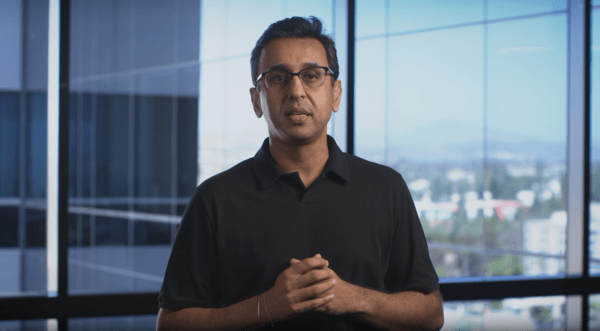
Akash Palkhiwala, chief financial officer of Qualcomm. (Photo: Qualcomm)

Qualcomm has signed a second agreement with a large-scale data center operator, or hyperscaler, to jointly design and produce artificial intelligence (AI) accelerators. The deal marks tangible progress in AI for Qualcomm, which has historically relied on smartphone chips for most of its revenue.

Akash Palkhiwala, Qualcomm’s chief financial officer (CFO), said at the Goldman Sachs Technology Conference 2026 on Sept. 8 that the company is working with another global hyperscaler in addition to Amazon. He said the custom silicon Qualcomm is developing with hyperscalers is intended not for auxiliary workloads but as primary AI accelerators in data centers.

The remarks indicate that Qualcomm is developing AI accelerators optimized for the customer’s data centers and services. Palkhiwala did not identify the hyperscaler. Major hyperscalers include Amazon Web Services (AWS), Microsoft, Google, Meta, Oracle and IBM. Qualcomm is already working with Amazon and Meta.

The agreement with the undisclosed hyperscaler is expected to be similar in structure to Qualcomm’s Amazon deal. Qualcomm and Amazon recently announced a collaboration on customized silicon for data center AI acceleration and high-performance optical connectivity solutions.

Qualcomm will supply the products to Amazon over the next 10 years. The agreement is valued at a total of $60 billion, or about 80.514 trillion won. Amazon will also receive warrants that vest in proportion to its purchases. The structure is intended to strengthen and extend the companies’ long-term partnership. Qualcomm has begun chip production, while Amazon has secured 15% of the warrants.

“The Amazon agreement is very large, but it is only the beginning,” Palkhiwala said. He added that Qualcomm’s technology collaboration with another hyperscaler is taking a similar form and is making strong progress.

Qualcomm has also agreed to supply data center central processing units (CPUs) to Meta. Its Dragonfly C1000 is planned for Meta’s next-generation server fleet. Dragonfly is Qualcomm’s data center product portfolio. Qualcomm is targeting more than twice the performance per watt of existing competing server CPUs with the C1000. A server fleet refers to a group of servers operating together to perform the same function.

Qualcomm expects its agreements with Amazon, Meta and the undisclosed hyperscaler to help push data center product revenue above 20 trillion won in three years. “We have already made significant progress toward our fiscal 2029 target of $15 billion, or about 20.07 trillion won,” Palkhiwala said. “We are at a point where we don’t need that many additional business elements.”

Qualcomm has recently been focusing its experience in advanced-node chip design and high-volume manufacturing on its custom silicon business. It is also developing Dragonfly commercial AI accelerators that are not customized for individual customers: the AI250 and AI300. The AI250 is scheduled for mid-2027, followed by the AI300 in 2028. Both products will incorporate Qualcomm High Bandwidth Compute (HBC) memory technology.
  •  

Global Technologies Targets 169.5 Billion Won in 2029 Revenue on LED, Auto Expansion

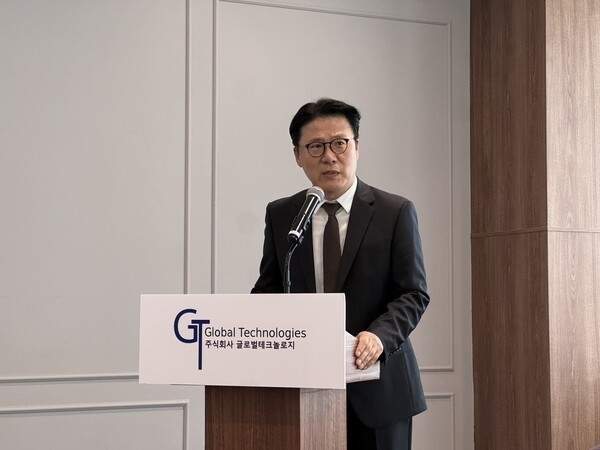
Kim Min-sun, CEO of Global Technologies, speaks about the company at a press briefing at the CCMM Building in Yeouido, Seoul, on Sept. 10. (Photo: THE ELEC)

Global Technologies aims to generate 169.5 billion won in revenue by 2029 by expanding its light-emitting diode (LED) driver IC, transparent display, micro LED and automotive system semiconductor businesses.

Kim Min-sun, chief executive officer of Global Technologies, said at a press briefing at the CCMM Building in Yeouido, Seoul, on Sept. 10 that the company plans to expand its LED driver IC technology from TVs to monitors and automobiles, while developing micro LED and automotive system semiconductors as new growth engines.

Global Technologies is a fabless chipmaker that designs LED driver ICs (LDIs) controlling the current and brightness of backlight LEDs. The TV market currently accounts for about 70% of its revenue. The company secured a purchase order from a Taiwanese display customer in July. It plans to begin mass production of monitor LDIs in December and is developing automotive products with a target of mass production in the second half of next year.

The company is also developing a red-green-blue (RGB) backlight module combining driver ICs, LED packages and lenses. The key technology is time-division driving, which alternately controls three light sources through a single output channel. Conventional designs use a separate channel for each light source. By sharing the control circuitry, the technology can reduce the number of driver ICs required to as little as one-third of the conventional level.

Global Technologies plans to use the reduced chip count to counter price competition from Chinese suppliers. TV makers can lower overall component costs without cutting the price of individual chips. The company aims to improve profitability by charging higher prices for chips incorporating the technology while increasing shipment volumes as customers expand their adoption of RGB LED models. A TV-set customer will evaluate the technology this month, with mass production targeted for early next year.

In transparent LED displays, the company is targeting commercial signage and automotive glass. The products combine driver ICs with ultra-small LED packages, allowing users to see through the display. Global Technologies has supplied commercial products to customers including Yangju City Hall in Gyeonggi Province and is developing products for vehicle rear windows and roofs.

In micro LEDs, the company is jointly developing pixel driver ICs, packages and modules. A 24-pixel driver IC for TVs is targeted for mass production early next year. The company is also developing modules for automotive center information displays (CIDs). It invested 5 billion won to establish a pilot line in Pyeongtaek for prototype production and process validation.

Global Technologies is developing lighting and communications products for its automotive system semiconductor business. It operates a joint research center with an automotive parts supplier and is developing about 10 products. Its smart ambient lighting (SAL) IC, which controls vehicle interior lighting, has secured an initial order for 3 million units, with deliveries scheduled to begin early next year. The company also plans to commercialize controller area network (CAN) communication chips used to exchange data among vehicle electronic systems.

The company posted first-half revenue of 28.8 billion won and operating profit of 1.155 billion won this year. It generated revenue equivalent to 97% of last year's full-year total in the first half and returned to an operating profit. Global Technologies plans to increase revenue from mass-produced products and raise its operating margin from a target of 7.7% this year to 21.8% in 2029.

Global Technologies is scheduled to list on the KOSDAQ on Sept. 29. It is offering 4 million shares at an indicative price range of 13,000 won to 15,000 won each, for an offering size of 52 billion won to 60 billion won. The company is conducting bookbuilding for institutional investors through Sept. 11 and will accept retail subscriptions on Sept. 16 and 17. Korea Investment & Securities is the lead underwriter.

The company plans to invest a combined 78.7 billion won through 2029 using IPO proceeds, operating cash flow and government funding. Of the total, 23.5 billion won will be allocated to research and development, 7.7 billion won to facility expansion and 47.5 billion won to working capital, including securing foundry capacity.

  •  

SK hynix Targets 600 Million Tons in Water Savings by 2030

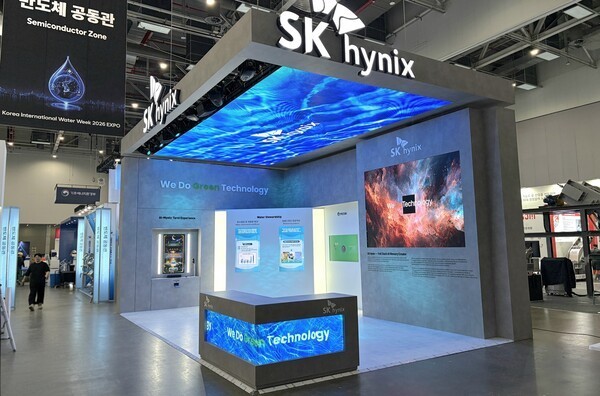
SK hynix presents its water conservation achievements and targets at Korea International Water Week 2026. (Photo: SK hynix)

SK hynix plans to save a cumulative 600 million tons of water at its Korean operations by 2030.

The company said it is presenting its water conservation achievements and targets at Korea International Water Week 2026, held at EXCO in Daegu from Sept. 9 to 11. Its exhibition booth highlights major water conservation, recycling and ecosystem preservation activities through videos and graphics.

SK hynix has operated a water and wastewater reduction task force since 2018, reducing water consumption and expanding reuse in semiconductor manufacturing. As a result, its Korean operations saved an average 170,000 tons of water per day last year, equivalent to the daily household water consumption of about 550,000 people.

Cumulative water savings reached 303.37 million tons by the end of last year, exceeding the company’s target of 264 million tons. SK hynix aims to increase the total to 329 million tons this year. Water reuse rose about 54% to 73.59 million tons last year from 47.88 million tons in 2022.

SK hynix’s Icheon site produces 94,400 tons of recycled water per day through its wastewater reuse facilities. The recycled water is supplied to facilities including air pollution control systems. Its Cheongju site became the first in Korea’s semiconductor industry to introduce externally treated reclaimed wastewater in 2023, recycling it for industrial use.

The company is also strengthening water management across the entire cycle from intake and use to recycling and discharge. Its wastewater treatment processes include ozone oxidation, activated carbon and multistage coagulation and sedimentation systems. SK hynix continues to develop and invest in additional technologies to reduce pollutants.

SK hynix also carries out activities to monitor local communities and ecosystems. It operates the ECOSEE citizen science program around Anseong Stream to track ecological changes before and after development of the Yongin semiconductor cluster. Citizens participate directly in surveys of plants, birds and aquatic organisms and in collecting data.

“We will continue to advance our water management system to use less water, which is essential to semiconductor production, and reuse as much of it as possible,” SK hynix said. “We will also steadily expand investments in process improvements and related technologies and facilities.”

  •  

SK hynix Revises Bonus Plan to 50% Cash, 50% Stock

(Photo: SK hynix)
(Photo: SK hynix)
(Photo: SK hynix)
(Photo: SK hynix)

SK hynix management and its labor union reached a revised tentative agreement on Sept. 9 that sets the basic performance bonus payment ratio at 50% cash and 50% stock. The union will hold a temporary delegates' meeting on Sept. 10, followed by a membership vote from Sept. 15 to 16.

The revised agreement retains the broad framework of a tentative deal reached last month while reducing the proportion of bonuses paid in stock. The previous agreement called for profit-sharing (PS) bonuses to be paid 40% in cash and 60% in stock. The revised plan sets both at 50%.

Employees can choose to increase the stock portion in increments of 10 percentage points, up to 100%.

Deferred portions of performance bonuses calculated based on last year's results, which had been scheduled for payment next year and the following year, will also be paid earlier. The measure is intended to reduce confusion as the bonus system shifts from primarily cash payments to a combination of cash and stock.

The company also revised part of its housing loan support program. Additional support beyond the basic program had been limited to married households, but the revised proposal extends eligibility to single-parent families.

SK hynix's Icheon and Cheongju full-time employee unions previously held a membership vote last month on a tentative agreement that included a 6.3% wage increase and changes to the PS payment structure. The proposal was rejected by 7,535 votes, or 50.08%, against and 7,510 votes, or 49.92%, in favor — a difference of just 25 votes.

  •  

Zeta Mobility Expands 4D Radar AI Into Senior Care

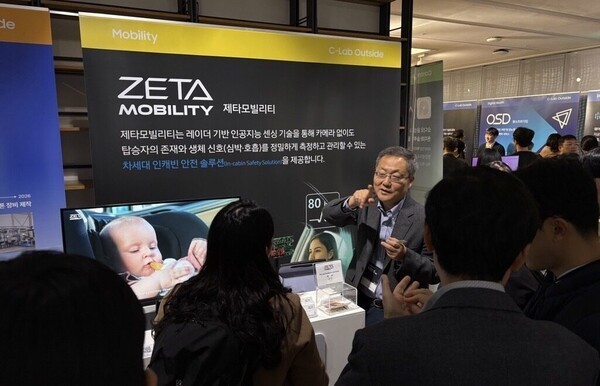
Zeta Mobility’s booth at Samsung Electronics C-Lab Demo Day 2025. (Photo: THE ELEC)

Startup Zeta Mobility is expanding its 4D radar artificial intelligence sensor-fusion technology, originally developed for autonomous driving, into senior care and healthcare. The company plans to produce tangible results this year through partnerships with a company and a university.

“We signed memorandums of understanding with two companies and institutions last month and began proof-of-concept testing,” Zeta Mobility Vice President Kim Sang-ki said on Sept. 9. The partners are senior care technology company Dolbomdream and Gachon University’s Intelligent Homecare Integrated Support Infrastructure Project Group, or AAL Center. Zeta Mobility aims to commercialize services for vulnerable populations using its technology.

Zeta Mobility is a deep-tech startup developing high-resolution 4D imaging radar and AI sensor-fusion technologies. The company was founded in February 2024 as a startup spun out of a laboratory at KAIST’s Graduate School of Mobility and joined the university’s startup incubator. In October that year, it was selected for the Ministry of SMEs and Startups’ Deep Tech TIPS program and Samsung Electronics’ C-Lab Outside startup support program. It was also selected for the ministry’s Super Gap Startup 1000+ program in April last year and received an award from the head of the Small and Medium Business Administration in May.

Radar emits electromagnetic waves, or millimeter waves, and analyzes reflected signals. Unlike conventional 3D radar, which measures distance, direction and speed, 4D imaging radar also captures height data. This allows scattered radar reflections to be converted into high-resolution three-dimensional point-cloud data.

Raw 4D radar data contains signal noise that makes it difficult to interpret. Zeta Mobility addresses this with its proprietary AI algorithm software, Zeta AI Engine. The software removes meaningless reflections and signal noise and extracts the shape of objects. By analyzing continuous time-series data, it can infer human movement, changes in posture and biometric signals such as heart and respiratory rates with more than 90% accuracy.

Zeta Mobility has integrated the technologies into three versions of its ARGUS platform, an intelligent system that detects, understands and transmits radar sensor data. The platform takes the form of a compact, low-power, high-efficiency board for edge AI, which runs AI models directly on devices where data is generated.

ARGUS-A is designed to detect safety conditions and driving environments for autonomous vehicles. ARGUS-C monitors vehicle occupants in real time. ARGUS-H is an indoor care product designed to detect falls among elderly people living alone and monitor biometric signals.

Zeta Mobility initially focused on autonomous driving and in-cabin occupant-detection sensors. But as commercialization and market adoption of autonomous driving progressed more slowly than expected, the company strategically shifted its business focus toward senior healthcare. Its 4D radar AI and sensor-fusion technologies can be applied to indoor residential spaces as well as vehicle interiors.

Partnerships With Dolbomdream, Gachon University to Test ARGUS-H

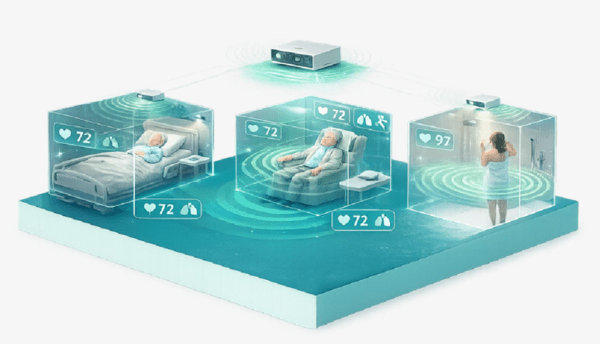
An example of healthcare monitoring using 4D imaging radar. (Photo: Zeta Mobility)

Zeta Mobility has secured infrastructure to test ARGUS-H through the two recently signed MOUs.

The company will first work with Dolbomdream on joint testing and commercialization of senior care and monitoring services. The companies plan to combine Zeta Mobility’s radar AI sensor technology with Dolbomdream’s wearable sensor-based healthcare technology and jointly pursue government projects and research and development programs. They also plan to expand their collaboration into worker safety management at industrial sites.

Existing senior-care technologies face trade-offs between accuracy, convenience and privacy. Falls among elderly people living alone frequently occur in private spaces such as bathrooms, toilets and bedrooms, where cameras face strong user resistance as well as ethical and legal constraints. Smartwatches and patch-type biosensors require users to wear them continuously and recharge them regularly. Elderly users may forget to wear the devices or take them off, creating monitoring gaps and potentially delaying responses to emergencies such as falls.

Zeta Mobility says its 4D radar AI technology can address those problems. ARGUS-H can be installed on a wall or ceiling to monitor an entire space without requiring the user to wear a device. Because it analyzes radar waveforms rather than visual images, it avoids capturing private visual information. It can also detect a person’s precise location and subtle movements in low-light or steam-filled environments where visibility is poor.

Zeta Mobility will work with Gachon University’s AAL Center to develop and commercialize intelligent homecare services for vulnerable populations. The center has researched a big-data platform for elderly people’s activities of daily living. Zeta Mobility plans to combine the university’s software and data research capabilities with its own technology to build infrastructure for real-time monitoring of elderly users.

The partners will also develop and deploy AI care equipment and personalized service models. They plan to support healthcare programs for elderly people run by local governments and community welfare organizations, while expanding into the senior healthcare and smart-home markets.

“We will use these recent demonstration agreements as a stepping stone to establish technical standards for smart-home senior care and secure our first supply contract with a construction company or healthcare platform within this year,” Kim said.

  •  
❌