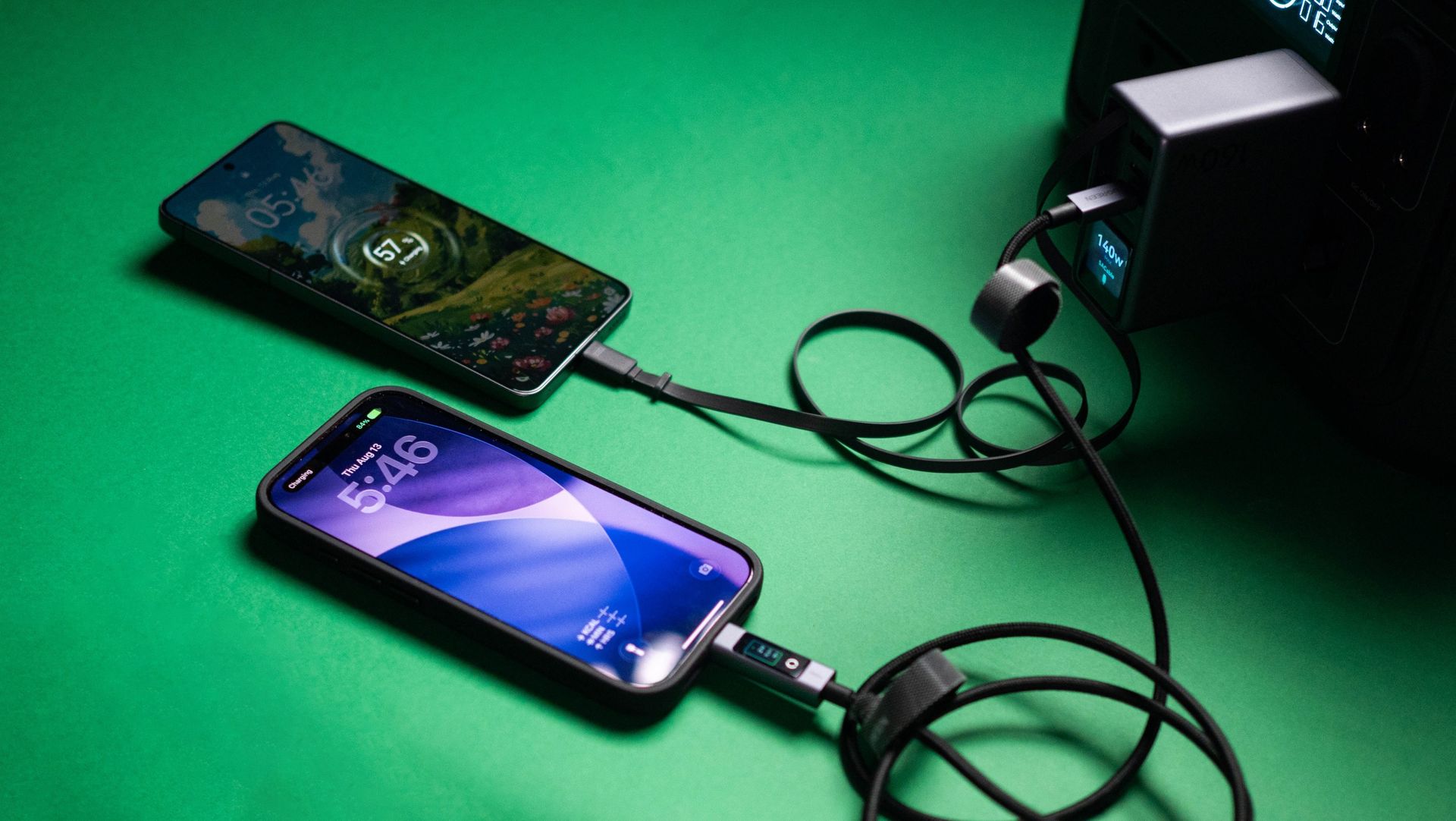
Portable power stations have moved beyond simply charging phones and laptops. As more people look for backup power for home appliances, RVs, outdoor equipment and emergency situations, the useful question is no longer just how many USB ports a power station has. It is whether the system has enough capacity, output power and charging flexibility to handle demanding equipment without becoming impractical to move.
The SolarPlay Q3600 is designed around that idea. It combines a 3,840Wh LiFePO4 battery with up to 3,600W of AC output, 2,000W solar input and multiple charging interfaces. The result is a large-format power station aimed at users who need considerably more than a conventional portable battery can provide.
A 3,840Wh Battery Changes What a Portable Power Station Can Do
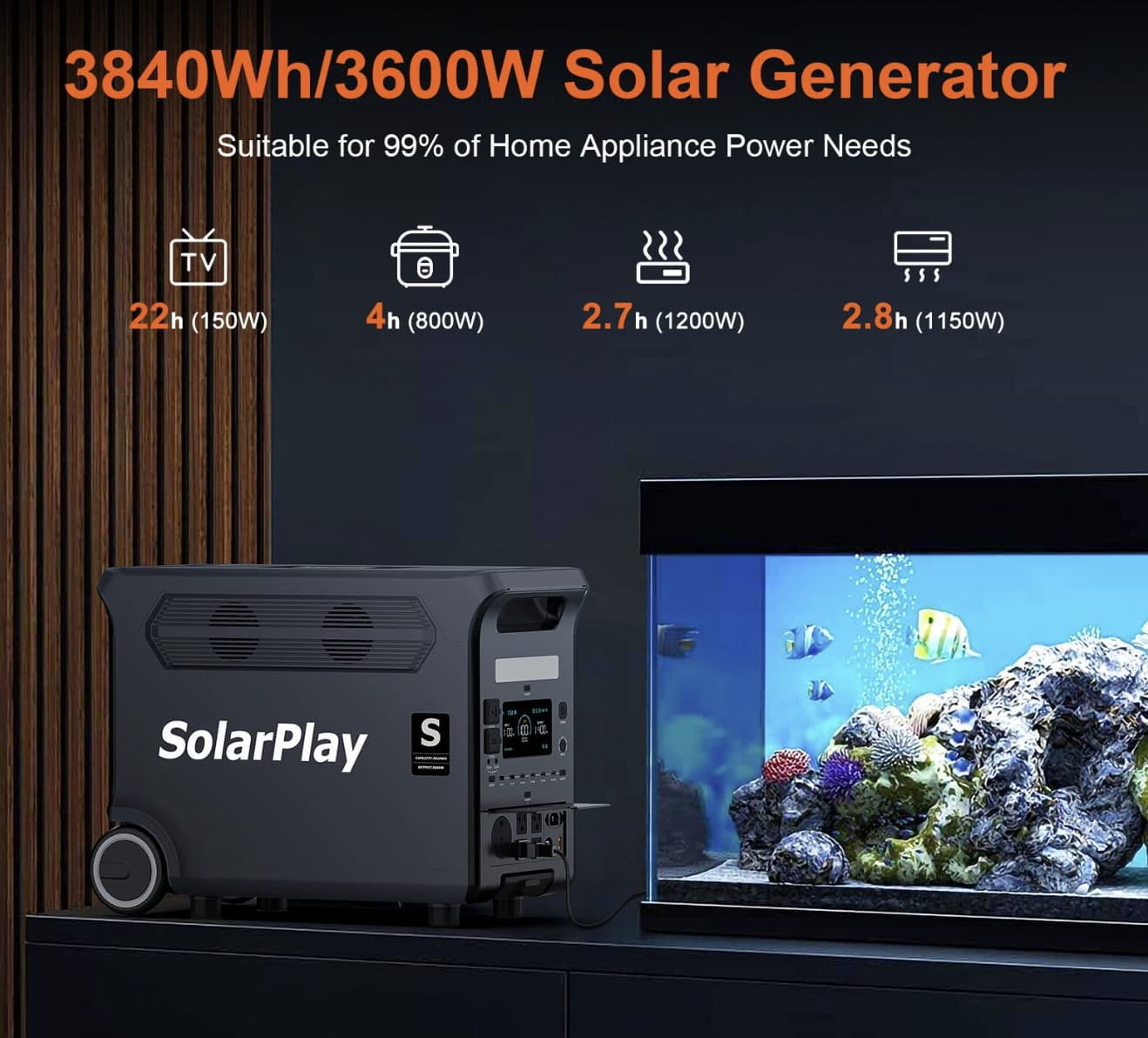
The Q3600’s biggest selling point is its 3,840Wh battery capacity.
That amount of stored energy gives the unit a very different role from smaller power banks or compact camping batteries. Instead of being primarily a device for keeping phones and laptops alive, the Q3600 is intended to support a wider range of equipment, including household appliances, workshop tools, RV equipment and other higher-power loads.
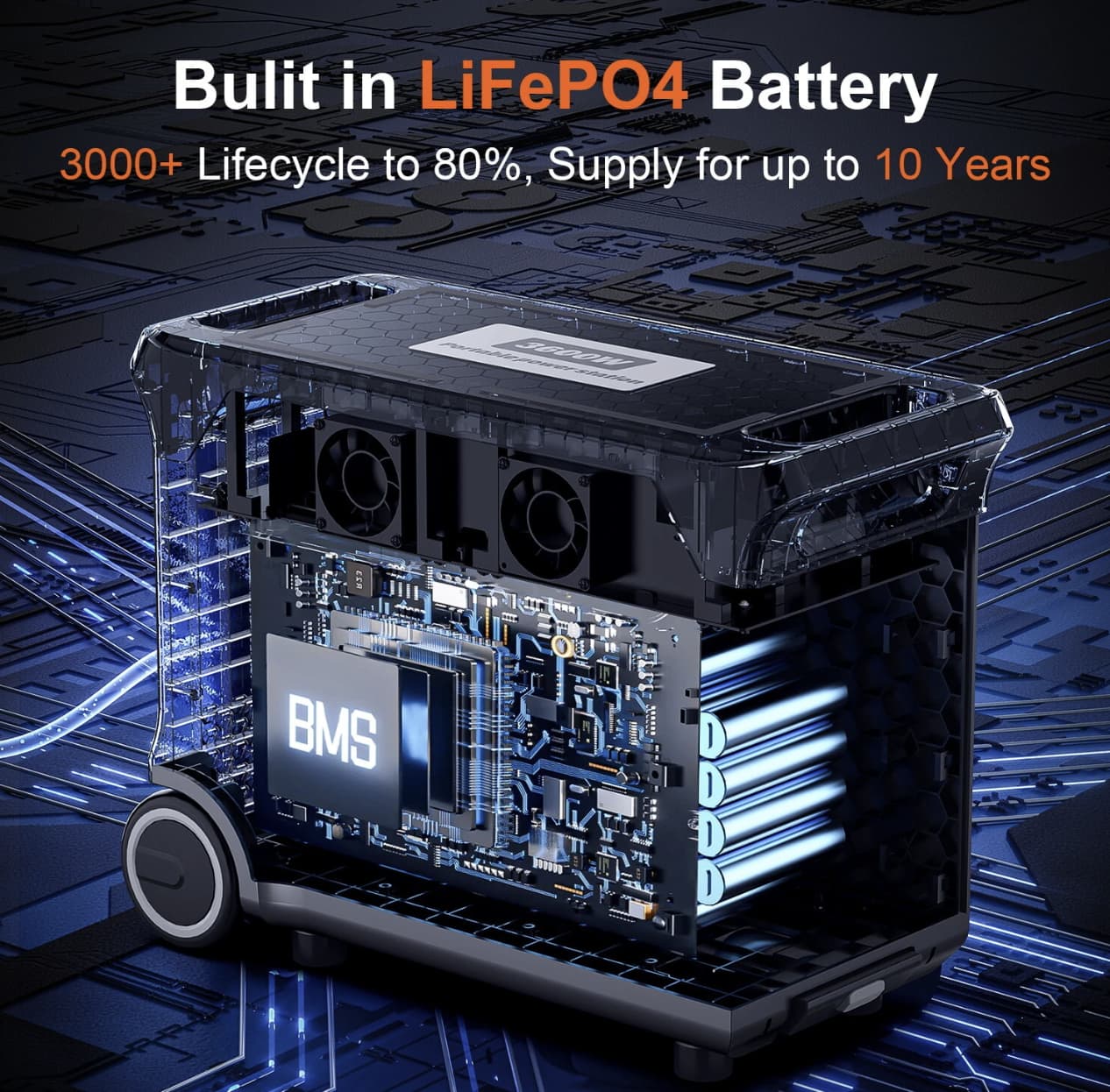
SolarPlay uses a LiFePO4 battery architecture for the Q3600. The manufacturer’s specifications list more than 4,000 charge cycles while retaining 80% of the original capacity, although real-world battery longevity will naturally depend on charging habits, temperature and load conditions.
For users considering a power station as an emergency backup, this distinction matters. A large capacity does not automatically mean unlimited runtime, because actual operating time depends heavily on the wattage of the connected equipment. A 3,840Wh battery can therefore be thought of as a substantial energy reserve rather than a guarantee of a specific number of hours.
3,600W of AC Output Makes It Suitable for More Demanding Loads
The Q3600 is rated for 3,600W continuous AC output and uses a pure sine wave inverter. The European version provides 220–240V AC output at 50Hz/60Hz.
This is one of the areas where the Q3600 separates itself from smaller portable power stations.
A 3,600W output ceiling gives users considerably more room for equipment with higher power requirements. That can be useful for appliances and tools that would simply be outside the practical range of a compact 1,000W-class station.
However, the sensible approach is still to check the rated and startup power of each appliance before connecting it. Motors, compressors and heating appliances can behave differently from their advertised average consumption, so the station’s maximum output should not be treated as a universal guarantee for every device.
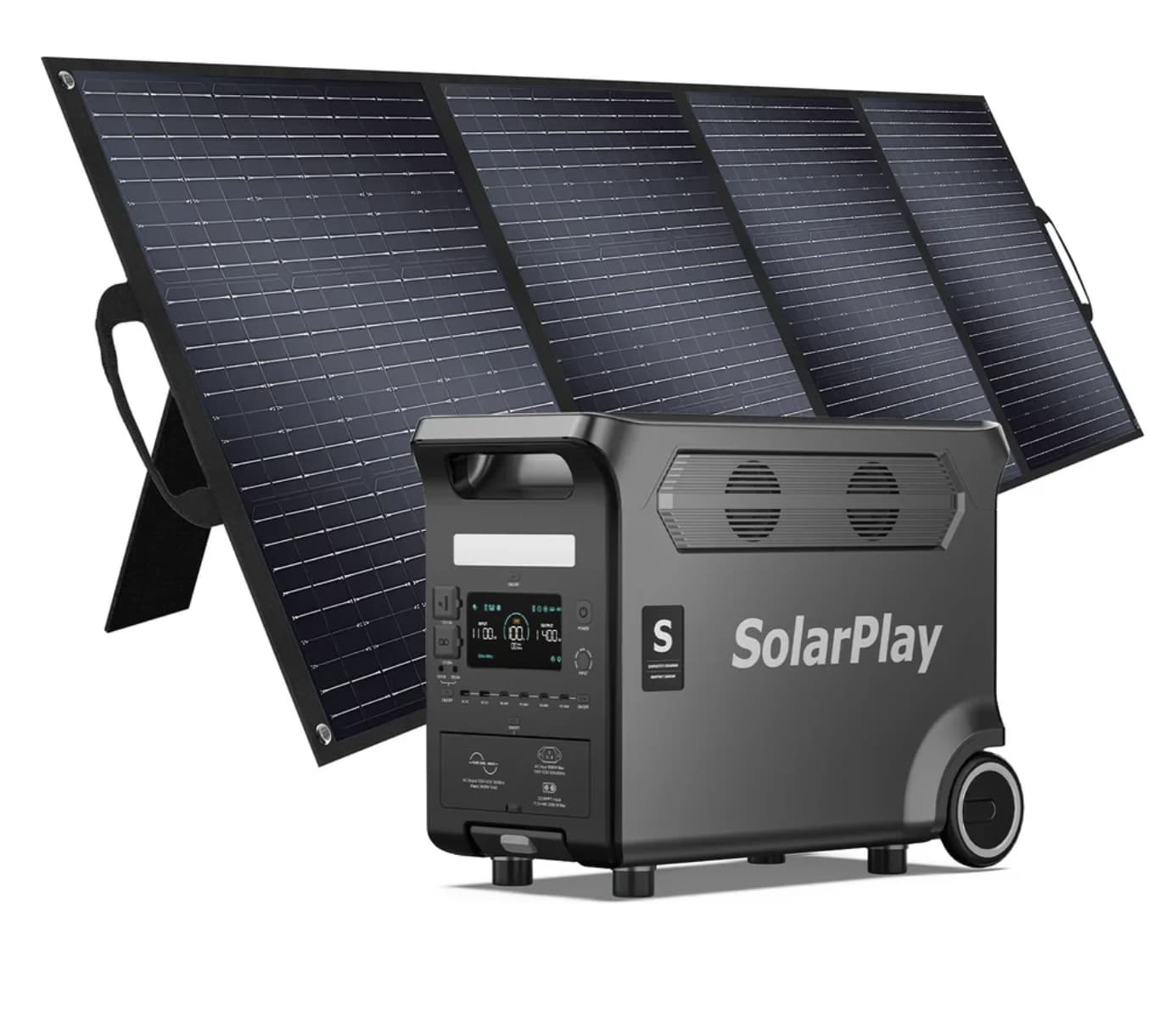
Solar Charging Is One of the Q3600’s Most Interesting Features
The Q3600 is not limited to wall charging. Its solar input can accept up to 2,000W, giving the system a much stronger off-grid charging capability than many smaller portable power stations.
SolarPlay states that the Q3600 can reach a full charge in approximately 1.5 hours when AC and solar charging are combined, rather than implying that a 3,840Wh battery can always be fully recharged from solar alone in that time.
The European model also provides adjustable AC charging levels of 400W, 800W, 1,200W, 1,600W and 2,200W. This gives users more control over charging speed and power demand depending on the situation.
That flexibility could be particularly useful during longer outdoor trips. Instead of treating the battery as a one-time energy source, users can recharge it during the day and use the stored energy later when solar production falls.
Multiple Output Types Make It More Versatile
Another strength of the Q3600 is the range of connection options.
The specification includes AC outlets alongside a 12V cigarette-lighter output, an XT60 port, DC outputs, USB-A ports and several USB-C connections. One USB-C port supports up to 100W PD output, making it suitable for higher-powered compatible devices such as laptops.
The Banggood listing describes the product as having 17 outputs, while SolarPlay’s current product page lists 15 output ports. Because the two sources present the port count differently, buyers should check the exact configuration of the package and regional version before ordering.
More importantly, the variety of outputs means the Q3600 can serve several types of equipment at the same time rather than functioning as a single-purpose AC battery.
UPS Support Adds a Practical Home-Backup Role
The Q3600 also supports a UPS function, which makes it more interesting for use around the home.
According to the listed specifications, the system can switch to battery power in less than 20 milliseconds under its specified UPS conditions. This is intended to reduce interruption when mains power disappears.
That feature can be useful for equipment that needs a more consistent power source, such as networking hardware, computers or selected electronic devices.
It should not, however, be confused with a dedicated enterprise-grade UPS system. Users with particularly sensitive equipment should check the manufacturer’s UPS specifications and the equipment’s own power requirements before relying on the Q3600 as their only backup solution.
Large Capacity Comes With a Real Weight Trade-Off
The Q3600 is portable, but it is not lightweight.
The listed bare-device weight is approximately 42.2kg, with dimensions of about 608 × 289 × 456mm.
That makes the built-in wheels and telescopic handle particularly important. The Q3600 is better understood as a movable power station rather than something most users will casually carry by hand over a long distance.
For an RV, garage, workshop, campsite or home backup location, this design makes sense. Users can position the unit where it is needed and roll it into place instead of repeatedly lifting the entire 42kg system.
Designed for Home Backup, RVs and Off-Grid Use
The Q3600’s specifications suggest several practical use cases.
For home backup, the large battery and high AC output provide a way to keep selected appliances and electronics operating during outages.
For RV use, the combination of AC, 12V and other DC outputs can reduce the need to carry separate power solutions for different types of equipment.
For off-grid applications, the 2,000W solar input becomes especially important because it allows the Q3600 to function as part of a rechargeable solar-based power system rather than relying entirely on the electrical grid.
Outdoor users should still consider the unit’s 42.2kg weight and physical size when planning transportation. Its wheels make movement easier, but this is not a lightweight backpacking power station.
What About Noise and Protection?
SolarPlay lists the Q3600 with multiple battery-management protections covering conditions such as overcharging, over-discharging, over-current and short circuits. The Banggood specifications also list a working temperature range of approximately -10°C to 45°C for the Q3600.
The product is also listed with safety and transport-related certifications including CE, FCC, RoHS, PSE, UN38.3 and MSDS documentation.
These features do not eliminate the need to use the power station within its operating limits, but they show that the Q3600 is designed as a substantial energy-storage system rather than simply a large battery pack.
SolarPlay Q3600 Specifications
| Specification |
SolarPlay Q3600 |
| Battery capacity |
3,840Wh |
| Battery type |
LiFePO4 / LFP |
| AC output |
3,600W |
| AC voltage |
220–240V |
| AC waveform |
Pure sine wave |
| Solar input |
Up to 2,000W |
| AC charging |
Up to 2,200W |
| UPS |
Less than 20ms under specified conditions |
| USB-C |
Up to 100W on dedicated PD port |
| DC output |
12V options |
| Weight |
About 42.2kg |
| Dimensions |
About 608 × 289 × 456mm |
| Operating temperature |
Approximately -10°C to 45°C |
Specifications can vary by regional version or package, so buyers should verify the configuration before purchase.
Is the SolarPlay Q3600 Worth Considering?
SolarPlay Q3600 power station is not trying to win the portability contest by being small and light. Its appeal comes from the opposite direction.
The 3,840Wh battery, 3,600W AC output and 2,000W solar input give it the kind of electrical capacity that makes sense for home backup, RV trips, workshops and longer off-grid use. The multiple output types and UPS function further expand its potential applications.
The biggest compromise is its size and 42.2kg weight. That means the Q3600 works best when it can be rolled into position rather than carried frequently.
For buyers who prioritize large energy storage, high output power and solar recharge capability over lightweight portability, the Q3600 offers a much more capable alternative to smaller portable power stations.
Before purchasing, users should also confirm the exact regional version, output configuration and included accessories, particularly because the current Banggood listing and SolarPlay’s own product page differ in how they describe the number of output ports.
The post SolarPlay Q3600 Brings 3840Wh Capacity and 3600W Output to Portable Backup Power appeared first on IGeeKphone China Phone, Tablet PC, VR, RC Drone News, Reviews.

 Login