❌

Reading view

Strange 'fast radio bursts' across the universe could help solve major cosmic mysteries: 'It's only the beginning'

Though their origins may be shrouded in mystery, fast radio bursts (FRBs) could be used to probe some of the universe's biggest puzzles. This includes probing the nature of dark matter, the invisible sort of matter that somehow dominates the universe, and dark energy, the mysterious force causing the expansion of our universe to accelerate. They could even shed light on the mysteries of neutrinos, or "ghost particles." Let's dive into how.

FRBs are brief but intense blasts of radio waves currently thought to erupt from rapidly rotating dead stars with the universe's strongest magnetic fields, called magnetars. As FRBs travel billions of light-years to reach Earth, they pass through dense clouds of gas and dust in galaxies. This "cosmic fog" changes the original FRB signal. What this means is these blasts of radio waves carry the fingerprints of how matter in the universe is distributed.

Mapping the distribution and "clumpiness" of ordinary matter in galaxies can then help trace the distribution of dark matter, the effect of dark energy and the mass of neutrinos.

"We've established that FRBs are a leading probe of the distribution of matter in the universe," team leader Kritti Sharma, a graduate student working with Vikram Ravi, a professor of astronomy at the California Institute of Technology (Caltech) and also part of the team, said in a statement. "These FRB data can be used to enhance cosmology experiments that are trying to answer questions about dark matter, dark energy, and the mass of neutrinos."

For this research, Ravi and Sharma analyzed a sample of about 100 FRBs. This represents the first time scientists have used FRBs to directly measure the impact of so-called "feedback" from galaxies on the clumpiness of matter in the large-scale regions between galaxies.

Cosmic ghosts and the dark universe

Ordinary matter, composed of atoms made up of electrons, protons and neutrons, accounts for just around 5% of the universe's energy/matter budget despite comprising stars, planets, moons, our bodies, next door's cat and everything we see around us on a day-to-day basis.

Of this budget, the other 95% is composed of dark energy (68%) and dark matter (27%). It's little wonder that scientists are very keen to better understand these two aspects of the cosmos, sometimes collectively referred to as the "dark universe."

Things get even more murky when considering how, of that 5%, the second most abundant particles in the universe, aside from particles of light or photons, are neutrinos. These get their nickname of "ghost particles" because they interact with other matter particles so infrequently that approximately 100 trillion neutrinos pass through your body every second without leaving any trace. This is possible because neutrinos are virtually massless, and scientists are keen to accurately measure the mass of these cosmic ghosts.

These three mysterious elements of the cosmos have played a vital role in the evolution of large-scale cosmic structures like galaxies and galaxy clusters. That means, in turn, that measuring the clustering of matter can reveal details about the aspects of the universe that influenced that clustering.
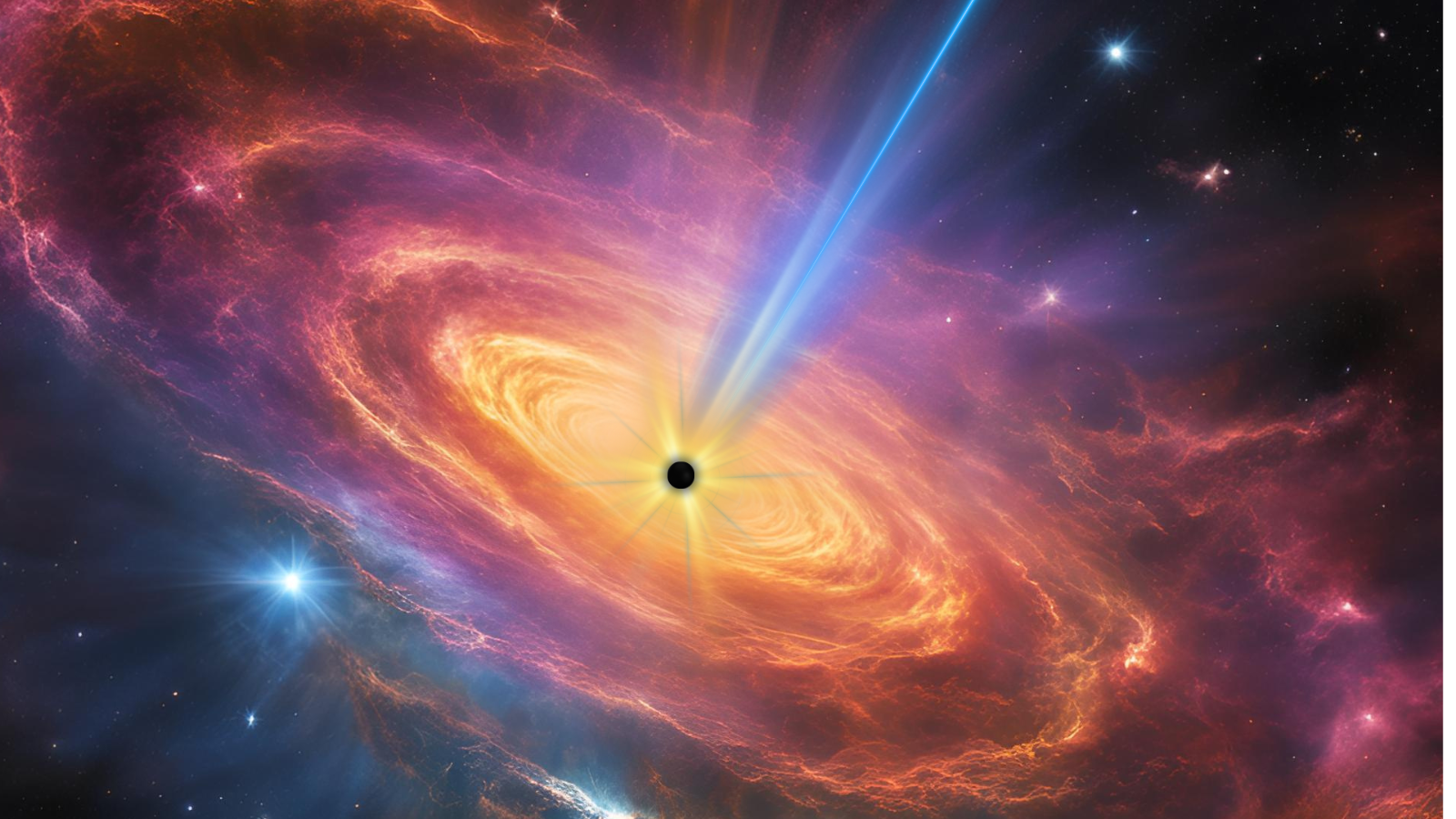
An orange and purple swirl with a black circle at its center. A bright tail emerges from the black circle

An illustration of a supermassive black hole pumping energy into its surroundings, a type of cosmic feedback that can smooth out clumpy cosmic matter. (Image credit: Robert Lea (created with Canva))

However, to do that, scientists also have to understand how other factors smooth out cosmic clumpiness. That includes the energy pumped out from the hearts of galaxies by feeding supermassive black holes, a type of cosmic feedback that smooths out clumpy cosmic matter lying outside galaxies.

"The feedback process thins the gas around the galaxies, redistributing matter across vast distances. It smooths out clumps of matter in a way that looks astonishingly similar to what massive neutrinos do, or what dark energy or dark matter theories predict," Ravi said. "Unless scientists can independently measure this contribution from feedback, they can't tell these effects apart."

That's where FRBs come in.
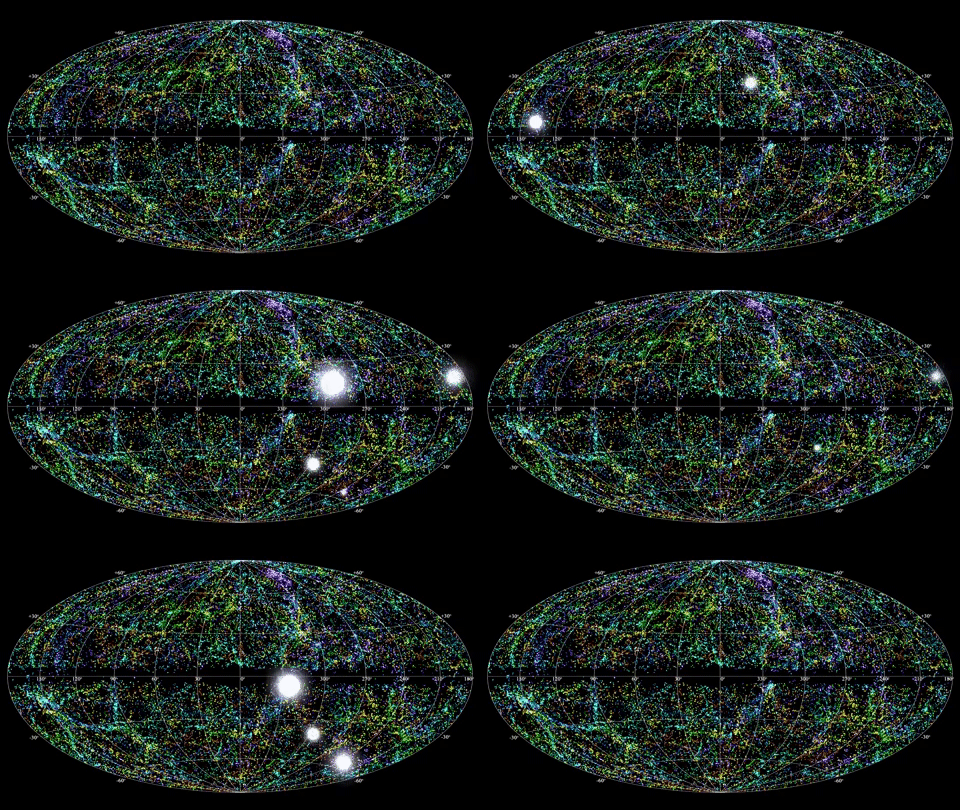
Flashes of light appear and disappear across a green oval with a grid pattern

An animation shows the random appearance of fast radio bursts (FRBs) across the sky. Astronomers have discovered about 85 since 2007. (Image credit: NRAO Outreach/T. Jarrett (IPAC/Caltech); B. Saxton, NRAO/AUI/NSF))

The researchers found that, while galactic feedback does indeed smooth surrounding material, making it less clumpy, the effect is weaker than has previously been measured.

"Our analysis of FRBs reveals how gas ejected by astrophysical feedback suppresses cosmic structure," team member Elisabeth Krause of the University of Arizona said in the statement. "This is amazing considering we only had about 100 FRBs in our sample. It's only the beginning."

The investigation of the universe with FRBs could get a major boost in 2029 when Caltech's Deep Synoptic Array (DSA) begins operating in Nevada. This powerful radio telescope is expected to find tens of thousands of FRBs, a major boon for cosmology.

The team's research was published on Tuesday (Sept. 8) in the journal Nature Astronomy.
  •  

This 'impossible' black hole merger may be explained by a warp in spacetime

A "forbidden" merger between two massive black holes may not have been quite as impossible as previously thought. That's according to new research that suggests the black holes involved were smaller than expected.

On Nov. 23, 2023, the gravitational wave detector LIGO (Laser Interferometer Gravitational-Wave Observatory) detected tiny ripples in spacetime caused by the merger of two black holes. What was incredible about this signal, designated GW231123, was that it seemed to be the result of a black hole with 140 times the mass of the sun colliding with another that holds 100 solar masses.

This raised eyebrows among researchers because usual models of stellar evolution struggle to account for such massive black holes, especially ones that seemed to be spinning as fast as these two. While scientists have been attempting to explain how such an odd black hole binary could form. The team behind this new research suggests it doesn't need to be explained at all. They think that the masses of these black holes were an illusion.

The key to this illusion is a phenomenon called gravitational lensing, first predicted by Albert Einstein's 1915 theory of gravity, general relativity, which also first predicted the existence of gravitational waves. This theory says objects with mass cause the curvature of space and time, united as a four-dimensional entity called "spacetime." The more mass an object possesses, the greater the curvature, and because gravity arises from this curvature, the greater the gravitational influence.

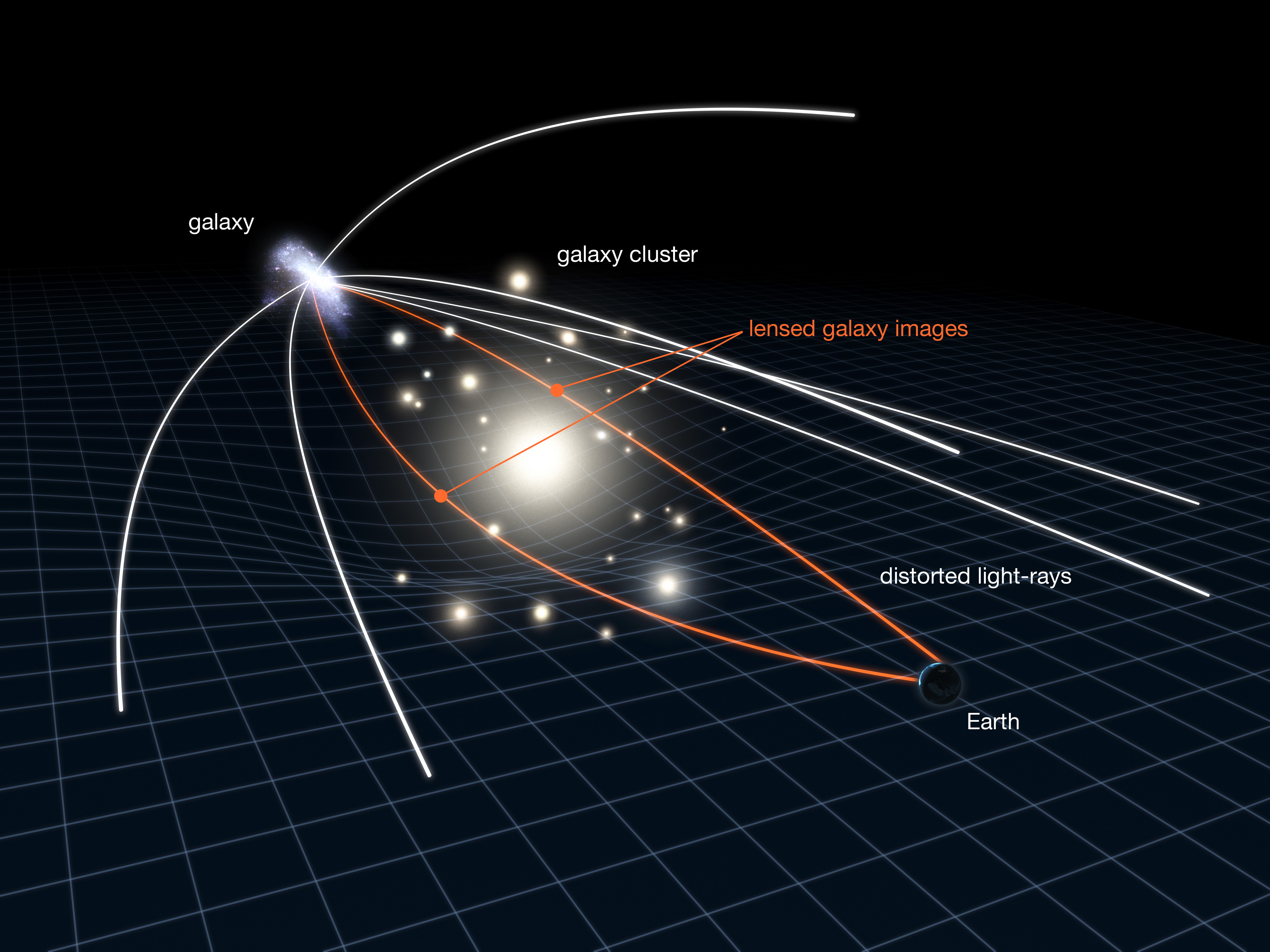
Gravitational lensing occurs when light from a background object passes a massive foreground object. The foreground object can warp the fabric of spacetime in such a way that the light's path is curved. This means light from the same background source can reach Earth at different times, depending on how much that light was diverted.

This difference in travel time can magnify a background source, and it has been used to great effect to observe distant and ancient galaxies ordinarily too faint to be seen.

This research team thinks the effect also applies to gravitational waves, suggesting the signal GW231123 is an example of gravitationally lensed ripples in spacetime that made the black holes appear larger than they actually are.

"Like light, gravitational waves can also be deflected, magnified and split into multiple signals by massive objects," team member Miguel ZumalacΓ‘rregui, group leader in the Astrophysical and Cosmological Relativity Department at the Albert Einstein Institute (AEI), said in a statement. "For gravitational waves, diffraction and interference effects give us an additional way to identify and study lensed signals."

Curved lines of different colors against a grid background

A diagram (not to scale) of how gravitational lensing works. (Image credit: NASA, ESA & L. CalΓ§ada)

To investigate this possibility, the team developed a mathematical model of gravitational lensing and created software powerful and fast enough to analyze it.

"If we assume that GW231123 was deflected and distorted by a compact object of about 190 to 850 solar masses β€” or by an extended structure such as a globular cluster β€” we can understand the observed high masses," said team member Srashti Goyal, who was based at the AEI when conducting the research. "Moreover, the lensing interpretation does not require unusually high spins."

When the team modeled the event with that consideration factored in, they found the merger involved a system with a mass of 140 solar masses, rather than the 240-solar-mass system initially theorized.

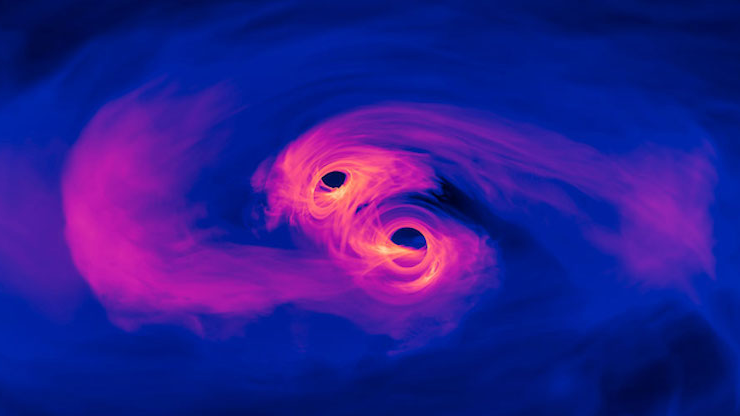
A purple hued image showing two black circles circling around one another in the center. There is a wave of pinkish gas trailing behind each of them.

A simulation of a black hole merger. (Image credit: NASA's Goddard Space Flight Center)

The team doesn't quite know what massive object is responsible for lensing the gravitational wave signal GW231123. But no matter what it is, if the team is correct, the lens could be something quite special.

"The nature of the lens remains a major mystery in our analysis, as individual compact lenses with 100 to 1,000 solar masses should be exceedingly rare," ZumalacΓ‘rregui said. "Future work will need to establish whether such lenses can form, or whether an ensemble of lighter objects, including stars, can explain this event."

The team can't yet conclusively say if GW231123 is the first gravitationally lensed gravitational wave signal. Finding future signals of the sort will require upgrades to the sensitivity of detectors like LIGO.

Though even before that happens, the research does point to the utility of gravitational wave astronomy to study some of the universe's most violent events.

The team's research was published on August 25 in the Astrophysical Journal Letters.

  •  
❌