❌

Reading view

How Apple is trying to normalize always-on AI

Apple does seem to have tried to ensure its controversial Audio Intelligence feature isn’t abused. Alongside the iPhone Duo and new iPhone 18 Pro range, Apple on Wednesday introduced a new Apple Watch equipped with a brand new feature it calls Audio Intelligence. The existence of this surprising tool was confirmed only on the eve of the launch event. Enabled by the new S11 chip on the latest Watch devices, this is actually a collection of four features:

  • Siri Recap, which creates high-level summaries of conversations during your day.
  • Live Rewind, which transcribes the previous 15 seconds of a conversation as text.
  • Music recognition, which relies on Shazam.
  • Sound recognition, which can identify things like sirens or alarms.

All of these features must be consciously enabled by the user and are not on by default.

What they have in common is use of artificial intelligence along with always-on microphones. While all four of these tools are being presented as opt-in, their existence will inevitably — and justifiably — raise privacy concerns. 

Apple saw those concerns coming, and to make the features work it has placed a Secure Exclave on the S11 chip inside the latest watches. This is a dedicated secure buffer on the chip that processes audio privately on the fly. It does so without creating a recording of ambient sound around you, and the data it works with is isolated from the rest of the system. That Exclave pairs with the iPhone’s Enclave using “a new audio-verified pairing mechanism that exists in addition to Bluetooth pairing,” Apple explains in a detailed white paper about how it works. 

For Siri Recap, the process works like this:

  • Apple Watch recognizes a conversation is taking place.
  • If so, audio flows into the Secure Exclave, encrypted, and transmitted to a similarly Secure Enclave on your paired iPhone.
  • The audio is then immediately deleted from the Watch. 
  • The phone will decrypt and transcribe the audio, condense it, and send that transcript to Private Cloud Compute for processing. 
  • The short summary is then made, returned, and deleted after seven days.
  • Speakers are not identified, recordings are not made, and detailed transcripts are not created or retained.

The company has also introduced safeguards for those around you. The system will deliberately omit some information, including potentially harmful content, financial data, or personal identifiers. When you use the Live Rewind tool, an audible chime plays on your device to alert nearby people that you are using the feature.

Challenges will emerge

For one thing, we don’t yet know whether the company will provide enterprise IT with device management tools to disable the feature on managed devices. It’s crystal clear that devices that are constantly gathering data will be seen as potential security risks — particularly in regulated industries. And it seems far more logical to provide new APIs to disable Audio Intelligence on managed devices than it would be to insist anyone wearing an Apple Watch put it in a lead-lined box before beginning the next safeguarding, healthcare, or product development meeting.

Another problem I see concerns Europe’s Digital Markets Act. It is, after all, inevitable that competitors (maybe including Meta) will want their devices to have equal access to the information gathered by Audio Intelligence. Based on the decisions Apple has made so far, it seems equally likely it will want to refuse such access; this is why these new features will not initially be available in the EU. 

There is also no doubt hackers will attempt to break into the system, though doing so will not be at all easy on account of the intentional way the company has built in security. I suspect, but do not know, that attempts will focus on the points at which data is exchanged across devices, rather than when the information sits within secure enclaves on those devices. It also makes sense that everyone who uses iCloud services for their data should put 2FA in place and pick strong passwords. 

What about iCloud storage?

The other challenge will be encryption, specifically ongoing attempts to penetrate iCloud data encryption by some nations, led by the UK. Even so, if access could be achieved to iCloud-stored Audio Intelligence text, what is obtained would only be summary data, not a recording. The system is architected so recordings are never made.

Apple’s white paper on the feature explores this in more depth: “Audio from the microphone enters the Secure Exclave of Apple Watch, where it is initially processed for speech, sounds, or music, without transcribing or storing the raw audio. This buffer is a continuously overwritten stream that exists only within the protected hardware and never creates an audio recording.”

Once you decide to keep a Recap or Life Rewind text, the raw audio is not saved to iCloud, only the text, and then only if you use 2FA and a device passcode. No one else, including Apple, can access the encrypted data you save, Apple said.

Where does this go next?

One pre-event rumor that didn’t come true concerned AirPods equipped with cameras and Vision Intelligence to understand physical context and surrounding, with the aim of enhancing Siri AI. I’ve expressed reservations about this idea, but do think the security model Apple has put in place for Audio Intelligence will turn out to be an echo of its intentions to secure Vision Intelligence transactions.

This implies a new chip with Silicon Enclave for AirPods Pro, a similar exchange of information in real time for summary and determination of context and content, and a process in which no recordings are made and media access beyond brief, time-limited summaries, is available. In short, Apple will use the same security model.

What about the rest of them?

That’s fine as far as it goes. But the other subtext is that while Apple seems genuine in its attempt to deliver relatively intrusive tech advances right, others will show less commitment to privacy and security. So, while it’s furthering the conversation about using these tools, Apple is also pushing public acceptance of such technologies.

I’m not entirely sure we’re ready.

Now please subscribe to my daily, human-curated Apple-related news headline feed at The Core, or follow me on BlueSky, LinkedIn, or Mastodon

  •  

Qualcomm’s next Snapdragon mobile chip comes into focus with on-device AI

Qualcomm is taking an unusual approach to the launch of its next-generation premium Snapdragon mobile platform this year. Instead of holding everything for its annual Snapdragon Summit in Maui happening later this month, the company has been methodically disclosing the architecture that will power the next wave of flagship Android phones over the past couple of weeks.

First, the company disclosed its new Oryon CPU architecture, followed by a major overhaul of its Adreno GPU. Today, Qualcomm is detailing the next-generation Hexagon NPU that will serve as the platform’s primary AI engine.

Taken together, the disclosures give us a pretty good picture of where Qualcomm is going before we even know the chip’s official name.

There is obviously a strong performance story here, anchored by a 5GHz CPU, but the more interesting theme running through the architecture is memory locality and specialized AI acceleration. Qualcomm is trying to keep more data close to the compute resources that need it, while distributing AI workloads across the CPU, GPU and NPU.

These architectural changes are important as the company continues to drive on-device AI beyond relatively simple generative features toward more persistent, agentic workloads.

Oryon hits 5GHz, bolstered by FlexCache

Qualcomm disclosed in August that its next Oryon CPU will be the first mobile CPU to reach 5GHz. The eight-core design includes two 5GHz Prime cores and six Performance cores, with Qualcomm attributing the frequency gains to its fully custom Oryon microarchitecture, an in-house Arm-based CPU design that gives the company full control over the cores, cache and memory hierarchy, branch prediction and CPU subsystem.

The 5GHz headline is certainly going to get attention. However, Qualcomm’s new FlexCache architecture may ultimately have a larger impact on sustained performance. FlexCache allows Oryon’s Prime and Performance cores to tap into the same shared cache pool, with capacity dynamically allocated based on the workload. So rather than a demanding core being limited to a fixed slice of cache, it can draw on more of the available pool when needed. This keeps larger working data sets close to the CPU cores and reduces high-latency trips out to system memory.

This approach should benefit everything from gaming and multitasking to content creation, but it also aligns well with agentic AI workloads, where tasks may move through several stages of processing and across different CPU cores. The basic goal is straightforward: keep the CPU fed and avoid expensive trips to external memory.

Qualcomm’s next-gen Adreno GPU adds dedicated AI engines

Qualcomm’s next disclosure focused on graphics, where the company is making one of the more significant changes to its Adreno GPU engine in recent years. The new GPU adds dedicated Adreno Matrix Cores for running AI models directly inside the graphics pipeline. They’re paired with 18MB of Adreno High-Performance Memory, or HPM, which provides low-latency local storage for tile-based rendering, frame buffers and GPU compute.

Qualcomm claims HPM provides a 12% power improvement compared to its previous-gen Snapdragon 8 Elite Gen 5.

The more visible feature for users, however, may be Adreno Neural Fusion, which combines AI super resolution, neural processing and frame generation in a unified graphics pipeline. There are obvious parallels here to what NVIDIA, AMD and others are doing with neural rendering on the PC, though Qualcomm’s next-gen Snapdragon SoC has to operate within a much tighter mobile power envelope.

Qualcomm claims enabling Neural Fusion reduces power consumption by up to 40% in its internal testing using the company’s Dragon Alley graphics demo. That’s an impressive number, though as always, we’ll want to see how the technology behaves across actual shipping games and devices before drawing any definitive conclusions.

Qualcomm has also helped integrate Neural Fusion technology into Unity and Unreal Engine, which may ultimately be just as important as the underlying hardware. Developer adoption determines whether features like this become meaningful platform advantages or just another tick box on a spec sheet.

Qualcomm’s Hexagon NPU is being reworked for agentic AI

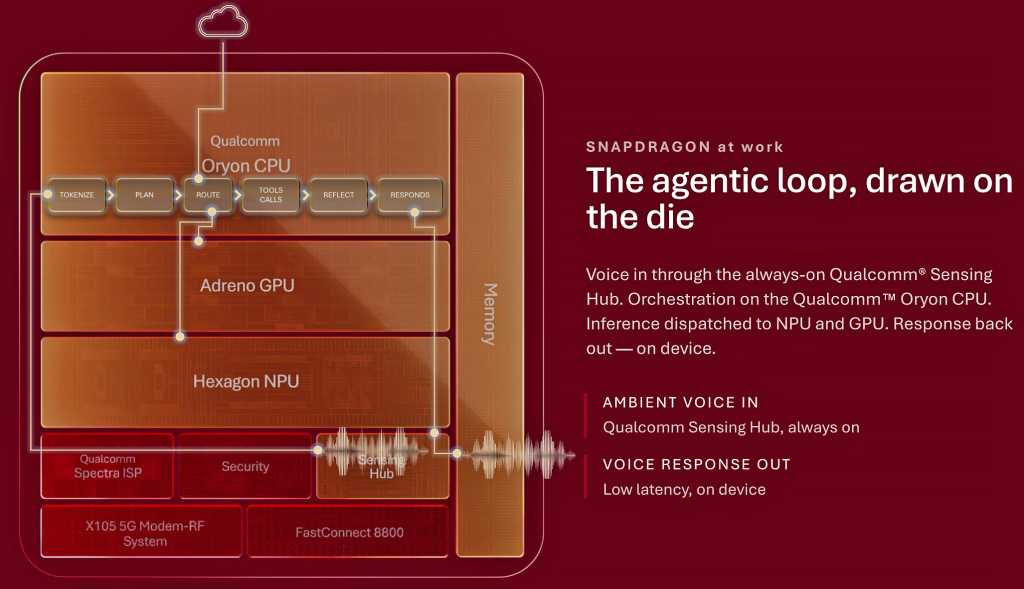
Qualcomm Snapdragon at work: The agentic loop, drawn on the die.

Qualcomm

The most recent disclosure centers on Qualcomm’s Hexagon NPU, where the broader architecture starts to come together. The company’s next-generation Hexagon introduces a new Element Accelerator designed for transformer workloads, alongside its existing vector and scalar processing resources. Qualcomm says the new block is optimized for fast action loops, key-value (KV) cache acceleration and context lengths of up to 32K.

Hexagon is also getting 50% more shared memory, and again, that memory complement is important. Model state, context and KV-cache data can generate substantial memory traffic, particularly with larger language models. Keeping more of that data close to the NPU can reduce latency and power consumption. Qualcomm says the architecture is designed for long-context reasoning, multimodal models, concurrent agents and low-latency action loops.

For INT4 quantized models, the company claims up to a 50% improvement in pre-fill performance versus its previous-generation Snapdragon 8 Elite Gen 5. Qualcomm is also targeting Mixture-of-Experts, or MoE, models as large as 30 billion parameters. In its example, the company points to a 30B model that activates only about 3 billion parameters during a given token-generation step. That selective approach is a natural fit for the tight power and memory constraints of a handset.

Qualcomm isn’t suggesting that a smartphone will simply run a 30B dense model entirely from DRAM, however. By activating only the experts needed for a particular task, MoE architectures can dramatically reduce active compute and memory bandwidth requirements, potentially making much larger classes of AI models practical on mobile hardware.

Qualcomm’s next-gen Snapdragon mobile impact

There is a larger competitive story here as well. For years, flagship smartphone competition largely came down to CPU, GPU, modem performance and power efficiency. AI is now another major area of differentiation, and Qualcomm is clearly designing its next-gen Snapdragon mobile platform around this need.

Apple has the advantage of controlling its silicon, operating system and software stack end-to-end. MediaTek continues to push aggressively into premium Android devices as well. Qualcomm’s response is to make its custom Oryon CPU, Adreno GPU and Hexagon NPU work more like a fully integrated compute platform, tuned for modern AI and agentic workloads.

This is a solid advantage for Android handset OEMs because many don’t have the resources to engineer this level of silicon integration themselves. Qualcomm can effectively provide its Android OEM partners, including Samsung, Xiaomi, Honor and others, with a common hardware foundation for on-device AI, advanced graphics and agentic computing. It also gives Qualcomm another way to defend its premium Snapdragon position.

The company’s custom Oryon architecture now spans smartphones and Windows PCs, and soon servers, while AI acceleration is distributed across its CPU, GPU and NPU. For business users, that could mean more AI processing happens locally, reducing cloud and network dependence, improving response times and keeping more potentially sensitive data on-device. And for IT organizations, Qualcomm now has an opportunity to provide a more consistent AI compute foundation across Windows PCs with Snapdragon X and premium Android handsets.

There is still plenty we don’t know, however. Qualcomm hasn’t disclosed the complete SoC specifications, final performance or power characteristics, or which devices will ship with it initially. Many of these AI experiences will also depend heavily on Android, app developers and the models themselves.

The new 5GHz mobile CPU may generate the biggest headline at Snapdragon Summit, but the more important developments may be what sit around it: more local memory, specialized AI acceleration and tighter integration between the CPU, GPU and NPU.

If Qualcomm can translate this architecture into better sustained performance, enhanced power efficiency and useful on-device AI experiences, it could strengthen its position in premium Android phones while putting more competitive pressure on Apple. For business users, the payoff could be more capable local AI without sacrificing the performance and battery life expected of a flagship device.

That is the part I’ll be watching most closely when the complete silicon picture is unveiled at Snapdragon Summit later this month. And I may even get some hands-on time with it in some benchmarks, as we have in years past, so we shall see.

  •  

The iPhone is now Apple’s ‘intelligent personal hub’

Twenty-five years ago, I sat near the front of the room while then-Apple CEO Steve Jobs rolled out Apple’s digital hub strategy, a vision in which the Mac would become the central manager of all manner of portable digital devices.

Now, a quarter of a century later, nearly all of those digital devices have become features on your iPhone, and the arrival of AI means the iPhone has become the intelligent personal hub, the central manager of, well, of you. Apple’s new CEO, John Ternus, went straight for the concept in his important opening remarks at Wednesday’s big iPhone launch, where nearly all the pre-event speculation came true.

The intelligent personal hub

“As we look ahead, we see a future filled with enormous discovery and transformation,” Ternus said at the Surprise and Shine event. “AI makes entirely new kinds of experiences possible. An AI can become even more useful when it brings together your life with the apps, services, and products you use every day. And this means the product at the center of your experiences becomes even more essential — what I like to think of as an intelligent personal hub.”

(To be clear: He’s talking about the iPhone.)

Think about it: all those tasks you now do on your iPhone are tasks AI can help you with. Siri AI lets you work on files and folders using spoken commands, while contextual AI lets you sift through all the data once gathered by your iPhone to do things, make things, create networks, or even organize luncheon. 

“It’s the intersection of broad new capability, and a deep understanding of your personal context that makes this idea so powerful,” Ternus explained.

AI’s brave new world

That’s the context within which Apple will be introducing all its future products, a battle the company now feels confident marching into now that it appears to have resolved its historical challenges with AI. At the same time, the company also seems to be doing its best to lean into privacy — enabling life-changing AI transformation of daily lives while putting a brake on scary privacy attacks. This is going to be foundational to what happens next at Apple.

Of course, you’re not reading this to look too deeply into what Ternus said about the future of Apple; you’ll also want some insight into the slew of devices the company introduced at its event. That list includes the:

The big surprise? Price

For some, the biggest surprise in these introductions was price. All of the accessories were kept at the same price as last year’s equivalents, while the new Pro iPhones came in at only $100 more for the entry-level model, rising to around $300 more at the more price-resistant highest end. An iPhone 18 Pro Max equipped with the max 2TB storage comes in at $2,499 compared to the $1,199 iPhone 18 Pro entry point. 

When it came to price, though, all eyes were certainly on the iPhone Duo, and Apple has given everyone (except competitors) a pleasant surprise on that. 

With a starting price of $1,999, the folding phone’s price hit the low end of expectations, and while that grows to an eye-watering $3,199 with 2TB of storage, it compares well with the market leader, Samsung. While the Galaxy Z Fold 8 begins at $1,899, in terms of features and design, Apple’s folding phone lines up with the Galaxy Z Fold 8 Ultra, which costs from $2,099. 

Dig a little deeper and you’ll see that while the iPhone has IP68-rated dust and water resistance, the Samsung equivalent has only IP48. You can drop the Fold 8 into five feet of water for up to half an hour and it should be OK, but you can chuck your iPhone Duo in almost twenty feet of water, and it should survive. Though you probably shouldn’t test that unless you’re a hugely successful “influencer” already generating a small nation state of money through clicks. If that’s you, good for you. I’m only slightly envious. 

A productivity powerhouse?

What that suggests is that the iPhone is less likely to get damaged and is better engineered, though it’s also ever so slightly thicker. Apple’s device is powered by what the company modestly described as the most powerful mobile processor on the planet — which it is, particularly for the AI tasks all the new iPhones can handle. That matters, particularly for applied contextual AI deployed across daily lives.

It also matters because the combination turns Apple’s device into a mobile productivity powerhouse, one that I think will likely affect iPad sales more than anything else. Though this wouldn’t be the first time a new Apple release ended up eating its siblings. 

The productive possibilities of Apple’s premium device will also be realized as app developers embrace both the form factor and Siri AI. Apple said during the keynote that more than 300,000 apps already work with Siri AI and more than 2.5 billion Siri requests are being made each day. That latter number will only grow now that Siri performance has been dramatically improved. 

While this argument applies to all Apple’s new devices, the fact of the matter is that you now have an iPad-sized object you can carry in your pocket that is capable of doing some really powerful tasks by spoken command alone. That’s the iPhone Duo – a product of an unexplored territory at the crossroads between mobile computing, daily digital existence, and the opportunities of AI.

It’s not for everyone, yet

I don’t expect the Duo will be for everyone; the vast majority of users won’t be spending $2,000 on a phone. But we know that the cost of technologies like this tends to decline, which suggests that in perhaps five years’ time, it will be possible to create equivalent devices for a much lower price. Right now, it’s for affluent Apple consumers, C-class executives, students, AI pros, medical professionals and others who might actually need this kind of performance and display space to get things done.

This, incidentally, is precisely the same group of people that first embraced the iPad when it appeared, turning that into the world’s best-selling tablet.

What might this mean for Apple? 

I traded a few messages with IDC analyst Francisco Jeronimo, who sees it like this: “Apple entered the foldable market and, in one keynote, set the price and the standard every rival will now be measured against.”

He also pointed out, the iPhone Duo is “…a direct test of whether Apple can use design, ecosystem integration and premium positioning to reshape a segment that has so far remained selective.” 

He’s right, of course, but Ternus also just defined what that segment, and the industry, is driving for. I’s the same thing Apple was aiming at 25 years ago. “iPhone sits at the center of an amazing ecosystem of intelligent features and experiences that work seamlessly across the products you use every day,” the company said — an “intelligent personal hub.” And the Macs are all right, too.

Now please subscribe to my daily, human-curated Apple-related news headline feed at The Core, or follow me on BlueSky, LinkedIn, or Mastodon.

  •  

Adobe Acrobat evolves beyond PDFs with enterprise search, AI content creation

Adobe on Wednesday unveiled a range of updates to Acrobat, including the ability to turn PDF documents into interactive visual reports and podcasts. And a new Knowledge Base feature connects Adobe’s Acrobat AI assistant to document sources such as Microsoft SharePoint and Google Drive.

It’s the biggest Acrobat update in several years, Adobe said, and highlights the application’s evolution from PDF reader to what the company now describes as an AI-powered document productivity and creativity platform. 

Acrobat users open more than 400 billion PDFs in the app each year, Adobe said, claiming 650 million monthly active users as of last year. 

Among the new additions is the ability to turn dense PDFs into interactive, visual documents and presentation slides. To create these, Acrobat’s AI assistant scans the selected file, asks questions about the user’s intent, then generates documents charts, images and navigation.

It’s also possible to turn documents and web links into podcast-style audio summaries — similar to capabilities in Google’s NotebookLLM and Microsoft Copilot Notebook. A new Stylize feature can enhance plain-looking documents, applying a template to turn them into “professional deliverables” such as CVs and invoices, Adobe said.

The audio and visual generation features are all available in paid Acrobat plans (Acrobat Studio, Acrobat Express and Acrobat AI Assistant). 

Another addition, Acrobat Knowledge Base, lets customers connect the Acrobat AI assistant to a wider range of file types, enabling users to ask questions about information held in documents stored in Microsoft SharePoint and Google Drive, for example.  

Acrobat’s Knowledge Base “transforms curated document collections — policies, playbooks, product information, pricing guidance, research — into cited answers available from Slack, Microsoft Teams, Acrobat, and other places employees already work,” Abhigyan Modi, senior vice president for Adobe Document Cloud, said in a blog post. 

Adobe also added an Analyzer tool designed to retrieve data from large volumes of documents. This could involve analyzing thousands of contracts or invoices to identify information such as renewal dates and revenue clauses.

That turns information once trapped in files into data that can inform finance, procurement, compliance, and the systems that support them, said Modi.

Analyzer is the more interesting of the two releases, said Mike Leone, vice president and principal analyst at Moor Insights & Strategy. “Knowledge Base is a search product and search products get judged feature against feature. Analyzer is closer to a data product, because that extraction work is what companies currently pay people and pipelines to do,” he said. 

“What I’d want Adobe to answer is whether that data can leave Acrobat and land where the rest of the company’s data lives. If it can, this starts competing for real data budget. If it stays inside the app, it’s a very good Acrobat feature.” 

Access to Analyzer and Knowledge Base requires an Acrobat Studio for Enterprise subscription. (Adobe doesn’t publish pricing.) 

In addition, Knowledge Base includes a credit-based model that places some restrictions on usage, with licensed users allowed up to 1,000 queries a month. Other actions, such as document uploads, queries from Slack and Microsoft Teams, and queries by employees without an Acrobat Studio license, draw varying amounts of Acrobat Studio “shared credits.” Adobe didn’t say how much additional credits cost once a yearly limit is reached.

 More information about Adobe’s Knowledge Base credit usage policy is available on Adobe’s website. 

Analyzer also includes a credit system that limits document ingestion and attribute extraction.

For enterprise customers, usage-based pricing can add complexity when managing employee access.

“The issue for a broad deployment is that headcount barely predicts usage,” said Leone. “One person pointing it at 10,000 contracts will burn more credits than a hundred people asking the occasional question. Pooling the credits across the whole organization is the right design, because usage on something like this is rarely spread evenly.

“One of the big challenges is that people could very well start rationing themselves because they don’t know what a question costs,” he said. “Or worse, a couple folks use all the credits and everyone else is out of luck. The last thing any organization wants is to pay for a knowledge tool that people won’t use or can’t use.”

  •  
❌