 Login

SpaceX Says Recovered Starship 40 Needs Several Months to Reach Texas
Starship 40’s Very Slow Journey Home Starship 40 covered thousands of miles from Texas to the Indian Ocean


NASA engineering teams are preparing for the launch of the Nancy Grace Roman Space Telescope, which will soon begin the first phase of its historic mission to help scientists unlock the mysteries of dark energy.
On Wednesday, the American space agency reported that the completed telescope, presently contained within its payload fairing, has been transported from NASA’s Payload Hazardous Servicing Facility to a SpaceX hangar located at the famous Launch Complex 39A at NASA’s Kennedy Space Center.
If all goes according to plan, the telescope will be launched aboard a SpaceX Falcon Heavy rocket at 7:26 a.m. EDT this Sunday, Aug. 30.
The telescope’s unique science instruments make Roman a different breed of space observatory from its predecessors, like the James Webb Space Telescope and Hubble Telescope, as they are designed with the special focus of advancing the search for dark energy.
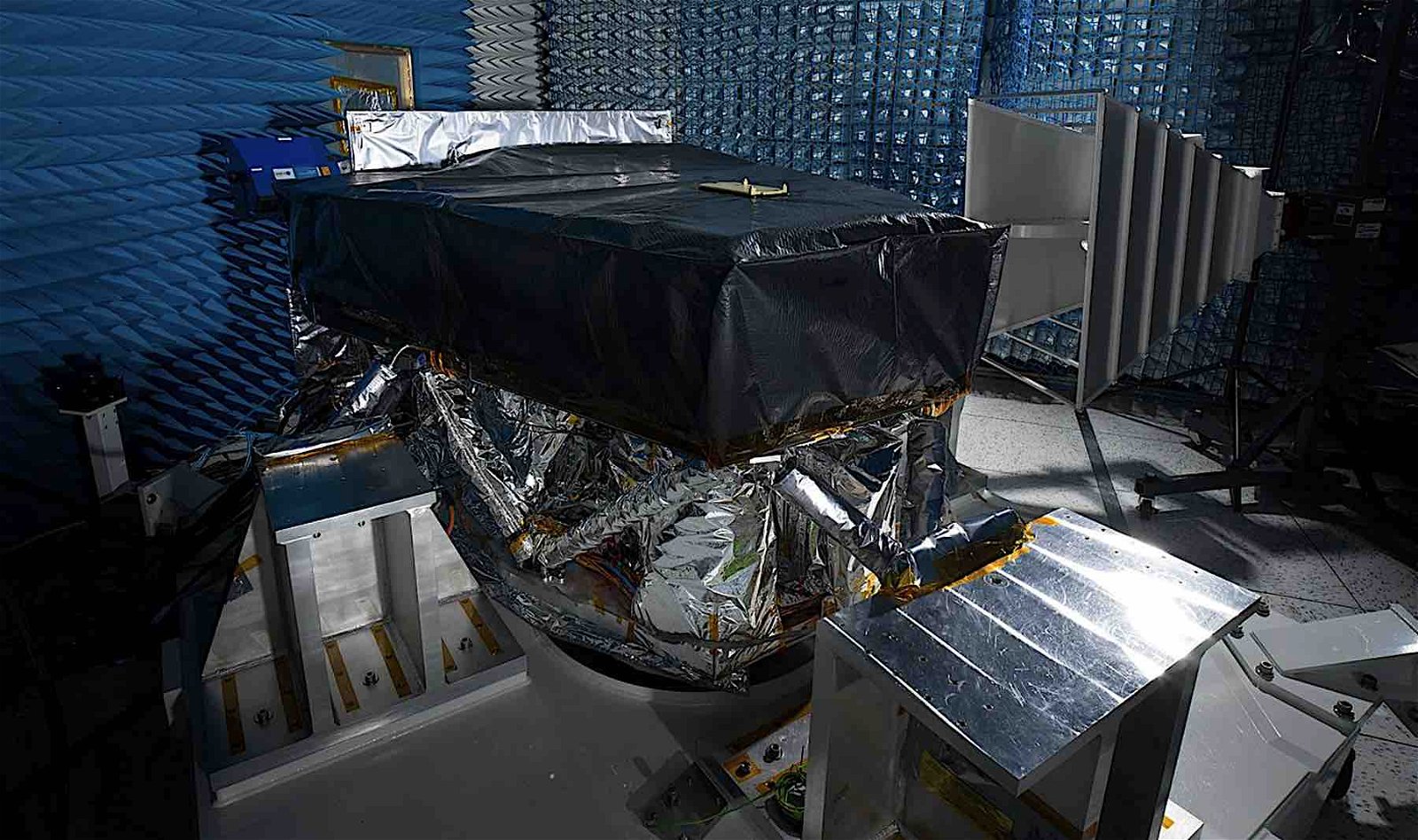
Roman is equipped with two primary capabilities, which involve its Wide Field Instrument (WFI) and Coronagraph Instrument. With a 300-megapixel, near-infrared camera designed for large area image capture and spectroscopy, the WFI will enable astronomers to observe a 0.281 square degree field of view and includes a special imaging mode with two slitless spectroscopy modes.
“The instrument provides a sharp point spread function, precision photometry, and stable observations for implementing the Dark Energy, Exoplanet Microlensing, and NIR surveys,” according to a NASA FAQ page detailing Roman’s primary instrument.
Meanwhile, the telescope’s Coronagraph Instrument also features both imaging and spectroscopy modes, with capabilities fine-tuned for imaging exoplanets.
“The Coronagraph will be the first instrument on a space telescope to make use of numerically optimized, precision-fabricated coronagraph masks,” NASA’s FAQ page reads. This will be achieved by employing a combination of deformable mirrors that will enable high-order wavefront control, a low-order wavefront sensing and control system, and finally, CCD detectors designed for electron multiplication and counting low-flux photons.
Along with its search for dark energy and exoplanets, Roman will also provide NASA and researchers around the world with an unprecedented opportunity to study the formation of galaxies and the way that dark matter governs their evolution over time.
NASA will begin live coverage of Roman’s launch on Sunday morning at 6:20 a.m. Eastern Time, and you can follow the updates online with NASA’s free streaming platforms.
Micah Hanks is the Editor-in-Chief and Co-Founder of The Debrief. A longtime reporter on science, defense, and technology with a focus on space and astronomy, he can be reached at micah@thedebrief.org. Follow him on X @MicahHanks, and at micahhanks.com.
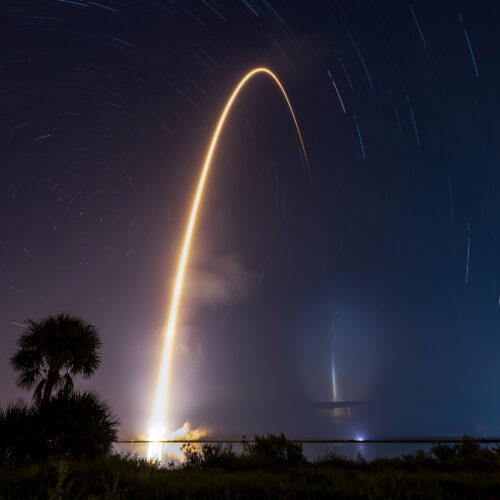
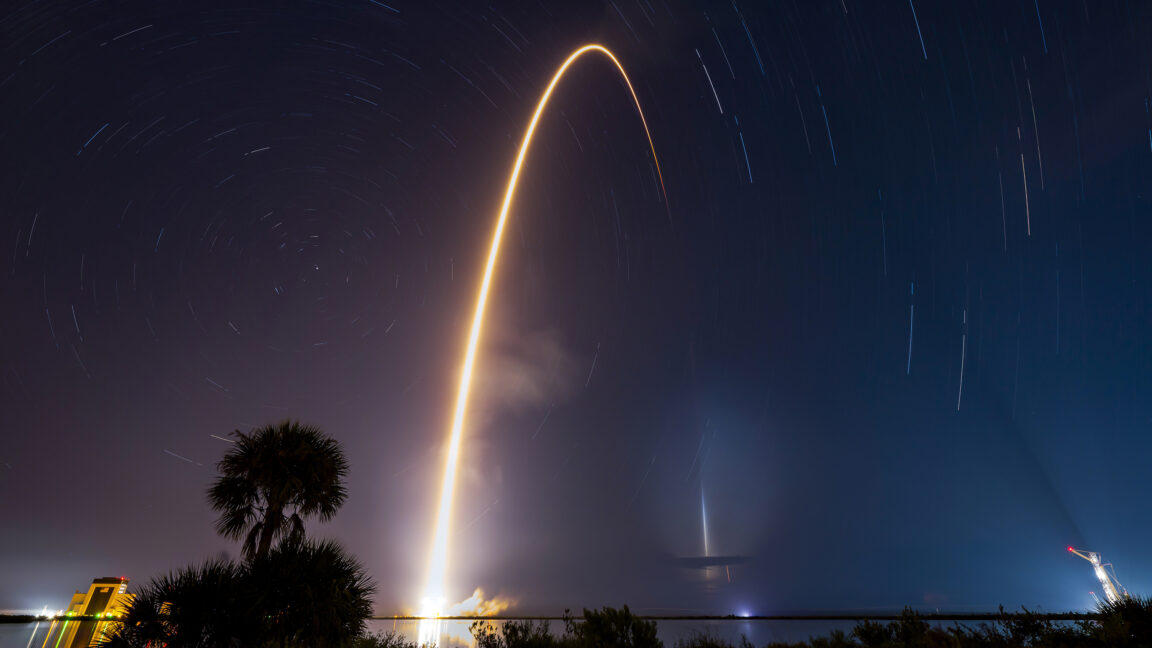
SpaceX made Florida's Space Coast home to the world's busiest spaceport for a decade, but that will change this year. The company is significantly cutting the number of launches from Florida until Starship arrives, a senior SpaceX official confirmed Tuesday.
The Falcon 9 rocket has been SpaceX's workhorse, routinely launching batches of satellites for the company's Starlink network, primarily from launch pads at Cape Canaveral Space Force Station and NASA's Kennedy Space Center in Florida. There were 165 Falcon 9 launches last year—about three flights per week—and about 75 percent of them carried Starlink satellites.
This year is different. SpaceX has launched more missions from its West Coast launch pad at Vandenberg Space Force Base in California since January, and this trend will amplify for the rest of the year.
© SpaceX
NASA’s Lunar Reconnaissance Orbiter (LRO) has captured the clearest images yet of a newly formed impact site on the Moon.
The 60-foot-wide crater was formed on August 5, 2026, as the upper stage of a SpaceX Falcon 9 rocket slammed into the lunar surface, prompting amateur and professional astronomers around the world to watch for signs of the spacecraft’s impact.
Although no obvious evidence of the lunar crash landing was observed, six days later, NASA trained the powerful eye of the LRO onto the suspected crash site, eventually gathering several close-up views that reveal the best images of where the rocket made impact that have been captured to date.
The rocket that collided with the Moon was a leftover from Firefly Aerospace’s Blue Ghost Mission 1, which originally launched in January 2025.
Although the upper stage of the rocket was never intended to collide with the Moon at the time of its launch, after carrying the Firefly Aerospace mission to space, it entered a highly elliptical orbit that, over the course of about 18 months, subjected it to intense solar radiation and repeated gravitational tugs from both the Earth and the Moon. The resulting deviations altered its trajectory enough that the rocket was placed on an unavoidable lunar collision course.
Capturing images of the new crater was no small task and required precision spacecraft pointing. The LRO travels approximately one mile per second in its orbit around the Moon, which means it completes a pole-to-pole orbit roughly every two hours.
Tilting the spacecraft to point its Narrow-Angle Camera toward the impact site during successive passes, the images had to be timed to within a window of less than ten seconds to prevent the newly formed lunar feature from being shifted several miles beyond the field of view of the LRO’s camera.
Fortunately, the LRO team has a good bit of experience when it comes to spotting and photographing high-resolution images of features on the Moon. The photos they captured between August 11 and 12 reveal the new 60-foot-wide crater, along with patterns evident in the surrounding landscape as lunar regolith was propelled outward from the impact site.

In the new before-and-after images, darker material can be seen, which has weathered over time due to surface exposure to cosmic rays, solar irradiation, and countless micrometeorite impacts. Contrasting with this darker surface area are brighter areas, visible in “rays” near the newly formed crater, where subsurface material that has retained lighter coloration was blasted outward.
Before locating the impact site, NASA scientists coordinated with professional and amateur astronomers, as well as several space agencies from around the world, to reconstruct the rocket stage’s trajectory based on publicly available data.
Much of that data came from NASA’s own Center for Near-Earth Object Studies (CNEOS), which helped to refine predictions about where the strike was believed to have occurred. Although normally part of the American space agency’s planetary defense efforts that track asteroids and comets that could potentially threaten Earth, the recent lunar impact served as a rare opportunity to test their prediction tools.
Once coordinates for the expected location of the impact were determined, NASA and its partners supplied these to the South Korean Space Agency (KASA), whose Korea Pathfinder Lunar Orbiter, or Danuri, and its high-resolution LUTI camera, were first to capture images of the crater.
At that time, it was determined that the crash site and resulting lunar impact feature were within about 0.6 miles of NASA’s original predicted location. Based on the KASA observations, NASA was able to supply the new information to its LRO team in advance of the successful capture of the new NASA imagery.
The resulting images offer one of the clearest views of a new crater on the lunar surface, and one produced by an object originating from Earth. Additional details about the photos and the technologies used to capture them can be found at NASA’s website.
Micah Hanks is the Editor-in-Chief and Co-Founder of The Debrief. A longtime reporter on science, defense, and technology with a focus on space and astronomy, he can be reached at micah@thedebrief.org. Follow him on X @MicahHanks, and at micahhanks.com.
