
❌

Reading view

Primordial Planetesimals from the Guts of Population III Stars

Protoplanetary Disk

While previous investigations of planet formation across the universe’s history suggest that planets trickled into the picture, a recent study has found that primordial planetesimals could have formed much earlier from the insides of the first stars in the universe.

First Stars, First Planets?

When the first stars flickered on, the universe was filled with pristine gas, containing only hydrogen, helium, and a little lithium. This gas, though great at making massive stars known as Population III (Pop III) stars, was not yet enriched with the heavy elements necessary for planet formation and, of course, life. Past studies have suggested that planet formation in the universe was gradual, taking several billion years to peak after billions of stars created and spilled the needed metals into the universe. However, local pockets of enriched gas from Pop III stars could have created the right conditions for planet formation earlier in the universe’s history.

Pop III stars burned bright and fast, exploding violently in pair-instability supernovae that completely shredded the progenitor, ejecting over 100 solar masses of metals into their previously pristine surroundings. Cosmological simulations suggest that oxygen from these supernovae could have produced significant water fractions within the dense cores of the supernova remnant. This may have set the stage for planet formation in water-rich disks around subsequent generations of stars as early as 150–200 million years after the Big Bang — does numerical modeling support this planet formation hypothesis?
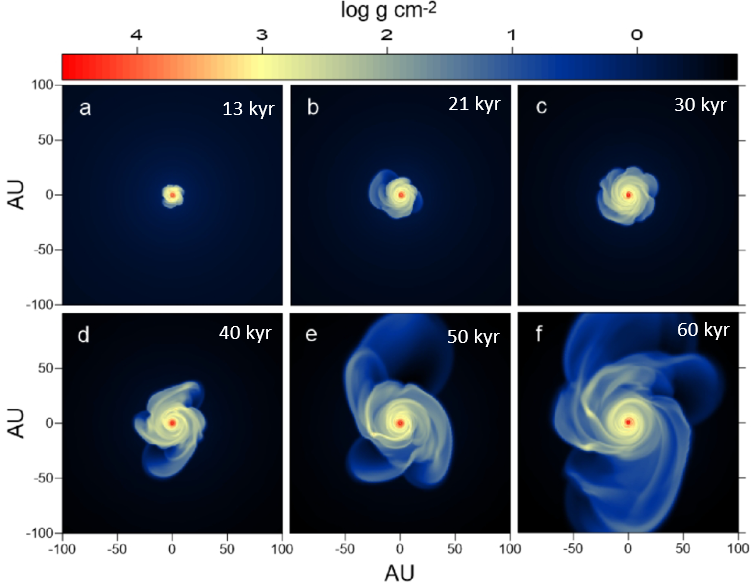
Protoplanetary disk growth

Simulation snapshots showing the formation and evolution of the protoplanetary disk for 13, 21, 30, 40, 50, and 60 thousands of years after protostellar birth. Click to enlarge. [Modified from Vorobyov et al 2026]

Primordial Planetesimals in Simulated Water-Rich Disks

To test if these water-rich dense cores within Pop III supernova remnants could form planetesimals, the building blocks of terrestrial planets, Eduard I. Vorobyov (University of Innsbruck; Southern Federal University) and collaborators performed numerical simulations tracing the collapse of one such gas core into a protoplanetary disk around a protostar. The simulations begin from the gravitational collapse of a 1-solar-mass gas cloud core, with a protostar emerging 24 thousand years after the initial cloud collapse. As the protostar’s gravity pulled in material from its surroundings, a rotating disk formed around the growing star.
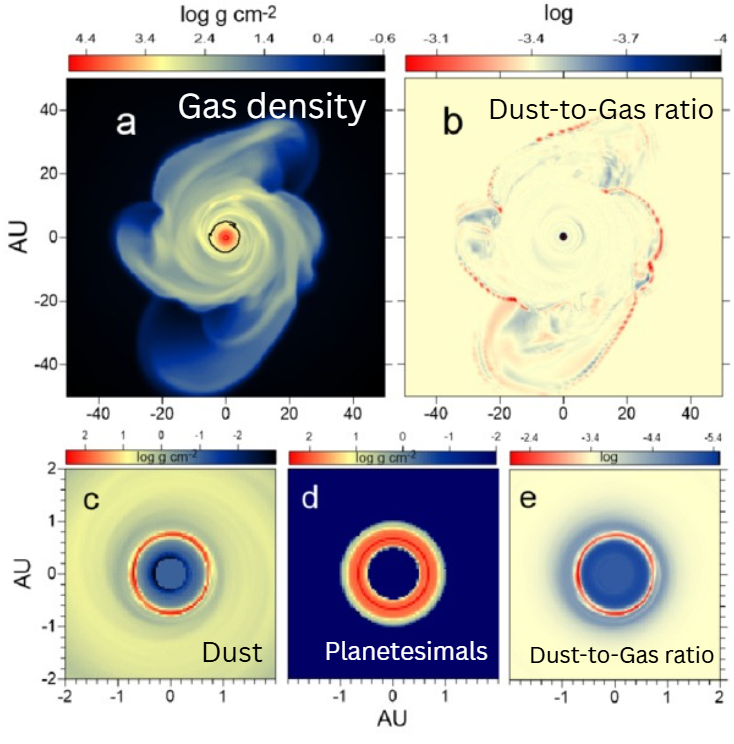
Protoplanetary disk evolution and planetesimal growth

Simulation snapshot 40 thousand years after the formation of the protostar showing the gas, dust, and planetesimal surface densities and the dust-to-gas ratio. Click to enlarge. [Modified from Vorobyov et al 2026]

Tracking the gas and dust evolution in the disk, the authors found that several Earth masses of planetesimals formed within 0.5–1.0 au of the 0.4-solar-mass protostar. While the simulations did not trace the disk all the way to planet formation (this requires complex multi-body modeling and lots of computing power), enough planetesimals formed to create a Mars- or Earth-mass planet in the future. Luckily, unlike their live-fast and die-young predecessors, low-mass stars born from Pop III supernova remnants would still be burning hydrogen in their cores today, and ancient metal-poor stars in the Milky Way’s halo may be home to the universe’s first planets that could be detected in future exoplanet surveys. This study showed, for the first time, that water-rich protoplanetary disks with planetesimals could pop up billions of years earlier than previously thought, changing our understanding of planet formation in the universe.

Citation

“Planet Formation at Cosmic Dawn: Planetesimals in H2O-rich Disks around Low-mass Stars,” Eduard I. Vorobyov et al 2026 ApJL 1007 L51. doi:10.3847/2041-8213/ae907c

The post Primordial Planetesimals from the Guts of Population III Stars appeared first on AAS Nova.

  •  

U.S. Department of Defense Initiative Funds AI Scientists to Help Predict the Future on the Battlefield

The United States Department of Defense has funded an effort by SUNY Polytechnic Institute scientists to use artificial intelligence to evaluate complex defense scenarios before they unfold, including real-time predictive analysis of multiple potential scenarios in a concerted effort to predict the future on the battlefield.

DoD and SUNY Poly officials said the ‘landmark’ $61.8 million award, which will directly support the U.S. Army Transformation Decision Analysis Center (TDAC), will use advanced, data-driven analytical tools to offer the U.S. Army an unprecedented tactical advantage, improving preparedness and reducing uncertainty in high-stakes decision-making battlefield environments

“The initiative aims to provide commanders with a decisive strategic advantage in an increasingly volatile global landscape by integrating high-velocity AI into the Army’s core decision-making frameworks,” a statement announcing the new award explained.

Using AI to Predict the Future Helps Army “Respond to Evolving Threats”

The first phase of the effort to use AI to predict the future will focus on synchronizing military operations in several critical domains, including land, air, space, and cyberspace. The team, which includes researchers from the University of South Florida and the University System of Maryland, said this phase will emphasize integrating generative AI, foundation models, and advanced inference systems to “simulate complex operational scenarios and provide predictive insights.”

“These tools will enable the Army to better assess risks, evaluate strategies, and respond to evolving threats in both competitive and crisis environments,” they explain.

As the SUNY Poly-led team moves into future phases, it will also explore several “advanced” capabilities not covered in the initial phase. For example, the team will evaluate synthetic data generation and anomaly detection. The announcement said the team also plans to explore large language models (LLMs) and time-series foundation models to “enhance situational awareness.”

Other areas of focus include AI system security and reliability, including the ability to operate in “adversarial and resource-constrained environments.” Critically, this effort also includes ensuring robust AI performance “even under cyber threats or disrupted conditions.”

Evaluating Complex Scenarios Before They Unfold

One of the more intriguing components of the new award involves simulating battlefield environments to predict the future. Specifically, the team said it hopes to use battlefield simulations to enable “spatial reasoning through the integration of generative AI and active inference models.”

“These innovations will allow military planners to evaluate complex scenarios before they unfold, improving preparedness and reducing uncertainty in high-stakes decision-making,” the statement explains, adding that the effort will “contribute to the Army’s broader modernization strategy, supporting the development of next-generation analytical tools that inform readiness, capability development, and operational planning.”

Dr. Michael Carpenter, Vice President for Research at SUNY Poly, said the work represents a major step forward for the integration of AI and machine learning to “support resilient and adaptive decision-making for the Army.”

“Our team is developing sophisticated models that can synthesize vast amounts of data, generate realistic scenarios, and provide actionable intelligence,” Dr. Carpenter explained. “These capabilities will be critical in helping the Army anticipate challenges and maintain a strategic edge.”

After noting their honor at receiving the award, SUNY Poly President Dr. Winston Soboyejo said the DoD’s confidence in their program “reflects SUNY Poly’s research excellence and our commitment to solving the nation’s most complex security challenges.”

“By working closely with our partners, we will deliver transformative technologies that ensure the Army remains agile, informed, and ready for any multi-domain conflict,” Dr. Soboyejo concluded, adding that “we are proud to contribute to technologies that advance science and engineering, and strengthen national security and global stability.”

Christopher Plain is a Science Fiction and Fantasy novelist and has spent the last six years as Associate News Editor and Head Science Writer at The Debrief. Follow and connect with him on X, learn about his books at plainfiction.com, or email him at christopher@thedebrief.org

  •  
❌