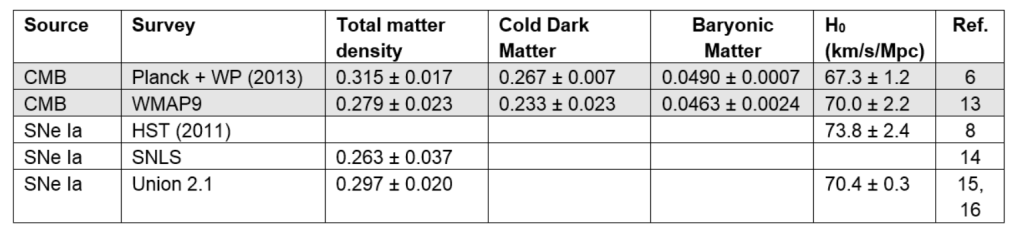
Dark energy is one of the least satisfying names in astronomy because it sounds more specific than it is. Scientists did not discover a glowing substance called dark energy. They gave that name to the unknown influence associated with the accelerating expansion of the universe. The evidence is strong that the expansion is speeding up […]
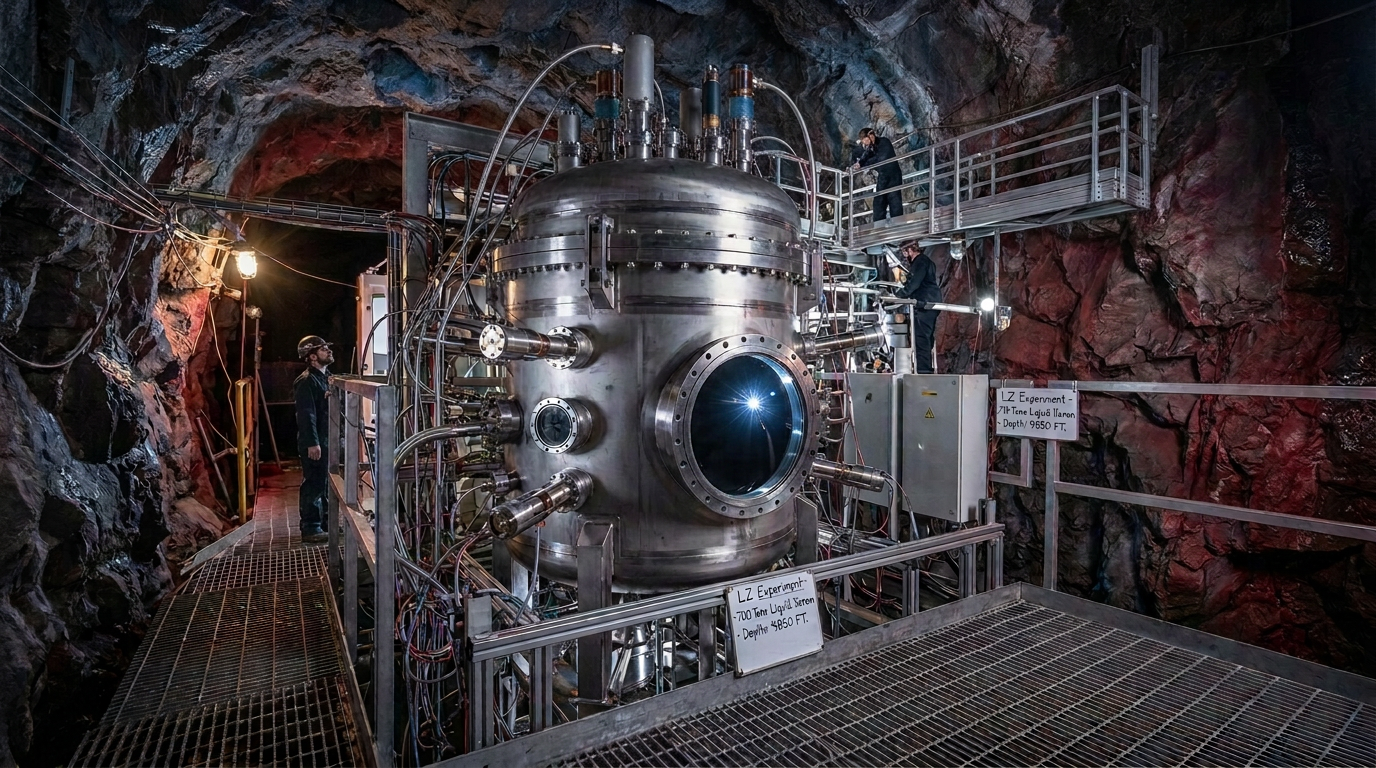
The LUX-ZEPLIN experiment in South Dakota recorded an unexplained flash of light in 2023, suggesting a potential dark matter particle interaction. While the statistical significance of 2.6-sigma indicates low odds of error, much more evidence is needed before confirming a dark matter discovery, which remains elusive despite ongoing research.
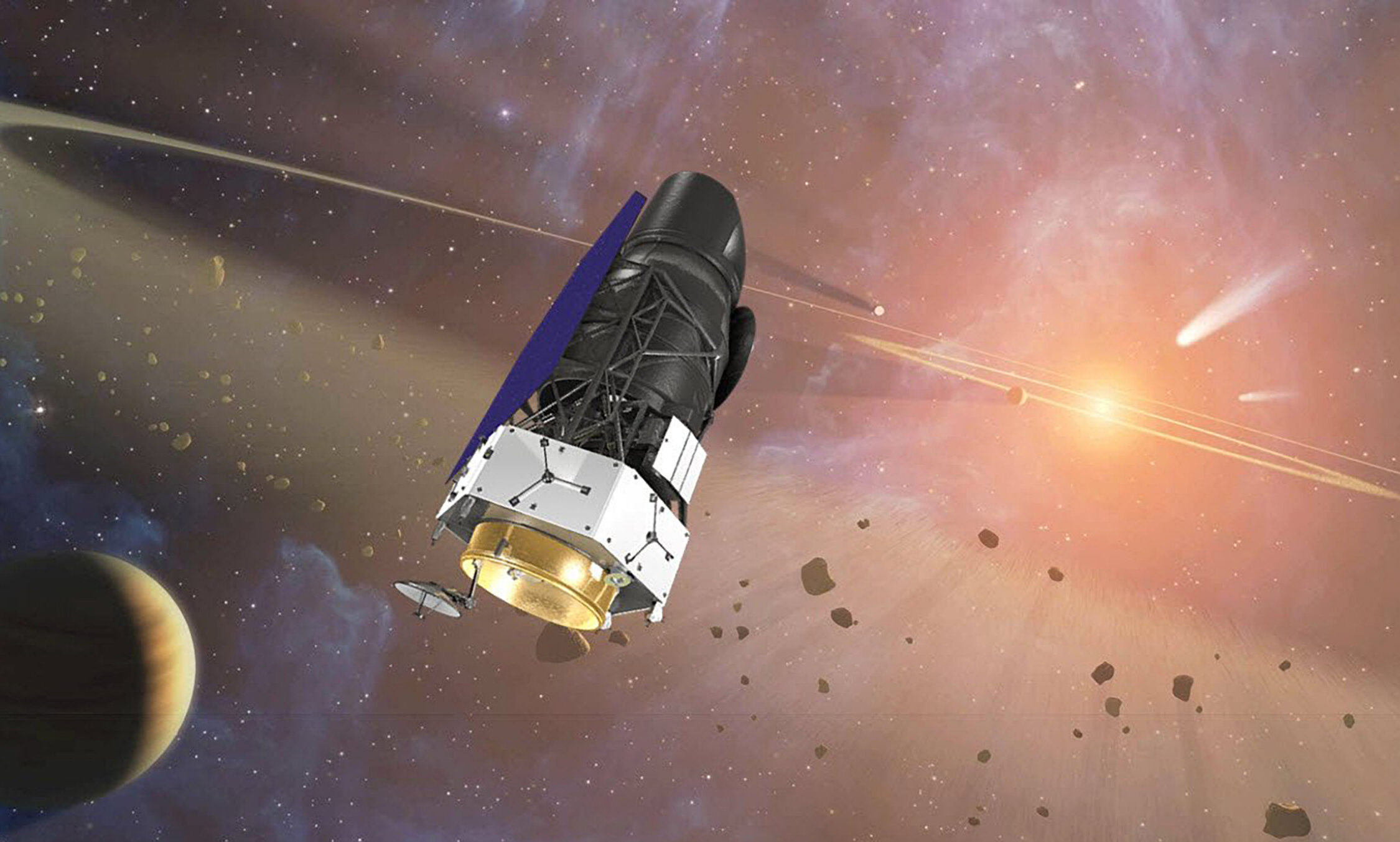
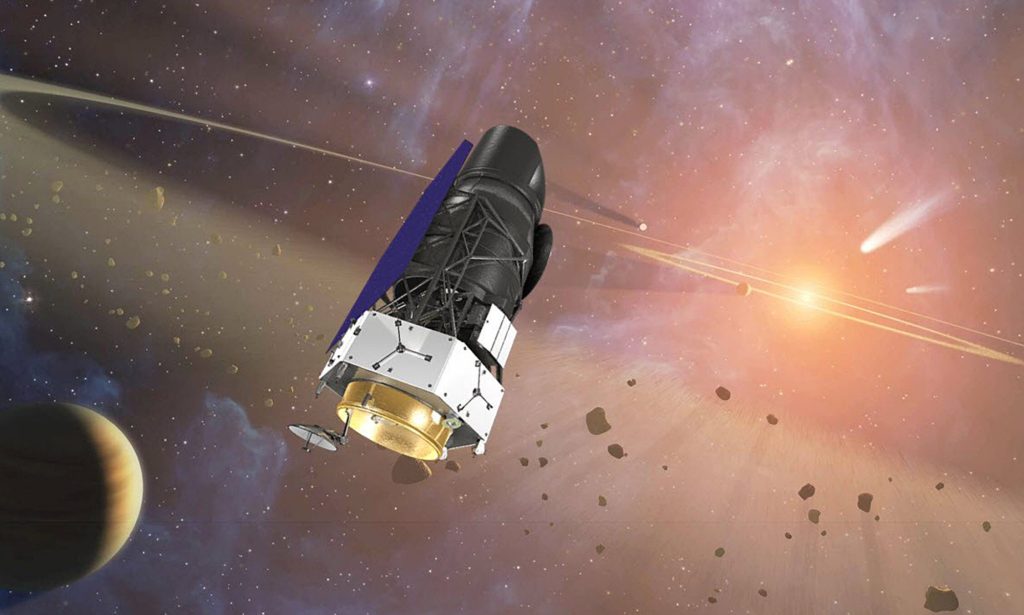
The Nancy Grace Roman Space Telescope, set to launch into orbit, aims to explore dark energy and dark matter, potentially addressing the unresolved Hubble Tension. This discrepancy highlights conflicting measurements of the universe's expansion rate. Some scientists believe Roman may confirm flaws in the standard cosmological model, leading to new physics.
A controversy over one of modern cosmology’s foundational ideas has been renewed, with new research that points to critical issues in a recent analysis defending the view that our universe is expanding.
Late last year, a research team at Yonsei University in South Korea presented new findings that challenged the longstanding view about our expanding universe, following new analysis of Type Ia supernovae. These stellar explosions hold a significant place in the modern debate since measurements of their brightness have helped measure the apparent expansion of the cosmos.
Based on their luminosity, the team argued that Type Ia supernovae are affected by their age, a factor that resulted in biases in past cosmological measurements. After correcting for this, the team’s new results shook the world of cosmology, as they implied that the cosmic expansion scientists have long observed may have already transitioned from acceleration to deceleration.
If this were true, it could also imply that dark energy, the mysterious nonluminous energy that currently explains the universe’s expansion, could be evolving, instead of behaving as a cosmological constant—a finding that struck a significant blow to assumptions in the standard Lambda-CDM model.
Pushback from Proponents of the Standard Model
However, in June, an international team led by University of Southampton researchers pushed back on those findings. According to the new analysis, the Southampton team said there appears to be a far weaker relationship between the ages of supernovae and luminosity, arguing now that the ages of the progenitors of these catastrophic stellar explosions may not change as dramatically across cosmic history as those of their host galaxies.
If true, it would seem to indicate that the proposed age correction was too small to upend the current evidence in support of an accelerating universe.
However, the research published in June wasn’t the final word on this brewing controversy.
A Cosmological Debate Continues
Now, the original Yonsei research team has fired back in Monthly Notices of the Royal Astronomical Society with an additional study, in which they point to methodological problems in both central arguments of the Southampton team’s recent rebuttal.
Once again, at the heart of the controversy is the debate over the relationship between the age of supernovae and the standardization of their luminosity. In short, the Yonsei team argues that the analysis presented in June combined supernovae across too broad a range of redshifts. The result is that the apparent correlations between their brightness are thereby weakened.
Dr. Chul Chung of Yonsei University, who led the recent research, says the issues with the new analysis are clear.
“The shallow age-bias slope reported in the rebuttal is therefore the result of a clear methodological problem in the analysis,” Chung said in a statement. “When the comparison is restricted to an appropriate redshift interval, the strong age dependence reappears.”
Chung and his colleagues also raise issues with how the June rebuttal addresses changes in supernova progenitor ages, noting that while reducing the estimated age difference across redshift would appear to weaken the required correction, doing so also results in steeper age luminosity relationships.
Correcting for such effects, Chung and his colleagues argue, produces results that remain largely unchanged based on their initial controversial findings.
It is important to acknowledge that while the new findings do not offer irrefutable evidence that cosmic expansion has ended, they do present strong new findings that revitalize the dispute over the effects of Type Ia supernovae and whether misinterpretations about them could be a driving force behind one of cosmology’s most important measurements.
Further, Chung and the Yonsei research team say their corrected supernova results align with independent findings based on baryon acoustic oscillation measurements obtained with the Dark Energy Spectroscopic Instrument (DESI). This could also be significant, if verified, since the team says this would appear to suggest that dark energy is indeed evolving.
New Tests and Ongoing Debate
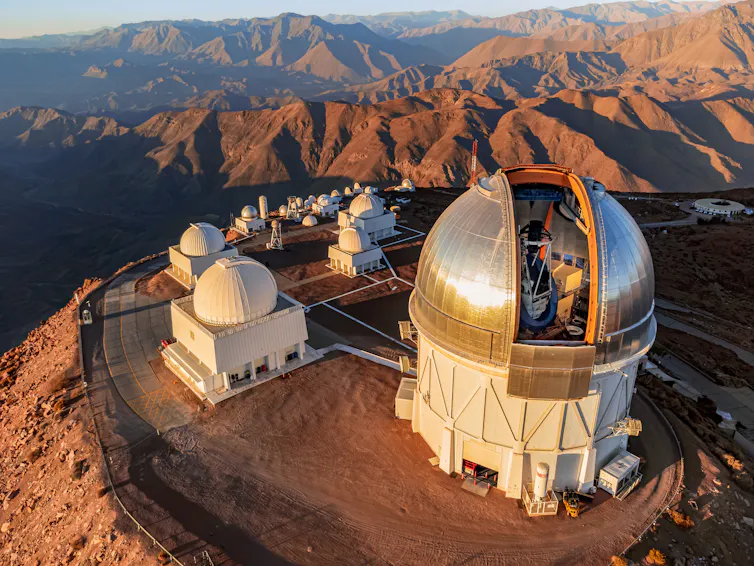
In the coming months, observations by the Vera C. Rubin Observatory could provide additional clues, and the Yonsei team suggests that comparing supernovae observations solely from within young host galaxies could potentially eliminate the suspected evolutionary biases that they say are present in current interpretations.
Thanks to the far greater collection of supernova samples from Rubin, researchers may soon be armed with enough new data to determine whether the controversy does indeed reflect past overlooked errors or if the evidence confirms that current views about the universe’s expansion may require a fundamental reset.
Micah Hanks is the Editor-in-Chief and Co-Founder of The Debrief. A longtime reporter on science, defense, and technology with a focus on space and astronomy, he can be reached atmicah@thedebrief.org. Follow him on X @MicahHanks, and at micahhanks.com.
Could our universe have been born inside a collapsing star? That idea recently made headlines, and I got a lot of questions about it. The paper behind them describes a new solution to Einstein's equations in which a collapsing star expands on the inside and never forms a black hole. Let's take a look.
Authors: Phil Wiseman, Senior Research Fellow and Ernest Rutherford Fellow in Physics and Astronomy, University of Southampton and Mark Sullivan, Professor, University of Southampton
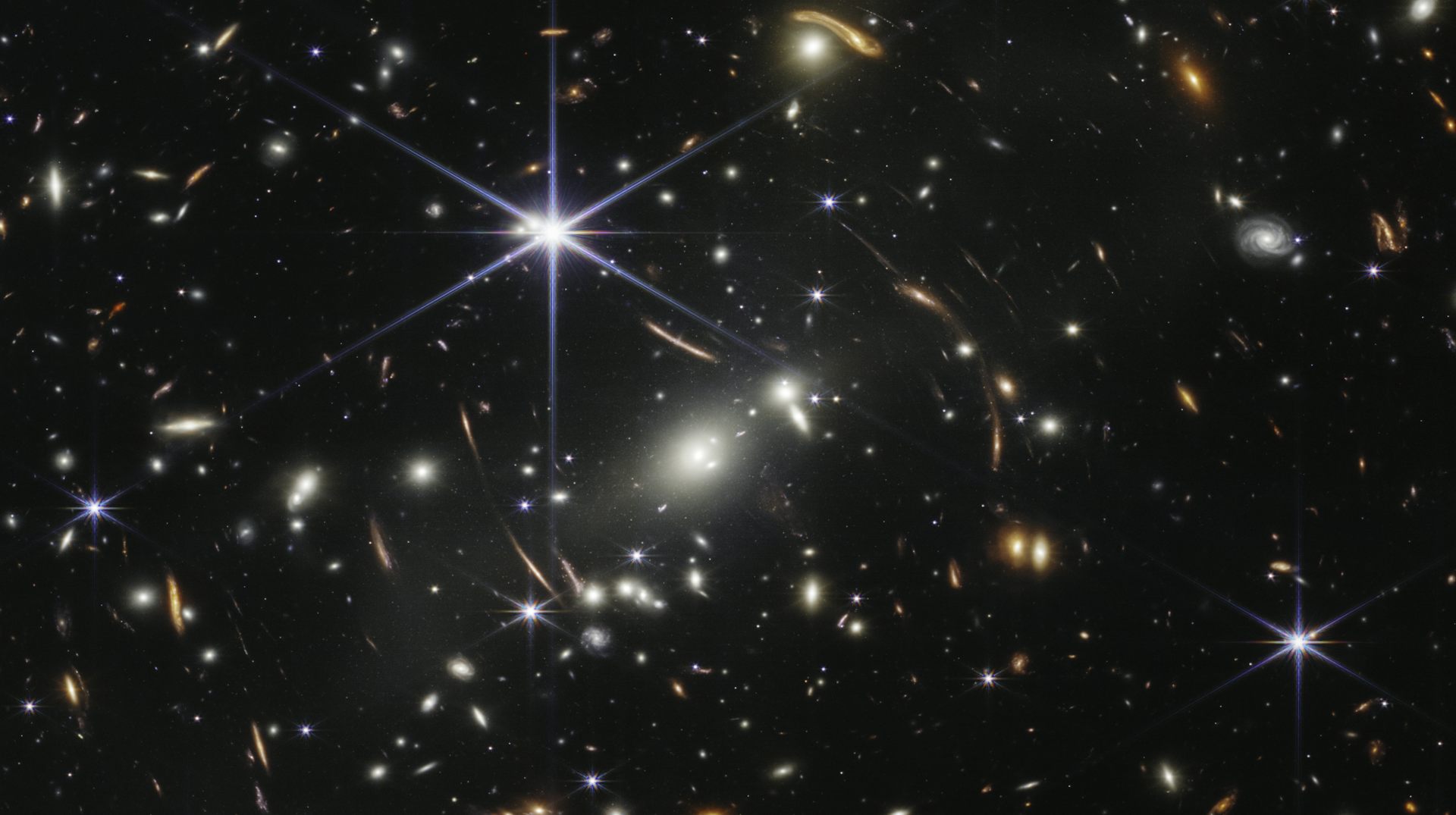
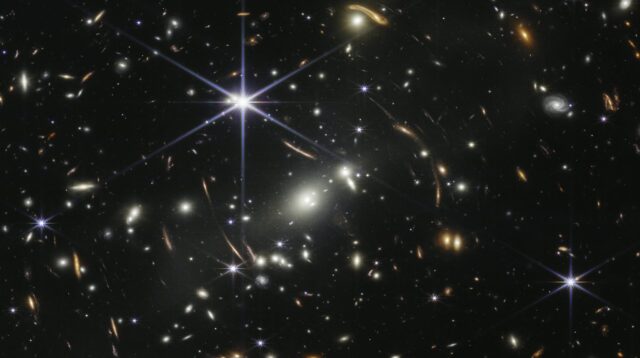
JWST Deep field. Source: Nasa, Esa, CSA, and STScI
A 2025 study by South Korean researchers caught the attention of the astronomy community when it suggested that the evidence behind dark energy could be wrong. Dark energy makes up about 70% of the universe but nobody knows what it is. This makes it a frequent target for scepticism.
Scientists had long known that the universe was expanding. But in the late 1990s, researchers discovered that this expansion was accelerating. Astrophysicists concluded that something must be driving the acceleration. They named this unknown quantity “dark energy”.
The 2025 re-analysis, by a team at Yonsei University in Seoul, suggested that the expansion of the universe was not in fact accelerating.
Our team at the University of Southampton has now gone through the Yonsei team’s findings. Our results, published in Monthly Notices of the Royal Astronomical Society (MNRAS), suggest that the results were a false alarm.
However, the Yonsei University team have said they stand by their results and that a follow up study supports their finding that the universe may not be accelerating.
What is dark energy?
In the late 1990s, cosmology was upended by a startling discovery. Scientists knew the universe was expanding, but they had assumed that gravity was gradually slowing down this expansion.
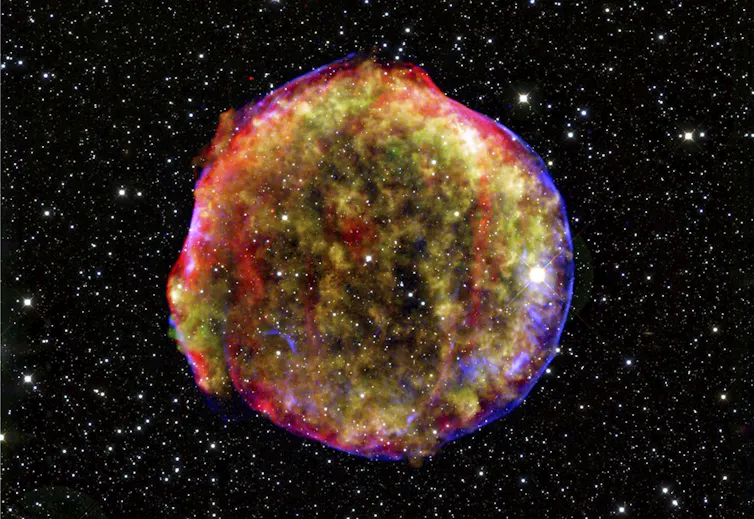
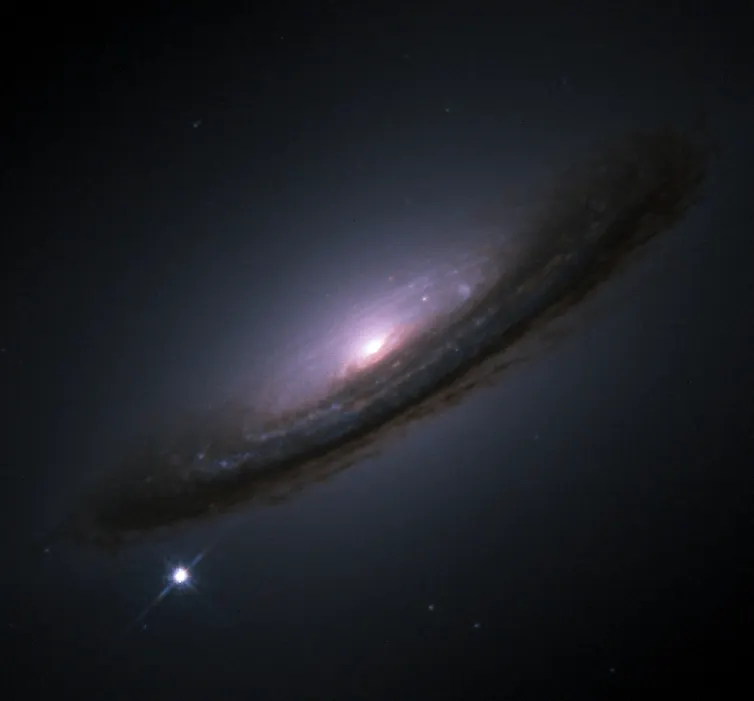
However, by observing incredibly bright, thermonuclear explosions of white dwarf stars, two independent teams of astronomers found the opposite. Because these explosions, known as Type Ia supernovae, have almost the same intrinsic brightness, comparing how bright they appear gives a precise distance.
In 1998, data revealed that distant supernovae were fainter than they should have been in a slowing universe. Because faintness implies distance, the observations placed these supernovae farther away than expected, and implied that the cosmic expansion was not slowing.
In fact, when the calculations were run, it was clear that the expansion of the universe was actually speeding up.
There was no convincing physical explanation for this “cosmic acceleration”. Physicists labelled the mysterious, repulsive force that causes the acceleration “dark energy”.
Cosmic calibration
To understand the Yonsei University group’s claims, we must understand how astronomers use supernovae as “standard candles” to measure cosmic distances. Type Ia supernovae are remarkably alike, but they are not identical.
Cosmologists correct for these differences. They use subtle calibrations to account for relationships between the brightness of the supernovae and measurements like their colour, the duration of their light curves, and the type of galaxies they explode in.
One of those corrections is well known but subtle. It links the brightness of a supernova to the size of the galaxy it exploded in. Big galaxies hold more stars, and so more mass. After the standard corrections, supernovae in those big (massive) galaxies come out a few per cent brighter than ones in small galaxies. Nobody knows why.
But bigger galaxies typically have older stars that are made up of heavier elements, which could in turn influence the properties of the supernovae that some of those stars become. The authors of the 2025 study proposed a far bigger evolutionary effect. They argued that the brightness of Type Ia supernovae changes significantly as the universe ages.
Specifically, they claimed that older white dwarf stars, which are more common in the nearby, present-day universe, produce brighter explosions. That would mean today’s supernovae are inherently much brighter than their distant, early-universe counterparts.
If true, the faintness we observe in distant supernovae would not be a result of their being further away, a relationship that is in turn driven by dark energy, but rather an evolutionary trait of the stars themselves. This claim threatened to dismantle almost three decades of progress in astronomy.
Addressing the claims
Extraordinary claims need careful testing. At the University of Southampton we embarked on an audit of the data, using observations from the Dark Energy Survey (DES), an astronomy project designed to constrain dark energy’s properties, alongside the same dataset used by the authors of the 2025 work. In doing so, we sought to replicate and test their conclusions.
Our re-analysis revealed what we saw as two problems in the Yonsei study: a technical omission and a flawed assumption about stellar populations. Once corrected, the data fell back in line with standard cosmological results, including those of DES.
Crucially, the 2025 study did not account for how supernovae in big galaxies come out a few per cent brighter than ones in small galaxies. When our team reapplied this correction to the same dataset, the correlation between a supernova’s brightness and galaxy age – presented by the Yonsei team in their paper – became far weaker.
This doesn’t mean that the age of a white dwarf star has no effect on the brightness of a resulting supernova. Indeed, most researchers in the field would likely accept that the brightnesses of supernovae are more affected by the age of the stars that explode than by the mass of the galaxy that it is in.
However, measuring a galaxy’s mass is far less expensive in terms of telescope time and requires fewer technical assumptions than measurements of the ages of galaxies, which are challenging. What we showed is that the galaxy mass calibration is adequate to the accuracy required to constrain dark energy.
Secondly, the 2025 analysis relied on a flawed proxy, incorrectly assuming that the overall age of a host galaxy is identical to the specific age of the star that exploded. But galaxies are not uniform like this: even large, ancient galaxies contain localised pockets of young stars.
By overestimating the difference in age between the stars that explode nearby and those that explode in the distant universe, by a factor of three to five, the Yonsei University study overestimated the amount by which the age-brightness calibration could bias supernova distance measurements.
Once these omissions were corrected, the data behaved as expected under the standard model of cosmology. As such, evidence for an accelerating universe remains secure.
Science friction
While the 2025 study turned out to be incorrect, the challenge it posed was valuable. Challenging accepted ideas and rigorously testing our observations is fundamental to scientific progress.
Their claims provided an opportunity for cosmology teams to return to their baseline data, interrogate their core assumptions, and test different ways of calibrating the measurements. When measuring distances, however, the age effect and the mass effect are highly correlated, and therefore we (the Southampton team) believe it is incorrect to make a full age-based adjustment to distances that have already been corrected for the mass effect.
The Southampton team was invited, among others, to a workshop at Yonsei in June 2026, where we discussed our methods and talked about ways to include both stellar mass and stellar ages into the brightness corrections.
In a follow up study, recently accepted by MNRAS, the Yonsei University team maintain that the ages of stars have an important effect on the supernovae they produce. They say that two methods used in earlier studies have suppressed the importance of this phenomenon.
When these effects are accounted for consistently, they explain, it leads to results similar to those in the 2025 study. “We therefore continue to find evidence that stellar-population age is an important factor in Type Ia supernova standardisation,” authors Junhyuk Son and Hyejeon Cho, told The Conversation.
“Because the typical ages of supernova host populations change with cosmic time, understanding this effect is important for precision measurements of the Universe’s expansion history.”
Future measurements will depend on understanding supernova explosions better. It is a job we hope the community can take on together. But none of this removes the need for dark energy: it is still there, and still unexplained.
Ultimately, we have shown that existing measurements of dark energy are robust. Rather than debating whether cosmic acceleration exists, the astrophysical community can return to the exciting task of figuring out what dark energy actually is and how we best measure it.
Over the next 10 years, the Vera C. Rubin Observatory in Chile will carry out a project known as the Legacy Survey of Space and Time, which will produce a sample of supernovae 20 times larger than the DES sample used in our analysis. There is no better time to be investigating the mysteries of dark energy.
By analysing the signals from extragalactic fast radio bursts, astronomers at the Massachusetts Institute of Technology (MIT) say that the “missing matter” in the universe is distributed further away from galaxies than most theoretical simulations predict. Their finding – which is counterintuitive since the gravity from galaxies tends to pull everything closer to them – could help us better understand how highly energetic galactic activities, such as jets from supermassive black holes and explosions from old dying stars, impact the formation of cosmological structures.
“Ordinary” matter, which is built from atoms and their protons and neutrons (collectively known as baryons), makes up stars and galaxies and everything we see around us. However, the best models of the universe we have today suggest that close to 90% of this baryonic matter is “missing”.
The radio signals of FRBs are stretched
As their name implies, fast radio bursts (FRBs) are brief, intense bursts of radio waves spanning multiple wavelengths. They were first detected in 2007 and since then, astronomers have spotted thousands of others, including some within our own galaxy. They are thought to originate from cataclysmic processes involving compact celestial objects such as neutron stars and typically last a few milliseconds or even less. And these FRBs can be used to probe the missing baryonic matter.
As they pass through the missing matter, the radio signals of FRBs are stretched (or “dispersed”) over time – that is, their overall duration becomes longer. The more missing matter they pass through, the more the signals are dispersed. The missing matter has an extremely low density – of just a single proton per cubic metre – so it is extremely difficult to identify, but researchers recently found that they could use the dispersion effect to detect it. In that previous study, they confirmed that intergalactic space, which contains most of the universe’s baryons, is home to tenuous clouds or filaments of diffuse plasma that make up the missing matter.
Data from CHIME and DESI
In the new work, a team led by astrophysicists Haochen Wang and Kiyoshi Masui has now gone a step further and mapped the extent to which this plasma extends. They did this by cross correlating the locations of millions of galaxies with the dispersion of nearly 3000 background FRBs on length scales of 0.1 to 50 Mpc.
The researchers used data from the Canadian Hydrogen Intensity Mapping Experiment (CHIME) catalogue and the Dark Energy Spectroscopic Instrument (DESI) survey. CHIME, a large radio telescope located in British Columbia, scans the entire northern sky for incoming radio waves and it can detect ultrashort, ultrabright radio signals. Indeed, it has detected about 4000 FRBs since it became operational. DESI, for its part, is an instrument mounted on the Mayall Telescope at Kitt Peak National Observatory, near Tucson, Arizona. It makes detailed measurements of the light coming from over 30 million galaxies – originally to provide estimates of dark energy, the mysterious force that is driving our universe’s expansion.
In all, the researchers detected 2870 FRB signals with CHIME and correlated these with the locations of around six million galaxies with DESI.
Missing baryonic matter scattered across a large radius
Their analyses revealed that on scales smaller than about 1 Mpc, the missing baryonic matter was indeed found around galaxies and galaxy clusters, but rather than being close to galaxies in a dense ball as expected, it was scattered across a large radius. “A galaxy is maybe a few 100,000 light years across, and we found missing matter out to about four million light years,” Masui says. “That’s further than the simulations predict.”
The new result backs up the idea that missing matter is projected out from a galaxy through highly energetic events, such as jets from supermassive black holes and explosions from old dying stars. These processes could be much more energetic than we think, note Wang and Masui, and they are stronger and much more violent.
The work, which is detailed in Physical Review Letters, proves that FRBs are a good way to study large-scale structures in the universe – in a similar way to how cosmologists have been using galaxies and the cosmic microwave background for decades, says Wang. “It has helped to establish FRBs as a new cosmological probe, especially for detecting the missing matter.”
FRBs will only become a more popular tool in this context, he adds, especially given that several new radio telescopes, with upcoming surveys such as CHORD, DSA-2000 and the SKA, are being constructed around the world to offer much better FRB data in the coming years. “Indeed, we have already received more FRB data from our telescopes and are working on expanding our study,” Wang tells Physics World.
And that is not all: the researchers say they are also busy improving their analysis technique. “Until now, we have mostly examined the dispersion of FRBs but we are now working on extracting information from FRBs’ spatial positions relative to galaxies. This will reveal more details on how the missing matter is distributed in the universe.”
A laser-ranging technique has allowed physicists to measure the frame dragging of the Earth with an uncertainty approaching one part in a thousand, representing the highest precision yet for this parameter. The new result not only provides one of the most stringent confirmations of Einstein’s theory of general relativity in the near-Earth environment to date, it also sets stronger constraints on some alternative theories that have been put forward to explain the unsolved mystery of the universe’s accelerated expansion.
Frame dragging, also known as the dragging of inertial frames, is one of the predictions in Einstein’s theory of general relativity. Here, a massive, rotating object not only curves spacetime, it also drags it around as it rotates. The effect is very large around huge objects like black holes but is much smaller around Earth. It can be detected, however, by monitoring the motion of certain satellites in orbit around our planet.
There is a problem though in measuring the very tiny shift of the orbital plane around the Earth predicted by general relativity because the Earth is not a spherically symmetrical body, explains Ignazio Ciufolini of the Chinese Academy of Sciences, who led this new study. He and his colleagues overcame this difficulty by analysing motion data from the recently launched Laser Relativity Satellite 2 (LARES-2), developed by the Italian Space Agency, and its predecessor LAGEOS.
The combined orbits of these satellites act like a huge gyroscope and their position can be measured via laser ranging: a laser pulse is emitted towards the satellite and reflected back from the retroreflectors covering its surface. “By measuring the time it takes the laser light to come back, we can very precisely determine the position of the satellite,” says Ciufolini.
LARES-2 is a small, spherical satellite with a radius of 0.212 m and it is extremely heavy, weighing in at nearly 295 kg. Its orbit, he notes, is therefore perturbed only by the Earth’s gravitation and to a much lesser extent by non-gravitational effects, such as the push of the photons from the Sun and the Earth.
Removing the influence of Earth’s lunisolar tides
One of the difficult steps in the measurements, Ciufolini explains, was removing the influence of Earth’s lunisolar tides. These are the subtle distortions in the Earth’s gravity field caused by the tides raised by the Moon and Sun, which would otherwise hide the signal the researchers were looking for. “The most challenging part was to get rid of the orbital influence of Earth’s ‘K1 tide’, which biases the precision of the frame-dragging measurement,” he says.
“Thanks to this precise measurement, which is an order of magnitude better than previous Solar System measurements, we have been able to set stronger limits of validity to some theories alternative to general relativity proposed to possibly explain the great mystery of the accelerated expansion of the universe,” he tells Physics World. “Some of these theories predict something that may be related to quintessence (a mysterious time-dependent scalar field).”
While these theories predict the same so-called post-Newtonian weak-field effects as general relativity, they predict a different frame-dragging effect, he adds. Increasing the accuracy of frame-dragging (and indeed other tests of general relativity) can therefore place further limits on these other theories. It could also shed more light on phenomena like the flow of time around rotating black holes, where frame-dragging is extremely pronounced.
Laser-ranged satellites remain in orbit for many decades (LAGEOS was launched by NASA in 1976) and will carry on providing data for a very long time. “The more time we have, the more observational data we can obtain and therefore tests of general relativity (not only frame-dragging but also other tests) can be carried out with much increased precision,” says Ciufolini. “This data could also improve our knowledge of the Earth and allow, for example, improved determinations of the Earth tides and its centre of mass, which is useful for the Global Positioning System.”

 Login