We have all seen something suddenly break: a phone screen cracks, a plastic object snaps or a piece of glass shatters. To our eyes, the failure seems to happen all at once. But what if the most important part of the break happens long before the final snap?
We have all seen something suddenly break: a phone screen cracks, a plastic object snaps or a piece of glass shatters. To our eyes, the failure seems to happen all at once. But what if the most important part of the break happens long before the final snap?
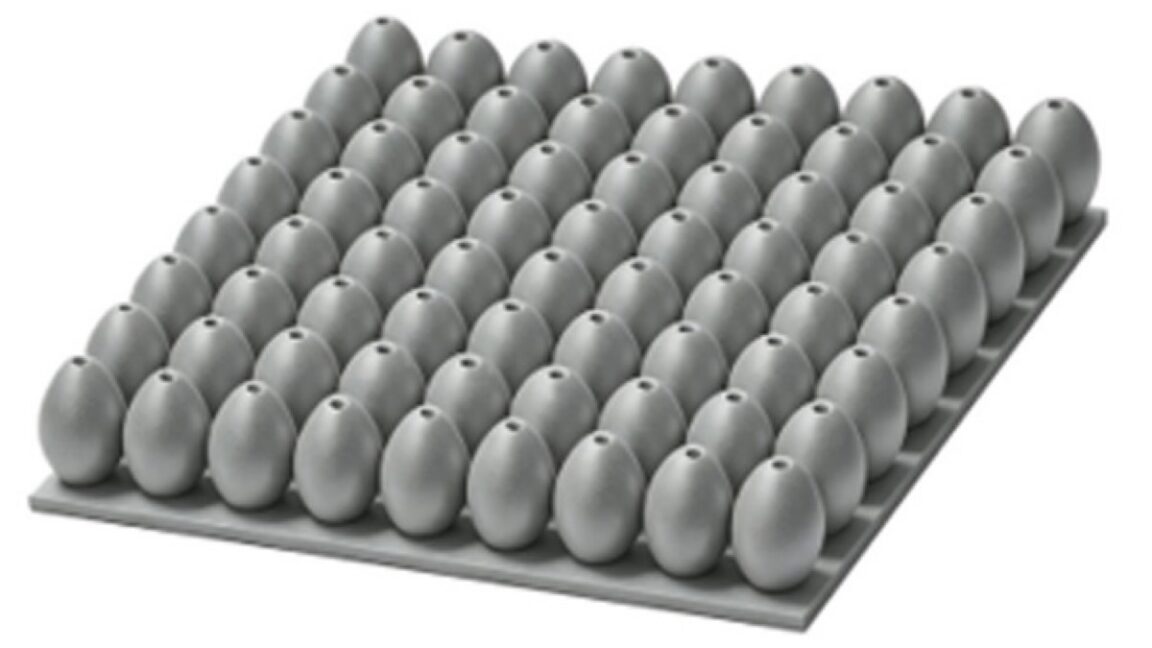
Scientists have designed a lightweight aluminum material inspired by eggshells that could one day help protect spacecraft from fast-moving pieces of space debris. Nearly one million pieces of debris larger than 1 centimeter are believed to be orbiting near Earth. These fragments can travel at extremely high speeds, so even a relatively small object can […]
For the first time, astronomers have pointed NASA’s two flagship space telescopes at the same patch of sky beyond Neptune and let them work as a team. Hubble handled the visible light. Webb handled the infrared. Together, they picked out 27 previously unknown trans-Neptunian objects, or TNOs — small, icy bodies that drift in the […]
Electronic voting, the use of electronic systems to cast, record or count votes, could potentially simplify the process of electing new political leaders or other representatives. While some countries have already started using internet-connected devices or electronic voting machines at polling stations, the trustworthiness, security and anonymity of electronic voting systems are still widely debated.
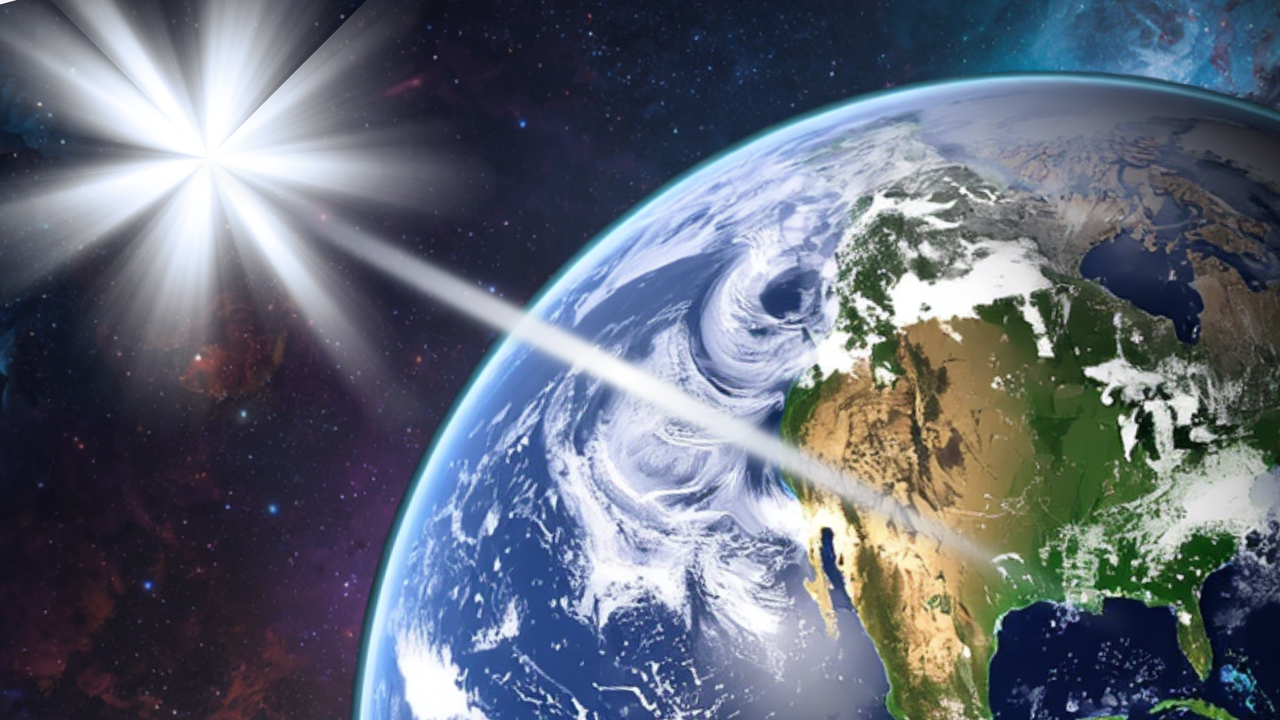
A photon, or particle of light, from the biggest cosmic explosion since the Big Bang, nicknamed "the BOAT" (for the brightest of all time), should not have reached Earth. That is, unless it defied rules defined by Einstein. Now scientists may know how it did this, with new research suggesting how the high-energy photon may have survived a journey of more than two billion light-years without being absorbed.
The BOAT, a gamma-ray burst officially designated GRB 221009A, was first detected on Oct. 9, 2022. Among the ocean of photons from the event that rained down on our planet was the highest-energy photon ever detected originating from a gamma-ray burst. It was detected by Carpet, an ultra-high-energy cosmic-ray detector located at the Baksan Observatory in the Russian Caucasus.
The problem is, according to all current rules of physics, a particle with such high energy shouldn't reach Earth from an explosion occurring such a vast distance away. That's because space isn't empty; it is filled with a "fossil" radiation field of photons left over from just after the Big Bang called the cosmic microwave background (CMB). It should be virtually impossible for a high-energy photon to travel 2 billion light-years without interacting with a CMB photon and being transformed. And still it came.
"We started from a very simple question: how did this photon survive a journey that, according to known physics, should have destroyed it?" team leader Giorgio Galanti from the Italian National Institute for Astrophysics (INAF) said in a statement. "The new data from the Carpet experiment showed us that the explanations proposed so far were no longer sufficient.
"We therefore looked for a theoretical scenario capable of consistently describing what we observe, without resorting to arbitrary corrections to the equations."
A hypothetical transformation
To investigate the mystery of how this high-energy photon reached our planet, Galanti and colleagues turned to incredibly light hypothetical particles called axion-like particles (ALPs).
ALPS could serve as a solution to this puzzle via a mechanism that would allow photons to transform into ALPs as they travel and then convert back into photons as they reach the Milky Way. The problem is that this still can't account for such a high-energy photon.
This team combined the idea of ALPs with a proposed violation of one of the fundamentals of Einstein's 1905 theory of special relativity called "Lorentz invariance."
In short, Lorentz invariance says that observers moving at different speeds should experience the same physical laws. The team tested the idea that Lorentz invariance could be violated at high energies, thus changing how photons propagate through space.
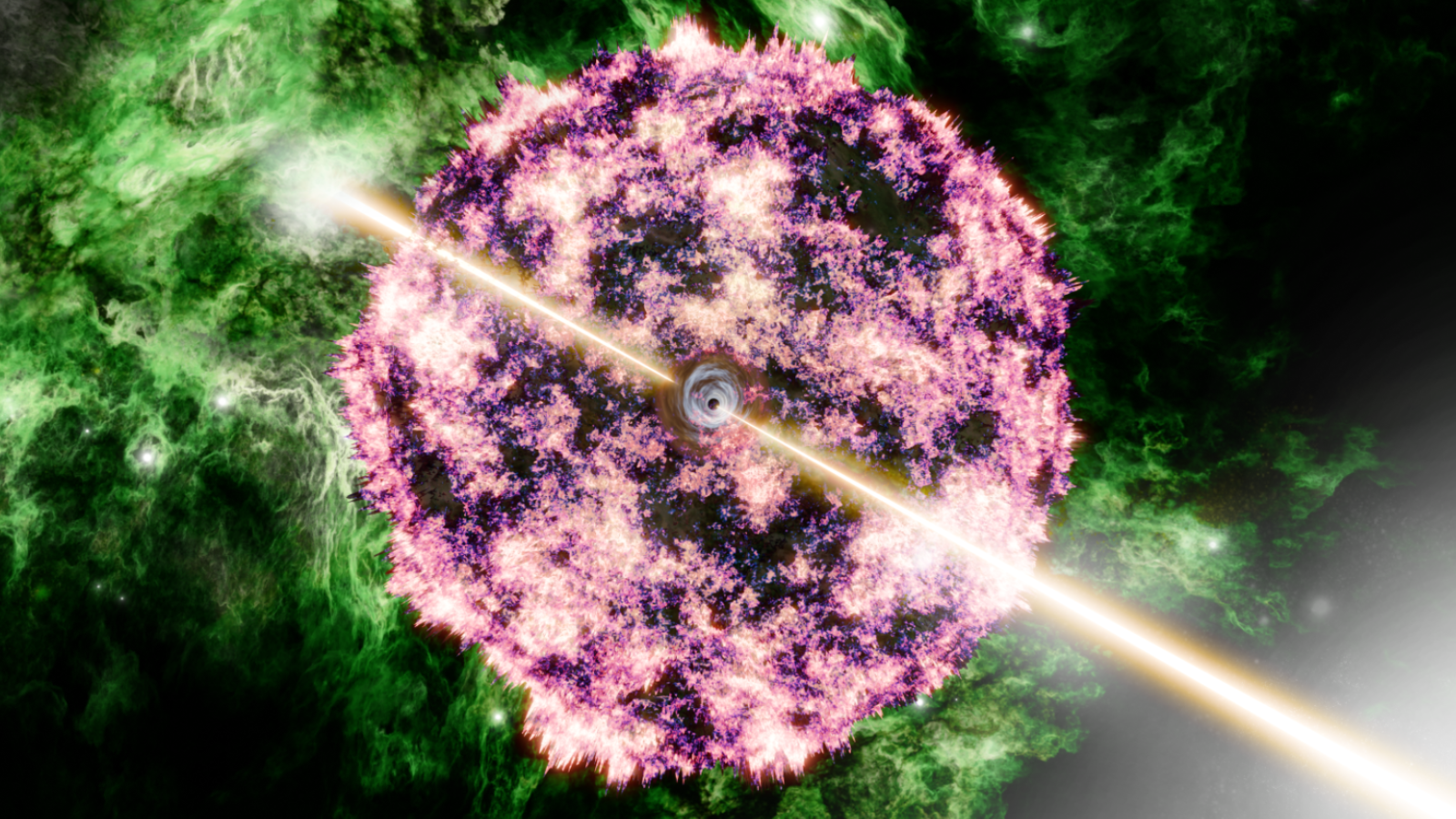
An illustration of the supernova that launched teh BOAT, the gamma-ray burst that is the most powerful cosmic explosion since the Big Bang (Image credit: Aaron M. Geller / Northwestern / CIERA / IT Research Computing and Data Services.)
In the scenario devised by the team the photon would have avoided being wiped out by interactions with the CMB as it would avoid interactionc with these fossil photons.
The new research therefore implies that at high enough energies, photons can take a "fast lane" through a transparent universe, dodging the physics that would normally force their destructive transformation.
Interestingly, there is some evidence relating to the BOAT that seemingly backs this theory. According to the picture developed by the team, this high-energy photon should have arrived at Earth around one hour after lower-energy particles of light originating from the BOAT. Indeed, that is exactly what happened.
"The most interesting aspect of our work is that, for the first time, it brings together two ideas that until now had been developed separately," team member Marco Roncadelli of the National Institute for Nuclear Physics (INFN) said. "If future observations confirmed this scenario, the universe would become a natural laboratory for studying quantum gravity at energies enormously higher than those achievable by any accelerator built on Earth."
The team's research is available on the repository site arXiv and has been accepted for publication in the journal Physical Review Letters.
Using solar and wind power for clean energy generation relies on the weather, which can be unpredictable. In addition to seasonal changes and daily variability, energy planners must also account for rare and extreme weather events. Traditional planning methods often fail to capture these events accurately, resulting in systems that are either overly expensive or insufficiently reliable.
In this work, the researchers aimed to develop a more effective way of planning energy systems that can cope with real climate variability. They built an artificial intelligence model trained on 30 years of wind and solar data from Pingtan in China. The model generated thousands of realistic weather scenarios, including both typical conditions and extreme events.
The researchers then used these scenarios to determine the most cost-effective and reliable combination of energy technologies. Their Integrated Energy System included solar panels, wind turbines, batteries, hydrogen production and storage, and a connection to the national electricity grid. The optimal system configuration was identified by testing its performance across all of the AI-generated scenarios.
The optimisation showed that the most effective renewable energy system combines several technologies working together. Wind and solar provide the main source of electricity, batteries manage short-term fluctuations in supply and demand, hydrogen storage provides backup during extended periods of low renewable generation, and the grid acts as an additional safety net.
The key finding is that batteries and hydrogen have complementary roles: batteries are best for balancing daily variations, while hydrogen is better suited to storing energy over weeks or months. Together, they help create a renewable energy system that is both reliable and cost-effective.
Imaginary numbers first appeared in the 16th century as a mathematical invention, introduced to solve equations that real numbers could not. As the name implies, many treated them as kind of trick to get results, rather than an underlying truth about the nature of reality. Although highly controversial at the time, these numbers are now ubiquitous in many fields of physics and mathematics.
One such field is quantum mechanics. Researchers routinely use complex numbers, which include both imaginary and real parts. For many simple quantum systems, you could think this is a mathematical convenience rather than a physical necessity. Predictions made with complex numbers can often be reproduced using only real numbers, albeit in a larger mathematical space.
The key question is: are complex numbers merely just a convenience, a trick, or are they necessary to understand complicated quantum systems? And if they are necessary, to what extent?
A team of researchers from France, Poland and Spain have been working on this problem and they’ve now come up with an answer. Their work relies on the composition postulate – a standard starting point for formulations of quantum mechanics which describes how quantum systems are combined mathematically.
They set out by studying a star-shaped quantum network. In this network, a number of outer parties (N) each receive one part of a quantum system, while a central party (Eve) receives the other parts from independent sources.
Each outer party chooses between several simple two-outcome measurements, while the central party performs one measurement with many possible outcomes.
Their strategy was to build a specially designed, conditional Bell test. The most well-known Bell test compares classical physics with quantum mechanics, with experiments demonstrating the latter is a better description of reality. However, Bell tests can compare the correlations predicted by many other different theories.
The two theories studied here were standard quantum theory using complex numbers and a different formulation of the theory only using real numbers. While it was already shown that complex numbers are necessary, just how much the predictions of complex and real quantum theories differ is still an open question.
They found that the ratio between the predictions of the two theories increased proportional to N-1. So as the network gets larger, real-number quantum theory becomes increasingly bad at reproducing the results of standard complex-number quantum theory.
The work therefore gives a clear answer to the original question. Namely, in sufficiently large quantum networks, complex numbers provide an advantage that can become arbitrarily large. If the composition postulate is respected, they are physically required.
Structured light is light with a designed spatial pattern. It can be shaped into standard topological structures, such as a twist in its phase or a changing polarisation across the beam. These patterns are useful because they can encode information, probe small distances and create topological field structures.
However, the issue is that is that these carefully engineered patterns often spread or degrade as the beam travels. This is a problem for real-world applications, such as precision metrology and super-resolution sensing.
In a new work, a team of researchers from Singapore and Spain went down a different route. They identified a spin structure which is both a topological texture and topological defect that is not laboriously engineered but appears automatically at the dark core of an optical vortex because Maxwell’s equations require it.
An optical vortex is a dark core in a light beam where the electric field vanishes. Because the field is zero there, the phase cannot be defined. The researchers found that the light around this core has a tiny, ordered spin pattern.
The called this a meronic spin defect. A meron is a texture that covers half of a sphere of possible spin directions, while a defect is a point where the direction becomes undefined. Here, both features occur together: the spin vanishes at the centre but forms a half-sphere-like pattern around it.
Crucially, these defects do not spread out during propagation. The beam might diffract as usual, but the normalised spin and polarisation patterns remain confined on subwavelength scales. They are also more stable against turbulence than standard engineered structures, because they arise intrinsically from Maxwell’s equations rather than from carefully balanced beam components.
Although still a fundamental result, the finding suggests that vortex cores could provide unusually stable and compact building blocks for future structured-light technologies.
Princeton’s PACMAN AI can control fusion plasma in milliseconds and predict dangerous instabilities before they start. In some fusion energy systems, particles can reach temperatures hotter than the center of the Sun. The challenge is keeping that extreme plasma under control, because disturbances can develop within just a few thousandths of a second, much faster [...]
A new theoretical approach helps connect quantum physics with classical thermodynamics by clarifying what counts as heat and useful work in tiny quantum machines. When a machine is reduced to a single atom and particles of light, even basic concepts such as heat and useful work become difficult to define. This problem sits at the [...]
Physicists around the world remain deeply divided on key mysteries of the universe, from dark matter to quantum gravity. The standard cosmological model failed to gain majority support, and no leading theory dominated the survey results. The largest survey ever conducted among physicists worldwide reveals surprisingly little agreement on some of the field’s biggest mysteries, [...]
In 2007, a piece of space debris punched a bullet-like hole through the radiator panel of the US space shuttle Endeavor. The shuttle program ended in 2011, but the space debris problem has only intensified as we launch more and more satellite constellations, telescopes, and spacecraft into orbit. That's why Chinese scientists have devised a new aluminum material inspired by eggshells that they believe could offer enhanced protection against debris fragments, according to a new paper published in the Journal of Applied Physics.
Eggshells have long fascinated scientists because of their mechanical properties. For instance, it's well known that cracking an egg requires applying just enough force to the center to achieve a clean break without completely shattering the shell. In 2012, MIT mechanical engineer Pedro Reis co-authored a paper demonstrating the link between an egg's ovoid geometry and its rigidity, a major factor when predicting how much force an object can endure before cracking. (As I wrote for Slate at the time, rigidity is related to, but distinct from, strength. If one eggshell has tiny cracks and the other doesn't, both shells have different strengths—the cracked one will break more easily—but the same rigidity.)
Reis started studying eggshells after participating in a popular physics demonstration: walking on cartons of eggs without breaking them. The key, he learned, was to align the eggs with their narrow tip (the most crack-resistant part) pointing up, and then carefully place one's feet to distribute one's weight over the entire surface area. This ensures that no single egg is overloaded. While it takes around 5.5 pounds of force to crack an egg, that depends on the direction in which the force is applied, as well as its distribution over the shell's surface.
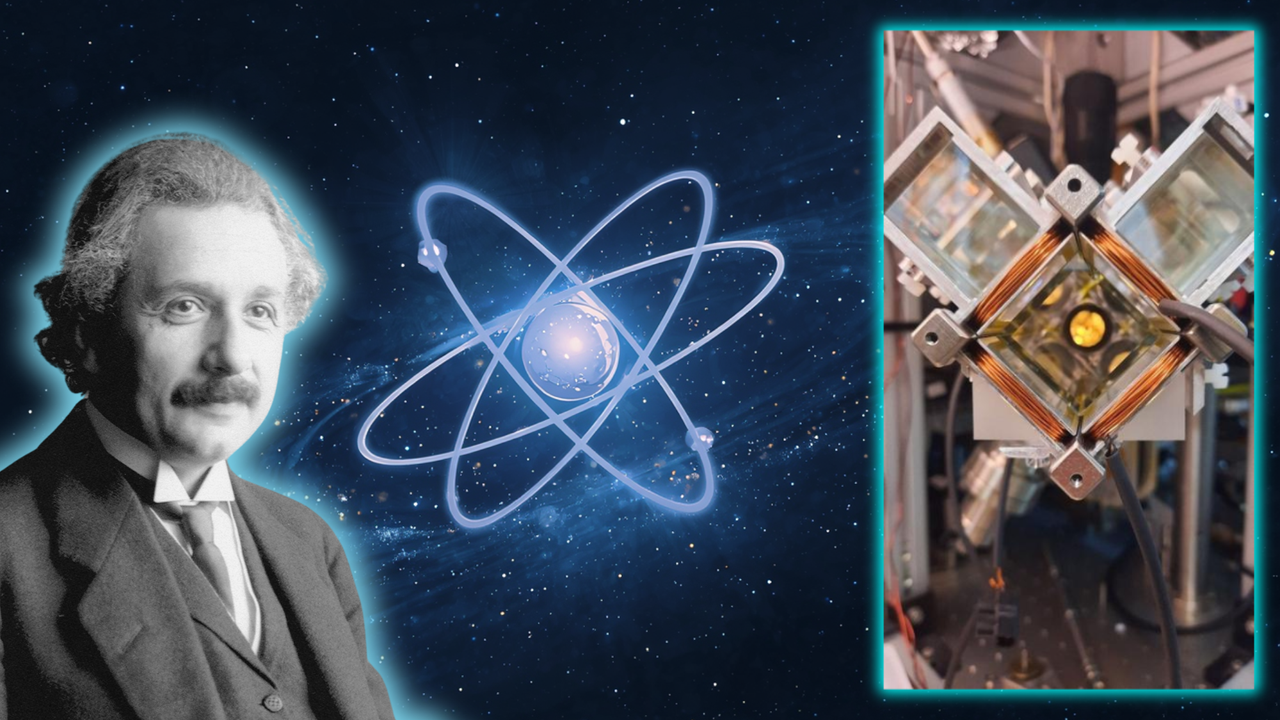
Scientists have spotted the first hints that Albert Einstein's formulation of gravity operates in the quantum realm.
The hints have to do with observations of a falling quantum object, and though this may not seem like a huge deal (literally, we are talking about atoms here), it could be an important step on the road to a theory of ... everything.
To start, we have to go back to the early years of the 20th century. Consider Einstein's iconic theory of gravity, general relativity, and the elusive realm of quantum mechanics. While the former describes the universe on scales of planets, stars and black holes, even demonstrating how galaxies and galaxy clusters formed, the latter describes the counterintuitive physics found on scales smaller than atoms. But there is a problem: these two important theories don't play well together.
A team of researchers has performed an experiment to find the point where quantum mechanics and general relativity meet. Namely, how the quantum properties of atoms change as those atoms fall under the influence of gravity.
"This is a unique paper, in the sense that it combines a hard experiment with a far-reaching theoretical interpretation, about one of the most fundamental questions in physics: How can gravity, described by Einstein's theory of relativity, and quantum theory, be unified into one understanding of the universe?" team leader Ron Folman of the Ben-Gurion University of the Negev said in a statement. "These two pillars of modern physics have so far eluded all attempts at a unified theoretical framework, but this complex experiment gives more hints as to how such a unification may be achieved."
Elevators and equivalence
At the cornerstone of the team's experiment is an important element of general relativity called the equivalence principle.
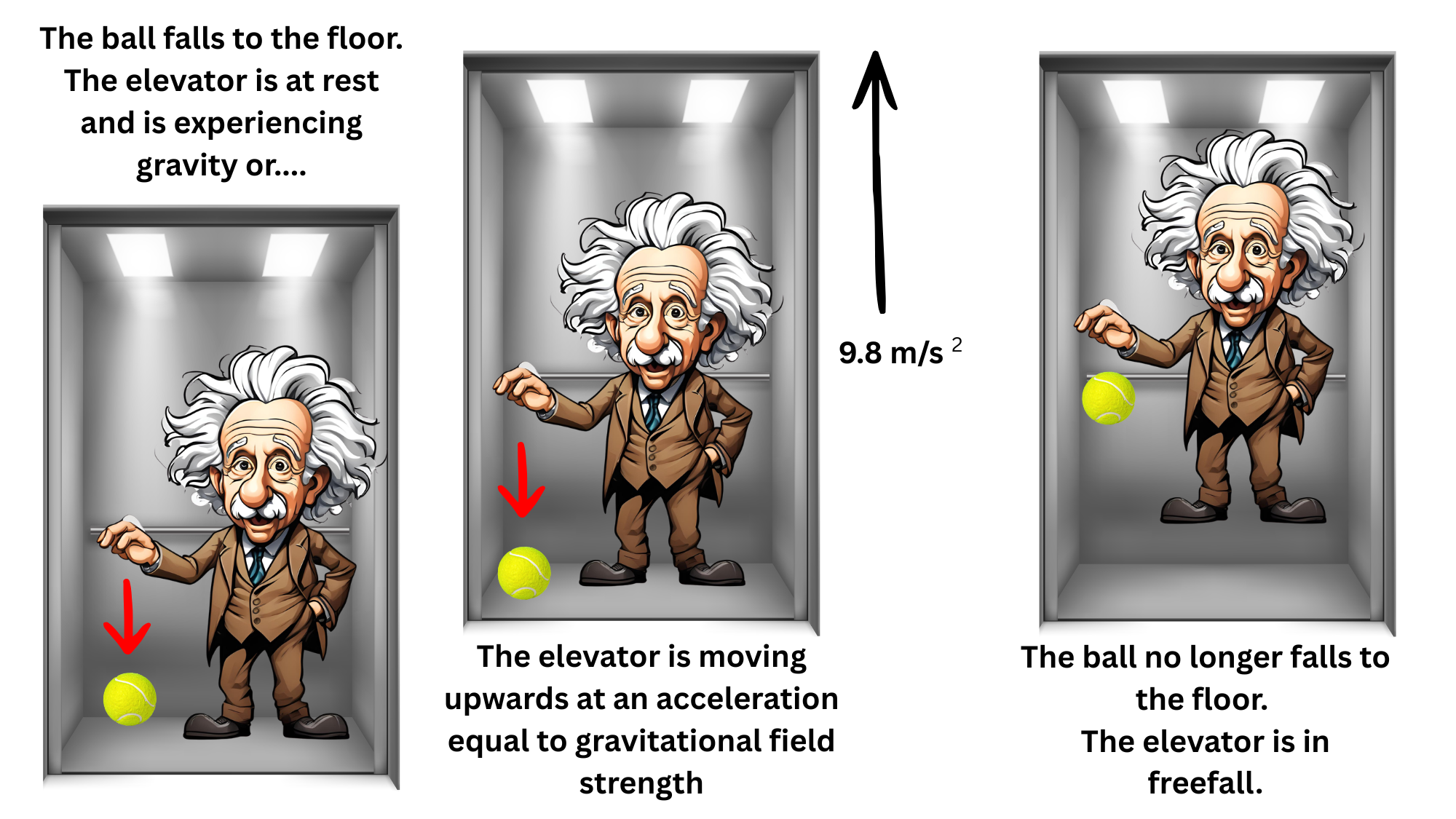
The equivalence principle states that, for an observer in free fall, gravity should disappear. If that sounds confusing, consider this popular analogy: You are inside a closed elevator with no view of your surroundings. You feel heavy. You might drop a ball, and it would fall to the floor of the elevator. Why would these things happen? Well, there are two options.
You might be sitting stationary on the ground floor, or the elevator could be moving upwards at an acceleration equal to the gravitational field strength of Earth, 9.8 meters per second squared. You can't tell the difference between gravity and acceleration. That's the equivalence principle.
Now, let's shake that up. Suddenly, you can't feel weight anymore. You drop the ball, and it floats. Gravity has disappeared, or the upward acceleration has ended. Inside the elevator, two things may have happened, and you can't distinguish between these two either. The elevator cable may have snapped, and you may now be in free fall, or the upward acceleration may have carried you to space and then ceased.
A demonstration of the equivalence principle. (Image credit: Robert Lea (created with Canva))
The big question now is: How do you test this on a quantum scale, especially for particles that behave as waves as they travel?
Wave hello to quantum gravity?
To measure the equivalence principle at a quantum scale, the researchers turned to a piece of equipment called the Quantum Galileo Interferometer. This allowed them to split the quantum wave associated with a traveling atom into two paths. One was held in place while the other was allowed to fall freely.
The team then reunited the wave to observe the changes gravity had introduced to the falling wave.
For the experimental subjects, the team chose a cloud of rubidium atoms, which they cooled to just above absolute zero. These were placed close to the surface of a specially designed atom chip. Using microwave pulses, the scientists placed the atoms in what is known as a quantum superposition.
A superposition is one of those really weird things unique to quantum physics, effectively allowing a quantum system to simultaneously exist in two or more contradictory states. In this case, the superposition allowed each atom to travel along two different paths at the same time.
Magnetic fields generated by the atomic chip applied an upward push along one path, counteracting the downward pull of gravity and holding it stationary. The other path was subjected to magnetic pulses pushing the atoms upwards. The pulses were then shut off, allowing the atoms to fall freely under gravity like a ball thrown into the air.
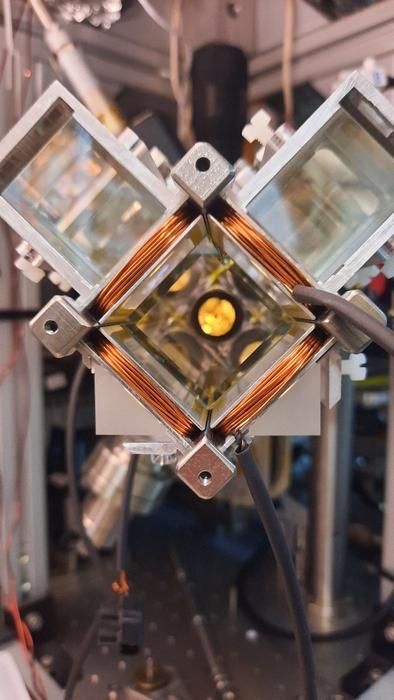
The 2D MOT apparatus which feeds the science chamber with cold atoms. At the center is a glass cell held under vacuum between coils producing magnetic fields. The atoms go into the science chamber through the tiny hole that may be seen in the center of the yellow (reflecting) surface. (Image credit: Or Dobkowski.)
When the waves were reunited, the team used an effect called interference, which occurs when the peaks and troughs of two misaligned waves meet, to measure changes in the free-falling wave.
This represented the first time that the effects of gravity and free fall on the phase of a quantum wave had been measured.
However, while this is an effective demonstration of Einstein's equivalence principle in the quantum realm, it isn't a demonstration of quantum gravity. Yet it remains a step along a frustratingly long road physicists have been traveling down for over a century with no end in sight.
"We have no consistent theory telling us why quantum physics should fail," team member Vlatko Vedral said in the statement. "This experiment pushes quantum mechanics into one of its most intriguing frontiers, gravity, and shows that, once again, its predictions hold."
The team's research was published on Wednesday (Sept. 2) in the journalScience Advances.
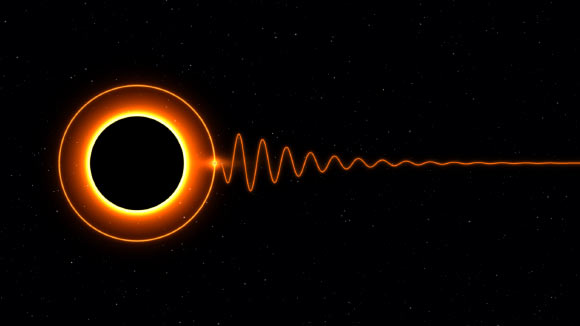
When two black holes merge, the resulting object rings like a struck bell, radiating gravitational waves that fade in a distinctive pattern called ringdown.

 Login


 ... What?