A drinking fountain marked “colored,” a segregated waiting room, or a sign separating public spaces by race could tell the story of an entire social system. During the Jim Crow era, these ordinary sights became symbols of a country where racial separation was woven into everyday routines, shaping where people could go, what services they […]
If you’re called by an unidentified number, the advice is to remain silent until you’re sure there’s a human being on the line. Is this the end of an era?
When Star Trek premiered in 1966, it introduced audiences to a vision of the future filled with advanced technology, distant worlds, and a diverse crew working together aboard the USS Enterprise. Alongside its groundbreaking ideas about space exploration and human progress, the series also became known for its distinctive visual style, particularly the futuristic uniforms […]
China has made astounding scientific progress over the past decade, with the country outperforming all others in the world according to a recent analysis by Nature. Based on data from 2025, its 2026 Research Leaders study puts China ahead of the US (in second), Germany (third) and the UK (fourth).
Across all disciplines, Nature reports that most (51) of the top 100 institutions in the world are in China, with only four in the UK. The picture is slightly different if you judge academic institutions based only on their work in the physical sciences, but China still has 30 of the top 100 institutions, with only seven from the UK.
Professional physicists may not care much for such league tables but they do reveal just how far China has come in recent years. The country’s scientific strength was particularly evident at the fourth International Congress of Basic Science (ICBS) in Beijing, which I recently attended.
Founded in 2023 by the Fields-medal-winning mathematician Shing-Tung Yau, this year’s ICBS ran from 9-21 August at the Beijing Institute of Mathematical Sciences and Applications (BIMSA), of which Yau is president. Its international character is evident from the fact that a total of 50 of its 140 full-time researchers are from outside China.
Awards and honours
Over 800 participants from more than 30 countries attended the congress, which had the theme “Advancing science for humanity”, with my participation supported by the organisers. The programme was huge, featuring over 500 academic sessions covering topics from generative AI reasoning to quantum information.
Meanwhile, Frontiers of Science Awards were given to over 500 researchers from 20 countries who had done work of “excellent and of outstanding scholarly value” over the last 5-10 years in the three fields represented at the ICBS. Authors from many Chinese institutions were among the recipients, underscoring the growing international impact and vitality of China’s basic science research.
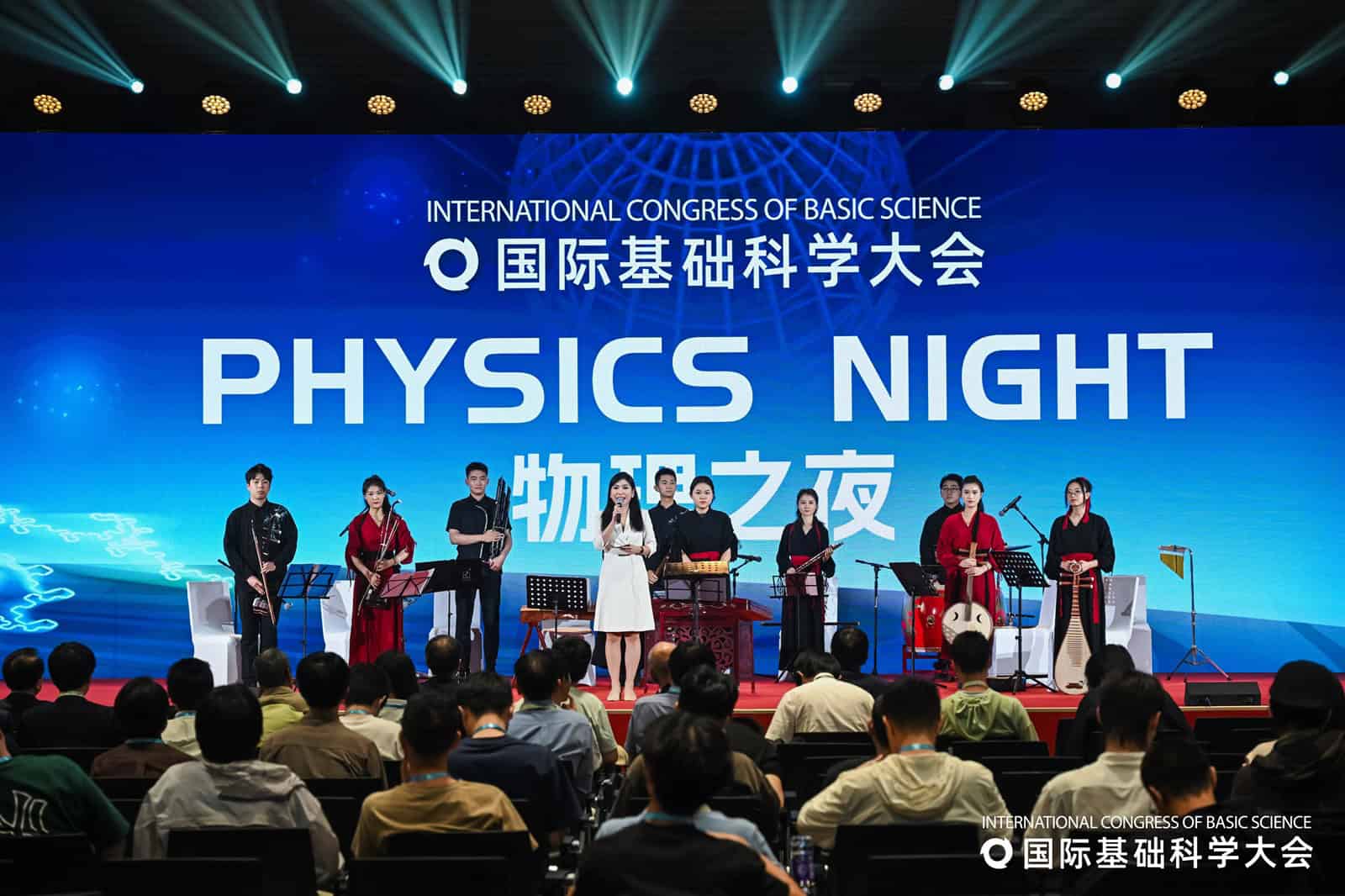
Youth focus Student nights wre held at the congress. (Courtesy: ICBS)
There were 20 plenary sessions, over 400 Frontiers of Science Awardee talks, plus events for entrepreneurs and school and university students. Especially engaging were the “nights of mathematics, physics and engineering”, enlivened by dance amd music performances by students. An exchange meeting was held too for research institutions in Beijing seeking to integrate basic science with frontier technologies
The closing ceremony saw the winners of this year’s ICBS Innovation Fellowships announced. They are all researchers under 50 who work full-time in China and have demonstrated potential in mathematics, physics, information sciences, and other fundamental and interdisciplinary fields. Each receives research funding and can work with a partner institution in China for an agreed period.
AI surges ahead
Artificial intelligence (AI) was one of the major themes of ICBS 2026. Fields medallist Martin Hairer from EPFL Lausanne, for example, said AI won’t end mathematics, but will transform how it’s carried out. It may speed up certain areas while others might fall away.
Caucher Birkar from Tsinghua University – another Fields medallist – pointed out that AI is highly capable in computation, searching for examples, and completing proofs of mathematical lemmas, but it remains difficult for AI to generate truly original ideas.
As for Robert Endre Tarjan, a Turing award laureate from Princeton University, he encouraged young researchers to be curious and commit themselves to long-term scientific exploration. Researchers, he said, can train AI to be a powerful tool for scientific discovery, but they must also develop their own ability to identify meaningful questions and establish independent judgment.
The last word was left to congress chair Shing-Tung Yau, who emphasised that while AI will enhance scientific research, the essence of scientific discovery will always depend on human creativity, imagination and independent thinking.
Record store shelves once told stories long before anyone dropped a needle on vinyl. A cover was an artist’s first impression, a single image meant to stop browsers mid-flip and pull them toward the turntable. Between the 1970s and the 1990s, that impulse produced some genuinely brilliant design work, alongside a wave of album art […]
Open any box of decades-old family photographs and there is a good chance one image will stop the scroll: a man in a belted sweater, knee-high boots, and a print bold enough to make modern eyes squint. Vintage menswear advertisements from the 1970s are full of moments like this, and viewed through a 21st-century lens, […]
On December 12, 1972, Château de Ferrières, the grand 19th-century estate owned by the Rothschild family outside Paris, became the setting for one of the most unusual private gatherings of the era. Hosted by Marie-Hélène de Rothschild, the event was not a traditional formal ball but a carefully staged surrealist spectacle filled with bizarre costumes, […]
American swimwear manufacturers entered the 1950s with a design philosophy borrowed directly from the corset makers and eveningwear tailors of the previous decades. Rather than treating the swimsuit as simple beachwear, companies like Catalina, Cole of California, and Jantzen engineered garments meant to shape and flatter the body with the same precision applied to formal […]

 Login