Login

Inoplaztech to Build 100-Ton Annual CNT Conductive Additive Capacity
Inoplaztech plans to expand its annual production capacity for carbon nanotube (CNT) conductive additives to 100 tons. Conventional CNT additives in liquid dispersion form are difficult to use in dry electrode manufacturing, which does not use solvents. Inoplaztech aims to target the dry electrode market by using its proprietary plasma technology to disperse CNTs in powder form.
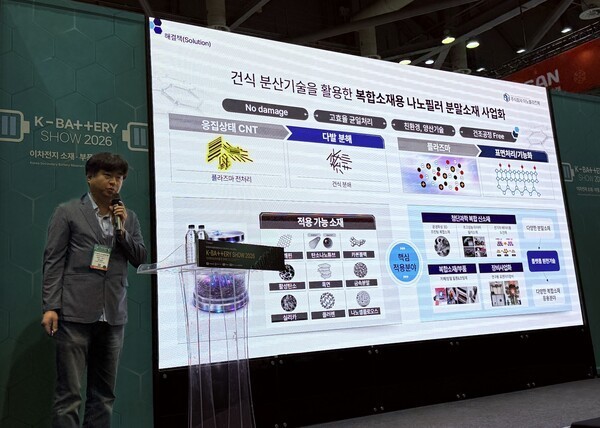
Inoplaztech CEO Lee Deok-yeon unveiled the company’s CNT conductive additive mass-production plan at the K-Battery Show 2026 Materials, Parts and Equipment Conference held Sept. 9 at KINTEX in Ilsan, Gyeonggi Province. Starting next year, the company plans to expand production facilities over three years to secure annual capacity of 100 tons. It plans to finance the investment through fundraising and programs including Scale-up TIPS, which supports the growth of small and medium-sized ventures.
CNTs are carbon materials used as conductive additives to improve electrical conductivity inside batteries. They can provide high conductivity in small amounts but tend to agglomerate, making them difficult to use as-is. A dispersion process is needed to separate CNT agglomerates and distribute them evenly throughout battery materials.
CNT conductive additives are currently produced mainly through a wet process in which CNTs are dispersed in a solvent using mechanical force. Dispersants are also used to prevent reagglomeration. The process can damage CNTs or leave residual dispersants that reduce conductivity. CNTs can also agglomerate again after the solvent is removed.
Inoplaztech disperses CNTs using plasma without solvents or dispersants. The process separates CNT agglomerates while treating their surfaces to suppress reagglomeration. Because the CNTs can be used as a powder rather than a liquid dispersion, they can be applied to dry electrode manufacturing.
Inoplaztech has been validating the applicability of its dry-dispersed CNTs with battery companies and others. It will now shift its focus from technology validation to securing mass-production capacity. The company expects annual sales of 20 billion to 30 billion won from its CNT conductive additive business once it reaches annual production capacity of 100 tons.
The company is also commercializing technology to improve CNT conductivity. The process uses plasma to attach nitrogen to the surface of multi-walled carbon nanotubes (MWCNTs), increasing their conductivity. Inoplaztech plans to begin selling nitrogen-functionalized MWCNTs as reagents by the end of this year. Such products remain relatively uncommon, with only three to four suppliers worldwide.
The goal is to improve the performance of relatively inexpensive MWCNTs so they can partially replace more expensive single-walled carbon nanotubes (SWCNTs). “Our long-term goal is to provide SWCNT-level performance at MWCNT prices,” Lee said.
Inoplaztech is also applying its plasma technology to other nanopowders. Nanopowder coating is a potential next business. As battery materials such as lithium iron phosphate (LFP) become finer, technologies capable of uniformly coating even small particles are increasingly needed. The company is considering plasma-based surface coating of fine powders as its next business area.
The dry plasma technology can also be applied outside batteries. Potential applications include polyethylene (PE) for battery separators, alumina fillers used in semiconductor thermal management materials and CNT composites for electric-vehicle tires. The underlying principle is the same: modifying surface properties so different materials can be mixed more effectively.
Inoplaztech is a nanomaterials company founded in 2018 as a startup by researchers from Ulsan National Institute of Science and Technology (UNIST). It has developed plasma technology that disperses aggregation-prone nanomaterials such as CNTs and graphene without solvents.