❌

Reading view

The moon may have formed in just 5 hours, new simulations suggest

The moon may have formed in as few as five hours after the cataclysmic collision between Earth and a long-lost protoplanet, new simulations suggest. The surprising findings could help shed light on other historic impacts throughout our cosmic neighborhood and beyond.

Experts strongly suspect that the moon was created when a Mars-size space rock called Theia smashed into an early version of our planet, back when the solar system was young and extremely unstable. This colossal impact likely would have turned the once-neighboring worlds into spinning clumps of molten rock that eventually coalesced and cooled into the versions of Earth and the moon we see today. Without this collision, which also may have left chunks of Theia buried deep within our planet, many scientists think that life may have never existed on Earth.

Lunar rocks collected during NASA's Apollo missions have provided evidence to support this theory, dubbed the giant impact hypothesis. These samples also tell us that the moon is around 4.5 billion years old, meaning the collision occurred roughly 100 million years after the sun was born. But although scientists have previously simulated the impact event, it has been tricky to ascertain exactly how the moon formed and how long it took to emerge after the Earth-Theia collision.

In the new study, published Sept. 1 in The Astrophysical Journal Letters, researchers conducted a series of simulations focusing on the varying potential geological properties of both Earth and Theia prior to their collision. This factor has been relatively understudied until now.

"When you simulate the Earth and the moon as colliding bodies with [different] geologic properties, it changes how the moon forms out of that impact β€” that's something we considered unnecessary before," study first author Adeene Denton, a geologist and planetary scientist at the Southwest Research Institute in Boulder, Colorado, said in a statement.
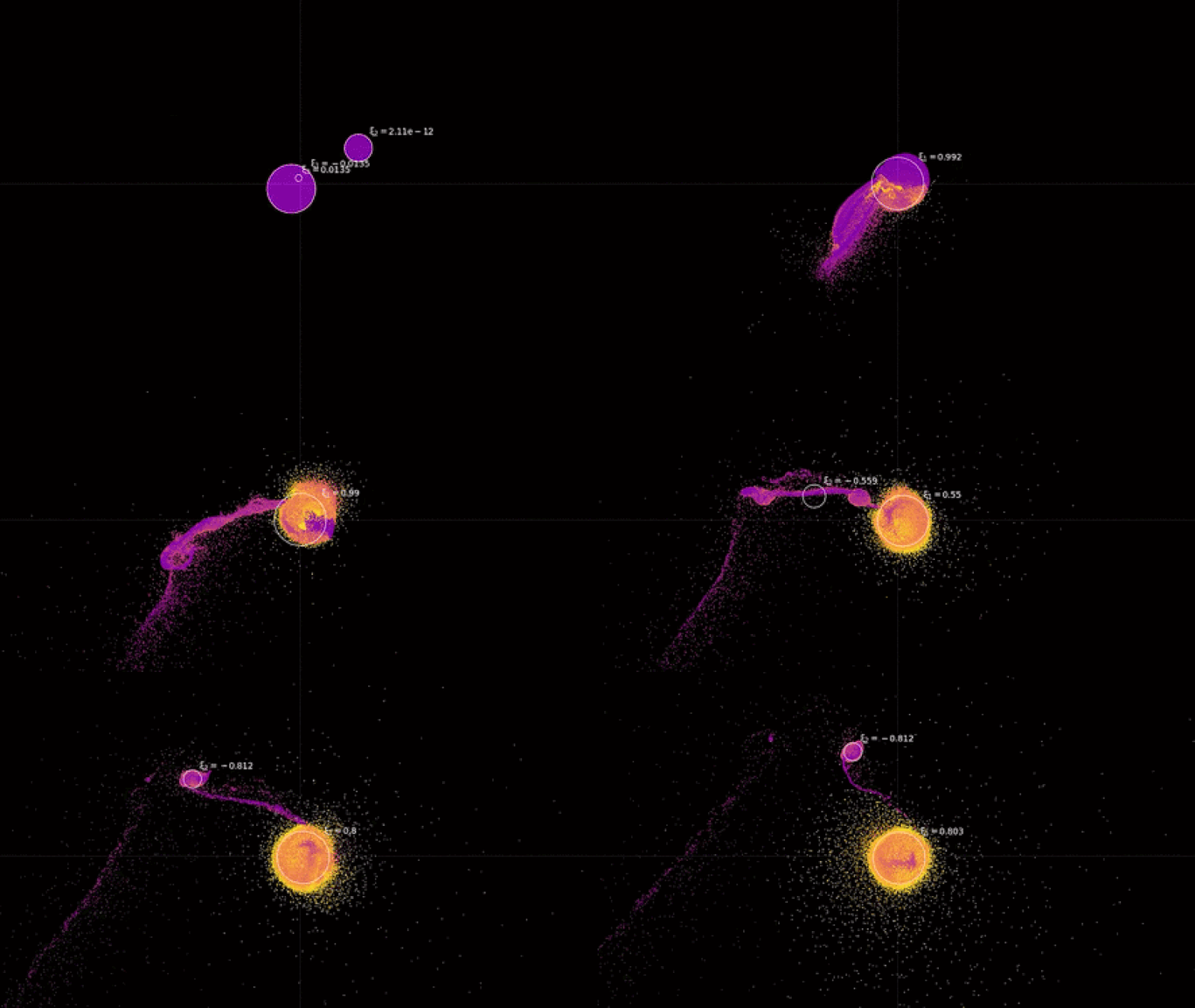
A GIF showing the simulation of the Earth-Theia collision and the resulting formation of the moon

Researchers simulated the ancient collision between Earth and Theia using a range of different geological properties and found that, with the right conditions, the moon could take shape in a matter of hours. (Image credit: Courtesy of SwRI)

Until now, simulations of the Earth-Theia impact have focused mainly on the masses of the colliding neighbors. But in the new study, the researchers were most interested in the material strength of the two bodies, particularly the hardness of their exteriors.

"Models have evolved to include material strength, something that's really important when you're studying collisions between smaller bodies like asteroids," Denton said. "We weren't sure if it would matter for the moon or not. When we did the simulations, we found it actually matters quite a bit."

The main factor in the strength of colliding bodies is temperature. Both Earth and Theia were very young when they smashed together, so they were still hot and had soft or molten surfaces. These properties would have cushioned the collision, allowing the debris to stay largely intact and enabling the moon to form more quickly. But when the giant impact hypothesis was first proposed (in 2001), researchers initially thought the collision occurred much later, meaning that the bodies would have cooled and become more brittle. In this case, their collision would have created a larger field of rocky debris that would have taken longer to coalesce.

Researchers simulated the collision using a range of potential temperatures and found that under the most extreme scenario β€” where the pair were at their hottest β€” the moon could have formed in just five hours. However, this is just one potential outcome, and there is no way of knowing exactly how hot β€” and, therefore, how strong β€” Earth and Theia really were when they smashed together.

When the moon took shape, it was initially covered with a magma ocean that took hundreds of millions of years to solidify. Even then, its increased proximity to Earth meant that it was likely a volcanic hellscape. However, over time, it moved away from our planet, cooling further, and it is now assumed to be geologically dead. (The moon is continuing to slowly move away from us and could eventually escape our planet's gravity entirely, if the dying sun doesn’t destroy it and us first in around 5 billion years.)

The new simulations highlight the importance of material strength in planetary impact modeling, which could change what we know about other ancient collisions, like the one that knocked Jupiter's moon Ganymede off its axis or the one that birthed Saturn's moon Titan.

Additionally, the findings could have implications in the search for exomoons β€” the hypothetical moons of distant exoplanets, which have so far remained elusive, according to Live Science's sister site Space.com. Until now, one of the main ways astronomers have been hunting for these alien satellites is by looking for debris fields around exoplanets. However, if the moon is anything to go by, these debris fields could be very short-lived and difficult to identify.
  •  

Earth's moon could have formed in just 5 hours after giant impact

The moon could have formed in a matter of hours following the giant impact between Earth and a Mars-size protoplanet early in the history of the solar system. The theory comes from new simulations that take into account how the internal temperature of young protoplanets affected their geologic properties and therefore the collisions they experienced.

This giant impact scenario has become the leading theory of how the moon formed, thanks in particular to work done by planetary scientist Robin Canup. Since 2001, she has conducted and refined numerous computer simulations that describe how a Mars-size body called Theia collided at an angle just right to throw debris into orbit around the proto-Earth.

Now other researchers are getting in on the act. Adeene Denton of the South-west Research Institute led a team who performed some of the most detailed simulations of the collision yet, taking into account more of the geologic properties of the colliding worlds.

"Models have evolved to include material strength, something that's really important when you're studying collisions between smaller bodies like asteroids or for my previous paper about the formation of the Pluto–Charon system," said Denton in a statement. "We weren't sure it would matter for the moon or not. When we did the simulations, we found it actually matters quite a bit."

It turns out that warmer bodies are weaker than colder ones. After the planets formed, they were still hot inside from their formation, which would have affected their material strength. Given that the moon-forming impact occurred not long after the solar system's formation, this would have affected the collision with Theia β€” but to what degree depends on exactly when the collision occurred and how much Theia had cooled.

As Theia smashed into Earth, it was utterly destroyed. While much of what was left of Theia's shattered iron core sank into the Earth, a large ring of debris wrapped around Earth to form the moon.

The main effect of the temperature being warmer in the outer few hundred miles of Theia was that it would have affected its ability to deform upon impact and absorb the momentum of the collision. This, in turn, would have affected how debris was strewn around Earth to form the moon. Therefore, by including varying temperatures and material strengths in the simulations, Denton's team was able to get a better look at how the collision and the resulting formation of our moon played out.

Previous simulations have shown two possible scenarios. One is that the ring of debris hung around for a substantial amount of time, allowing the moon to accrete from it gradually. The other scenario, first depicted in NASA-led simulations in 2022, implies that the moon came together from this debris in a matter of hours.

Now, Denton's models potentially bolster this startling possibility.

If Theia was colder, meaning that the impact occurred a little later in the history of the solar system, perhaps 100 to 150 million years after the birth of the planets, then the ring of debris would have formed in such a way as to allow the moon to accrete gradually. And because it was stronger, more of Theia would have survived intact to merge with Earth.

On the other hand, a warmer Theia that impacted Earth less than 60 million years after the planets' formation, would create a scenario where the moon could form very quickly while Theia itself would be obliterated.

"Depending on how hot the Earth and Theia are prior to the collision, the impact can destroy Theia and produce this massive disk of debris that eventually forms the moon," said Denton. "But when I used the same parameters as original impact modeling – down to the equal temperature structures inside both bodies β€” within around five hours, an intact moon emerged."

That would have been quite a day in the history of our planet, acquiring a new moon and an almighty headache all at once.

"These surprising and exciting new results imply a potential connection between the physical properties of the moon today, including perhaps its volatile content, and the thermal state of the Earth and Theia at the time of the giant impact," said the Southwest Research Institute's Robin Canup, who was not involved in this study. "This in turn might help scientists better constrain when the moon-forming event occurred."

In both scenarios, the moon appears to be made mostly from Theia's mantle material, with just a little bit of Earth's mantle mixed in. This latter finding is surprising, given the similarities between the moon's composition and Earth's mantle. However, research has shown that there's clearly more to the story because despite the similarities there are also some puzzling differences in the levels of isotopes that cannot be easily explained by current simulations, including Denton's.

The simulations could have repercussions in the search for exomoons. If the moon did form in a matter of hours, then searching for exomoon-forming disks around terrestrial exoplanets might be a fruitless endeavor because such disks would be so short-lived. Moon-forming disks around gas giant exoplanets would be a different matter, however, because those disks do not form from impacts, but rather from material leftover from assembling those planets.

The results were published on Sept. 1 in The Astrophysical Journal Letters.

  •  
❌