While Earth’s atmosphere is constantly changing, many spectacular storms and atmospheric waves on Saturn remain stable for decades or even centuries.
Images from NASA’s Voyager craft as it flew-by the planet in the early 1980s revealed a large and long-lived hexagonal atmospheric wave around Saturn’s north pole.
Yet despite decades of observations from other craft such as the Cassini mission, no similar wave has been reported in the southern hemisphere or elsewhere.
The researchers discover the phenomenon thanks to images from NASA’s Hubble Space Telescope as well as ground-based telescopes as the planet’s south pole came back into view from Earth due to Saturn’s axial tilt.
It seems that the 10-sided wave developed between 2023 and 2025 and may still be evolving, in contrast to the 40-plus years of steadiness shown by the hexagon.
The longitudes of the decagon’s vertices oscillate over a period of 32 days, and its movements suggest it may be trapped by the curvature of an atmospheric jet.
The researchers suggest the wave could have been created by a spatially periodic disturbance in the jet peak or driven by an “anticyclonic vortex” to its north.
However, further study is required to better understand how it formed and how it compares to the hexagon structure in the north.
“The most intriguing part to me is that this seems to have just formed recently,” notes study co-author Amy Simon from NASA’s Goddard Space Flight Center in Maryland. “The question is, why did it suddenly form now when we haven’t seen one before?”
As wildfires and extreme heat events rage across the world, “apocalyptic” has become an increasingly common descriptor. These climate disasters are not unprecedented, however. New research suggests they may have been the main mechanisms behind the mass extinction event that killed the dinosaurs – and much other life on Earth – 66 million years ago.
Our modern understanding of this extinction dates back to 1980, when the father-and-son, physicist-and-geologist team of Luis and Walter Alvarez presented evidence that it was triggered by an asteroid strike. Subsequent work identified the Chicxulub crater in Mexico’s Yucatán Peninsula as the likely impact site, but debate has persisted – including over how a single asteroid could cause worldwide destruction.
In the latest work, Brandon and Alexandria Johnson, a husband-and-wife duo at Purdue University in the US, fit another piece into this puzzle. By combining Brandon’s research on impact cratering with Alexandria’s expertise on the behaviour of atmospheric particulates, they found that the asteroid impact sent up a near-impermeable layer of dust that smothered the entire planet. Their research, published in Journal of Geophysical Research: Biogeosciences, breathes new life into a theory that had fallen out of favour: that extreme heat and wildfires were the main killers on the day the asteroid hit.
The key to ignition
At some level, this dust layer likely produced a cooling effect, much as large volcanic eruptions do today. Indeed, a previous study showed that condensed droplets of rock known as spherules would have blocked the Sun’s radiation from entering the atmosphere.
At the Earth’s surface, however, the Johnsons think the dinosaurs had the opposite problem. The impact also sent a massive plume containing over 1000 km3 of vaporized material high into the atmosphere. When this material rained down as spherules, the dust cloud’s potential cooling effect was reversed.
“[The spherules] are essentially adding energy back to the atmosphere by travelling through it to the surface. That energy has to go somewhere,” Alexandria Johnson explains. “What we found is that this dust layer over the planet is essentially acting like a lid, and it’s keeping almost all the radiation that should try to find its way back out to space and reradiating it back down to the surface. So it’s enough to not only kill the dinosaurs but actually start widespread wildfires.”
Both researchers were surprised at just how opaque this dust layer was. By their reckoning, it trapped almost all radiation within the atmosphere, allowing a staggeringly tiny upwards transmittance of just 10-286.
“I asked [Brandon] to redo my calculation, I was like ‘make sure these numbers are right’, because this is absolutely nothing,” says Alexandria. “I expected more than what we got to be reradiated out, but the fact that it doesn’t just enhances the whole idea of the heat pulse killing things off in a very quick manner.”
Based on the Johnsons’ estimated heat fluxes, any creatures that couldn’t shelter or burrow – dinosaurs included – would have suffered temperature-induced deaths within an hour or two of the impact. The radiation was also more than enough to ignite lichens, grasses and pine needles, destroying vast amounts of plant life through wildfires.
Never-ending night
Anything that survived the heat then had to face the darkness. “You would have had darkness lasting for a long time which then can cause collapse of the food chain in the oceans and cause oceanic extinctions,” says Brandon Johnson. The dust particles were about as small as those in wildfire smoke, and they may have blocked out the Sun for as long as decades before settling into what we now see as the K-Pg boundary: a rock layer a few millimetres thick that contains high levels of iridium, identified by the Alvarezes as coming from an asteroid.
Although some previousworks suggested that the impact couldn’t have ejected enough material to trigger such large-scale effects, Brandon says his analysis of rock vaporization thresholds indicates that the plume’s mass was big enough to facilitate the transport of material across the planet’s atmosphere. Without this transport, he adds, the wreckage would have been more localized to the Chicxulub impact site.
Given the interdisciplinary nature of the field, Brandon thinks there are many ways this line of research could continue. Possibilities include investigating the geological record in more detail and combustion experiments to better understand the wildfires’ impacts. He himself is hoping to carry out 3D impact simulations which can more accurately incorporate the vaporization of rock. “Essentially, [we want] to see what happens to that vapour and see if it is going to expand and be deposited globally as we expect,” he says.
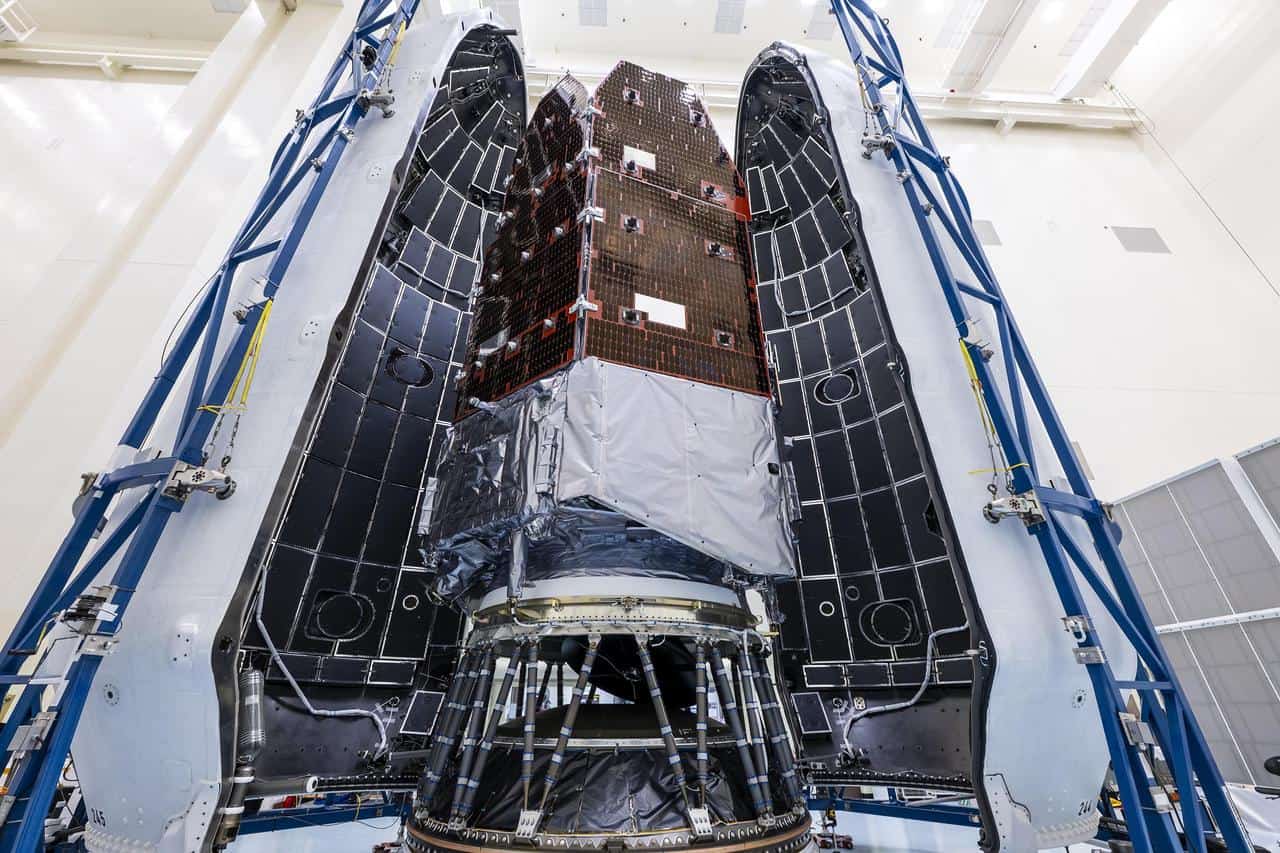
NASA has successfully launched the $4.3bn Nancy Grace Roman Space Telescope. The observatory took off atop a SpaceX Falcon Heavy rocket from Florida’s Kennedy Space Center at 7.26 a.m. local time on 30 August. The craft will now spend three months travelling to a point in space known as the second Sun–Earth Lagrange point (L2) where it will survey space with a field of view at least 100 times greater than the Hubble Space Telescope.
From L2, which lies about 1.6 million kilometres from Earth, the Nancy Grace Roman Space Telescope will yield insights into dark energy and dark matter, discover and characterize exoplanets, map billions of galaxies, and gain fresh understanding of black holes.
It will do so via a 2.4 m primary mirror that is accompanied by two instruments: a wide-field instrument will obtain images in visible and near-infrared light, while an experimental coronagraph will use masks, prisms and mirrors to cancel out the light from stars to help detect exoplanets.
“Roman will be a discovery machine that will bring us closer than ever before to answering humanity’s most profound questions about our cosmic history,” notes Nicola Fox, associate director for NASA’s Science Mission Directorate.
NASA intends the observatory to operate for at least a decade, with three specific surveys planned for its initial five years. The first will identify tens of thousands of distant supernovae, many more than the 2000 currently known, while a second survey will observe more than a billion galaxies.
Both these sets of measurements, combined with data from other survey telescopes, will be used to improve our understanding of dark energy and its potential role in the speed at which the universe expands. Their observations of gravitational lensing will also allow astronomers to map dark matter.
A third survey, meanwhile, will search the centre of the Milky Way for signs of gravitational microlensing that will reveal more than 2000 otherwise invisible exoplanets.
Space surveyor: the observatory will yield insights into dark energy and dark matter, study exoplanets, map billions of galaxies and to gain fresh understanding of black holes. (Courtesy: SpaceX)
Mother Hubble
The observatory was initially known as the Wide-Field Infrared Survey Telescope before it underwent several design changes due to cost pressures. In 2020 it was then renamed after Nancy Grace Roman (1925–2018), who in the early 1960s became NASA’s first chief astronomer and is known as “the mother of the Hubble Space Telescope”.
Yet the Roman observatory won’t replace Hubble or the James Webb Space Telescope, rather it will complement them, providing data from wide areas of the universe that those two instruments will then be able to observe in greater detail.
Indeed, Roman will survey the universe a thousand times faster than the Hubble, creating 1.4 billion terabytes (1.4 zettabytes) of information daily – the highest data rate of any NASA astrophysics mission.
NASA says that machine learning, artificial intelligence and “citizen science” will be used to help sift through the data and flag findings that astronomers will then study.
NASA administrator Jared Isaacman praised the mission as “exactly the kind of success story we want to see”. He noted that it was completed “ahead of schedule and on budget”, adding that it “will demonstrate what is possible when America’s space programme pairs bold ambition with disciplined execution”.
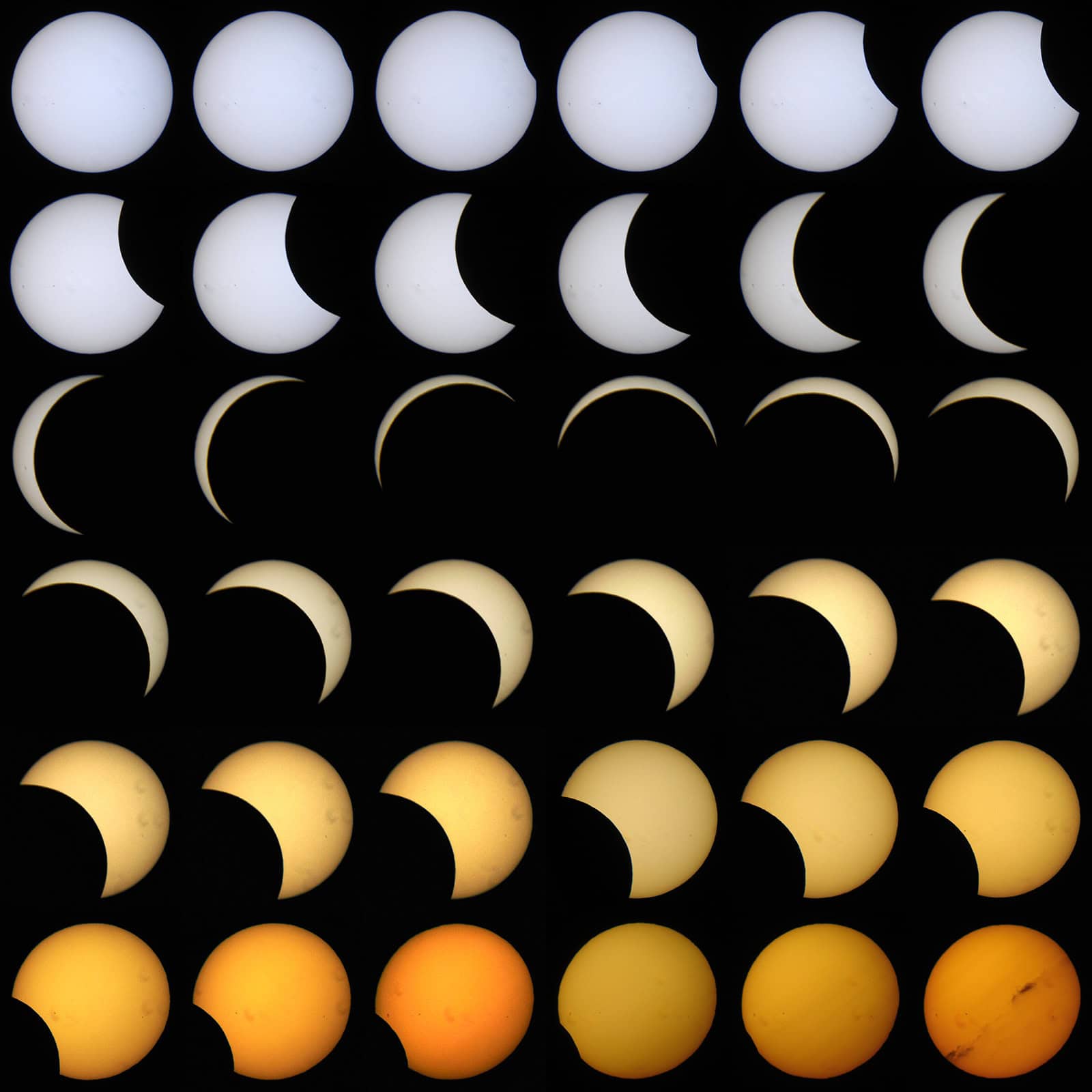
Packed with physics This photo montage of the 12 August 2026 solar eclipse as seen from the Isle of Wight, UK, holds a surprising amount of science. (Courtesy: Sean Ryan)
The UK’s hot, dry summer provided widespread clear skies for the solar eclipse that took place on Wednesday 12 August 2026. It was not a total eclipse – you had to be in northern Spain for that – but Britain still enjoyed a partial eclipse between around 6 p.m. and 8 p.m. BST, depending on location.
With typically more than 90% of the Sun’s disc covered – and with the event occurring after many people had finished work – the circumstances were ideal for a rare, immersive mass-engagement with physics.
Many people had got hold of eclipse glasses in advance or searched through kitchen cupboards for a colander to produce shadow patterns
Widespread public-awareness raising by professional and amateur astronomical societies had led to a strong build-up to the event in mainstream and social media. As a result, much of the public was aware the eclipse was coming, and many people had got hold of eclipse glasses in advance or, failing that, searched through kitchen cupboards for a colander to produce shadow patterns.
Here in the UK, friends and families gathered on west-facing hills, parks and village greens that evening with folding chairs, smartphones, cameras, telescopes and colanders, to enjoy the spectacle over a picnic tea. In built-up areas of towns and cities, many sought out west-facing windows of homes and offices.
I’m an old-school visual observer and recorded the eclipse sequence using 20-year-old equipment
While the eclipse on the UK mainland was deepest in Cornwall, I took my chances on the Isle of Wight, just off the coast of southern England.
Amateur astrophotography has been revolutionized over the last few years thanks to specialized high-sensitivity astronomical CMOS cameras, but I’m an old-school visual observer and recorded the eclipse sequence using 20-year-old equipment.
The montage presented here contains 36 frames spanning the entire eclipse sequence and packs in a wealth of physics. Besides the obvious relative motion of the Earth, Moon and Sun, three sunspot groups are visible, approximately delineating the solar equator; the camera was aligned with the sunspot groups and the equatorial mount maintained this orientation.
The Moon’s sharp-edged silhouette is a reminder that it has no atmosphere, whereas the Sun is brighter in the centre than the edge. Known as “limb-darkening”, it arises because of the temperature gradient of the tenuous solar photosphere – and is a reminder that the perceived edge of the Sun is merely a wavelength-dependent opacity transition.
While we often describe the Sun as yellow, the transmission profile with the OD5 solar filter that I used here gives it a slightly silvery-blue tinge. But as the Sun sank lower in the sky during the evening, wavelength-dependent extinction and scattering reddened the light, so the silvery disc progressively turns distinctly yellow and then orange.
Along with the colour change, the solar disc takes on an oblate form in the final row of frames due to differential atmospheric refraction close to the horizon. Terrestrial clouds close to the local horizon are seen in the final frame.
For many people viewing an eclipse for the first time, talk of intersecting orbital planes is perhaps already too much physics for one evening, but for those who wish to look a little deeper, more questions – and more physics – pop up the closer you look. What have you spotted in the montage that I haven’t?
The technical stuff
I took these images using a portable 90 mm diameter Maksutov-Cassegrain telescope (a Meade ETX-90) on an equatorial mount with a battery-powered drive, a full-aperture glass OD5 solar filter, and a 25 mm focal-length eyepiece paired in eyepiece-projection mode with a 5 megapixel Sony Cyber-shot CCD digital camera.
The camera was set for manual operation: minimum ISO (100), minimum aperture (f/5.6), fixed focus (achieved at f/2.8), and manually adjusted exposure time (1/400 – 1/13 s). Image processing was minimal, conducted using ImageJ software, which is widely used in biomedical imaging.
Shadowing of the sensor by dust on the lens surfaces was partially corrected by dividing through by a normalized clear-sky exposure. Frames were cropped manually and re-scaled in intensity to compensate for increasing atmospheric absorption as the Sun sank towards the horizon, and for changes of exposure duration.
Newborn and rapidly growing supermassive black holes could be powering the mysterious “little red dots” that litter the early universe. That is the conclusion of an international team of astronomers who have found the best evidence yet for a new kind of object called a “black-hole star”, which appears to be driving a little red dot that existed just 660 million years after the Big Bang.
“A little red dot is an extraordinary object,” says team leader Rohan Naidu, of the University of Hawaii and MIT. “Somewhere within it lies a black-hole star, surrounded by a good old fashioned galaxy.”
When the James Webb Space Telescope (JWST) began observing the distant universe in the summer of 2022, astronomers were astonished to find lots of little red dots. They are highly luminous as one would expect an active black hole to be, but their spectra are odd, looking more like stars with no X-ray emission.
Some astronomers believe little red dots are dense cocoons of gas incubating a growing black hole at their cores. As the black hole accretes gas from the interior of the cocoon, it radiates energy that is absorbed by the cocoon – making it glow brightly. This is similar to how stars shine, the radiation from their core heating their outer layers. Hence these hypothesized objects are dubbed black-hole stars.
Until now, however there had only been circumstantial evidence for this hypothesis. Part of the problem is that in most cases the light from the little red dots mingles with the light from the unresolved host galaxy, clouding the observations.
Miracle or mirage?
Naidu is co-lead of the Mirage or Miracle (MoM) survey. When pushing to high redshifts (further distances) with the JWST, it can be difficult to discern whether a faint red splotch is really a high-redshift galaxy or a cool star in the foreground masquerading as something from the early universe.
Now, MoM has found a black-hole star shining 100 billion times brighter than any known star, and drastically outshining its host galaxy.
Called MoM-BH*-1, the object is incredibly luminous at longer wavelengths, but below the wavelength corresponding to the Balmer series of hydrogen emission there is no light at all. This sudden drop in luminosity is called the Balmer break and is often seen in young stars.
“In MoM-BH*-1 the Balmer break is three to four times stronger than any we’ve seen ever before,” says Naidu. “This feature alone tells us there is something truly singular afoot, and that this is a new kind of astrophysical object.”
Extremely dense cocoon
Simulations modelling the Balmer break and the object’s luminosity strongly suggest that there is a 100,000 solar mass black hole at the centre of MoM-BH*-1, surrounded by an extremely dense cocoon of gas.
“The physics of how its light is being produced by this dense gas cocoon around this black hole is radically different from what we see around us in the local universe,” says Naidu.
If the object is indeed a black-hole star, a salient question is how did the black hole form? Numerous possibilities have been raised, from the direct gravitational collapse of a gas cloud to the merger of a cluster of massive stars.
Naidu favours an explanation involving a supermassive star – an object that could have formed about 150 million years after the Big Bang when the universe was dense with hydrogen and helium. According to many popular models, these conditions spawned stars thousands of times the mass of the Sun.
Recent outburst
Naidu points to the life cycles of the massive stars in the Milky Way, which top out at a few hundred solar masses. Eta Carinae, for example, had an outburst in the 1840s that made it the second brightest star in the sky for several days. The outburst from this 100-solar-mass star left a cocoon of gas called the Homunculus Nebula. A much larger supermassive star could have had a similar outburst and then collapse to a black hole, thereby creating a black hole star.
“In the past few months I’ve seen so much evidence for this, that at this point, it is the main hypothesis that needs to be proved or disproved because the similarities to supermassive stars are uncanny,” says Naidu.
Indeed, it is possible that every supermassive black hole in the universe could be a relic of the very first giant stars created just after the Big Bang. Over time these objects would steadily erode their gaseous cocoon, eating it away from the inside-out while radiation from accretion onto the black hole would blow away the remainder of the cocoon. This is supported by a recent discovery by NASA’s Chandra X-ray Observatory of a little red dot that existed 11.8 billion years ago and from which X-rays are starting to peak through holes in its shredded cocoon.
Naidu is suitably awe-struck by the possibilities, describing how “it’s inspiring to be witnessing the birth of supermassive black holes.”
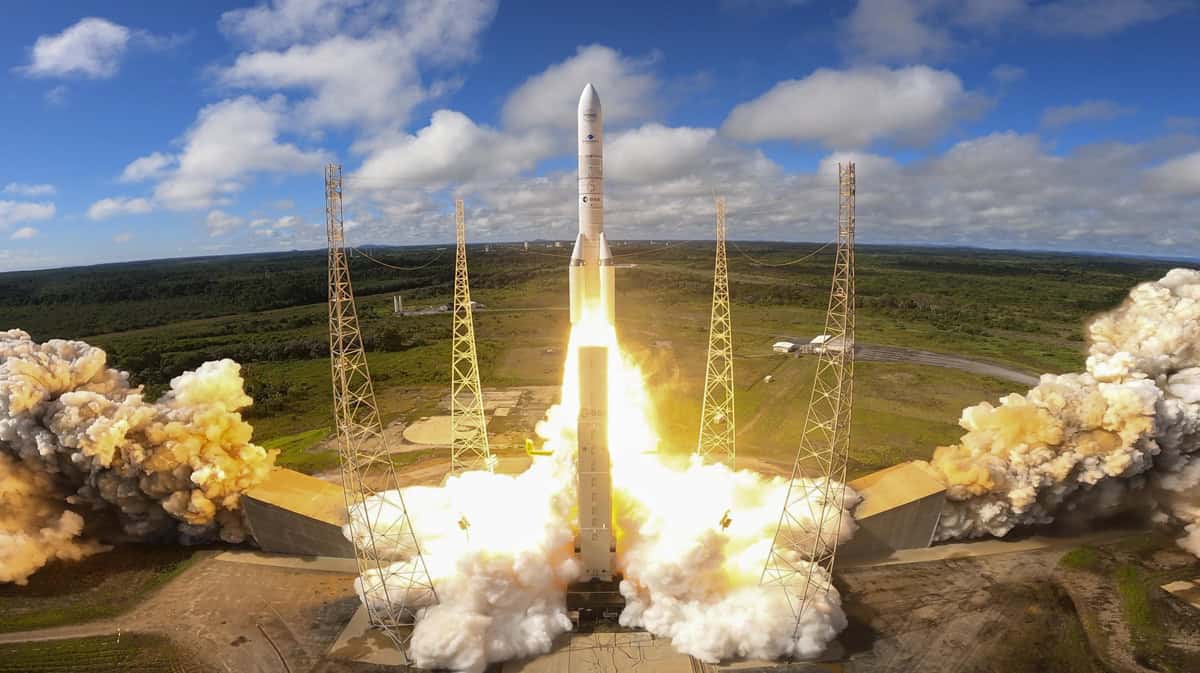
Multinational missions Ariane 6 is the latest rocket in a long history of launchers – demonstrating the power of multinational co-operation for more than five decades. More than 3000 staff are working at ESA to implement space missions for exploring the universe, protecting our planet or serving our daily life. (Courtesy: ESA)
The European Space Agency (ESA) is globally recognized for its iconic space missions that push the boundaries of science and technology, whether it’s a rendezvous with a comet, landing a probe on Saturn’s giant moon Titan or mapping the stars of the Milky Way in unprecedented detail. But ESA does so much more than these headline-grabbing scientific and exploratory endeavours.
“Space is no longer solely a playground for curious minds,” says Eric Wille, ESA Head of the Opto-Electronics Section. “It’s really important for our everyday life too.” In fact, modern society relies on space technologies.
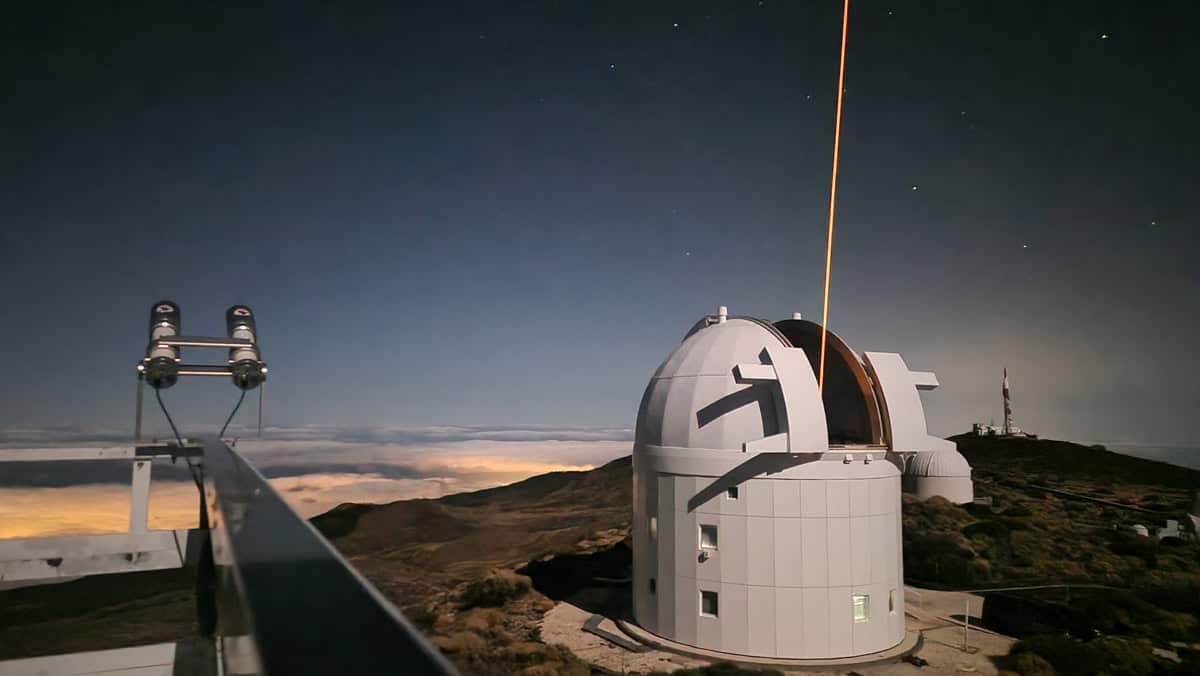
Project management The ESA Optical Ground Station in Tenerife is used to develop laser technologies for high-speed data links or quantum communication. The laser beam projects a guide star to control an adaptive optics system that improves the beam quality of the optical communication link. It is one of several ESA laboratories managed by Eric Wille and the opto-electronics section for testing optical systems for space. (Courtesy: ESA)
Satellite-based environmental monitoring, weather forecasting and global navigation are obvious examples, but there are many other important applications. For instance, the global financial system could not function without atomic clocks aboard satellites time-stamping millions of stock trades and digital payments every second. Similarly, when natural disasters strike, satellite networks become essential lifelines: mapping floods, tracking wildfires and helping with the co-ordination of emergency response efforts on the ground.
Fulfilling all of these roles and ESA’s bold space ambitions – from seeking answers to big questions about the universe to watching over our precious planet – requires a highly dedicated, technically proficient and multi-skilled workforce made up of scientists, engineers and various other professionals.
Diverse and challenging work
When Wille joined ESA as an optical systems engineer in 2009 after completing his PhD in experimental quantum optics, it was the sheer diversity of challenging work that attracted him. “Working in an international space agency, you’re partly a researcher, partly a project manager, partly also someone with ambassadorial skills,” he says. “That mixture is really something which I found at that time very attractive and I still like today, very much.”
Charlotte Pachot also craved a technically challenging role after her master in optics. She found it at Thales Alenia Space in France as a space engineer working on optical instruments. But after a few years, her interactions with ESA staff through joint projects convinced her to join the Agency as an optical engineer. She is now Lead Payload Engineer for the Laser Interferometer Space Antenna (LISA) mission, intended for launch in 2035, which will be the first gravitational wave detector in space.
Both Wille and Pachot have found that the technically challenging work at ESA is particularly satisfying because it has real-world impact. The first 10 years of Wille’s ESA career were largely spent on Athena (Advanced Telescope for High ENergy Astrophysics; now renamed NewAthena), a powerful X-ray observatory set to launch in the late 2030s that will provide fresh eyes on a wide range of hot and energetic processes in the universe.
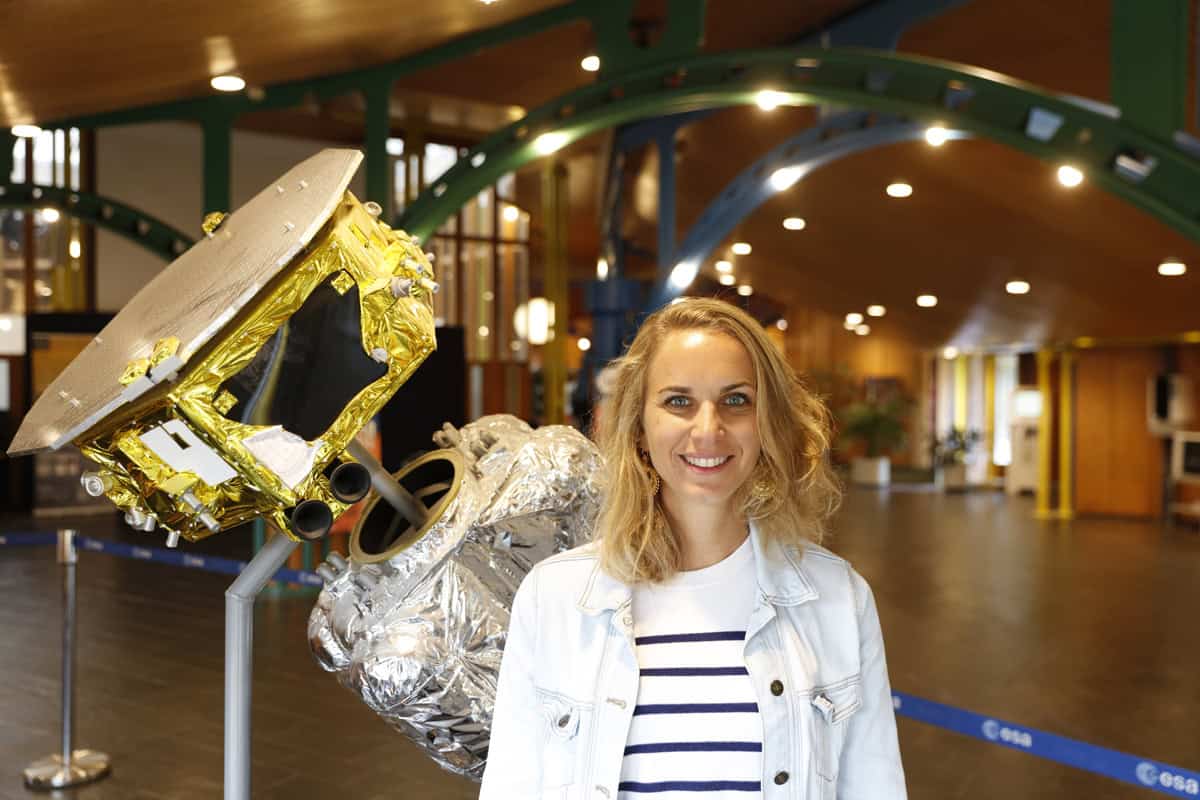
Charlotte Pachot is overseeing the LISA optical bench assembly. Next to her is a model of LISA Pathfinder that tested critical technologies in space in 2016. (Courtesy: ESA)
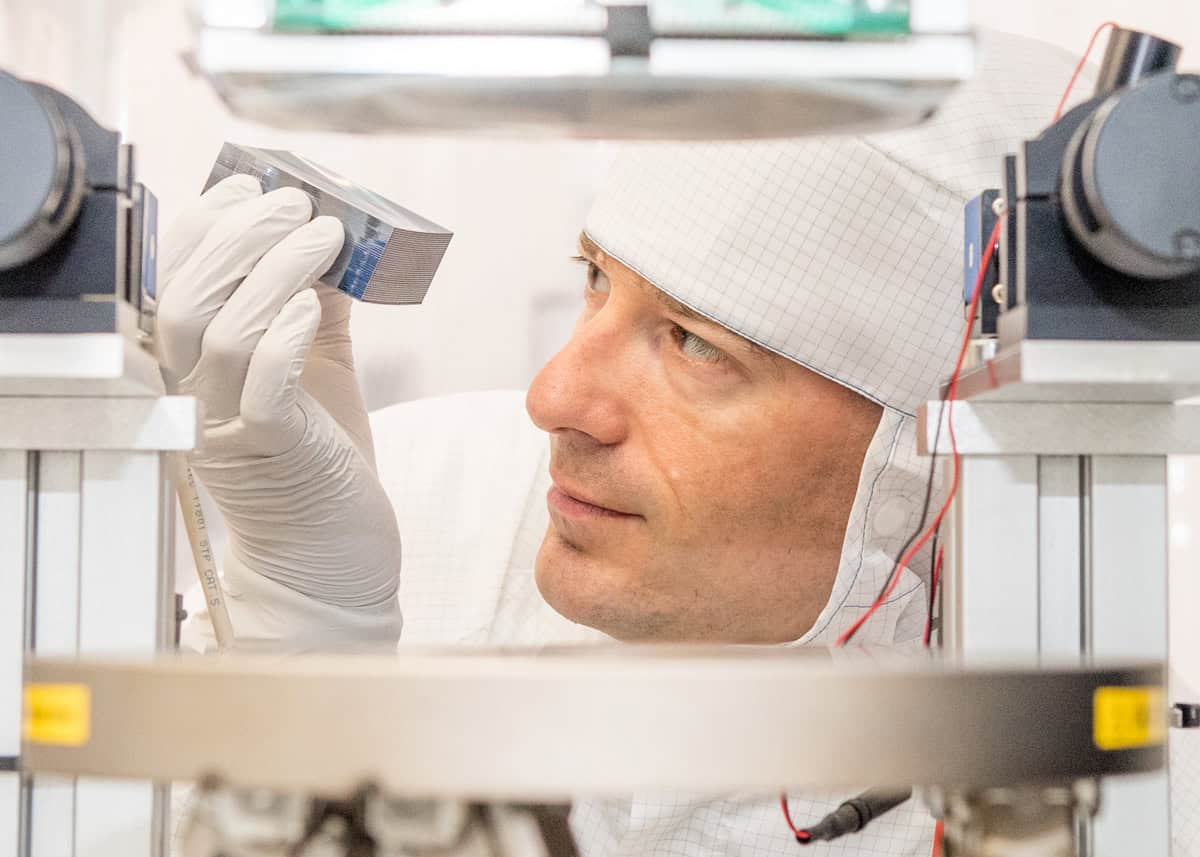
In this role, Wille and the ESA team collaborated with an industrial consortium led by Dutch measuring instrument supplier cosine to develop a completely new type of optics, called silicon pore optics. Using techniques perfected by the semiconductor industry, cosine bonded and stacked many silicon plates on top of each other. By shaping the plates, a lightweight mirror to focus X-rays was created; in fact, 10 times lighter than the ones flying on current X-ray missions XMM-Newton and the Chandra X-ray Observatory.
Like Athena, LISA will also provide fresh eyes on cosmic events, but through the unique prism of gravitational waves. This will be achieved through a completely new approach involving a triangle of three satellites spaced 2.5 million kilometres apart.
Understandably, LISA calls for a unique optical bench, which Pachot is managing from design to manufacturing and testing. She sees her role as being like that of a conductor of an orchestra: a lot of her time is spent co-ordinating team members and partners, while also helping to solve technical, budget and schedule problems. For Pachot, tackling these daily friction points is part and parcel of working on real-world big science. “The instruments are very complex technically, very challenging, but they are also real pieces of hardware as part of a real project,” she says.
International community
As Wille and Pachot’s stories show, ESA selects talent from different career stages. The Agency offers several programmes that support students, graduates and experienced professionals in finding the right role for their profile and interests.
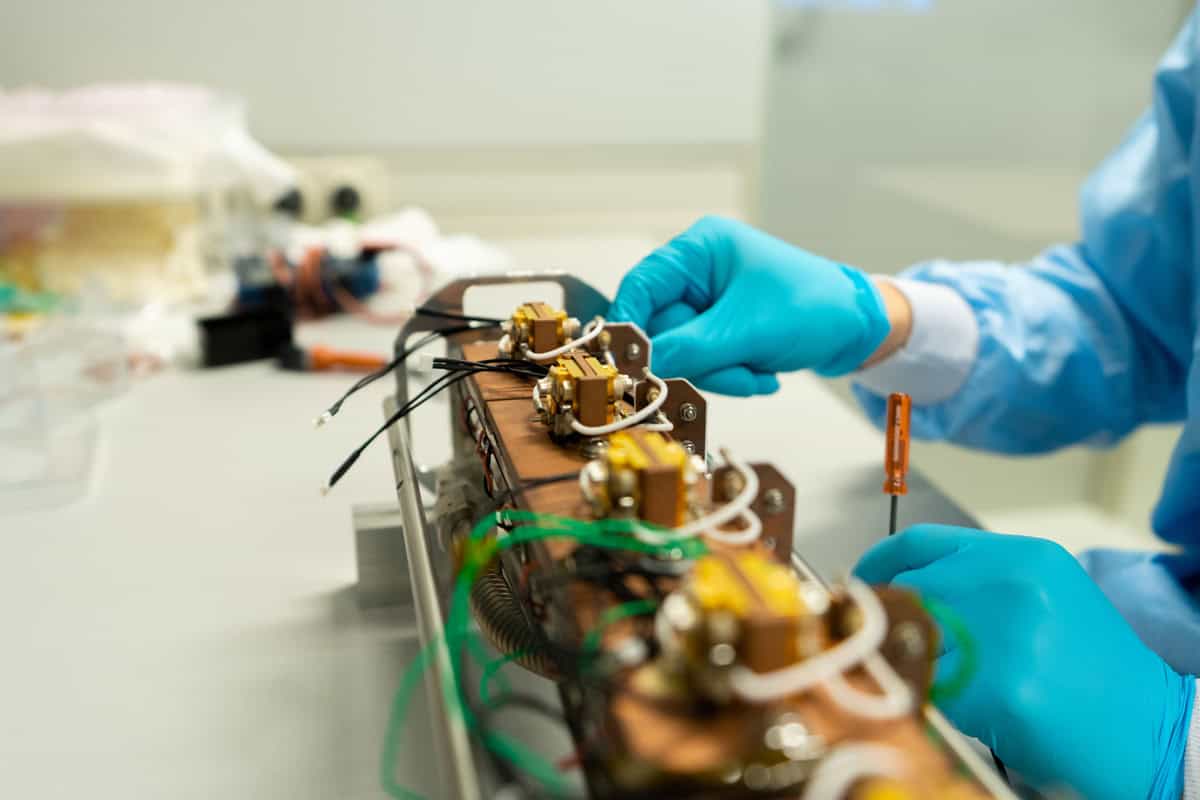
Device testing Lasers are used in many different space applications. Igniting launchers, high-speed optical communication, LIDARs for atmospheric measurements or for measuring gravity waves with LISA. The opto-electronics laboratory at ESTEC is frequently used to characterize the lifetime and performance of high-power diode lasers.(Courtesy: ESA)
For example, university students can benefit from ESA Academy sponsorship, such as participating in hands-on projects or training sessions. They can also join ESA as interns. Graduates can apply to ESA’s Graduate Trainee Programmes where they can gain experience on actual ESA projects and develop technical and professional skills. And for those currently in industry with less than three years’ experience, the Junior Professional Programme allows them to join ESA as staff members for four years and benefit from tailored learning and development opportunities to prepare them for a long-term position.
Whichever pathway they take, once new recruits get started in their first role, an excellent employment package – including competitive salary and pension scheme, hybrid working and flexible hours, and professional development training opportunities – comes as standard.
Eric Wille inspecting a new X-ray mirror using stacked silicon plates. The mirror was assembled using an automated stacking robot partially visible in the foreground. (Courtesy: ESA)
What sets ESA apart is the multicultural work environment. Team members might come from any of ESA’s 23 Member States and nine further Cooperating States and Associate Members. And recruits can be based in more than nine locations in seven countries (France, Germany, the Netherlands, Italy, Belgium, Spain and the UK). This makes for a melting pot of cultures.
“There’s a very lively expat community,” says Wille. “At the European Space Research and Technology Centre (ESTEC) and other big sites, it’s like a small Europe.” This cultural diversity is of course intentional. “The problems we have to solve require teamwork,” says Pachot. “And this is made easier at ESA because we all see problems in a different way depending on our culture.”
Working life at ESA
Want to learn more about working at ESA? Take a look at life at ESA and what ESA offers. Quickly find out which programme could be the best fit for you by following the pathways to ESA on this flowchart.
The first direct glimpse of vacuum birefringence has been claimed by astronomers who have studied X-ray and radio emissions of a neutron star that is both a magnetar and a pulsar. A central, but unconfirmed prediction of quantum electrodynamics (QED), vacuum birefringence involves the polarization of the quantum vacuum by powerful magnetic fields.
Made by a US-led international team, the observation could lead to the use of magnetars as natural laboratories to study other extreme-field phenomena of the quantum vacuum. However, another group headed by researchers in Italy remains unconvinced that the data constitute a “smoking gun” for vacuum birefringence. They believe that alternative explanations remain viable.
Birefringence occurs when the refractive index of a medium depends on the polarization of the radiation passing through it. When refraction occurs at such a medium, there is an angular separation of the two differently-polarized waves. This occurs with certain crystals such as calcite and lithium niobate, where the anisotropic lattice structure interacts differently with oppositely polarized photons. Birefringence can also arise from the interaction of photons with magnetic fields in plasma.
Virtual pairs
A key prediction of QED – first made in 1935 by Werner Heisenberg and Hans Euler – is that sufficiently strong magnetic fields can make a vacuum birefringent by polarizing the virtual electron–positron pairs that fluctuate in and out of existence. Ninety years on, however, vacuum birefringence had not been observed because the huge fields required cannot be generated in the laboratory.
“Having a natural lab already existing that could look into some of these effects is something that would be very beneficial,” says astronomer Rachel Stewart of George Washington University in the US. “That’s something people have probably been looking into for decades.”
Stewart and colleagues’ natural lab is a magnetar. These objects comprise a rare subtype of neutron star that have extreme magnetic fields of up to 1011 T. This makes magnetars the most magnetic objects observed in the universe and bright sources of X-rays. Data from NASA’s Imaging X-ray Polarimetry Explorer (IXPE) telescope have shown that this radiation is often polarized.
This is not surprising because the surface of a magnetar is likely to be surrounded by magnetized, birefringent plasma. The plasma’s field, however, should be tangled and variable, so the net polarization imprinted on light emitted into the far field should be relatively small.
Magnetic axis
If the magnetar’s intense magnetic field polarizes the vacuum of empty space, then the birefringence polarization imprinted onto the X-rays should follow the orientation of the magnetic poles into the far field as the magnetar rotates. Disentangling the two effects is difficult, however, because it is not generally possible to ascertain the orientation of the magnetic poles with respect to the direction of our observation.
A very few magnetars, however, are also pulsars that emit narrow beams of radio waves from their magnetic poles. The magnetic and rotational poles of a pulsar are misaligned, which causes the radio beam to sweep around like a lighthouse beam. If Earth happens to be in the path of the beam, we observe radio pulses.
In the new research, Stewart and colleagues observed the magnetar 1E 1547.0−5408, which is unique among observed objects for having persistent, bright radio emission alongside its X-ray emission. They combined observations from two space-based X-ray telescopes – IXPE and the Neutron Star Interior Composition Explorer (NICER) – with radio observations from Australia’s Murriyang telescope.
The radio observations allowed the team to the work out the angle between the magnetar’s magnetic and rotational poles and the angle between the rotational pole and the direction of our observation. This gave them the information needed to disentangle the two birefringence effects.
Large polarization
The researchers found a high degree of polarization in the detected X-rays – up to 80% at photon energies 2–3 keV in energy. They point out that this high degree of polarization is consistent with vacuum birefringence being driven by the magnetar’s powerful field.
The X-ray emission is closely aligned with the radio emission, which the researchers believe is naturally explained by the magnetic poles of the star being closely aligned with the rotational poles – and difficult to reconcile with alternative explanations.
However, another recent paper challenges this interpretation. Roberto Taverna of the University of Padova in Italy, who led the work, says that pairing the radio emission data with the X-ray observations was “very smart”, but he says that “it is not obvious to me whether the two observations – the radio and the X-rays – are compatible or not.” He says that, if the X-ray emission all emerged from one small region such as a hotspot slightly away from the radio polarization axis, the X-ray radiation would be polarized in the absence of vacuum birefringence. As a result he does not believe the observation is a “smoking gun”.
George Younes of NASA’s Goddard Space Flight Center in Maryland – part of the US group – argues that Taverna and colleagues are “ignoring about 60 years of radio pulsar science…They are hiding behind the fact that magnetars are different from pulsars, so we don’t know exactly where the radio emission comes from and all results are on the table,” he says, “but there are fundamentals that we should not ignore.”
The US-led team is now investigating further to see whether they can find more evidence for vacuum birefringence. Nuclear astrophysicist Hoa Dinh Thi of Rice University in Texas, who led the theoretical effort, is now modelling QED effects of magnetism on radiation in the plasma. “In the far future we also plan to use machine learning in the model so we can explore the different sources together and understand better the properties of neutron stars and magnetars.”
The image shows the Helix Nebula, a bright ring of gas that is located 650 light-years from Earth in the constellation Aquarius.
Resembling a giant human eye, its familiar ring formed from material expelled by a star near the end of its life. The remnant of that star, a white dwarf, lies at the nebula’s centre.
Astronomers trained the Modular Optical Telephoto Hyperspectral Robotic Array (MOTHRA) on the nebula while it was still being constructed at the El Sauce Observatory in Chile’s Coquimbo Region.
When complete later this year, MOTHRA will use 1,140 high-end telephoto lenses and filters that function as a giant 4.8-m aperture refractor telescope to detect the extremely faint glow of gas across large swaths of the sky.
In the image above, the MOTHRA data are shown in black and were collected in November 2025 using 190 or so lenses. These have been combined with previous observations made by the Hubble Space Telescope and the Kitt Peak 4 m telescope, which are shown in colour.
The MOTHRA data reveal a collection of 22 complete or partial arc-shaped glowing shock waves on the eastern side of the nebula.
Dubbed bow shocks, the waves resemble those that form in front of a boat moving through water. In the Helix Nebula, mostly invisible clumps of stellar debris dart rapidly through the thin gas among stars. The glowing bow shocks mark where those clumps collided with the surrounding gas.
By studying the image, astronomers traced the star’s debris as it is stripped, broken apart and gradually mixed into interstellar space.
“We are seeing material shed near the end of a star’s life being broken apart and returned to the galaxy,” notes Yale University astronomer Pieter van Dokkum, who led the study. “That handoff – from recognizable stellar debris to the diffuse gas between the stars – has been very difficult to observe.”

 Login