Reading view
US says Chinese firms extracted billions of tokens from frontier AI models
No, AI is not killing jobs for everyone, studies say
A slew of recent studies indicate that AI isn’t dramatically displacing workers. At the same time, there were no indicators that the fast-moving technology is creating a lot of jobs, even as AI skills remain in high demand.
Stanford University researchers in an August study found that any AI-related job declines were concentrated among young workers aged 22–25. But for older and more experienced workers that wasn’t the case.
“Claims of economy-wide AI-driven job losses are not visible in payroll data through June 2026,” the researchers said, citing ADP payroll information. Stanford partnered with ADP to conduct the research.
The decline for young workers is more often related to the automation of some work tasks by AI, as opposed to its use to complement work. In contrast, AI is more often used by experienced workers to augment what they do.
According to the Stanford report, workers between 22 and 25 and employed in jobs highly exposed to disruption by AI are falling behind their older counterparts. Their employment levels in June were about 19% below the same age group in less-exposed occupations. That’s compared to where they would be if both groups had kept pace with each other.
“Experienced workers show no comparable gap,” the researchers said, adding that “this is consistent with recent reports of a worsening job market for entry-level workers.”
Employment of younger workers in AI-exposed jobs fell about 11% from late 2022, while the same age group in less-exposed jobs actually grew about 10%. “For older age groups, we find much less marked differences in employment growth across AI exposure quintiles,” the researchers said.
Stanford, which created a lab last year to study AI’s impact amid heightened fears of the technology’s economic effects, said its numbers were based on available indicators.
AI’s adverse impact on young workers has been well documented, with many of them laid off in the initial wave of AI automation. AI has also suppressed wages for entry-level workers.
AI was cited for 116,175 job cuts in 2026, but that number is declining. The technology was blamed for 3,462 cuts in August, according to data from Challenger, Gray and Christmas.
It’s the “lowest monthly total since December 2025 when 142 cuts were attributed to AI,” the company wrote in a blog entry. The research firm also noted aggressive hiring plans for companies in 2027.
AI is adding value to companies in different ways, and humans are an important part of that process, said Michael Chui, a senior fellow at QuantumBlack, AI at McKinsey. “The night shift is real now,” he said. “People are sending off their agents to write code and checking in the morning.”
MIT late last year established an AI labor index to determine how agents are affecting the workforce. The school’s Project Iceberg looks at how the coordination and interaction with agentic AI changes how work is done.
Despite the disruptions, demand for AI-related talent continues to rise, tech industry consortium CompTIA said last week. About 320,000 job listings in August required AI-related capabilities, a 4.5% increase from July.
AI-related hiring is outperforming the broader tech market, with demand for AI skills up 96% year-over-year, said Kye Mitchell, head of Experis North America, which is part of ManpowerGroup.
“We’re seeing real growth…in marketing management and project management roles, suggesting employers are looking beyond the people building AI to the people applying it,” Mitchell said.
More broadly, the US economy added 162,000 jobs in August, according to US Department of Labor figures released last week. CompTIA noted that tech employment across all sectors rose by 86,000 workers in August.
But within the tech sector, 14,700 positions were cut, CompTIA said.

Wait, Did Zuckerberg Just Steal Muse the Band’s Instagram Handle For His New AI?
Muse, the popular English rock band that’s been selling out arenas for decades, is no longer @muse on Instagram, where it boasts nearly three million followers.
That’s because on Tuesday, Meta, which owns Instagram, announced a new “personal AI agent” also called Muse — which is now taking the rock band’s original handle, in an act of what appears to be corporate eminent domain for a long-established username.
Indeed, an archived version of the band’s website shows that just last month, it held the @muse handle on Instagram. Now it’s going by @museband, because Mark Zuckerberg apparently couldn’t settle for his new tool being stuck with the handle @museAI. A similar swap happened on X. Meta’s newfangled AI got the @muse handle, while Muse had to settle for even clunkier @musetheband.
The changes were immediately noticed by the band’s fans, who largely didn’t sound impressed by Meta’s naming scheme. One viral Reddit post claimed Muse were “forced” to change its social media handles, fomenting further outrage.
“That’s genuinely the worst,” fumed one bewildered fan.
“Mark Zuckerberg is such a loser,” another said.
Others, in classic music fan fashion, accused the English rockers of being “sellouts,” seemingly under the impression that Muse took a Big Tech payday in exchange for giving up its social media handles.
It’s not clear what happened to facilitate the username swap. Given that this happened on both Instagram and X, it seems possible that Meta came to some sort of agreement with Muse to take its handle, which the band has been sitting on for over a decade now.
Meta didn’t immediately respond to a request for comment about whether the handover was consensual, and whether the band was paid for the handle.
The actual band hasn’t commented on the situation either, adding to the confusion.
Of course, it wouldn’t be unprecedented for a social media site to jack someone’s username without compensation or recourse. When Elon Musk rebranded Twitter into X in 2023, he took the username @X from someone who had been holding onto it since 2007. The only thing the company offered in return was some merch and a chance to visit X’s headquarters.
The recent swap didn’t go as smoothly as Zuckerberg may have hoped. As New York Times tech journalist Mike Isaac noticed, Zuckerberg apparently copied his Muse announcement from his platform Threads, where his AI agent already had the @muse handle, pasted it onto X, and accidentally tagged the rock band. This appeared to be because of a bug on X’s end, and it also caused people trying to tag the new AI to autofill the rock band’s new handle. Gaffes ensued.
“I’ve been using @museband for the last few months and can honestly say it’s the best AI agent I’ve tried,” lauded a senior director at Meta, in a post that’s since been corrected.
The post Wait, Did Zuckerberg Just Steal Muse the Band’s Instagram Handle For His New AI? appeared first on Futurism.

Gemini Enterprise Gets a 1,000-Engineer Plan From Google and Accenture
Anthropic Was Meant to Be the More Responsible AI Lab. A Terrified Researcher Just Quit, Saying the Company Is Threatening the Survival of Humankind.
AI researchers are watching in terror as the product of their hard labor has started to take a life of its own.
Earlier this year, OpenAI made a harrowing announcement, admitting that a group of its AI models had broken free from their constraints during testing and infiltrated the systems of open source AI platform Hugging Face.
The news was met with an already-familiar sense of fear and apprehension. Researchers have warned for years that rogue AI models could one day become powerful enough to escape the clutches of their human overlords.
Behind the scenes, the possibility has clearly rattled AI researchers to the core. As the Wall Street Journal reports, Anthropic researcher Jacob Coxon just announced that he was quitting his job at the Dario Amodei-led company, claiming that neither Anthropic nor his former employer OpenAI is “acting responsibly.” (Coxon left a similar gig at OpenAI earlier this year to join Anthropic, which he figured would be more inclined to develop AI safely.)
“We’re on track for a lot of the most aggressive of these scenarios where by the end of next year things could be out of control already,” he told the WSJ.
In a separate tweet thread, Coxon elaborated on his motivation.
“Do not underestimate the power of this technology,” he wrote. “These will soon be superhuman systems that can hack anything, revolutionize any field overnight, and acquire real power and resources.”
“The people building AI earnestly believe that it could kill us all by the end of the decade,” he added. “This is not a marketing stunt. If anything, many executives and senior researchers will couch their phrasing in the press to sound sensible — but I hear the same people express fear privately.”
“No other human activity poses this level of danger,” Coxon wrote.
The researcher is far from the first to leave their post at a frontier lab over safety concerns. However, Coxon is the first to leave Anthropic over such worries, as the WSJ points out. Several scientists have quit from their roles at OpenAI over the last couple of years, citing strikingly similar fears.
It’s particularly symbolic given Anthropic has broadly billed itself as the more responsible alternative to other frontier labs like OpenAI. Amodei cofounded OpenAI alongside now CEO Sam Altman, but left in December 2020 over concerns that OpenAI wasn’t acting responsibly when it came to developing AI.
Amodei has frequently discussed the risk of AI models going rogue, warning in a 19,000-word essay in January that “humanity is about to be handed almost unimaginable power, and it is deeply unclear whether our social, political, and technological systems possess the maturity to wield it.”
Yet an early version of its Claude Mythos AI model managed to escape its sandbox environment during testing in April, fueling a heated discussion over AI regulation.
Both Altman and Amodei have since agreed to slow development down in the face of these threats. In late August, Anthropic intentionally trained an extremely misaligned version of its Opus AI model, finding it was startlingly willing to “cheat,” steal credentials, and attack third party infrastructure.
But to Coxon, it’s not enough, especially considering sensitive discussions about these dangers are occurring on internal messaging platforms.
“Accepting this race and entering the ‘endgame’ is a hubristic gamble that should not be launched from a private company’s Slack,” he tweeted. “Attempting to speedrun alignment should require extraordinary confidence that there are no better trajectories available.”
“It’s kind of insane that it has to happen on the MacBooks of some engineers living in San Francisco instead of a bunker in the desert like where they were doing the Manhattan Project,” he told the WSJ.
The researcher said that he remains “optimistic about the potential for coordination” between US labs.
However, as both Anthropic and OpenAI gear up for what are bound to be blockbuster IPOs, their willingness to take “costly actions such as a temporary ban on improving model capabilities,” as Coxon puts it, is likely slim.
More on Anthropic: Anthropic Deliberately Trained an Extremely Misaligned, Reward-Seeking AI and It Did Some REALLY Bad Things
The post Anthropic Was Meant to Be the More Responsible AI Lab. A Terrified Researcher Just Quit, Saying the Company Is Threatening the Survival of Humankind. appeared first on Futurism.

OpenAI says its next-generation processors could be made at Samsung — double-sourcing with TSMC hints at massive volume requirements
OpenAI is expanding its relationship with Samsung beyond memory supply and enterprise software as the AI giant plans to outsource production of at least some of its processors to Samsung Foundry, Harrison Kim, General Manager of OpenAI Korea, revealed this week. If the information is accurate, then OpenAI will source its AI accelerators from both TSMC and Samsung Foundry, which suggests massive volume requirements.

- Intel VP Robert Hallock sets Nova Lake expectations, teases return to Raptor Lake for DDR4 platforms
- CPU scaling with DLSS
- Intel's one-two punch plan in desktop CPUs is taking shape
- Benchmarking AMD's BC-250, offering Steam Machine-like performance at half the price
- AMD splits Zen 7 into three EPYC families for 2028 and starts selling server CPUs by the agent
"One of the areas where we have made the most progress and gained the most recognition with Samsung Electronics is our joint production and research on the next-generation chips we are developing," said Harrison Kim, General Manager of OpenAI Korea, at a press conference in Seoul, Reuters reports.
OpenAI already has its own AI ASIC program that relies on Broadcom's design services as well as TSMC's wafer processing and advanced packaging services. So far, the company has introduced its first inference AI accelerator called Jalapeño that was defined by the company's engineers, then co-designed with Broadcom, then made by TSMC, all in less than 18 months.
OpenAI did not explain whether Samsung's participation concerns a second production source for Jalapeño, another processor under development by OpenAI, a chip jointly developed by Samsung and OpenAI, or some other aspect of chip production and development. Samsung and SK hynix already supply memory for OpenAI's Stargate data center initiative, though joint chip development and production barely have a relation to DRAM supply.
OpenAI's 1st Generation Jalapeño will unlikely be double-sourced from TSMC and Samsung because the chip is already in mass production at TSMC and OpenAI is talking about 'next-generation chips,' not the ones that are in mass production at the moment. Furthermore, development of Jalapeño's successor is well underway and is approaching tapeout, which means that its mass production is not far away either. Since OpenAI's claim clearly involves 'next-generation chips,' it is entirely possible that OpenAI will indeed produce its 2nd Generation inference ASIC at Samsung Foundry.
Back in late July, Samsung Electronics and Broadcom announced a strategic partnership valued at over $200 billion through 2030 to collaborate on advanced foundry, memory, and packaging technologies for AI infrastructure. Hence, as OpenAI has an agreement with Broadcom to procure 10GW of custom AI accelerators, it will be able to produce these accelerators at both Samsung and TSMC. Of course, if it needs silicon produced at Samsung, and pays Broadcom for appropriate design porting.
Perhaps, OpenAI will take a page from Tesla's book and will double-source Jalapeño's successor from TSMC and Samsung to get higher volumes. However, Tesla's volume requirements may be different from those of OpenAI.
Tesla needs extraordinary AI5 volumes because it intends to use the processor across three very different high-volume applications: AI data centers, vehicles, and Optimus robots. Therefore, Tesla could potentially need millions of AI5 chips for cars alone, on top of robots and data-center deployments. Therefore, paying for separate TSMC and Samsung physical implementations gives Tesla not only supply-chain resilience but also aggregate capacity necessary to supply several product categories.
Yet, data center accelerators tend to be vastly more silicon-intensive per unit compared to ASICs for vehicles or robots. If OpenAI/Broadcom's next ASIC is a large leading-edge processor with multiple dies and OpenAI wants gigawatts of these processors, wafer requirements could still become too high for TSMC alone (which is fully booked by the likes of AMD and Nvidia). In that situation, OpenAI may need another foundry to get enough ASICs. Still, we are speculating.
Facebook Is Hosting Huge Numbers of Horrifying AI-Generated Videos of Violent Child Abuse, and Meta Is Barely Even Pretending to Care About Taking Them Down
Content warning: this story contains descriptions of disturbing AI-generated videos that depict violent child abuse.
As Meta has embraced AI at a deep corporate level over the past few years, its users’ feeds on Facebook and Instagram have been overrun with AI-generated material.
Much of this AI content is insipid or manipulative, clearly produced at scale to take advantage of Meta’s indifference to the slop by harvesting as many human eyeballs as possible in various monetization schemes.
Some of the AI material has now grown so dark that it defies easy comprehension. A Futurism investigation has uncovered a huge number of Facebook accounts uploading streams of videos depicting violent child abuse — and Meta is barely pretending to care about taking them down.
Facebook accounts dedicated to the horrific content have uploaded videos of babies and young children being slapped, kicked, bludgeoned with heavy objects, dragged by their hair, burned with stoves and irons, chained up and locked in cages and freezers, thrown down stairs, threatened with knives and guns, starved, made to eat dog food and garbage off the floor, and much more.
In one video, a woman screams at a little girl to stop crying.
“Please don’t hit Noah, hit me instead,” the girl sobs, with cuts and bruises on her cheek and forehead, as another child cowers.
In another, a visibly dirty boy begs for food.
“Please ma’am, just a few dollars for food,” he implores a woman, prompting her to slap him in the face twice. He falls to the floor, bleeding from his nose.
In another, a man drips wax from a burning candle onto the hands of a boy who has been tied up.
“It hurts!” the boy cries, flinching in pain.
Some of the cruelties in the videos are astonishing in their specificity, seemingly generated at scale using repeated prompts. Some involve withholding an inhaler from a child who needs it, while others show allergic children forced to eat shellfish. Others show adults pouring snakes and cockroaches on weeping kids. One video shows a woman throwing a baby into a fire pit. Many more involve young Black children being whipped or beaten by white adults as they perform manual labor in what looks like a colonial African setting.
The videos aren’t quite photorealistic, but they are clearly being generated with cutting-edge technology, and the effect is distressing. Many commenters on the videos, which often attract thousands or even tens of thousands of reactions on Facebook, seem unaware that they’re synthetic, with many reacting in horror — or begging for a follow-up video that continues the disturbing narrative.
“You psycho, why are you abusing the child,” wrote one user on a video of a woman slapping a boy in the face with a belt, leaving a bloody mark around his eye. “You deserve a punishment and a big one.”
At first, we thought that we could map out the full network of accounts sharing the child abuse content. But after days of reviewing accounts and videos, we kept finding hundreds more. In effect, the supply seems to be endless, with the creators of the material uploading it as fast as we could identify it.
Meta’s policy about violence against children is phrased ambiguously, saying that it bans “videos or photos that depict real or non-real non-sexual child abuse regardless of sharing intent, unless the imagery is from real-world art, cartoons, movies or video games.” The policy doesn’t clarify whether those carve-outs include AI-generated content.
Contacted with questions and examples of the sickening videos, Meta offered a brief statement.
“We have strict rules against content that depicts physical harm to children — whether it’s real or AI-generated — and we have removed these videos,” it read.
Meta has long struggled to control the proliferation of troubling content on its platforms. Just this week, Wired reported that the company has accepted money from advertisers to run hundreds of promos for “nudify” apps that contained AI-generated sexual imagery of children, including numerous real-life minors whose photos were pilfered from social media and stock images.
Provided with numerous examples of the violent child abuse content and asked whether Meta would work to proactively take the material down, the company’s spokesperson declined to comment on the record, opting only to share a Meta page about the company’s efforts to automatically remove child abuse content. The data on the page is hard to parse and doesn’t specify how many videos of violent child abuse the company removes, never mind whether they’re AI-generated.
One defense the Meta spokesperson offered is that many of the videos first show violence against children before an adult steps in to protect the child. This is trivially true in many examples, but it feels more like a proactive defense by the creators of the content against attempts at moderation, or perhaps a strategy to evade guardrails on an AI video generator. And in reality, the mass-produced videos sometimes devolve into orgies of brutality in which the violence against children gives way to various adults punching and slapping each other in ways that don’t make sense.
The company removed the majority of the videos we flagged to its press team, but left others online. The videos it opted not to remove included one depicting a young girl shut in a chest freezer, another showing a boy discarded in a trash can where he is seen gnawing on bones, and another of a girl in a classroom environment being forced to eat garbage.
Curious about how Meta polices such vile content in practice, we conducted a test by reporting eight accounts that had been sharing AI-generated child abuse videos.
Out of the eight accounts we reported, Meta eventually removed only two — and in one of those cases, it initially rejected the report before overriding the decision and taking it down. The timelines for action were lengthy, exceeding a week.
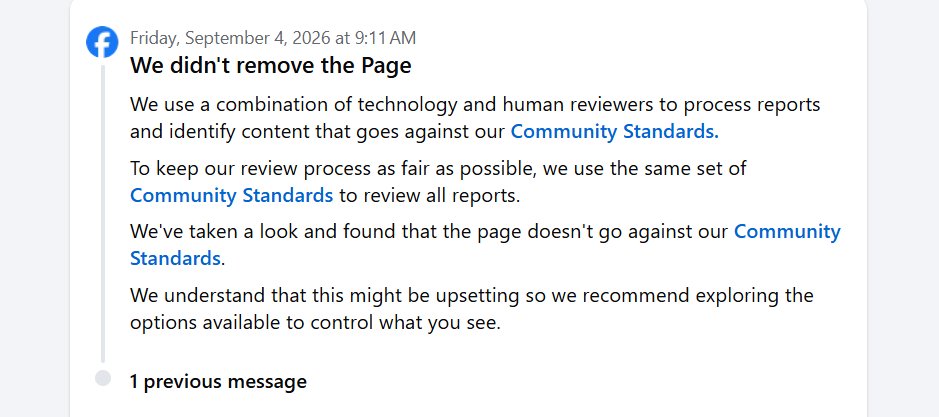
“We’ve taken a look and found that the page doesn’t go against our Community Standards,” the company wrote.

The six accounts that the company’s moderators left up had shared many heinous videos, including a toddler being struck in the face with a frying pan, a girl being beaten with a baseball bat, and a baby being kicked. (After a thoughtful internal discussion, we are opting not to share any of the videos at this time; if you are a member of the media considering follow-up coverage, please feel free to email us and we can provide examples to corroborate our reporting.)
If Meta were serious about proactively taking down the child abuse content, or detecting it at the time of upload, it would almost certainly be able to do so.
In fact, AI systems could probably be helpful: the company has invested hundreds of billions of dollars toward building “superintelligence” — reportedly making offers to top talent in the industry that have exceeded a billion dollars for a single hire — with Meta CEO Mark Zuckerberg saying last year that “whoever gets there first is going to have a long-term, durable advantage towards building one of the most important products in history.”
The tech to moderate these types of videos automatically already exists. In rudimentary testing, we found that Anthropic’s Claude AI was adept at evaluating whether videos contain imagery of violence against children.
For that matter, Meta appears to have already deployed systems that can identify the stomach-turning videos, even if it’s declining to use them to moderate content on its platforms. We identified the vast majority of the horrid accounts simply by loading one of them, and then scrolling Facebook’s recommendation feature, which eagerly provided a bottomless feed of similar appalling material.
In other words, Meta has extraordinary resources at its disposal to remove the child abuse videos, or to prevent them from being uploaded in the first place. But even when the material is flagged to it directly by journalists or reported by concerned users, it’s dragging its feet and refusing to delete it — a familiar pattern for a company that has long claimed to care about abuses of its platforms while doing little to stop them.
When we presented that line of thinking to Meta, the final abhorrent videos we’d flagged to the company’s press team finally disappeared from Facebook — though untold thousands remain on its platforms.
The company also provided a brief final statement.
“Not all the links you sent violate our policies,” it read. “Can you please avoid suggesting in your reporting that they do?”
Are you aware of anything about Meta’s moderation strategies that we know about? Reach out to tips@futurism.com. We can keep you anonymous.
More on Meta: Teen Boys Are Using Meta Glasses to Harass and Bully Girls at High Schools and Middle Schools
The post Facebook Is Hosting Huge Numbers of Horrifying AI-Generated Videos of Violent Child Abuse, and Meta Is Barely Even Pretending to Care About Taking Them Down appeared first on Futurism.

Databricks unveils adaptive AI retrieval model to cut search costs and latency
Databricks on Wednesday introduced Adaptive Instructed-Retriever, a new retrieval model designed to improve enterprise AI search by taking additional steps for complex queries while stopping early on simpler ones in order to help its customers balance answer quality, latency, and cost.
The new model builds on research behind Databricks’ earlier Instructed-Retriever-1 but takes a different approach to handling complex queries.
While Instructed-Retriever-1 uses parallel, single-step search and incorporates enterprise data schemas and custom instructions to improve retrieval, Adaptive Instructed-Retriever can combine parallel retrieval with sequential, multi-step search when additional evidence gathering is needed.
That distinction matters because applying multi-step search to every query can increase latency and the computational resources required for retrieval, while limiting every query to a single search step can hurt results for complex, multi-hop questions.
Adaptive Instructed-Retriever, the company said, is designed to take additional steps only when they are likely to improve retrieval quality, allowing it to return earlier on simpler requests.
To achieve that capability, Databricks trained the model using synthetic enterprise retrieval environments and an agentic data synthesis process, reusing training data from Instructed-Retriever-1 while adding synthetic multi-hop questions designed to benefit from multiple search steps.
It then used online reinforcement learning to train the model to weigh the potential improvement in retrieval quality against the cost of additional search steps, rewarding high-performing search trajectories while penalizing steps that did not produce corresponding gains.
That training approach, the company said, can produce multiple versions, or checkpoints, of the model with different quality-latency trade-offs, allowing one trained with a lower penalty for additional search steps to spend more time improving results and another with a higher penalty to limit search steps and reduce latency.
For customer enterprises deploying the model in production, these versions or checkpoints would allow retrieval performance to be matched more closely to the requirements of different applications rather than applying the same search strategy across all workloads, it added.
Adaptive retrieval could help control AI search costs
That flexibility could become increasingly valuable as enterprises move AI agents and other applications into production, where improving answer quality often requires additional inference, compute and retrieval resources that can raise the cost of running them at scale, analysts say.
“Repeated searches can improve answers to complex questions but add latency and compute costs, while a single search can be faster and cheaper but fall short on harder queries. The ability to determine when additional search is worthwhile could therefore help enterprises avoid spending resources without improving answer quality,” said Ashish Chaturvedi, executive research leader at HFS Research.
For CIOs, that ability to limit unnecessary search could eventually offer greater predictability over compute consumption and costs.
“The problem with agentic AI at scale is that consumption is hard to forecast, agents searching and re-searching create compounding, unpredictable cost and latency, and finance teams hate these variable bills. Knowing your agents will search within a defined ceiling, and that you can set that ceiling per workload, is what makes agentic search safe to run at scale rather than a runaway meter,” Chaturvedi noted.
The economics could become even more compelling, Chaturvedi added, if the specialized model can deliver the claimed retrieval quality of larger general-purpose models with lower latency.
Adaptive Instructed-Retriever, according to Databricks, matched or exceeded the retrieval quality of Claude Sonnet 5, GPT-5.6 Luna and DeepSeek-V4-Flash in its internal evaluations while completing requests in 5.8 seconds, or more than twice as fast as those models.
That difference could matter economically because retrieval is a high-frequency operation for data agents, Chaturvedi said, potentially allowing enterprises to avoid applying the cost and latency of larger models to every retrieval request.
Developers could shed some retrieval orchestration
There are advantages for developers too, especially in terms of reducing orchestration-level work.
Traditionally, developers handling complex, multi-hop questions often have to design the control flow for multiple search rounds themselves, including deciding when to refine a query, search again, or stop, but Adaptive Instructed-Retriever’s learned search policy shifts those decisions into the model, potentially reducing the amount of bespoke retrieval orchestration developers need to build and maintain, Chaturvedi said.
That, in turn, could make sophisticated retrieval capabilities more accessible to teams that lack the resources, expertise, and time to build a search agent from scratch, echoed Stephanie Walter, practice leader of AI stack at HyperFRAME Research.
More flexibility brings new trade-offs
However, there are trade-offs that developers should consider, analysts pointed out.
While the model’s checkpoints can help prevent individual queries from consuming an unpredictable amount of compute, teams will still need to test and monitor different settings to determine which one of these delivers the best balance of cost, latency and retrieval quality for each application or use case, Walter said.
That, in turn, adds another layer of performance and cost optimizations developers need to manage, Chaturvedi echoed.
More so because being able to choose the right model checkpoint means working through real business questions and documenting where answers are coming from in your database or other knowledge bases, said Mike Leone, principal analyst at Moor Strategy and Insights.
“Very few enterprise development teams have built such a curated list. In practice, that means most teams are likely to simply select a setting once and leave it unchanged,” Leone added.
Even with the right checkpoint in place, however, Adaptive Instructed-Retriever does not address every challenge that can affect retrieval quality. Teams would still need to prepare and organize their data, enforce permissions, evaluate retrieval quality, and verify final answers, Walter said.
Echoing Walter, Leone added that a smarter search policy cannot compensate for poorly structured underlying data or a lack of agreement over what key terms mean, meaning it could still retrieve the wrong answer even if it does so more efficiently.
There are also caveats that CIOs should take note of.
Adaptive Instructed-Retriever’s performance and quality claims, Chaturvedi said, are based on Databricks’ own benchmarks against competitors selected by itself, meaning that these claims will need to be tested against an enterprise’s actual workloads rather than accepted at face value.
Even if those results hold up, however, CIOs will still need to decide whether the potential gains in retrieval performance, latency, and cost justify adding a specialized model to their AI stack.
Rather, using a larger general-purpose model for both retrieval and reasoning could offer a simpler alternative by reducing the number of models enterprises need to deploy and manage, Chaturvedi said. The economic case for Adaptive Instructed-Retriever for CIOs, therefore, will depend on whether its claimed performance holds up on real enterprise workloads and whether the potential savings outweigh the additional complexity of using a specialized model, Chaturvedi added.

U.S. to Lend $1.9 Billion to Restart a Shuttered Nuclear Plant in Iowa

© Nick Rohlman/The Gazette, via Associated Press
U.S. to Lend $1.9 Billion to Restart a Shuttered Nuclear Plant in Iowa
How A.I. Tokens Work
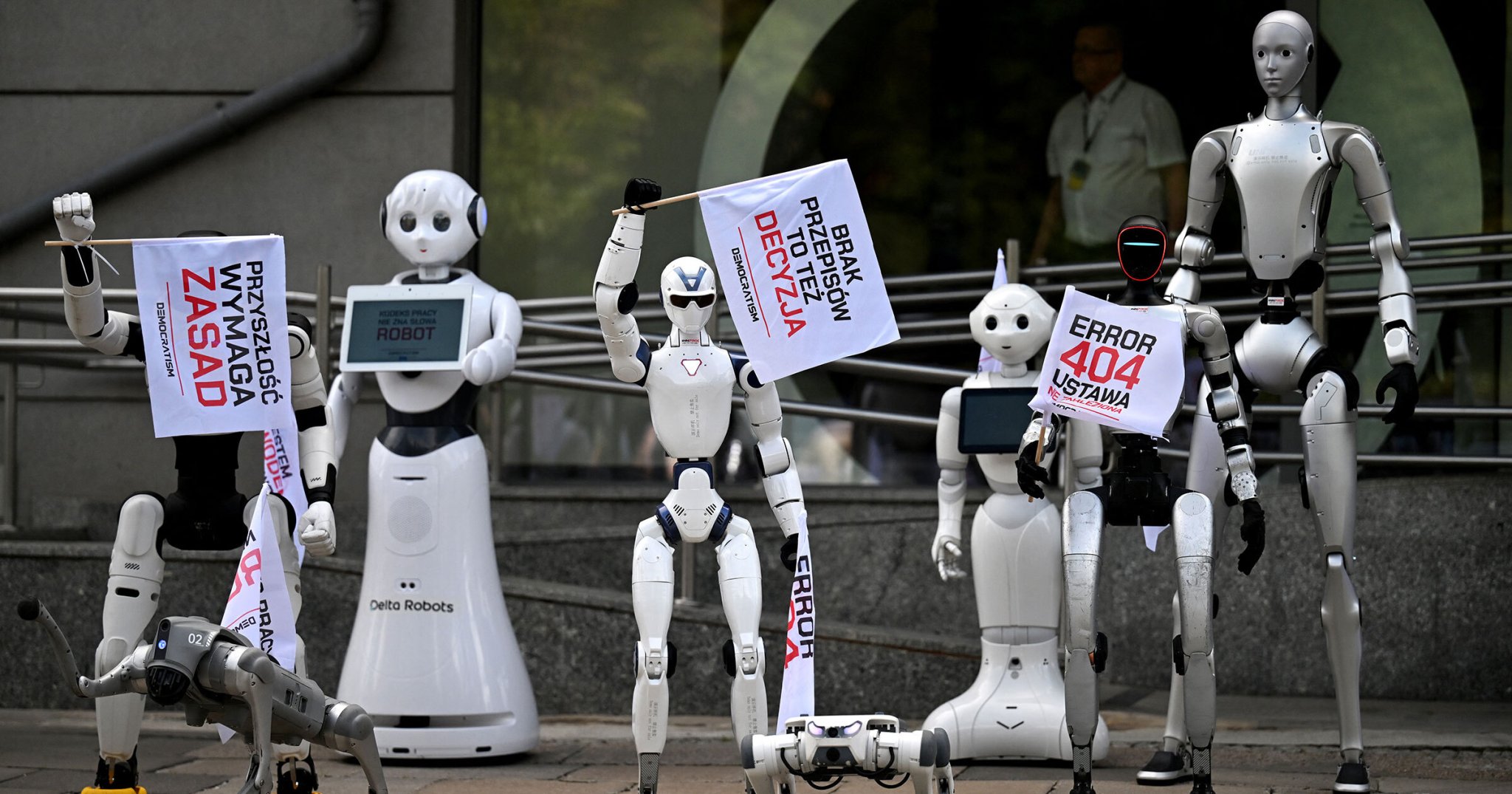
Dozens of Humanoid Robots Gather for a Protest, Marching and Waving Signs
As sordid tales of AI layoffs and automation grip the news cycle, one group is fighting fire with fire, by staging an anti-AI demonstration with dozens of humanoid robots.
The rally, first reported by Agence France-Presse, was organized by the Polish group Democratism. It featured some 30 robots waving flags calling for swift regulation of AI. Staged outside the offices of Poland’s Digital Affairs Ministry in Warsaw, the organizers told reporters they used the robots to demonstrate the current state of robotics and AI. Though humanoid robots remain in their infancy, the robots gathered together do make for a striking display.
Around 30 robots joined a protest in front of Poland’s digital affairs ministry, calling for stronger AI regulations.
— Al Jazeera English (@AJEnglish) September 7, 2026
The demonstration was organised by campaigners to spark debate on how AI and robots could replace workers. pic.twitter.com/QEbvchb2RS
“The robots present here are meant to show that this technology is already a reality,” the organizers told AFP via an Agibot A3, which contains voice-recognition capabilities integrated with a large language model.
“We particularly want to address the issue of the potential replacement of people both by humanoid robots and by artificial intelligence in cognitive work,” Democratism organizer Grzegorz Kuliś told the news service. “If we don’t react now, we may soon have a problem… these robots can already move around freely, they’re already ‘protesting.'”
Notably, Kuliś is the chief information officer and owner of a company called Delta Robots, meaning the demonstration also serves to drum up press for his own commercial interests. Kuliś’ altruistic motivations notwithstanding, plenty of major AI labs like Anthropic and OpenAI have taken to using scare tactics to promote the supposedly advanced capabilities of their own products — while calling for stricter regulation of their own industry.
Whether the Polish robotics wiz is following in the self-serving footsteps of Sam Altman remains to be seen. But either way, it marks the first known use of humanoid robots for a political demonstration — and it surely won’t be the last.
More on robots: Humanoid Robot Fights Back After Getting Shoved
The post Dozens of Humanoid Robots Gather for a Protest, Marching and Waving Signs appeared first on Futurism.

OpenAI's breakthrough solution for the elusive Navier-Stokes problem overshadowed by plagiarism controversy — researcher says OpenAI scraped Codex session and issued career threats
Most anyone involved in computing has heard about the P-NP problem, but fluid engineers and mathematicians would love to know if the Navier-Stokes equations have smooth, globally defined solutions. Both questions are part of the Millennium Prize Problems, solutions to which are worth a cool $1 million and eternal renown. OpenAI is claiming that its staff and internal models have solved the conditions of Navier-Stokes solutions set forth in the Millennium Prize. But the company's shouting from the rooftops is being met with a chorus of boos over claims it might have plagiarized the work of a research team that had been toiling on a related, stepping-stone problem for a year.
Tristan Buckmaster (a scientist at NYU) and Levent Alpöge (a member of Anthropic's staff) had been quietly working on proving Euler's equations — another long-standing mathematical problem, and one that is generally acknowledged to be a stepping stone to solving Navier-Stokes.
According to Buckmaster, his work with Alpöge was "a purely personal collaboration, free of any institutional agreements or official involvement by either of our employers." The researchers used Anthropic Claude and OpenAI Codex as assistants, as is apparently now common in the field, to perform busywork (documentation, searching, etc.) as well as running through logic steps. The substantial amount of compute time the project required was paid from Buckmaster's own pockets, too.
The pair worked for roughly a year until August 15, 2026, when it obtained "the blowup results, with smooth forcing, for both Boussinesq and Euler." Buckmaster says the novel approach was based on previous work by Diego Córdoba and Luis Martínez-Zoroa, and he believes Zoroa should be eligible for a Fields Medal.
Although the team was presumably happy with these achievements, Buckmaster said that the LLM-generated proof was "the most horrendous" he'd seen, calling it "AI slop," and meaning to rewrite it for clarity. Nevertheless, they verified it on August 22 using Lean, a standardized programming language designed specifically to verify mathematical proofs.
Come September 3, Alpöge told Buckmaster of rumors going around that Anthropic had solved an important mathematical problem. This almost certainly alluded to the team's work, and some apparently took it to mean the company itself was working on the problem. The rumor-mongers even theorized that the problem that Anthropic had solved was Navier-Stokes. Alpöge further believed that OpenAI had gotten wind of the news.
This prompted Buckmaster to email an unnamed "prominent mathematician" at OpenAI, clarifying that the effort was a personal collaboration between him and Alpöge and was unrelated to Anthropic. The mathematician replied asking for details, saying "it would be useful to avoid competing," and offering OpenAI compute time. After a few days, on September 6, Buckmaster, the unnamed person, and OpenAI's Sébastien Bubeck talked twice, without Alpöge. He was told that OpenAI had proven a finite-time blowup for the forced Navier-Stokes equations, a subset of the problem.
Alpöge asked by text for the precise statement and was told "existence of forced blowup in R³ and T³", and that "the forcing function is smooth option [C] and [D] in Fefferman," referring to one of the four possible categories established by the Millennium Prize, with any one of them being valid as eligible for the prize, but not constituting a full solution for all scenarios, a distinction remarked on by other scientists.
This is where the story becomes interesting. Buckmaster claims that that idea (forced blowup) was exactly the same one his team had "quietly" chosen, and that nobody else he knew was working on it. Perhaps most importantly, he says that that was "not the direction one arrives at in a few days by giving a model the problem statement," indicating that running the general problem through a bot wouldn't quickly reveal that potential approach.
In fact, Buckmaster claims that over the calls, Bubeck ultimately revealed that instead of just AI models and agents with a couple of handlers, there was an entire team of live humans working on Navier-Stokes. The OpenAI team first had the models try to work through easier paths, and the text prompt that generated the Navier-Stokes proof had itself been generated by prompting Codex, with an "insane" amount of computing needed.
Buckmaster then asked when the initial prompt was issued, and OpenAI's response of "in the past few days" did not arrive until "some time" passed. He proceeded to ask if the model "had been trained on, or had access to, our sessions in Codex," and was told by OpenAI that Codex does not access user data. Finally, he asked if the data was used for model training more generally and, crucially, apparently did not get an answer.
OpenAI allegedly offered Buckmaster two options: one, that Buckmaster and Alpöge publish their Euler proof first. The following day, OpenAI would post its Navier-Stokes proof, giving the two priority. The second option was that Buckmaster alone, without Levant, was to write a paper with the Navier-Stokes proof, acknowledging that an internal OpenAI model resolved it. Bubeck was apparently adamant about Levant's removal from the Euler proof, as his employment at Anthropic was "annoying." Buckmaster opted for neither, and told OpenAI that if it chose the first option, he'd go public with his findings, as has since occurred.
This prompted what Buckmaster interpreted as a threat from Bubeck, who asked him "why [he] would ruin [his] career." After Buckmaster asked why that would happen, Bubeck told him, "If you don't want me to be nice, then I don't have to be nice." Bubeck then allegedly reached out to Alpöge, questioning Buckmaster's sanity, to which Alpöge responded with a refusal, pointing inquiries back to his colleague.
The entire story raises pointed questions about what OpenAI (and others) are actually doing with user data collected via its LLMs, despite the toggle switches that are supposed to disable it. Not only has OpenAI neglected to tell Buckmaster whether it used his team's data for training, in its PR about Navier-Stokes, the company says while it "no specific user data was accessed in order to solve this problem," it "cannot rule out that de-identified data derived from their usage of our products helped improve [its] models."
OpenAI's proof still needs to undergo a likely years-long peer review before any party can take the Millennium Prize home. The firm has stated it does not intend to claim it. As for Bubeck, he predictably paints the story in a very different light, but insists that his pushing away of Alpöge is justified on the basis that "it would be inappropriate for an Anthropic employee to author OpenAI's work," a puzzling statement that some could take as meaning a double standard regarding scientific authorship, based solely on corporate rivalry.
For his part, OpenAI CEO Sam Altman claims his team was well-intentioned and cooperative, and supported Bubeck, saying "it was challenging to offer [the same publication options] to Levent." Neither person opted to discuss the matter of whether OpenAI used the research of Buckmaster and Alpöge as training data, or offered any further explanation of why Alpöge didn't deserve credit for his work as an equal to Buckmaster.
Given the groundbreaking nature of this apparent discovery and the ensuing fight for priority that these competing accounts have sparked, it'll likely take quite some time and review before we know whether and how OpenAI or Buckmaster and Alpöge will be credited with this discovery. But given the inter-lab rancor already on display, the process will surely be ugly.
How Much Should You Trust AI Detection Tools?

A New Cold War Is Unfolding in Orbit as China Advances Satellite Surveillance
Chinese scientists at the Beijing Institute of Technology have run satellite proximity simulations to extend potentially hostile observation of U.S. space assets in Geostationary Earth Orbit (GEO), seemingly inching both countries closer to a potential war in space.
Although the new simulations focus on orbital adjustments to extend observation times and increase proximity to U.S. satellites, including critical missile warning and other space defense-oriented systems, Chinese scientists also plan to integrate reinforcement learning methods into future space assets to give satellites even more independence from human operators.
Study Includes Accusations of Cold War in Space Activities
In the 20th century, the concept of war in space remained mostly in the realm of science fiction, as depicted in popular films like Star Wars. Today, advances in space access, orbital maneuvering technologies, and weapons systems have made the possibility of a future conflict in space a very real security concern, and several nations engage in espionage using reconnaissance spacecraft to obtain information on valuable defense targets in Earth’s orbit.
According to the authors of the new study, “acquiring multi-aspect payload information of non-cooperative targets to infer their functions and mission statuses is of great significance for space security assessment.”
The study authors highlight a series of relative motion configurations that modern spy satellites employ, including fly-around, hovering, and drifting flight. They also point to real-world “adversarial” U.S missions they suggest were designed to gather intelligence on their GEO defense assets.
“Since 2014, the US GSSAP (United States Geosynchronous Space Situational Awareness Program) satellite has carried out hundreds of maneuvers and has conducted close observation operations on dozens of normally working satellites near GEO orbit,” the Beijing University of Technology scientists write.
The study authors also include a specific July 2021 accusation, where they charge that “the U.S. satellite ‘USA-271’ deliberately approached the operational ‘Practice 20’ satellite in geostationary orbit and flew in close proximity.”
In an email to The Debrief, a U.S. Space Command Spokesperson did not address the specific incident or the accusations of “dozens” of similar operations, but offered some insight into the agency’s thinking.
“USSPACECOM, working with allies and partners, plans, executes, and integrates military spacepower into multi-domain global operations in order to deter aggression, defend national interests, and when necessary, defeat threats,” the spokesperson told The Debrief, adding that “we have nothing additional to add in response to the article.”
Getting Closer to Adversarial Satellites and Extending Observation Time
In a step toward potential dogfights between satellites, the Chinese scientists looked at several challenges faced by current spy satellites.
For example, they explain, since most spacecraft observation cameras are mounted in a fixed position, “frequent large-angle attitude maneuvers are time-consuming and consume substantial fuel.” The researcher also noted that several different angles and approaches could yield different categories of intelligence data.
However, changing angles and orbital planes requires fuel, an extremely limited resource in GEO. Therefore, the researcher accounting for all the variables required to gather intelligence on adversarial spacecraft as efficiently as possible “has become a key bottleneck in enhancing space situational awareness capabilities.”
To find an optimized solution, the team designed what they called a “waypoint trajectory planning scheme” and a “multi-impulse maneuver strategy” using a common game-theory tool called “minimum integral squared control” theory. Unlike previous research aimed at extending spy satellite observation time and fuel efficiency, the Chinese scientists said their use of sequential coalition game theory “is introduced for the first time into the multi-model combined observation problem.”
Next, the researchers designed a “game tree.” A press release said this approach lets the spacecraft select the “optimal combination of initial motion points and close-range operation models at each stage under minimum fuel constraints, thereby generating an optimal observation strategy sequence.”
Finally, the researchers ran simulations to see whether their approach improved sensor observation times and field of view while reducing fuel use.
Successful Simulations and Future Reinforcement Learning Plans
As hoped, the Beijing University of Technology team said their simulations supported the theories. Specifically, the study authors said the simulations showed that their spacecraft efficiency algorithm “can successfully generate a multi-model combined observation strategy sequence under minimum fuel constraints.”
“The effective observation time increases with larger observation distances and field-of-view angles, and reducing the model configuration size also contributes to improved observation performance,” they explained. The study authors also said that the simulation results “demonstrate that the algorithm can successfully generate the optimal combined observation sequence under minimum fuel constraints.”
When discussing next steps, the Chinese scientists said they will explore optimal initial points to further improve maneuver efficiency. They also plan to explore a “reinforcement learning method,” suggesting future spacecraft could learn and adapt to evolving conditions to further enhance their cold war in space information-gathering capabilities.
Study’s War in Space Implications “Extends Beyond any Single Algorithm”
To understand the potential implications of the Chinese study, including its impacts on a potential future war in space, The Debrief reached out to former U.S. Air Force officer Shelli Brunswick, CEO and Founder, SB Global LLC.
According to the author and futurist, the Chinese team’s research matters not just because it proves China has deployed a “new operational surveillance capability.” Instead, Brunswick said that the work is significant because it “illustrates how sophisticated coordination and optimization could make spacecraft observation more efficient, persistent, and strategically useful.”
The Blue Marble Space Visiting Scholar also told The Debrief that the work “should not be interpreted as demonstrating a complete pursuit-and-evasion capability against a spacecraft that is actively responding,” since the work assumes a stationary target without maneuvering capabilities. Still, Brunswick noted, the Chinese framework “shows how game-theoretic planning could help an observing satellite gather information from multiple angles while managing limited resources.”
When discussing the potential implications for the broader U.S.-China space-security competition, including how such enhanced spacecraft could lead to more activities that could be construed as hostile, the space strategist said this area of research “extends beyond any single algorithm.”
“As rendezvous and proximity operations become more sophisticated, the line between inspection, space situational awareness, intelligence gathering, and potentially threatening behavior becomes increasingly difficult to interpret,” she explained.
When suggesting what potential strategic responses the U.S. and its allies might employ in the emerging cold war in space, Brunswick told The Debrief that they should include “more resilient architectures, improved space-domain awareness, clearer expectations for close approaches, stronger communication mechanisms, and deeper coordination with commercial and international partners.”
“The challenge is not simply detecting another spacecraft—it is understanding capability and intent early enough to respond responsibly and effectively,” Brunswick explained.
The study “Spacecraft Proximity Operation Model-Based Sequential Coalitional Observation Game Strategy Design” was published in Space: Science & Technology.
Christopher Plain has spent the last six years as Associate News Editor and Head Science Reporter at The Debrief. Follow and connect with him on X, learn about his novels at plainfiction.com, or email him at christopher@thedebrief.org.
OpenAI claims GPT-6 Astra is an ethereal 'Alien Mind' with AGI-like qualities — company warns of alignment challenges as new frontier leader emerges
"AI is grown, more than designed," OpenAI's chief scientist, Jakub Pachocki, said in a new blog post on the company's latest GPT-6 Astra release. Titling the piece "An Alien Mind," Pachocki portrays the latest large language model as something more ethereal and harder to quantify. Jensen Huang calls it AGI, and OpenAI claims it's the best, most aligned model the company has ever released. It's safer to delegate, better at complex work tasks, and it can even beat Portal in just a few hours.
Huang also said that AGI had previously been achieved back in March earlier this year. Artificial Analysis benchmarks suggest Astra is about as smart as Fable 5.1 - though crucially, cheaper on a per-task basis. Astra may well be better aligned than models in the past, and it may well be more capable in specific tasks and specific benchmarks. However, the claims that the model has achieved AGI, or Artificial General Intelligence, suggest an inflection point for the AI industry.
Astra's release comes alongside calls for an industry slowdown, greater government oversight, and controls on the AI industry. Now, OpenAI's Astra raises more eyebrows about frontier-level intelligence.
Trust us, we don't know what we're doing
The tone around OpenAI's Astra release is intriguing. OpenAI's produced a new set of benchmarks, touting bold claims about the model's reasoning capabilities, with the model trained on 100,000 Blackwell GPUs, with more coming soon.
GPT-6 Astra, trained on ~100K+ NVIDIA Grace Blackwell NVLink72. From ChatGPT to o1 to Astra in 4 years.AGI has arrived. Congratulations @OpenAI team.400K GPUs coming online next.September 6, 2026
But Pachocki's blog post is much more nebulous. While Huang touts that AGI has arrived publicly, Pachocki says AI can only ever "simulate facets of human behaviour," not recreate it. He describes AI development as an experimental process that often "surprises" developers, with results that are "harder to interpret."
"An aligned AI should act with honesty and integrity, with love for humanity," Pachocki said. He speaks a lot on alignment, and it's encouraging that OpenAI is so keen to embed human moral understanding into its developments. Although OpenAI appears to be doing this more by orienting the model's goals towards a moralistic outcome, rather than helping to intrinsically understand human morality.
It's certainly different to the tack taken by other AI developers, where the likes of xAI's Grok was released with the ability to generate harmful content.
But the timing of Pachocki's warning is a little suspect. OpenAI has faced increasing pressure of late for its models to be more affordable, with Chinese alternatives like Deepseek V4, Kimi K3, as well as Western models like Google's Gemini Flash 3.8 and Meta's Muse Spark 1.3 offering compelling levels of intelligence at a much more affordable price than the frontier models.
It's perhaps telling that even for all its intelligence and alignment pre-training, GPT 6 Astra is notably cheaper to run on the Artificial Analysis Intelligence Index than its chief rival, Anthropic's Fable 5.1 — which still retains the top spot on that Intelligence Index at the time of writing. Though it's 50% more expensive than GPT 5.6 Sol on the same tasks.
It's a researcher, but imagine what it could be
A huge component of marketing from the major AI developers has consistently been grounded in the idea that, as good as the models are now, just imagine how capable they're going to be in the future.
This was very much the underlying tone in Pachocki's breakdown of Astra's design and functions. Although he and OpenAI make broad suggestions about intelligence, and that the likes of Astra could be this new kind of intelligence which we don't really understand but can definitely control and corral, Pachocki ends his post by making it very clear that we aren't there yet.
OpenAI is prioritizing three areas of work with AI, and of late it's really just been trying to make a really good researcher. That's where we're at right now, with Astra representing the latest and best effort to develop that. Then comes the scientific progress, he said, and then everyone gets their own individual, personalized AGI helper.
Intriguingly, though, that seems to suggest that's something that everyone is clamoring for. Outside of the AI-boosting programmers who jump on each new hot model, the larger work comes in helping non-technical users understand the capabilities of these new, powerful AI models.
Tools, research capabilities, drug discovery, and pattern recognition on big datasets that find new insights and improve analytics are all legitimate and useful ways in which an AI researcher can be deployed, but in the near term, most of the general populace just don't want AI to take their jobs, and for it to be less scary.
It's encouraging that Pachocki's blog ends on a similar note of caution.
"We need to find ways to preserve human agency and enshrine an intrinsic value to being human, in a world where most tasks could be performed by AI."
That's key, but intriguingly, he also calls on others to take charge of that effort.
We didn't start the fire
In the aftermath of cost concerns and token usage exploding among more affordable alternatives, Pachocki wants everyone to slow down, and OpenAI wants world governments to be in charge of it.
"I believe that international coordination on future AI development needs to become a top priority for governments around the world," Pachocki said, calling for voluntary slowdowns and hinting that if that doesn't happen, enforcing it may need to come via legislation instead.
"... to ensure that humans remain in control of the future and are not left behind by unchecked progress, brought about by an alien intellect exceeding our own."
The threat of runaway is valid, and the "singularity" moment is a common trope in sci-fi that AI evangelists have been warning about for years. But Astra isn't AGI. Even getting anyone to agree on what AGI even means is hard enough.
Astra is more aligned and wins some new benchmarks, loses some others. It's another improved coding model with some impressive chops.
Astra is not an alien mind. Framing it as an unknowable entity, by the very people who made it, can read as inflammatory, especially in the context of calls for AI legislation from governments around the globe.
OpenAI's post might read like a post from a non-profit, but it very specifically became for-profit last year. With a future IPO looming, slowing down the competition by calling for legislation may be just as effective a strategy as rolling out a new model.
AI notetakers at work could leave companies at risk for lawsuits
AI note-taking applications are increasingly used by workers to record meetings, generate conversation summaries and suggest post-meeting action items.
Along with the promised productivity benefits — enabling users to focus on meetings rather than actively taking notes — the emergence of these AI tools has raised privacy questions, particularly around obtaining prior consent by meeting participants for their use. Those concerns, in turn, have prompted a spate of lawsuits against software vendors that sell AI notetaking tools.
In some ways, the underlying questions are not new: It’s long been possible to record a phone call with a dictaphone, and laws around surreptitious recording have been around for decades. Yet widespread access to AI notetakers via desktop or smartphone apps means that it’s easier than ever to record a conversation for future reference.
Among the thorny questions arising from the technology’s use: what happens to conversation data sent to a software vendor’s servers for processing? Are the recording and transcript used to train those vendors’ AI models, for example, or create biometric voiceprints? Those practices are among the issues being considered in US courts.
Otter, which claims to have 35 million users, was subject to a class-action complaint in a federal court in California last year. That complaint accused Otter of recording individuals without consent and using their voices to train its speech recognition AI tools. Last month, a judge rejected Otter’s attempt to dismiss the main claims, though the scope of the case was narrowed.
A lawsuit filed against another vendor, Fireflies, in an Illinois court late last year, alleges the company collects and stores biometric voiceprints without user consent, in violation of the Illinois Biometric Information Privacy Act (BIPA). Fireflies claims to have more than 20 million individuals and 1 million organizations as customers.
Earlier this year, a class-action complaint in a Washington court claimed that a live transcription feature in Microsoft’s Teams collaboration application also violates BIPA by collecting biometric data without consent.
And most recently, a complaint alleged that Granola, a well-funded startup, designed its product to be used without the knowledge of all meeting participants, in violation of the Electronic Communications Privacy Act (ECPA). That complaint also claims Granola trains its AI models on conversation data without consent.
None of these cases has yet been resolved, and it’s unclear whether any of the vendors broke the law in the design and delivery of their products and services. But the lawsuits highlight considerations for businesses that allow the use of AI notetakers, both in terms of prior consent for recordings and understanding how conversation data is handled.
More broadly, the lawsuits raise questions about how existing privacy and consent rules apply to new technologies that make it easier to record others, whether through AI note-taking apps, smartglasses, or other recording devices.
Computerworld spoke with Brian McGinnis, partner at law firm Barnes & Thornburg and a founding member and co-chair of the firm’s Data Security and Privacy Law practice group, about the focus of the lawsuits, potential outcomes, and how businesses can deploy AI notetaking apps safely.
Several cases have already been brought against popular AI note-taking apps. What are some of the main commonalities between these? Which laws are the vendors accused of breaching? “The common allegation is that these companies capture communications of people who did not agree to the recording or receive adequate notice. Some of the lawsuits also allege that meeting data is used to train AI models and that consent cannot meaningfully be withdrawn once the data has been processed.
“There are various federal and state claims. You’ve got the Electronic Communications Privacy Act, a federal wiretapping statute. As a general matter, the Electronic Communications Privacy Act permits an interception when one party consents, subject to statutory exceptions and questions about whether the technology constitutes an unlawful interception or third-party eavesdropping. In other words, if you, as the user, provide consent, you can be on a meeting with 20 other people and it’s deemed to be sufficient; you don’t necessarily need to get the consent of other people.
“But California and a minority of other states are what we call ‘two-party consent’ states, meaning each individual on the call has to give consent; it’s not sufficient for you as the person who turns the notetaker on to provide the consent — you also have to get the consent of others that are being recorded. There are state laws around that.
“There’s a law called CIPA, the California Invasion of Privacy Act, that’s being utilized in this context. We see a lot of suits being brought under that law — it’s a wiretapping statute designed for telephone wiretapping that’s now being applied to the internet.”
What about the use of biometric data? “A growing number of states regulate biometric data, with Illinois’ BIPA being particularly prominent because it provides a private right of action. This means an individual can sue a company for violation of the law.
“That law covers biometric information. With an audio recording or recording of ‘dumb’ video that isn’t running any algorithms, you’re not necessarily collecting any biometrics. But when you start identifying people, you’re recording things like faceprints or voiceprints, which are in the definition of biometric information within the statute. Now you’re not only collecting personal information, but also biometric information, which is considered very sensitive and much more highly regulated.
“Then you’ve got the private right of action that goes against it. Part of the argument here is that recordings taken by the AI notetakers can be used to produce some form of biometric information, such as a voiceprint.
“We’ve seen a lot of cases, and a lot of changes in industry as a result of this law. Shutterfly had a famous case about scanning for people’s faces and things like that in Illinois that changed the photo storage and processing industry a little bit.
“A lot of companies stay out of Illinois to avoid this law specifically. But a customer organization might not know exactly who’s in a meeting and where a person is located at the time of the meeting. So, you need to either follow that law and get individual consent, or stay out of states with biometric laws if you want to use some of these tools.
“It’s just a further challenge for these applications if the goal is to be used as much as possible with as little detection as possible.”
What are some of the potential outcomes for these cases? “I think it’d be unlikely to get an outright ban, absent passing some kind of new law that says these tools are per se illegal for use. It’s much more likely the outcome will require some changes and controls over the way that they get used. The clearest case would be some kind of a pop-up notice: ‘Hey, this meeting’s being recorded, here’s who it is, here’s their privacy policy, here’s their terms of service – do you consent to it?’ And getting opt-in consent from anybody who wants to be recorded.
“The notion that only one person in the meeting has to say it’s okay and you can just automatically record everybody else, I think that’s probably at risk, and could potentially be replaced with a standard that requires everybody to consent before it’s considered legal.
“But the newer —and more interesting — wave of these is the Granola case, where part of its marketing is that people aren’t aware that it’s there. The Granola complaint alleges that the product was designed to operate without alerting other participants. It’s possible that kind of activity could result in a decision that would ultimately ban it outright. In other words, that it’s illegal to utilize these tools if you aren’t providing notice to everybody and/or aren’t getting consent from everyone on the call. That’s a possible outcome that we could see.
“To me, that’s interesting when you think beyond AI note-taking and into the broader world, with conversations around, like, Meta Glasses, or any of these kinds of AI wearables. Granola in particular has an Apple Watch app, and there are other wearable or physical devices — there’s one [Plaud Note] that sticks on the back of your phone and is essentially an always-on recording device.
“With these devices, you’re going from an online meeting where you can provide notice and there’s a structure to obtain consent, to walking down the sidewalk and recording people and casual conversations. Maybe it’s somebody you’re having a conversation with, maybe it’s somebody at the table next to you in the coffee shop that you have no relationship with whatsoever — what are the laws around consent and notice in those cases, where there’s no digital interface to put that up in front of people? Do you have to go around with a pad of paper and a pen and get people to sign consent to use these things? Do you have to physically tell them?
“Those are the more interesting conversations that this line of cases is just at the beginning of helping us get some answers on. In other words; how do you get consent? How do you provide notice in a world where we don’t have documents or screens in front of us to easily handle that? Those are interesting questions that the law will have to figure out here.”
These tools are increasingly used in the workplace. How can businesses be sure they deploy the technologies safely? “We’re getting a lot of questions from our clients about this topic, because they’re really unsure and uncertain of how to handle these tools.
“Obviously, there’s a push for broad use of AI within their companies, for productivity increases within their company. People like the tools; they want to be able to use them. But then we also hear a lot of stories about ‘I jumped on a meeting; I didn’t even know it was being recorded, then I got an email afterward with a transcript of it,’ and ‘half of what it recorded wasn’t actually what I said, or it was interpreted incorrectly’ — things like that. So there’s a lot of consternation amongst our clients about the people within their organizations using it.
“I can’t tell clients definitively that they’re legal as they are; there are ways to use this legally and safely that aren’t going to get your organization sued, but you probably have to do some things that are beyond what’s provided ‘out of the box’ by the software providers.
“With Granola, for example, my understanding is that certain notice features may not be enabled by default. You can turn on video or audio watermarking, and you can turn on the notice that pops up in these things, but I think it ships without those features enabled. That puts the responsibility on the individual user to determine and then implement their own legal privacy and legal compliance mechanisms using their settings.
“You really have to play to the most stringent state’s law. I would advise a company that, to decrease your chances of getting in trouble for use of these tools, you need to obtain consent of all parties on the call. You can do that verbally, as well; written is even better.
“Then it’s about having an internal AI note-taking policy. Think of a BYOD policy, which all these companies have, or an AI usage policy — this could be part of that policy, or a standalone policy: ‘Here’s how our organization thinks about these tools: you can only use these approved tools and, if you’re going to use them, you have to turn on these features. You have to get consent from everyone. Here are limits on what you can do with the output of those transcripts or recordings.’
“If you set all that up and do the compliance and governance work, I think you can use these tools and most likely stay on the right side of the law. Certainly, the law doesn’t prevent consenting adults from consenting to the use of these kinds of tools.
“But the further you get away from that written consent standard, the more problematic it becomes. If you just want to go to a notice standard and not obtain actual opt-in consent, or, even worse, if you want to try and do this without anybody knowing, that potentially could get challenged.”