❌

Reading view

Third Early Career Workshop, Sept 2026

Physics of the Cosmos Third Early Career Workshop

NASA’s Physics of the Cosmos Program, in collaboration with the Physics of the Cosmos Program Analysis Group Executive Committee, is pleased to announce the Third Early Career Workshop. Participants will benefit from engaging interactive sessions covering essential topics including grant opportunities, navigating data archives, and effective strategies for career advancement.

Physics of the Cosmos about Physics of the Cosmos Third Early Career Workshop

Location

Virtual

Dates

22-24 September 2026
1:00pm-4:00pm ET / 10:00am-1:00pm PT

Community

Physics of the Cosmos

Type

Workshop

Physics of the Cosmos

Inspiring the Next Generation of Astrophysicists

The workshop will be held on September 22 – 24, 2026, from 1:00PM to 4:00PM Eastern Time and will be fully virtual.

This workshop aims to provide early career scientists with valuable insights into the groundbreaking research conducted within the Physics of the Cosmos Program, demonstrate essential tools and resources available to them, and address their questions and concerns.

Registration about Inspiring the Next Generation of Astrophysicists
Physics of the Cosmos Third Early Career Workshop Poster

This third workshop will discuss three topics—Science, Missions, and Career Development— and will also showcase the importance of collaborations.

This workshop is tailored for graduate students, postdoctoral researchers, and early-career scientists looking to enhance their professional trajectory in astrophysics.

Workshop Schedule

The workshop will include a tutorial on the NASA Astrophysics Data System (ADS) Science Explorer (SciX), talks on upcoming missions including the Compton Spectrometer and Imager (COSI) and the Ultraviolet Explorer (UVEX), updates on NASA programs for students and postdocs, a CV writing mini-workshop, presentations by your fellow early career researchers on exciting science and technology development projects, and much more!

The full program will be coming soon.

Downloads

Physics of the Cosmos Third Early Career Workshop Poster

Aug 11, 2026

PDF (679.39 KB)

News Straight to Your Inbox

Subscribe to your community email news list

We will never share your email address.
Privacy Policy

Sign Up
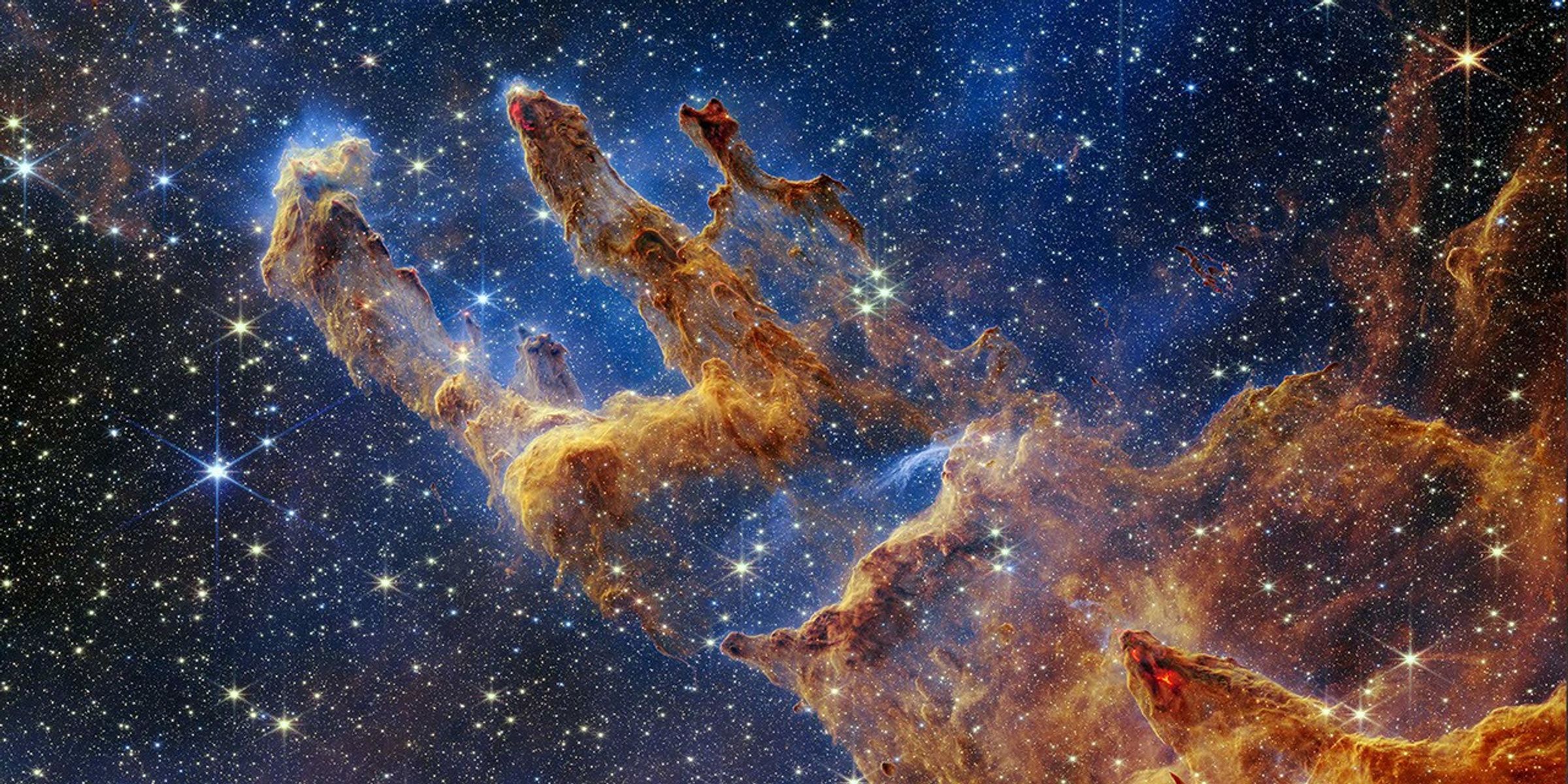
This cropped horizontal image has layers of semi-opaque rusty red colored gas and dust that starts at the bottom right and goes toward the top left. There are three prominent pillars rising toward the top left. The left pillar is the largest and widest. The peaks of the second and third pillars are set off in darker shades of brown and have red outlines.

The post Third Early Career Workshop, Sept 2026 appeared first on NASA Science.
  •  

AO Astrophysics Explorers Program 2026 SMEX Amended

Announcement of Opportunity Astrophysics Explorers Program 2026 Small Explorer (SMEX) Amended Text Released

10 August 2026

The National Aeronautics and Space Administration (NASA) Science Mission Directorate (SMD) announces the release of Amendment #1 to the Announcement of Opportunity (AO) to solicit Principal Investigator (PI)-led space science investigations for the Small Explorer (SMEX) opportunity under the Astrophysics Explorers Program on the NASA Solicitation and Proposal Integrated Review and Evaluation System (NSPIRES). To find the full amended AO text and a copy of Amendment #1 visit https://nspires.nasaprs.com/, and select “Solicitations” at the top of the page, and on the next page in the search box, input the number “NNH26ZDA011O” or use the direct short URL https://go.nasa.gov/APSMEX26. In the event of any lapse in NASA operations, please visit NSPIRES for further information.

Changes within the AO text are noted by using bold for new text and strikethrough for deleted text. The proposal due date, September 9, 2026, remains unchanged. For a summary of the changes made to the AO, locate the Amendment #1 document on the right side of the AO landing page on NSPIRES. Additionally, the official Question and Answers (Q&A) document has been updated on the Science Office for Mission Assessments (SOMA) web site at https://explorers.larc.nasa.gov/APSMEX26/SMEX.

All new questions or comments about the Astrophysics SMEX 2026 AO shall be addressed via email to Dan Moses, APSMEX26 Lead Program Scientist, dan.moses@nasa.gov; Hannah Jang-Condell, APSMEX26 Deputy Program Scientist, hannah.jang-condell@nasa.gov; and Omar Torres, Lead Acquisition Manager for the 2026 Astrophysics SMEX AO, SOMA omar.torres@nasa.gov using subject line “APSMEX26” to be properly routed. The Q&A period for the SMEX 2026 AO ends 14 days before the proposal due date.

Any costs incurred in preparing a submission in response to this notice or the full APSMEX26 AO are solely the responsibility of the submitter.

NASA Science

NSPIRES

NASA Solicitation and Proposal Integrated Review and Evaluation System

Explore
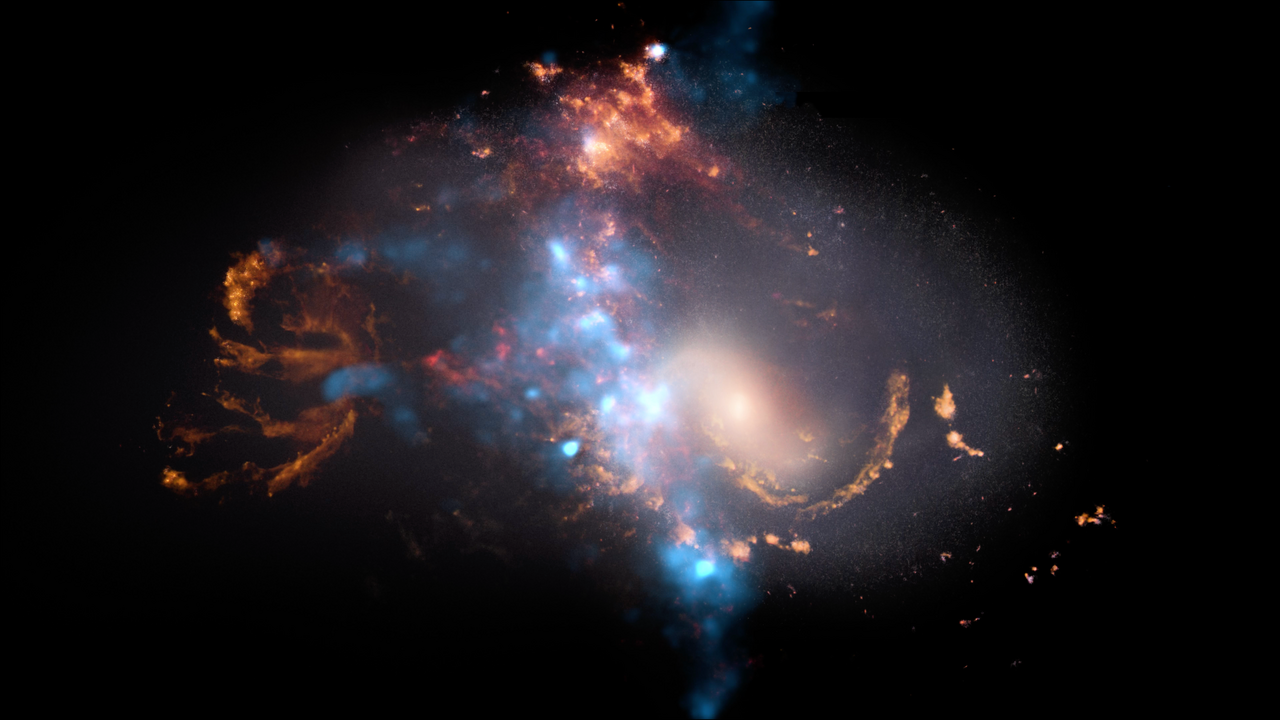
Against a black background, a peculiar galaxy is in the center and takes up most of the frame. This asymmetrical object has distorted spiral arms that extend to the left, above, and to the lower right. The galaxy’s arms are light orange and are not smooth or solid in texture, instead resembling blots and streaks of paint. The galaxy’s distorted spiral arms are overlaid by a light blue ridge of blurry blotches, which are brightest and heaviest in the center and fainter toward the left, ending before the orange areas. The blue blotches also extend to the bottom at the center and faintly toward the top center, but are not seen toward the right. A bright, almost-white orange point is near the center right and has a hazy halo surrounding it, taking up about a tenth of the image. Over the majority of the image is a semi-transparent, elliptical-shaped area that has a white, fuzzy glow.

News Straight to Your Inbox

Subscribe to your community email news list

We will never share your email address.

Privacy Policy

Sign Up
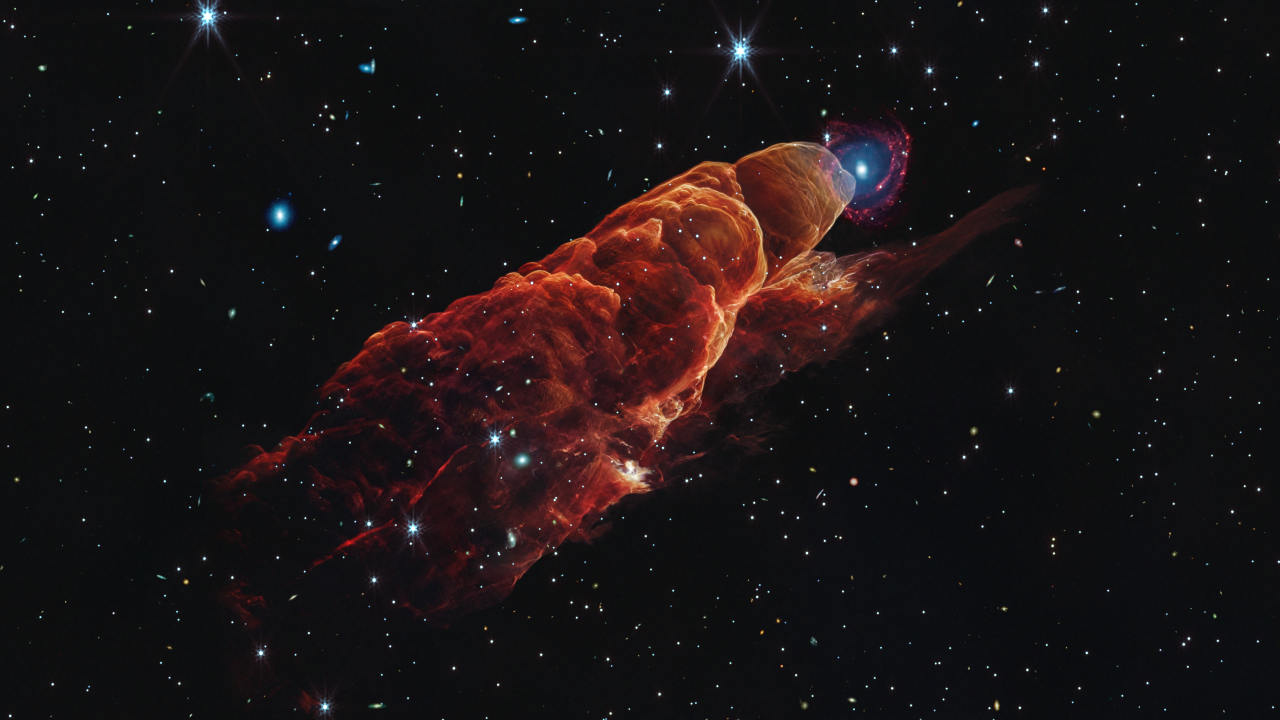
Angled from the upper left corner to the lower right corner is a cone-shaped orange-red cloud known as Herbig-Haro 49/50. This feature takes up about three-fourths of the length of this angle. The upper left end of this feature has a translucent, rounded end. The conical feature widens slightly from the rounded end at the upper right down to the lower right. Along the cone there are additional rounded edges, like edges of a wave, and intricate foamy-like details, as well as a clearer view of the black background of space. In the upper left, overlapping with the rounded end of Herbig-Haro 49/50, is a background spiral galaxy with a concentrated blue center that fades outward to blend with red spiral arms. The background of space is speckled with some white stars and smaller, more numerous, fainter white galaxies throughout.

The post AO Astrophysics Explorers Program 2026 SMEX Amended appeared first on NASA Science.

  •  
❌