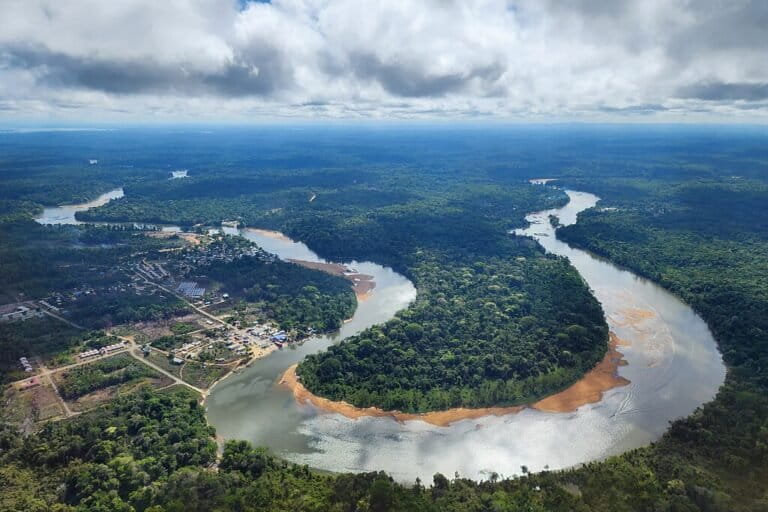
The government in Suriname has started toughening up on land developers who illegally clear the Amazon Rainforest for agriculture and cattle ranching, according to Suriname President Jennifer Geerlings-Simons, speaking at an Aug. 4 press briefing. In recent months, officials have started investigating illegal settlements and revising zoning for hundreds of thousands of hectares of mostly primary forest, previously set aside for agribusiness. Many areas under development are connected to Mennonites, a conservative Christian group who migrated to the country from other parts of the region, with plans to establish religious farming communities. “The people who are active there in the interior and have cleared land to live there, are there illegally,” Geerlings-Simons said during the briefing. “And that means that we’re going to take measures against them.” In 2023, Mongabay revealed that private agribusiness investors were working with the government to develop a Mennonite pilot program, in which around 1,000 families would be relocated from Bolivia — and possibly other parts of the region — onto as much as 30,000 hectares (about 74,000 acres) of land in interior departments of Suriname. In 2023 and 2024, Mongabay also published stories detailing the government’s plan to transfer around 467,000 hectares (1,153,982 acres) of mostly primary rainforest from the Ministry of Land Policy and Forest Management to the Ministry of Agriculture, Livestock and Fisheries (LVV) for future agribusiness development projects. Geerlings-Simons during the press briefing Aug 4. Image courtesy of Key tv 8.2 Backlash to the plans focused on Suriname’s 93% forest cover…This article was originally published on Mongabay
Over the past two decades, Belize lost around 20% of its forest cover — more than 350,000 hectares (865,000 acres). Much of it is the result of agricultural expansion by Mennonites, the conservative Christian denomination that arrived in the country more than six decades ago. To understand the corporate machinery that’s allowed the Mennonites to expand so quickly, often outbidding private landowners and environmental groups trying to protect the rainforest, a Mongabay investigation conducted extensive interviews and reviewed dozens of land records. The investigation found a unique system of strategic land titling and pooled financial resources, with communities consolidating numerous properties under a single corporation or church entity. “[Mennonite communities] pride themselves on being more autonomous,” Elma Kay, chair of the board of directors of the nonprofit Maya Forest Corridor Trust, told Mongabay during the investigation. “They’re very efficient at managing their finances, harnessing those to acquire more land as a community, as a collective.” Many Mennonite communities live without modern technology, rejecting electricity and other conveniences. At the same time, some have adopted heavy machinery for agriculture, helping them become one of the leading national producers of crops and poultry. In the process, they’ve consolidated hundreds of thousands of hectares of land under single corporations and church entities. Individual Mennonites and their families are issued certificates to occupy the land by community leadership, rather than a traditional title. With the certificate, the land can be transferred within the community without being legally bought or sold, leaving development largely off…This article was originally published on Mongabay

 Login