❌

Reading view

The Cocoon from a Massive Star’s Death: VLA Radio Polarization Study of Possible Historical Supernova Remnant G7.7–3.7

Tian-Xian Luo et al 2026 ApJ 1003 152
Polarization measurements show evidence of shock compression and possible interaction between a supernova remnant and previously formed circumstellar shells from the progenitor’s mass loss.

The post The Cocoon from a Massive Star’s Death: VLA Radio Polarization Study of Possible Historical Supernova Remnant G7.7–3.7 appeared first on AAS Nova.

  •  

A Massive Hot-Jupiter Companion that Disfavors Giant Planet Formation beyond the Water-Ice Line

Eritas Yang et al 2026 ApJL 1004 L29
The presence of a 34-solar-mass brown dwarf companion to an ultra-hot Jupiter suggests that the hot Jupiter must have formed within 1.5 au of its host star to remain dynamically stable.

The post A Massive Hot-Jupiter Companion that Disfavors Giant Planet Formation beyond the Water-Ice Line appeared first on AAS Nova.

  •  

The Large Smooth Patch on Comet 9P/Tempel 1: Remnant of a Recent Past Event

J. L. Rizos et al 2026 Planet. Sci. J. 7 123
Using gravitational flow simulations, researchers link smooth areas on the face of a comet to a single event 600–1,200 years ago, possibly connected to multiple close encounters with Jupiter.

The post The Large Smooth Patch on Comet 9P/Tempel 1: Remnant of a Recent Past Event appeared first on AAS Nova.

  •  

Isolating Sgr A East: The First Uncontaminated X-Ray Maps of a Galactic Center Supernova Remnant

Mayura Balakrishnan et al 2026 ApJ 1003 128
Sgr A East strongly overlaps with plasma associated with the Milky Way’s central supermassive black hole, but new efforts to disentangle this emission have successfully isolated the remnant’s emission.

The post Isolating Sgr A East: The First Uncontaminated X-Ray Maps of a Galactic Center Supernova Remnant appeared first on AAS Nova.

  •  

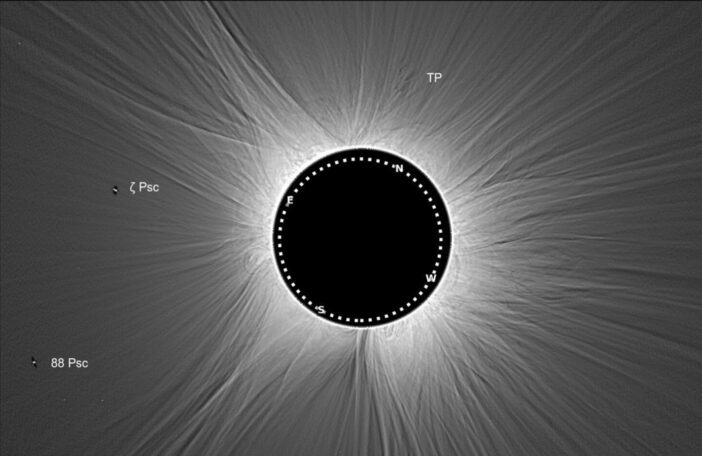
Featured Image: Citizen Science and Solar Structure

solar corona during a solar eclipse

During the 8 April 2024 solar eclipse, the path of totality swept across North America, dazzling millions of skygazers. Scattered along this path were 82 viewing sites of the Dynamic Eclipse Broadcast Initiative citizen science project, which aimed to observe the dynamics of the tenuous solar corona. Though poor weather dashed many observers’ hopes, the project managed to collect data at 11 sites spanning 2,700 kilometers, capturing 49 minutes of coronal behavior. The image above shows the solar corona as seen during totality from one of the DEB Initiative sites. In a recent research article, Matthew J. Penn (Southern Illinois University Carbondale; Tucson Amateur Astronomy Association) and collaborators described the results of the Initiative’s viewing efforts, including identification of downflows and outflows, plumes, coronal loops, and apparent motion of background stars. To learn more about these observations of the solar corona, be sure to check out the full article linked below.

Citation

β€œStructure and Dynamics of the Inner Corona Measured from the DEB Initiative 2024 Eclipse Image Sequence,” Matthew J Penn et al 2026 ApJL 1006 L25. doi:10.3847/2041-8213/ae8797

The post Featured Image: Citizen Science and Solar Structure appeared first on AAS Nova.

  •  
❌