❌

Reading view

Scientist Reveals Plan to Save Earth From Destruction by the Sun

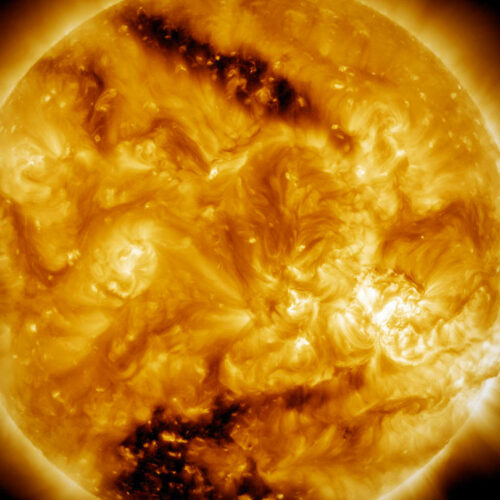
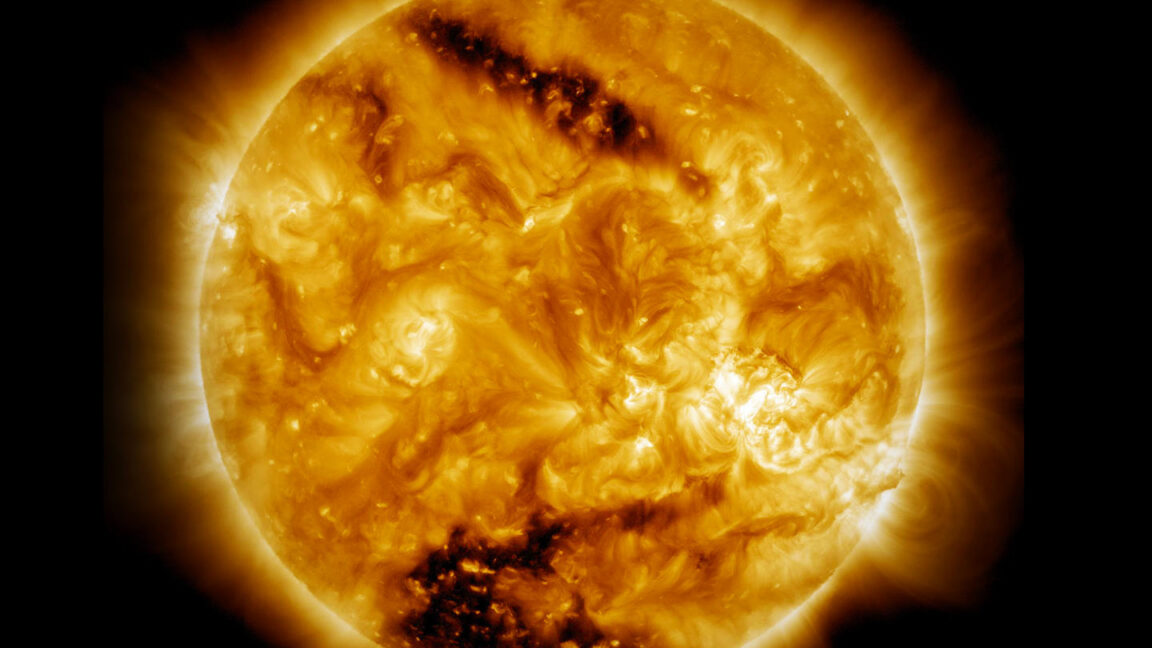
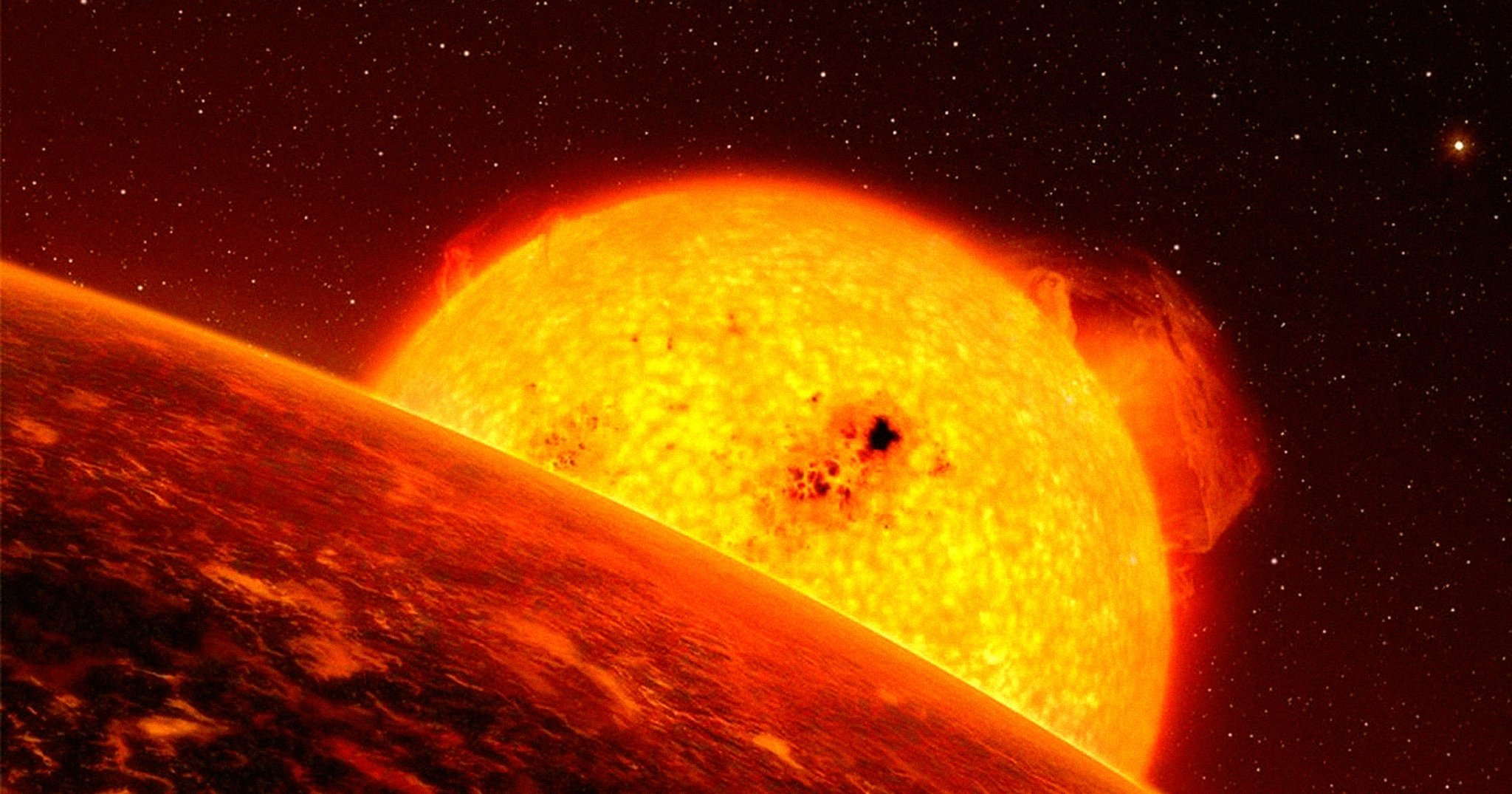
In something like five billion years from now, our Sun is expected to run out of hydrogen fuel, expanding into a red giant that will eventually either engulf the Earth or send it spiraling outwards, an all but guaranteed end of all life on our pale blue dot.

But there may be a way for humanity to survive past the Sun’s demise even without having to leave our planet, as independent researcher Gabriel Harry outlines in a paper accepted for publication in the Journal of the British Interplanetary Society.

It’s admittedly extremely far-fetched, but it’s a fun thought experiment that he argues could result in Earth staying habitable for another “9.1 million billion years.” Who could possibly argue against that?

In an accompanying piece for Phys.org, Harry lays out his daring plan. First, he proposes blocking out the Sun to keep the Earth from burning to a crisp by placing a “large sunshade at the Lagrange point 1, which is a “gravitational balancing spot between the Sun and Earth.”

“We’d need to cover a huge 70-degree area of the sky to ensure the red giant would be eclipsed,” he wrote. It would indeed be immense: it’d need to be roughly 434,000 miles in radius, tied to a carbon tether 1.2 million miles in length.

To provide the warming radiation that was now being blocked, Harry suggests sending fusion reactors some 4,000 miles deep into Jupiter’s atmosphere to produce energy, which would then have to be transmitted via laser back to the Earth.

And to move the Earth away from the self-destructing Sun, Harry thinks we could “redirect an asteroid to fly close to Earth’s surface a million times, with the gravitational slingshot effect gradually transferring energy to increase Earth’s orbital distance.”

Moving it that far away would stop the Earth’s tectonics and nutrient cycles, something Henry images could be solved by “sinking [4 pounds] of antimatter” into the Earth’s core per day.

Fast forwarding some four to five billion years, and any surviving humans would need to move the entire solar system out of the way of an incoming Andromeda galaxy, which is currently on a collision course with the Milky Way, Harry argues. To do so, he suggested firing a “beam of hydrogen just above or below the Sun’s north or south pole” to generate a “gravitational slingshot effect.”

In all, Harry’s galaxy-brain proposal would allow humans to stay alive without having to cover interstellar distances — something that would require a “million times” more energy — or terraforming a new planet. Because, after all, what’s better than staying right here, a comfortable place organic life has called home for around four billion years already?

“By building and maintaining the safeguards, for 9.1 million billion years, life on Earth would enjoy comfortable geology, security, seasons, days and starry nights — until, in a hundred trillion years, the last star fades out and the night sky turns dark,” Harry on Phys.org.

More on the Sun’s death: Earth Will One Day Die, But We Could Survive By Moving Here

The post Scientist Reveals Plan to Save Earth From Destruction by the Sun appeared first on Futurism.
  •  

Lost in Space: Rare Cosmic Flare Exposes a Wandering Black Hole Far From Its Galaxy’s Center

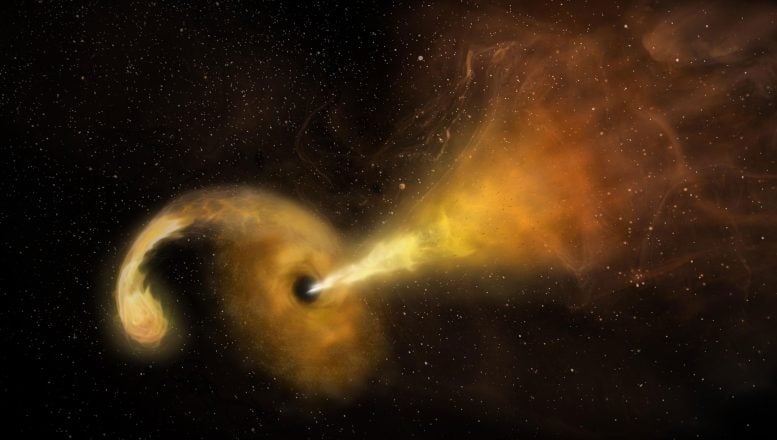
Artist Concept of a Tidal Disruption EventA rare tidal disruption event exposed a massive wandering black hole about 30,000 light-years from its galaxy’s center. A star was torn apart nearly 30,000 light-years from the center of a massive nearby galaxy, exposing a black hole where astronomers rarely see one. The unusually distant flare revealed an extremely rare “wandering” black hole and [...]
  •  

Dark Matter May Be Leaving a Signal in Earth’s Atmosphere

Galaxy Dark Matter Halo Illustration Art ConceptEarth itself may be one of the world’s largest detectors for ultralight dark matter. Earth may already contain one of the largest dark matter experiments ever built. Instead of relying only on specialized equipment inside a laboratory, scientists have found a way to use the planet’s magnetic field, atmosphere, and surface as parts of a [...]
  •  

The world's biggest solar telescope caught vortexes on the Sun's surface

Wherever two fluids slide past each other at different speeds, the boundary between them buckles, then curls, then rolls up into vortexes. It’s called the Kelvin-Helmholtz instability, and the physics behind it was worked out in the late 1860s. We know this instability explains why wind causes ripples on the surface of water and clouds shear into a row of curves.

For decades scientists argued the same thing must be happening with plasma on the surface of the Sun, and yet nobody had been able to confirm it. Now, a team led by David Kuridze and Friedrich Wöger of the National Solar Observatory reports that Kelvin-Helmholtz instabilities are not just visible on the Sun, but they’re ubiquitous. Their new study proposes that this may change the way we think about how heat, mass, and magnetic energy move through the Sun's atmosphere.

Telescope’s test drive

The reason plasma whirlpools on the Sun stayed hidden for so long is rather trivial: They are very small. Their scale sits below what telescopes with mirrors smaller than 2 meters can resolve. For most of the history of solar physics, that has ruled out every telescope on Earth. This changed when the US National Science Foundation opened the Daniel K. Inouye Solar Telescope, a 4-meter instrument in Hawaii and the largest solar telescope in the world. The telescope entered its operational phase back in November 2021.

Read full article

Comments

© NASA/Goddard/SDO

  •  
❌