Igeekphone News August 8, 2026 — The Google Pixel 11 Pro has reportedly appeared in new real-world images ahead of Google’s upcoming Made by Google event, giving consumers an early look at the company’s next-generation flagship smartphone.
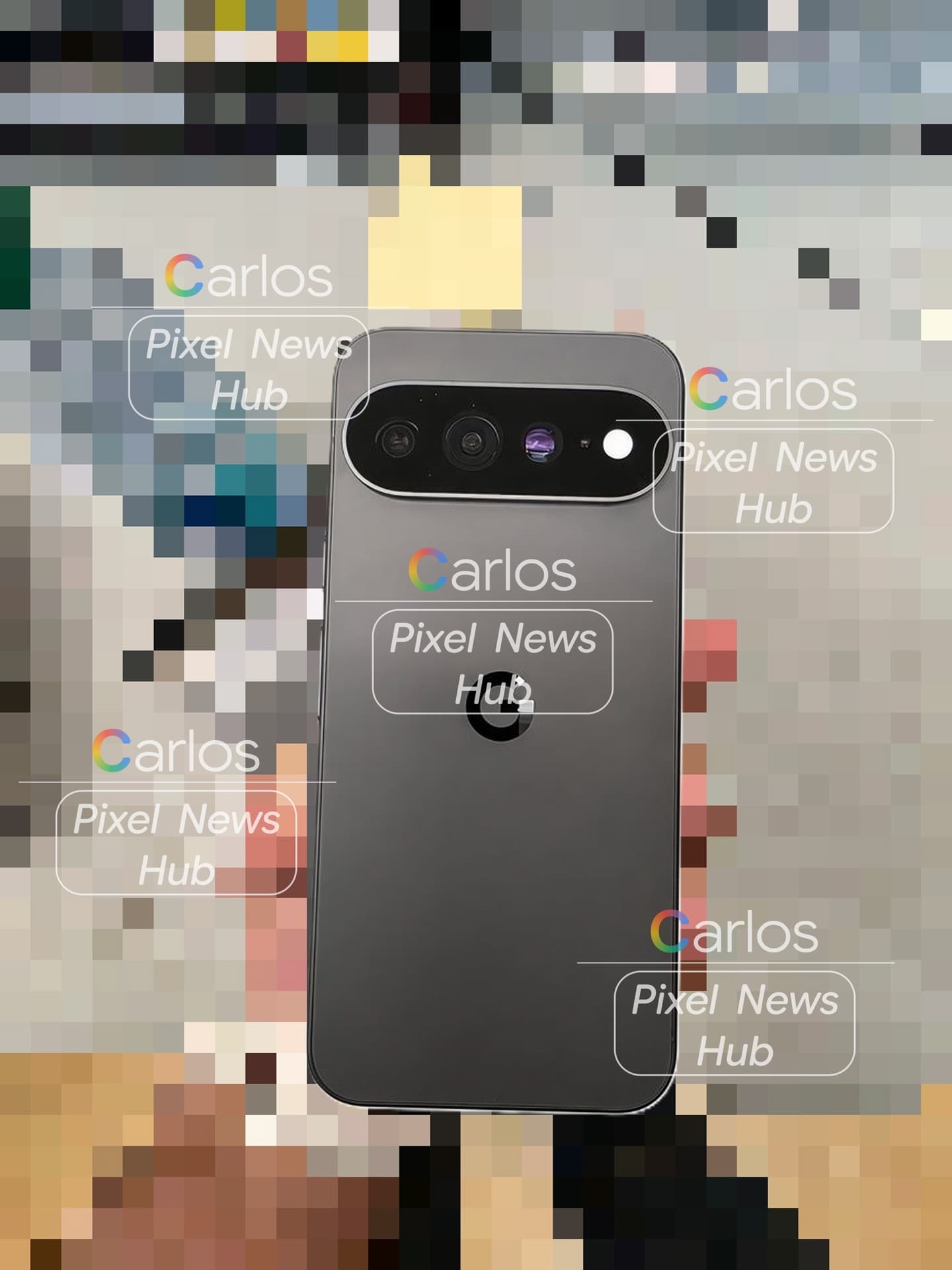
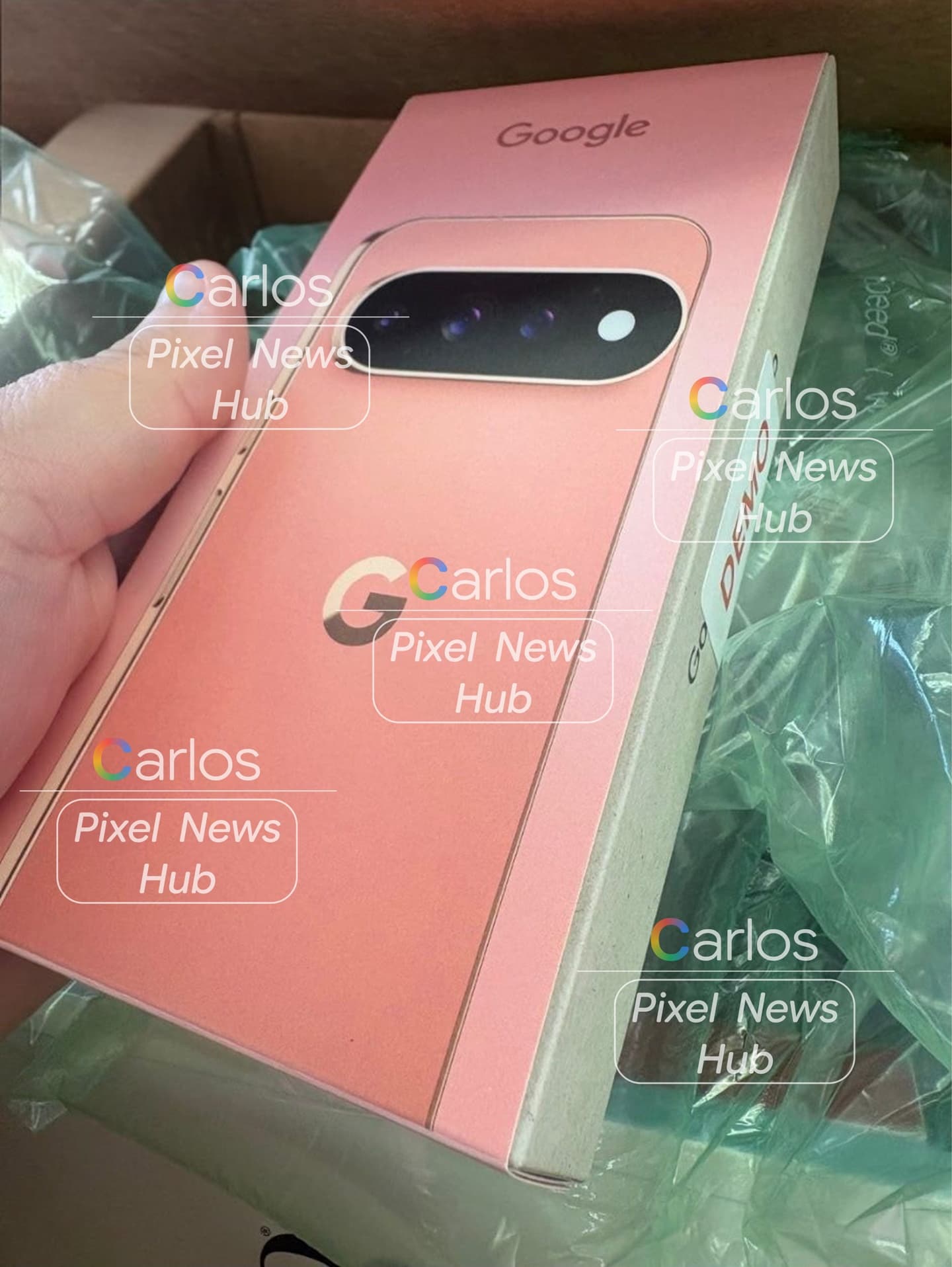
Images shared by X account @PixelNewsHub reportedly show a Pixel 11 Pro demonstration unit placed inside its retail packaging. A second set of hands-on images appears to show the phone in a matte black finish. According to the source, the demonstration devices had already reached operators ahead of Google’s official launch event.
Google is expected to introduce the Pixel 11 series on August 13, 2026, although the company has yet to officially confirm the full specifications, pricing, or availability details.
Pixel 11 Pro Appears in Sand Dune and Matte Black
The newly leaked images reportedly show the Pixel 11 Pro in a sand dune colorway, with the handset positioned inside a product box.
Another hands-on image shows what appears to be a matte black version of the flagship. While the authenticity of unofficial leaks cannot be independently confirmed, the physical appearance of the device appears to correspond with previously leaked Pixel 11 Pro renders.
The appearance of what are described as demonstration units is particularly notable because such devices typically indicate that the smartphone is approaching its official launch.
Circular Telephoto Camera Opening Returns
One of the most noticeable changes visible in the latest images concerns the telephoto camera.
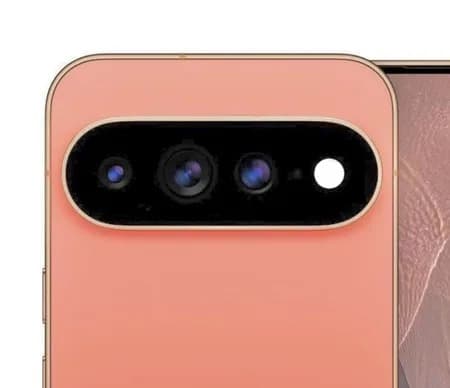
The black Pixel 11 Pro shown in the leaked photos reportedly features a circular opening around the telephoto lens. This matches renders that surfaced last month and suggests that Google could be changing the visual design of the telephoto camera compared with the current-generation Pixel 10 Pro.
The Pixel 10 Pro uses a more distinctive square-shaped periscope telephoto lens opening. On the Pixel 11 Pro, Google appears to be moving toward a circular design, potentially creating a cleaner and more symmetrical appearance within the rear camera bar.
Design Changes Could Be a Key Highlight
Although the Pixel 11 Pro is expected to retain Google’s recognizable Pixel design language, the camera system could receive some of the most visible changes.
The Pixel series has increasingly relied on its horizontal camera bar as a signature design element. Changing the telephoto lens opening from the square format seen on the Pixel 10 Pro to a circular opening could give the Pixel 11 Pro a subtly different visual identity while maintaining the overall Pixel aesthetic.
The newly surfaced photos also appear to show a relatively understated matte finish, particularly on the black model.
Pixel 11 Series Expected on August 13
Google is expected to officially unveil the Pixel 11 lineup at its Made by Google event on August 13, 2026.
The company has not yet provided complete details regarding the Pixel 11 Pro’s specifications or pricing. As a result, information circulating ahead of the event should be treated as unofficial until Google confirms it.
Beyond the Pro model, the Pixel 11 family is expected to include additional devices aimed at different price segments, although Google’s complete launch lineup remains to be confirmed.
What We Know About the Pixel 11 Pro So Far
Based on the latest leak and previously surfaced information, the Pixel 11 Pro is expected to feature:
Model: Google Pixel 11 Pro
Expected launch: August 13, 2026
Event: Made by Google
Reported colors: Sand dune and matte black
Telephoto design: Circular lens opening
Previous-generation comparison: Pixel 10 Pro uses a square periscope telephoto opening
Pricing: Not officially announced
Availability: To be confirmed
Final Thoughts
The latest Pixel 11 Pro images provide another glimpse at Google’s upcoming flagship ahead of its expected August 13 unveiling. The reported circular telephoto lens opening is particularly interesting because it represents a visible departure from the square periscope design used on the Pixel 10 Pro.
With demonstration units reportedly already reaching operators, more information could emerge in the days leading up to Google’s event. For international buyers, however, the most important details—including official pricing, regional availability, camera specifications, and hardware features—will have to wait for Google’s formal announcement.
Google is expected to officially unveil the Pixel 11 series on August 13, 2026. Until then, the leaked images and specifications should be considered unofficial.
If you feel like the internet is turning into a place for bots — not to mention by bots — you’re not alone.
Social media platforms have been flooded with low-effort AI slop, while even once renowned publications are doubling down on the tech by outsourcing writing and editing responsibilities to the tech. In June, Cloudflare found that website traffic from AI agents and bots had overtaken human-generated traffic for the first time — even earlier than predicted.
In the latest sign of the bot takeover, Time magazine has begun serving ads specifically aimed at AI agents. As Digiday reports, it’s an effort to adapt to a new reality governed by the tech. Their promise to would-be clients: by optimizing ads for the bots, brands could be made more visible to AI chatbots and show up in more responses.
The publication started stripping down its webpages last month from HTML to markdown — text-only versions, which live in parallel to the user-facing pages — that are easier for AI agents to ingest. Alongside these new pages, the company is using AI to generate agent ads, which are formatted as FAQs that include a brand’s information and messaging, according to Digiday, and are labeled as “sponsored content.”
It’s a bizarre new tack for the online media industry, which has been reeling from a massive drop in traffic. That falloff has largely been attributed to Google stopping users from visiting websites by serving them with often inaccurate AI summaries.
To stay afloat in an industry mired by continuous layoffs, Time is trying to reinvent itself by appealing to advertisers that want sway in the AI era. A striking metric: the publication said it’s seeing more bots crawl its pages than humans on most days. It says several brands, including online banking service Ally Bank and not-for-profit Project Management Institute, have already signed up.
“Maybe it’s more important to influence the agent than even the human, because with a human you influence one person,” Mobian cofounder and CEO Jonah Goodhart told Digiday. “When you influence ChatGPT, you’re influencing potentially all of ChatGPT. If ChatGPT changes what it says about [a brand], it’s massive and it’s more than any one campaign could ever do.”
“The big idea here is LLMs and AI want trusted information about brands,” he added. “We’re serving that up to them in a very straightforward, easy way.”
To Time, it’s part of a broader effort to sell a Generative Engine Optimization — the AI era evolution of the Google-centered Search Engine Optimization industry — product to brands.
It’s an open question whether Time‘s gambit will pay off and make up for lost search traffic. As Digiday points out, it could even backfire if tech platforms like Google were to change the rules by penalizing AI-oriented ad spam or serving markdown pages aimed at bots that differ from what human users see.
In short, there’s no guarantee it will work, but Time is experimenting regardless.
Time chief operating officer Mark Howard told Digiday that “this is brand new, and we believe that we are paving the first path forward here.”
Il video appena rilasciato da Mountain View è breve, incisivo e curioso. Perché big G sceglie di puntare su un aspetto di Pixel Watch 5 che sicuramente non rappresenta una novità rispetto alle generazioni precedenti: il design, che resta praticamente fedele a quello della primissima generazione.
E fa leva sul design per lanciare una frecciatina all'Apple Watch: "Imagine a watch that tracks your health, sleep and fitness…but still has the decency to look like a watch". Letteralmente: "immagina un orologio capace di tracciare la tua salute, il sonno, l'attività fisica... ma che ha ancora la decenza di avere l'aspetto di un orologio" (volendo essere meno legnosi, appiccicati alla lettere e più diretti "ma che sembra comunque un orologio").
Google recently changed how it refers and assigns names to hacking groups. TechCrunch spoke with one of the world’s foremost experts on tracking hackers to understand why companies give hackers codenames.
Residents of Fort Wayne, Indiana may have to say goodbye to over four acres of federally protected wetland — at least if Google has its way.
New reporting by local publication WANE revealed that a company called Hatchworks LLC, a data center developer for the tech giant, is looking to fill in several acres of federal wetlands as part of the third phase of “Project Zodiac,” a $2 billion hyperscale data center project.
As WANE reports, Hatchworks submitted an application to purchase 4.26 acres of forested wetland outside of Fort Wayne. Of that, about 2.13 acres of the land may soon be paved over to build three new buildings, as well as a labyrinth of waste water pipes and electrical infrastructure.
Granted, four acres isn’t the largest footprint in the world — that’s roughly the size of your average Walmart supercenter — but if the application proceeds, it would nonetheless see a private company hoovering up protected land for the sake of wealth accumulation.
And if state authorities decide to go ahead with the data center campus, it would be permanently carving up a slice of Indiana’s all-important floodplains. These wetlands serve many valuable functions, not just as home for diverse plant and animal life, but also as a natural basin for rainwater, protecting nearby communities from flooding and soil erosion.
Much of the incoming data center campus would occupy a parcel of pre-paved farmland, likely geoengineered from its original wetland long ago. Rather than color within those lines, Google’s Hatchworks would rather stick to its original design plans, explaining in its filing with the Indiana Department of Environmental Management that it’s simply impossible to avoid shellacking the marshland.
“It was determined that meeting the project purpose and completely avoiding water resources was not feasible,” the filing reads. “Priority was placed upon avoiding as much of the large woodlots… as possible. Given these constraints, and the required layout and dimensions of the data center buildings, it is not possible to accommodate the development without impacts to the woodlot containing [the wetlands].”
“Environmental stewardship is central to our data center design. Our engineers have intentionally designed the layout of our Fort Wayne campus to avoid more than 75 percent of regulated wetlands — preserving over 32 acres of the highest-quality forested land on the property,” a Google spokesperson said after this story was first published. “To address minimal impacts across approximately nine acres, we’re providing over 18 acres of mitigation credits for a 2-to-1 net gain in conserved and restored wetlands in Allen County and across Indiana.”
The proposal will soon go to a virtual public hearing before it’s approved, though developers already have an anticipated start date of September 14. Given that previous phases of the Google campus are already completed, it’s hard to imagine Indiana officials will prevent the bulldozers from rolling in — though with enough public backlash, anything is possible.
A Google já permite aos utilizadores de Android fazerem uploads de backups automáticos dos seus ficheiros a partir dos smartphones para o Google Drive.
The latest software update from Google officially expands the capabilities of its Google Maps app by upgrading the built-in assistant. The new version allows the navigation tool to handle multi-step tasks that used to require opening several completely separate apps. Users can now simply tell the app to order a specific meal for pickup along […]
In the mid-'90s, the web was exploding, but finding anything of actual value on it felt like an elaborate negotiation with whatever proto-search engine happened to be standing closest to the door. Unlike now, when Google is widely seen as both portal and gatekeeper, sites like AltaVista, Lycos, Excite, HotBot, and Ask Jeeves promised to tame the chaos, each with its own suite of quirks, charms, and flaws.
The real story of pre-Google search is not that early engines were inferior. It's that they reflected a different Internet entirely, one where directories mattered, crawling was still an art, ranking was fragile, and the idea of “search” had not yet hardened into a single dominant interface.
A different kind of web
The first thing to remember about the pre-Google Internet is that there was no built-in assumption that you could search for everything. Many users found pages through Yahoo-style directories, bookmarks, newsgroups, email signatures, and links from site to site because the web was still small enough that human organization could compete with machine indexing. It was an era of Wild West-style discoverability. Search engines existed, but they were only one part of a larger ecosystem that blended curation and accident.
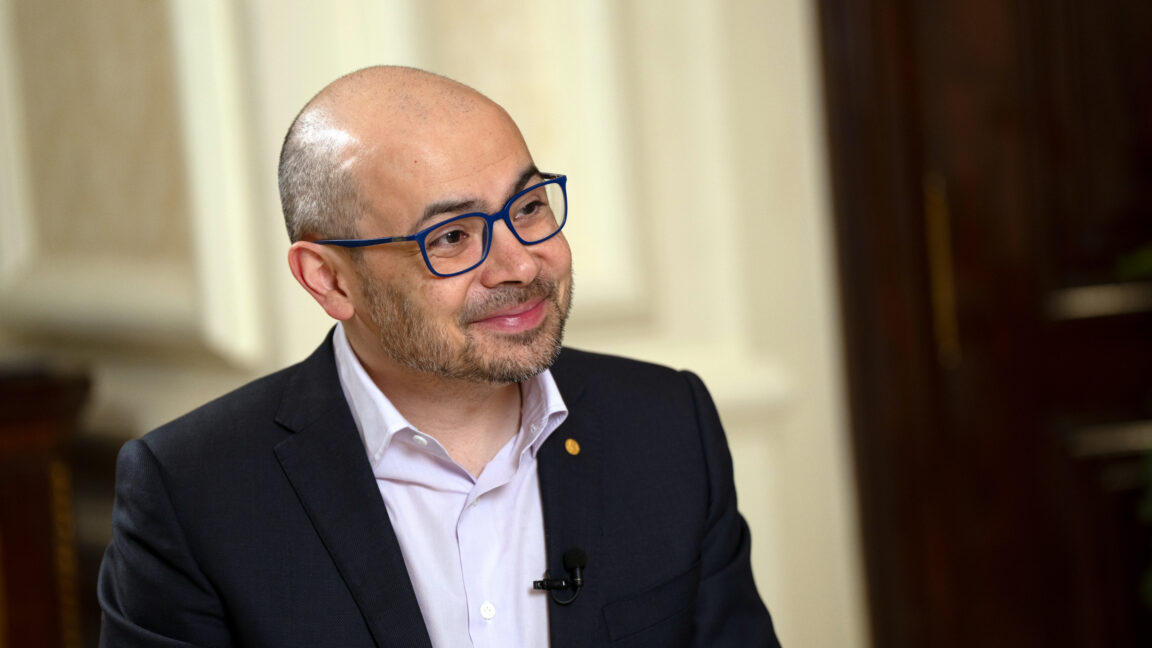
Google CEO Sundar Pichai (pictured) revealed a major shake-up within its AI division, with DeepMind co-founder and CEO Demis Hassabis stepping back from day-to-day operational management to focus on overarching strategy, AGI and scientific breakthroughs.
Under the new leadership structure, Koray Kavukcuoglu, former CTO of Google DeepMind and chief AI architect, steps up as SVP of Google DeepMind, reporting directly to Pichai.
Kavukcuoglu, who has been with DeepMind for 13 years and previously led foundational projects like WaveNet and Deep Q-Networks, will now directly oversee Gemini model development, frontier AI research and developer ecosystems.
Hassabis transitions into a newly created strategic role as chair of Google DeepMind and chief scientist of Alphabet.
In a note sent to employees, Pichai stated the shift allows Hassabis to dedicate his attention to shaping the long-term future of AGI and scientific applications, alongside his ongoing leadership at drug-discovery subsidiary Isomorphic Labs.
Hassabis expressed confidence in the transition, emphasising he plans to focus on broad strategic initiatives and high-impact applications of AI in healthcare, particularly accelerating efforts to treat major diseases.
The executive shift comes at a period of rapid product momentum for the internet giant’s AI stack.
According to internal metrics shared by Pichai, the flagship Gemini consumer application has surged past 950 million monthly active users, while the open-weights Gemma model family has surpassed 900 million downloads.
The reorganisation also marks the end of an era for two foundational figures in modern computing infrastructure.
Jeff Dean, Google’s chief scientist and long-time head of Google AI, is departing after 27 years alongside Google senior fellow Sanjay Ghemawat.
The pair are launching independent public benefit company aimed at applying machine learning to scientific and engineering discoveries. Google will serve as a founding investor and cloud infrastructure partner for the new entity, maintaining an active collaborative research framework on advanced systems.
“Jeff Dean is at a moment where he wants to try something new, and we’re excited to support him in that,” Pichai stated.
As competition in model capabilities intensifies across the industry, Google is doubling down on its full-stack approach which spans custom silicon, cloud infrastructure, and consumer applications to seek an edge in the race toward advanced AI.
Google got a slow start with generative AI after seemingly being caught flat-footed by Microsoft's Copilot reveal. What a difference a few years make. Now, Google is at the forefront of AI development (for better or worse), but new cracks are beginning to show. The company's string of high-profile personnel departures continues, and DeepMind CEO Demis Hassabis has now said he will hand off day-to-day responsibilities to take on an oversight role at parent company Alphabet.
Hassabis was one of the founders of DeepMind, and he maintained a key leadership role after Google acquired it. As the generative AI boom took off, Hassabis has been one of the loudest voices predicting the impending creation of artificial general intelligence (AGI), which is typically described as an AI with human-like capabilities and intelligence.
In his memo announcing his decision to leave DeepMind, Hassabis again leans on the promise of AGI. "I've been working towards AGI my whole life and now, like many of you, I feel it is close at hand," said Hassabis.
Google Assistant's days have been numbered for a while, but the company has now settled on a date to retire its pre-AI assistant robot. In an email being sent out to users, Google confirms that Assistant on Android devices will be shut down starting on September 4, forcing everyone over to Gemini. Google told us it was coming, but that doesn't make it hurt any less.
The initial plan was to retire Assistant in late 2025, but the service got a brief reprieve as Google shored up some aspects of Gemini. Now that Gemini is ready to take over, Google will begin ending support for the old system on September 4, but the email notes that it may take several weeks for the process to complete. So those stubbornly clinging to Assistant may still be able to use it a bit longer before the option disappears. For those who made the switch already, nothing will change.
By ending Assistant on mobile devices, Google is also killing it on myriad other gadgets that connect to your phone for smart features. So smartwatches, headphones, and cars with Android Auto are also being forcibly moved to Gemini. Most of Google's smart home devices have already transitioned to Gemini.
Losing access to your Google account might just be the epitome of a modern-day nightmare.
Especially if you’re using Android and even more so if you’re invested in lots of different Google services on top of that, the amount of access and info connected to that one single sign-in is just staggering. Think about it: You’ve got everything from your Android apps and settings to potentially your email, your documents and spreadsheets, and all of your assorted files in Google Drive. And that’s to say nothing of all the images you might be backing up to Google Photos, the notes you might be storing in Google Keep, and even random things you might not think about like your browsing activity in Chrome or your location-related data in Maps.
It’s a lot, to say the least. And that’s precisely why it’s so important to think about your Google account security proactively and do everything you can to (a) make sure no one else ever gains access and, equally important, (b) make sure you never lose access to that all-encompassing sign-in.
But even with all of those layers, the issue still remains of what happens if for any reason you aren’t able to get into your own Google account one day. And now, Google’s got a new option to help you make sure that nightmare never actually comes to pass.
Suffice it to say, it’s well worth your while to consider. But there are some important things you should know about it first.
The system of which we speak is an option to use a sophisticated selfie of yourself to sign into your Google account in an emergency — if all of your usual methods are for whatever reason not getting you through the gate. It happens more often than you’d think. And having multiple secure workarounds in such a scenario could be a massive lifesaver if it ever happens to you.
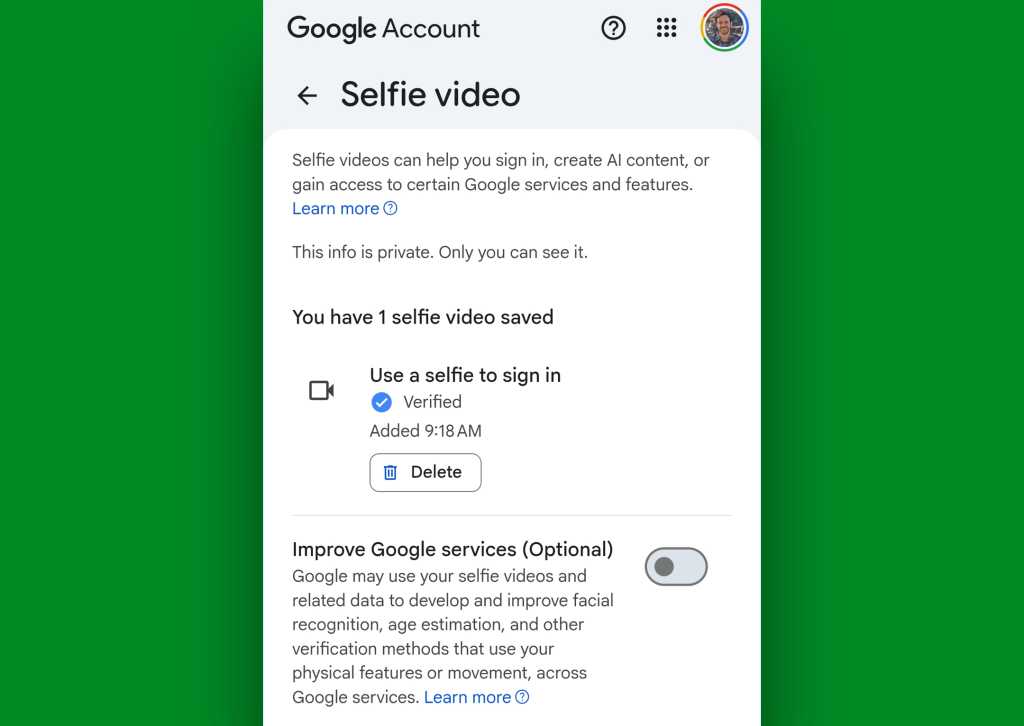
Depending on where you look, the option is called “selfie for sign-in,” “video verification,” or sometimes just “selfie video.” (Hey, this is Google we’re talking about here. Branding has never been a strength.) The system was announced in a random blog post a couple weeks back and has been slowly but surely showing up under the hood for accounts around the world ever since — but you’d never know it unless you happened to poke around in the exact area of your Google account settings where the option appears.
In my experience so far, it seems most average Android-owning animals are woefully unaware of its existence — and those who are aware of it are mostly perplexed by how exactly it works and if or when it’s advisable to use.
I’ve set it up on my own personal Google account, and I’ve explored every last nook and cranny. Here’s everything there is to know:
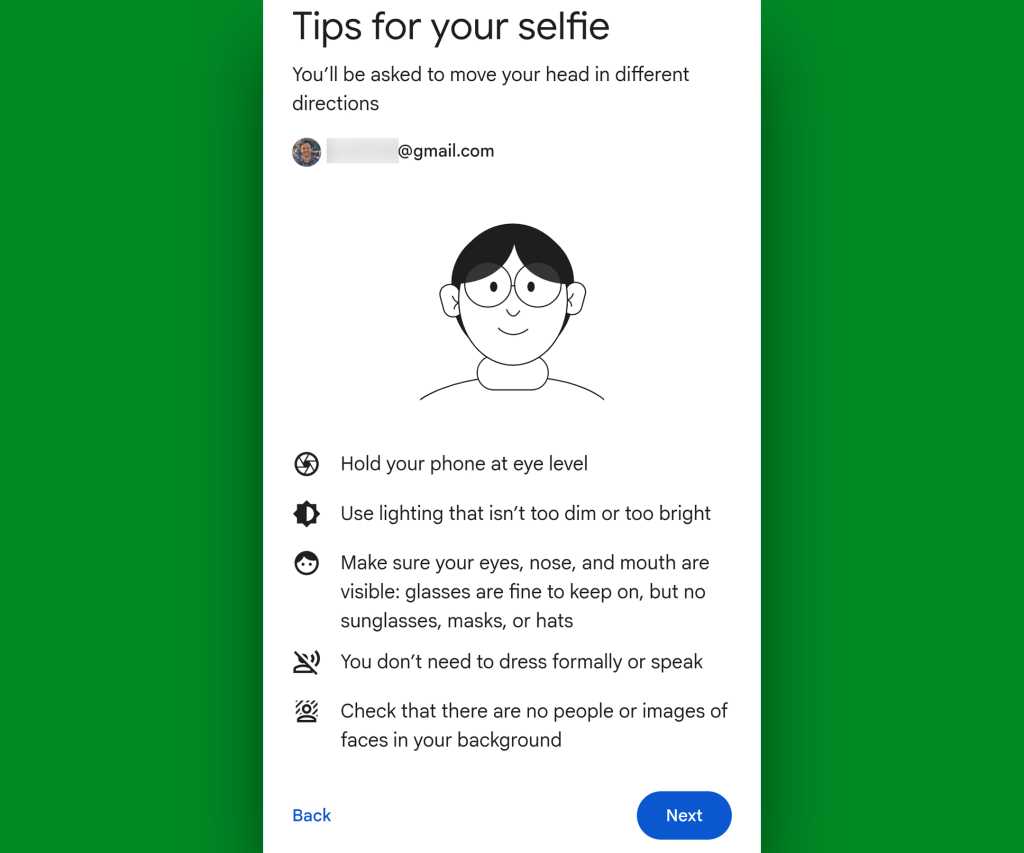
Provided the feature is available on your account now, you’ll just click a couple o’ quick buttons to get the process started, then you’ll follow some simple prompts to stare into your camera longingly for a few moments.
Setting up a Google selfie sign-in is surprisingly swift ‘n’ simple.
JR Raphael, Foundry
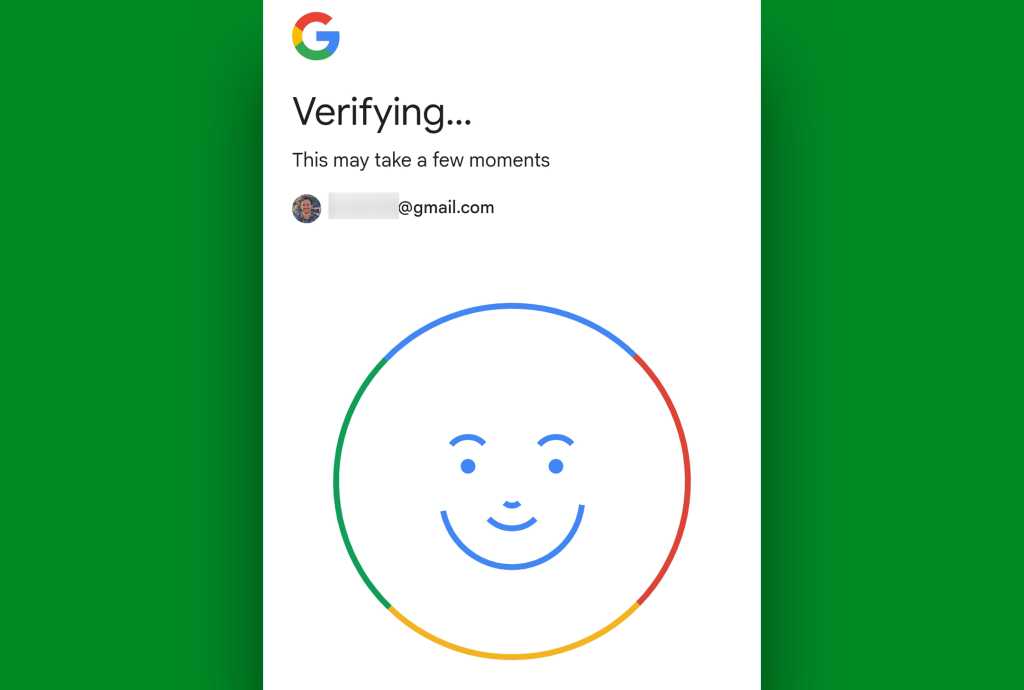
The system will ask you to turn your head in specific directions. Then, it’ll take a handful of seconds to process and save your stunning turn on the virtual runway.
The process takes less than a minute to verify and save your selfie video.
JR Raphael, Foundry
And — well, that’s pretty much it.
2. Your selfie video is only for access to your Google account — not your phone or tablet
This is slightly confusing, since most modern Android devices offer the ability to use biometrics on the lock screen and show your face to unlock the phone itself — but the selfie sign-in system we’re speaking of here has nothing to do with any of that. It won’t unlock your device in any scenario or have any connection to any specific phone or tablet.
It’s connected purely to your Google account, and its sole purpose is acting as a mechanism to let you sign into that account — not to unlock or access any specific piece of hardware.
Speaking of which…
3. It’s only there as a last resort
Once you set up your selfie sign-in, odds are, you’ll never actually think about it again or have a reason to use it. Anytime you sign into your Google account, you’ll still use your standard password, passkey, and any two-factor authentication you’ve placed on the account.
The selfie path is there only in the event that all those regular methods are for some reason failing you. It’s unlikely, but it’s not impossible. And with your selfie video saved, if that situation ever arises, you’ll have an easy alternate way to prove your identity — by submitting a live on-the-fly selfie video and allowing Google to match it with your original saved one — so you can avoid getting locked out.
4. The selfie sign-in is designed to be both private and secure
When it comes to matching a saved selfie video and a new live one, Google requires different movements to verify validity and avoid any impersonation attempts.
Google says the data from your saved selfie video is always encrypted, too — not just in transport but also at rest, when it isn’t actively being used — which means no one else should ever be able to access it or do anything with it. You can always opt to delete a saved selfie video entirely, if you want, via that same Google account settings page.
And on that note…
5. You can prevent your selfie video from being used for any form of training
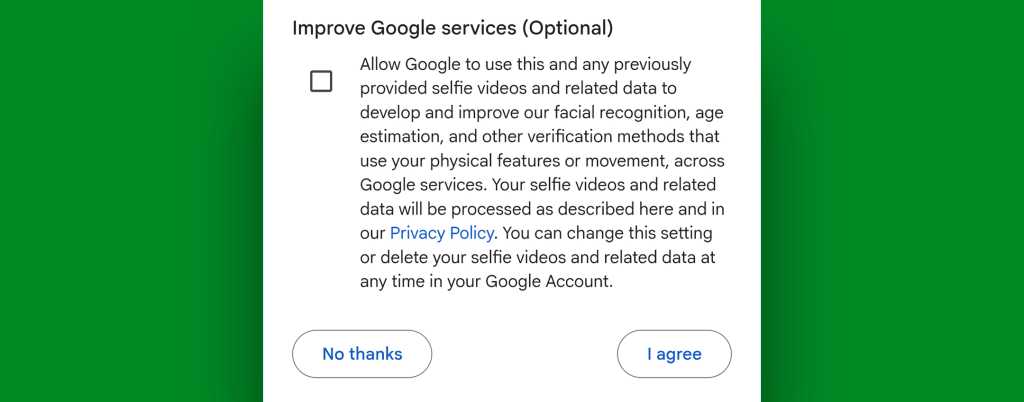
Lots of folks are understandably uneasy about the idea of their personal data — including their personal faces! — being used for any manner of machine learning these days. Google does ask for permission to do that and anonymously lean on your submission to help improve its facial recognition systems when you sign up for the selfie sign-in option, but critically, you can easily say no thanks.
When you’re in the midst of the selfie sign-in setup, look for the option to “Improve Google services.” It’ll appear at the bottom of the initial service agreement.
Keep that box unchecked, and your selfie video will never be used for any form of training or other purposes.
JR Raphael, Foundry
As long as you don’t check the box in that area, your selfie sign-in data will never be used for anything other than its primary intended purpose. And if you ever change your mind or are unsure of how you initially answered, you can also always revisit and revise that decision on that same Google account settings page.
The option to opt out of model training is always available on the selfie video settings screen.
JR Raphael, Foundry
6. Selfie sign-ins are (so far) only for individual Google accounts
With this initial rollout, Google’s selfie sign-in option is not available for accounts that are part of a Google Workspace team or organization. That kind of makes sense, since in any such situation, you could always turn to an admin for help if you were ever to lose account access, anyway.
This is something more intended for individual Google accounts, where you’re on your own and largely out of luck if you ever lose access. So whether you’re conducting business from an individual account or using an individual account alongside a Workspace-connected company sign-in, it’s something to consider for that part of your online identity.
The only other noteworthy asterisk is that selfie sign-ins won’t work with accounts where Advanced Protection is enabled. Advanced Protection is an extra-heightened form of Google account security created for people in the public eye or otherwise at an elevated risk of a targeted attack, and so it deliberately makes it much more difficult to get into an account in ways that go above and beyond what’s necessary for most ordinary organisms. If you have Advanced Protection on for your Google account, selfie sign-in won’t be available for you.
But for the rest of us, it’s a powerful new path that could prevent an unthinkable nightmare — and all you’ve gotta do is take two minutes to set it up now and then hopefully forget all about it.
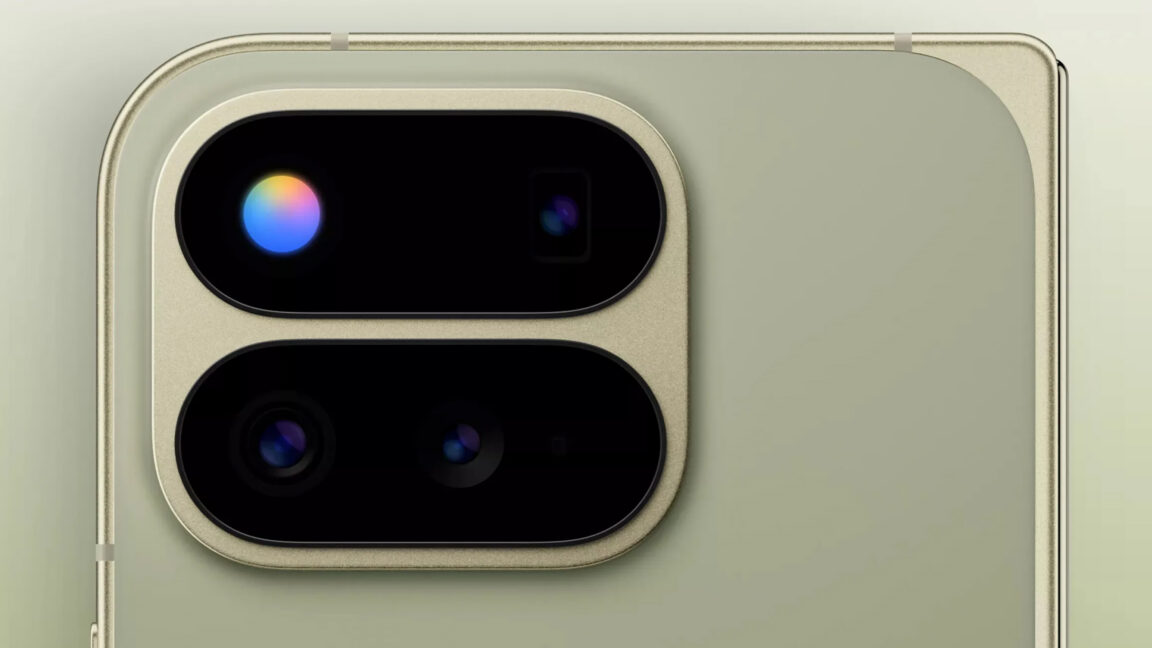
Google will reveal the Pixel 11 series later this month, but leaks and teasers so far have painted a picture of phones that have barely changed since last year. One notable exception seems to be the illuminated dot from some of the teasers. This has been rumored as "Pixel Glow," but a new leak all but confirms a different (and less interesting) name. Say hello to HiLight.
A post on Bluesky by WinFuture's Roland Quandt shows the new LED inside the camera module of the Pixel 11 Pro Fold. We can see the actual body of the device rather than a shadowy outline as in Google's teasers, and it does look a bit different than the previous Pixel Fold.
The camera bump on the Pixel 11 Pro Fold is smaller, with no separate section for the flash off to the right. It appears that HiLight is the flash. Presumably, it still works as a flashlight and camera flash, but it can also produce a range of colors.
 Login